Navigating the Cosmic Horrors: A Deep Dive into Mothership RPG Modules
The vast, unforgiving expanse of space is a fertile ground for horror, a truth keenly understood by the creators of Mothership, the acclaimed sci-fi horror role-playing game. Known for its "Panic Engine" and brutal, cinematic survival mechanics, Mothership has cultivated a thriving ecosystem of third-party modules, ranging from concise trifold adventures to sprawling campaigns. A recent deep dive into this burgeoning content library by a seasoned Game Master, aimed at refreshing an open table campaign, has unveiled a diverse landscape of creative concepts, innovative mechanics, and, at times, frustrating design hurdles.
This exploration highlights the delicate balance between innovative design and practical usability, a common challenge in the vibrant indie RPG scene. From salvage operations gone wrong to quantum realities unraveling, these modules offer glimpses into the terrifying possibilities of the cosmos, but their execution often dictates whether they become a GM’s treasured tool or a taxing project.
The Quest for Cosmic Scares: An Overview of Recent Module Releases
The endeavor to restock a Mothership "jobs board" for an ongoing open table campaign underscores the continuous demand for fresh, engaging scenarios. The Mothership system, with its emphasis on short, high-stakes adventures, often benefits from modular content that can be easily dropped into an ongoing narrative. However, as this review demonstrates, the quality and readiness of these modules can vary significantly, requiring GMs to approach new content with a critical eye and, often, a willingness to undertake additional design work.
"Reclaimer": A Salvage Operation Marred by Design Flaws
Concept: "Reclaimer" positions player characters as a salvage crew tasked with extracting valuable resources from the long-abandoned Galloway Outpost, a mining and research facility on the desolate desert moon Kara-9. The premise introduces immediate conflict: another corporate team has been dispatched simultaneously, leading to a race against time and rivals. Complicating matters further, the outpost is slated for an inevitable, timed collapse within hours of the PCs’ arrival.
Strengths: The core concept of a competitive, time-sensitive salvage operation within a crumbling facility is inherently strong, offering ample opportunities for tension, moral dilemmas, and dynamic player choices. The module is anchored by a promising map, which, despite its inconsistencies, provides a clear spatial layout conducive to potential conflicts between the rival crews. The notion of a rapidly deteriorating environment creates a palpable sense of urgency, a hallmark of effective Mothership scenarios.
Challenges: Despite its solid foundation, "Reclaimer" suffers from significant usability issues that render it senselessly hostile to the GM. Foremost among these is its custom micro-pamphlet format, which necessitates an intricate print-and-fold process. While aesthetically novel, this format proves impractical in play, notably by splitting the Galloway Outpost map across multiple, non-contiguous spreads, making tactical navigation and overview extremely cumbersome. Further hindering usability, the map employs a series of custom symbols lacking any explanatory key, leaving GMs to decipher their meaning, often unsuccessfully.
Beyond formatting, the adventure is functionally incomplete. The central dynamic of timed scavenging is undermined by the absence of critical information; no guidelines are provided for the time required to salvage materials, nor are values assigned to the various salvage types (industrial fuel, raw minerals, rare electronics) listed. While salvage types are mentioned, their specific locations on the map are vague, incomplete, and at times contradictory, making it impossible for a GM to consistently adjudicate player efforts. Furthermore, the narrative is plagued by a surprising multitude of continuity errors, such as the map depicting a space station rather than the described land-based outpost, and inconsistencies regarding the rival team’s arrival.
Implications: "Reclaimer," despite its compelling premise, demands an unreasonable amount of preparatory work from the GM. To run it effectively, a GM would need to redesign the map for clarity, create a comprehensive key for its symbols, establish a coherent timeline for salvage operations, assign values to resources, and iron out numerous narrative inconsistencies. This level of GM intervention transforms what should be a ready-to-play module into a significant design project, earning it a D grade.

"Meat Farm": Biological Horrors and Mapping Mysteries
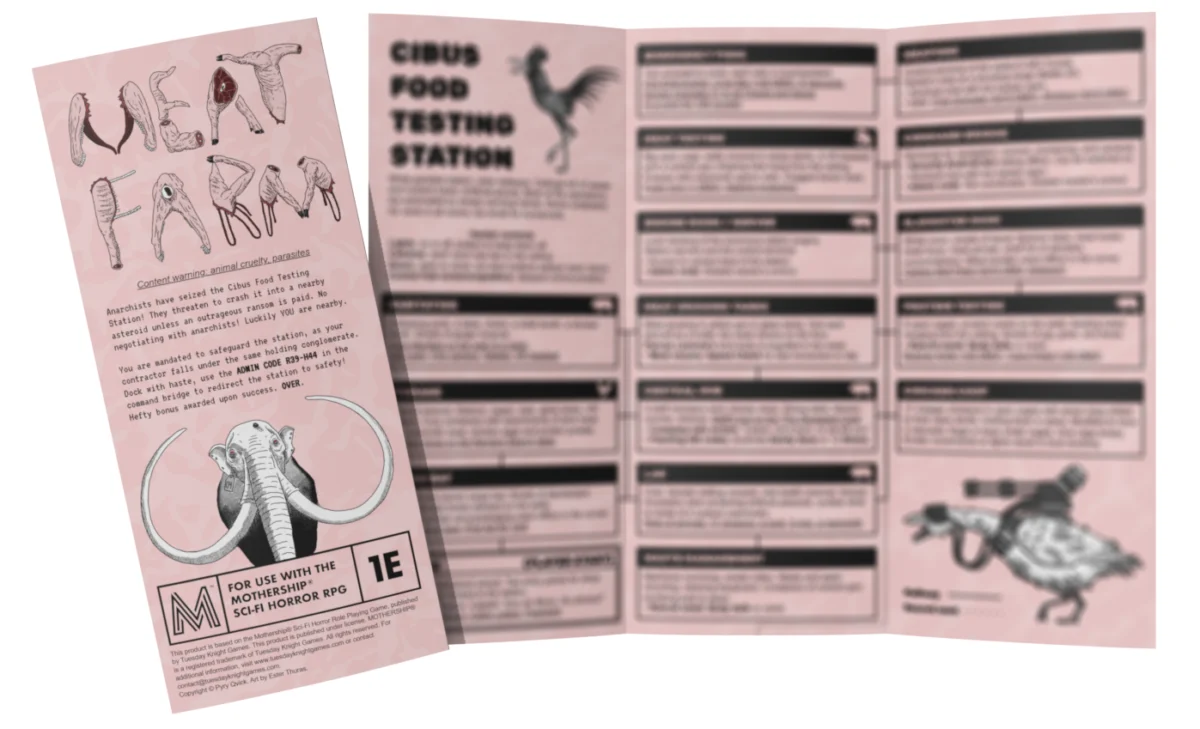
Concept: "Meat Farm" plunges players into a corporate research station, Cibus Station, that has been subverted by a lone hacker. The hacker has unleashed experimental subjects, killed most of the crew, and is holding the station for ransom. Player characters are dispatched by their corporate overlords to regain control, facing a gauntlet of threats including automated defenses, a homicidal android, and a station overrun by grotesque experimental animals.
Strengths: Pyry Qvick’s "Meat Farm" excels in its layered approach to threat design. The combination of environmental hazards (automated stations), intelligent adversaries (the hacker, the android), and creature features creates a dynamic and unpredictable environment. The module’s standout feature is its impressive menagerie of monsters, a "nifty combo pack" that includes memorable horrors like "turret gooses," "parasite pigs," and "albino mammoths." These creatures are cleverly integrated into vividly keyed rooms that offer varied and interesting encounters. The module effectively leverages the "creature feature" genre inherent to Mothership, delivering unsettling and memorable adversaries.
Challenges: The primary detractor for "Meat Farm" lies in its pointmap, which is described as maddeningly vague to the point of incoherence. While pointmaps are intended as abstract representations, they must still convey a coherent sense of the game world. When a map fails to allow the GM to describe the environment clearly or presents illogical connections between rooms, it severely impacts gameplay. This vagueness forces GMs to undertake a significant re-arrangement of the room keys to create a functionally coherent map, a task that detracts from the module’s otherwise strong design.
Implications: "Meat Farm" presents a potent blend of action and horror, with a strong roster of unique threats. However, the nebulous pointmap represents a substantial barrier to immediate play. GMs prepared to invest time in re-mapping the station will find a rewarding and terrifying adventure, but those seeking a plug-and-play experience will face frustration. Its potential for intense gameplay and memorable encounters secures it a C grade, contingent on GM adaptation.
"Carrion Protocol": Flesh-Eating Mayhem with Narrative Gaps
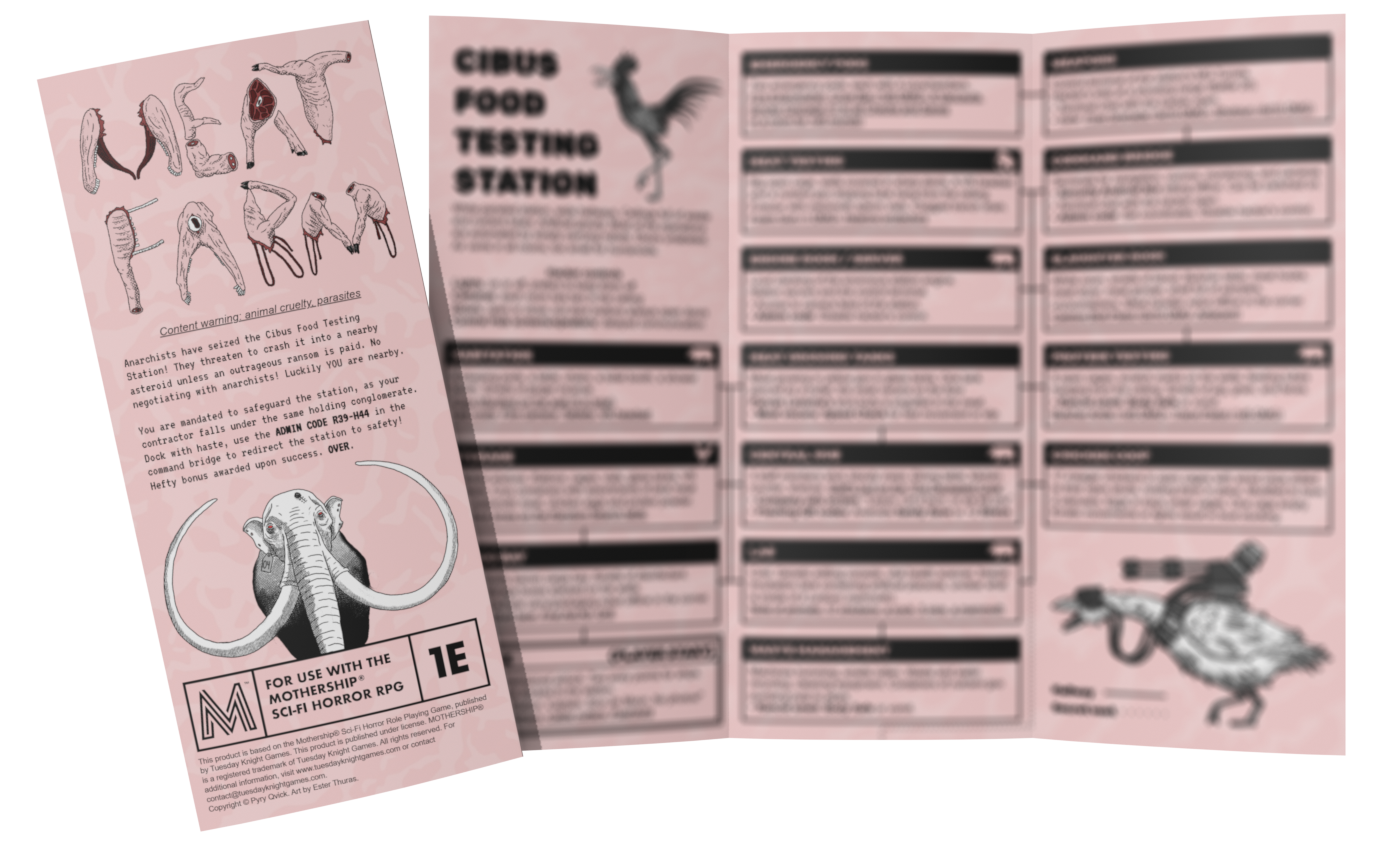
Concept: "Carrion Protocol" sends player characters responding to a distress call from the FUV Irene. Upon arrival, they discover a catastrophic malfunction in the ship’s "meat labs," originally designed to provide fresh food. The vessel is now overrun by semi-sentient flesh growths and predatory "violent fleshhounds," transforming the ship into a gruesome, living nightmare.
Strengths: This module is praised for being short, creepy, and fun, delivering a visceral horror experience typical of Mothership. The concept of a ship consumed by sentient, hostile biomass is inherently disturbing and provides a strong foundation for a survival horror scenario. The imagery of overgrown compartments and roaming flesh-creatures creates a potent atmosphere of dread and claustrophobia, a perfect fit for the game’s tone. As a "pay-what-you-want" title, it offers accessible horror.
Challenges: The main issue with "Carrion Protocol" is the lack of a clear, coherent pre-event narrative. While "clues" like blood trails and corpses are scattered throughout, they don’t coalesce into an understandable sequence of events leading up to the PCs’ arrival. This ambiguity makes it difficult for the GM to consistently answer player questions about what transpired, undermining player agency and immersion. A specific continuity problem arises with the stated pace of flesh growth ("every 10 minutes a room adjacent to meat growth is overgrown"); at this rate, the entire ship would have been consumed long before a distress call could be answered and responded to, creating a logical inconsistency that challenges suspension of disbelief.
Additionally, the module, presented as a pamphlet, suffers from persistent PDF printing issues across all available versions. This means GMs cannot reliably print and assemble the pamphlet as intended, adding a layer of logistical frustration to an otherwise atmospheric module.
Implications: "Carrion Protocol" offers a compelling and disturbing premise, rich with immediate horror potential. However, its narrative gaps and technical printing flaws require GMs to actively fill in backstory details and find workarounds for the pamphlet format. While the problems are "not terribly difficult to fudge your way around," they detract from the overall polish and ease of use. Its strong atmospheric qualities, despite these shortcomings, lead to a C grade.
"Burying Grounds on Pavel Theta": Undead Opossums and Unanswered Questions
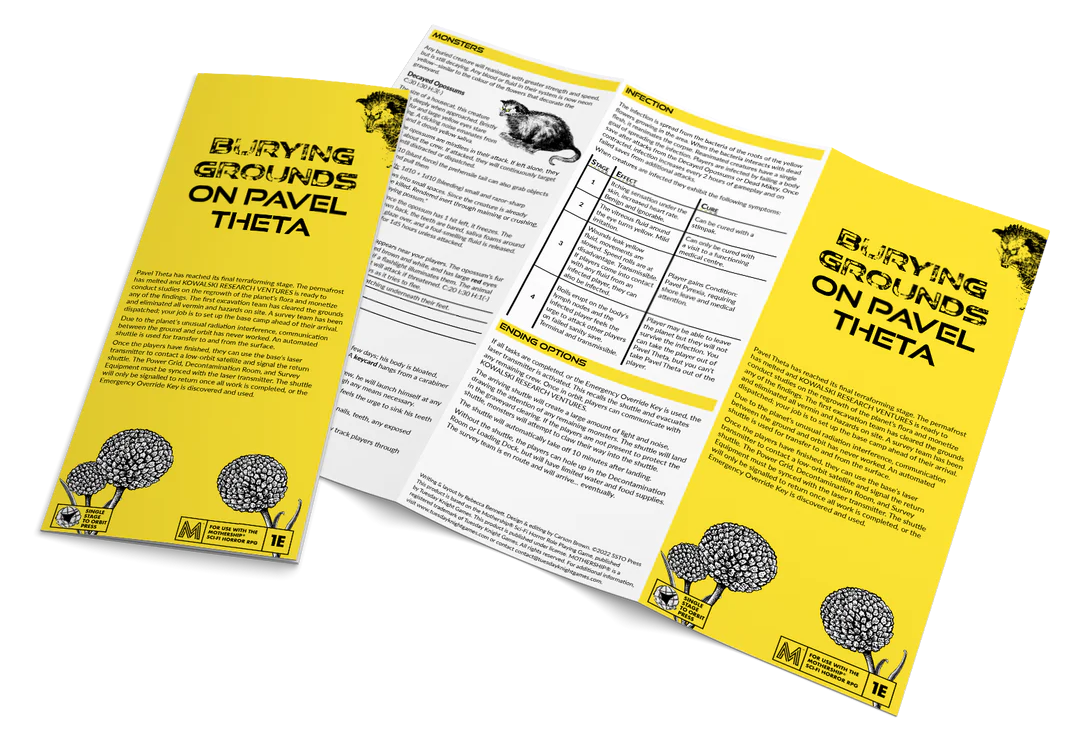
Concept: Rebecca Bennett’s "Burying Grounds on Pavel Theta" presents a Pet Sematary-inspired scenario on a newly terraformed world. Player characters are a backup team sent to investigate after contact is lost with the initial base camp crew. The chilling discovery awaits: any corpse buried on Pavel Theta reanimates as an undead horror, including a member of the original team, Mikey, and, more disturbingly, a horde of undead opossums.
Strengths: Conceptually, this adventure is highly praised for its unique and unsettling premise. The idea of undead opossums is remarkably creepy and effectively utilized, complete with a "great pacing mechanic" that ensures their presence is both menacing and dynamic. The Pet Sematary riff provides a familiar yet terrifying foundation, translating a classic horror trope into the Mothership universe with creative flair. The specific, low-level threat of reanimated wildlife adds a distinct flavor to the module.
Challenges: Similar to "Carrion Protocol," "Burying Grounds" desperately needs an authoritative background narrative. Critical questions about the previous team’s fate (beyond Mikey), the origin of the opossums, and how they came to be buried remain unanswered. This lack of detail forces the GM to invent crucial backstory elements, which can lead to inconsistencies when players inevitably probe the scenario’s lore. The adventure also includes three recorded audio logs intended for player immersion, but these are reportedly performed by voice generators with a flat, unengaging intonation, rendering them largely unusable and detracting from the module’s potential for atmosphere.
Implications: "Burying Grounds on Pavel Theta" possesses a genuinely terrifying and engaging concept, with the undead opossums being a standout element. However, the sparse background information and unconvincing supplementary materials (audio logs) mean that the module, despite its cool ideas, "falls apart when you look at it," especially under player scrutiny. GMs will need to develop a robust backstory to make the scenario truly coherent and impactful, leading to a C- grade.
"Quantum Cargo": A Brilliant Conundrum of Reality Bending
Concept: "Quantum Cargo" unfolds aboard the FMV Dirac, where researchers from Quantum Dynamics Corporation (QDC) were perfecting quantum duplication technology. Dr. Flora Ciama’s attempt to steal a prototype device accidentally triggered a quantum collapse. The ship, which seemingly vanished, reappears weeks later broadcasting multiple distress signals. PCs are dispatched to retrieve top-secret research, only to find the Dirac trapped in a quantum flux. At ground zero, three different versions of Dr. Ciama are endlessly replaying the heist: one succeeding, one failing and causing the explosion, and one trapped in the quantum core chamber.
Strengths: This module is lauded for its "incredibly clever structure" and "core premise." The dynamic interplay of four different zones, each with random quantum effects, combined with a location key filled with "reality-bending set pieces," creates a truly unique and mind-bending experience. The concept of multiple, simultaneous realities coexisting and interacting within the ship is a masterclass in sci-fi horror. Despite minor omissions, the module demonstrates a "loving attention to detail," notably by providing detailed player maps, which significantly enhances usability and immersion. The intricate setup offers immense replayability and opportunities for GMs to surprise and challenge their players.
Challenges: While exceptional, "Quantum Cargo" does have a few minor issues. Similar to "Burying Grounds on Pavel Theta," it could benefit from a more definitive crew list and a slightly more coherent, single explanation of the events leading up to the PCs’ arrival. These omissions, while not as critical as in other modules due to the inherent quantum weirdness, still require some GM interpolation.
Implications: "Quantum Cargo" stands out as a high-quality, innovative Mothership module. Its ingenious structure and reality-bending narrative elevate it above many of its peers, offering a truly special experience for players and GMs alike. Despite minor lacunae, its strengths far outweigh its weaknesses, making it a highly recommended adventure for those seeking sophisticated sci-fi horror. Its ability to create unique, dynamic scenarios secures it a strong B- grade.
The Broader Landscape: Challenges and Opportunities in Module Design
The varied reception of these Mothership modules highlights several recurring themes within indie RPG design, particularly concerning short-form adventures.
The Indie Design Ethos: Innovation vs. Polish
The indie RPG scene is a hotbed of creativity and experimentation. Designers often push boundaries, exploring novel mechanics, formats, and narrative structures. This ethos is evident in the clever concepts behind modules like "Quantum Cargo" and "Burying Grounds." However, this rapid innovation can sometimes come at the cost of polish. Resources for extensive playtesting, professional editing, and comprehensive layout design are often limited, leading to rough edges, incomplete information, or usability issues that might be caught in a larger, corporate publishing environment.
The Pamphlet Format Dilemma: Accessibility and Usability
The trifold or pamphlet format is a popular choice for Mothership modules, offering a concise, digestible adventure that is often affordable or even free. This format promotes accessibility and encourages quick production. However, as seen with "Reclaimer" and "Carrion Protocol," this format can become a significant detriment when not executed flawlessly. Issues like split maps, unkeyed symbols, difficult printing, or awkward information flow arise when the design prioritizes compactness over functionality. A well-designed pamphlet can be a gem, but a poorly executed one can be a nightmare to use at the table.
GM Burden vs. Creative Freedom: The Unfinished Adventure
A recurring criticism across several modules is the expectation that the GM will perform significant design work to make the adventure playable. While Mothership thrives on emergent gameplay and GM improvisation, there’s a fine line between providing creative prompts and delivering an unfinished product. When modules lack crucial details like salvage values, coherent backstories, clear timelines, or functional maps, they shift the burden of design from the creator to the GM. This can be frustrating for GMs seeking a ready-to-run experience, particularly in an open table format where prep time might be limited. The question arises: at what point does "leaving room for the GM" become "relying on the GM to finish the module"?
Narrative Cohesion: The Backbone of Horror
For horror scenarios, a clear, consistent, and logical backstory is paramount. When players investigate a mysterious situation, they expect their questions to be answerable and the world to react coherently. Modules like "Carrion Protocol" and "Burying Grounds on Pavel Theta" falter by not providing an "authoritative background." This makes it challenging for GMs to maintain verisimilitude and respond consistently to player inquiries, which can break immersion and diminish the sense of dread. The horror often lies in understanding what happened and why, even if the answers are unsettling.
Official Responses and Community Engagement
While the original review does not include direct official responses from the module creators, the indie RPG community, particularly around Mothership, is highly interactive. Platforms like Itch.io and DriveThruRPG, where these modules are sold, often feature comment sections and forums where players and GMs provide feedback.
Developer Engagement: It is common for indie developers to monitor these channels and, in many cases, issue updates, errata, or even revised versions of their modules based on community feedback. The detailed critiques offered in reviews like this provide invaluable insights that can guide future iterations of existing products and inform the design principles of new ones. Acknowledging issues like unkeyed maps, printing problems, or narrative gaps demonstrates a commitment to improving the user experience.
The Role of Reviews: Comprehensive reviews serve as a vital filter for GMs navigating the vast content landscape. They highlight both the triumphs and tribulations of module design, helping GMs make informed purchasing decisions and prepare adequately for the challenges a module might present. The grading system, though subjective, provides a quick reference point for overall quality and usability.
Implications for Players and Game Masters
The exploration of these Mothership modules offers several key takeaways for both GMs and players in the wider RPG community.
For Game Masters:
- Thorough Pre-Reading is Essential: GMs must be prepared to read modules critically, identifying potential gaps, inconsistencies, or usability issues before bringing them to the table.
- Adaptation and Augmentation: Many promising modules, despite their flaws, can be salvaged and transformed into excellent experiences with a GM’s willingness to adapt, fill in narrative blanks, and even redesign elements like maps or mechanics.
- Value Proposition: Consider the "GM burden" as part of the module’s value. A cheap or free module might require significant personal investment, while a pricier one should ideally be ready-to-run.
For Players:
- Diverse Experiences: The indie scene offers an incredible array of creative scenarios, but the quality of the experience can be highly dependent on the GM’s preparation and ability to adapt to a module’s shortcomings.
- Embrace the Rough Edges: Part of the charm of indie RPGs is their raw, experimental nature. Players might encounter more unique concepts, but also more unpolished elements.
For Designers:
- Prioritize Clarity and Completeness: Even in concise formats, clear instructions, comprehensive keys, and coherent narratives are paramount for GM usability.
- Test Usability, Not Just Playability: Beyond ensuring the game mechanics work, designers should test how easily a GM can run the module, considering aspects like map legibility, information accessibility, and printing functionality.
- Balance Innovation with Practicality: While pushing creative boundaries is encouraged, designers should ensure that innovative formats or concepts do not inadvertently create barriers to entry for GMs. Providing supplementary materials (like a separate, printable map) can mitigate issues with integrated designs.
Conclusion
The journey through these Mothership modules reveals a dynamic and creatively charged corner of the RPG world. While some modules, like "Reclaimer," present a frustrating cocktail of compelling ideas and flawed execution, others, such as "Quantum Cargo," stand out as shining examples of ingenious design, pushing the boundaries of what a short adventure can achieve.
The Mothership ecosystem continues to be a fertile ground for cosmic horror, demanding both discernment and dedication from its Game Masters. The pursuit of hidden gems within this vast sea of content is a rewarding one, provided GMs are prepared to occasionally polish rough diamonds into dazzling scares. As the Mothership community continues to grow, the feedback generated from these explorations will undoubtedly help shape the future of module design, hopefully leading to more polished, complete, and terrifying adventures for all. The void is vast, and its horrors await, ready for those brave enough to explore them.