
The Restoration of the Indie Spirit: Trash Goblin Surpasses Funding Goals as Crowdfunding Campaign Enters Final 24 Hours
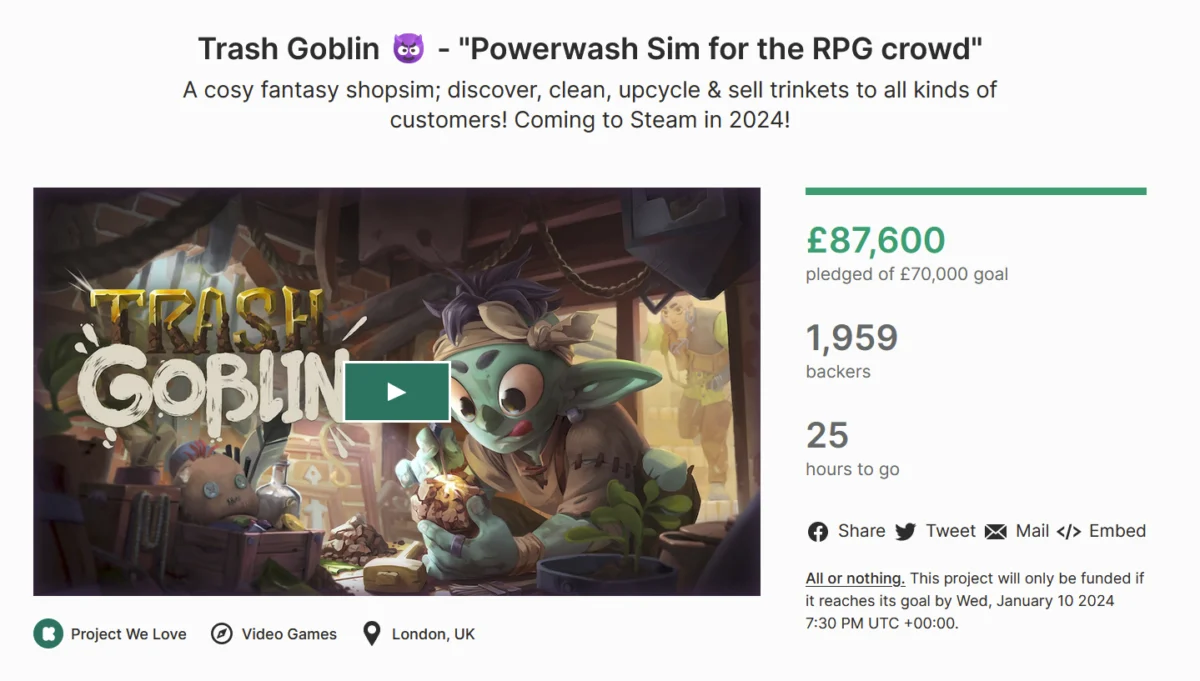
In an era where the video game industry is often dominated by high-stakes blockbusters and live-service behemoths, a quieter, more tactile revolution is taking place in the "cosy gaming" sector. Leading this charge is Trash Goblin, a whimsical restoration simulator developed by Spilt Milk Studios. As of January 9, 2024, the project has officially surpassed its primary funding goals on Kickstarter, reaching 124% of its target with just 24 hours remaining in the campaign.
The success of Trash Goblin represents more than just a financial win for an independent studio; it signals a shift in consumer appetite toward "zen" experiences and marks a significant professional transition for industry veteran Nicholas Lovell. Lovell, the founder of Gamesbrief and a renowned strategist in the business of games, recently stepped into an executive role at Spilt Milk Studios to help steer the project toward the finish line.
Main Facts: A Triumphant Conclusion to a Strategic Campaign
Trash Goblin is billed as a "cosy trinket-cleaning game," a description that undersells the intricate mechanical depth and narrative charm the developers have poured into the title. Often compared to Powerwash Simulator but reimagined for a fantasy RPG audience, the game tasks players with uncovering, cleaning, repairing, and eventually selling various "trash" items found in a vibrant, magical world.
The Kickstarter campaign, which launched in late 2023, hit its stride in the first week of January 2024. Having already secured 124% of its initial funding goal, the studio is now aiming for a "magic number" of £100,000. This final push is intended to unlock additional polish and perhaps further stretch goals that would expand the scope of the goblin’s workshop.
Key data points for the campaign include:
- Funding Status: 124% funded (as of January 9, 2024).
- Time Remaining: 24 hours.
- Primary Platform: Steam (PC), with high emphasis on wishlist growth.
- Core Mechanics: Cleaning, upcycling, and shop management within a fantasy setting.
Chronology: From Concept to Crowdfunding Success
The journey of Trash Goblin began well before its Kickstarter debut. Spilt Milk Studios, a developer known for its eclectic portfolio including titles like Lazarus and Tango Fiesta, sought to create an experience that resonated with the burgeoning "wholesome games" movement.
Phase 1: Conceptualization and Prototyping
The team at Spilt Milk recognized a gap in the market for games that focused on the "aftermath" of adventuring. While traditional RPGs focus on the hero’s journey, Trash Goblin focuses on the economy of the world—the items left behind and the beauty found in the discarded. The development team focused on the tactile satisfaction of cleaning, utilizing shaders and physics to make the act of scrubbing grime off a gold chalice feel rewarding.
Phase 2: Strategic Realignment
A pivotal moment in the project’s history occurred when Nicholas Lovell transitioned from a non-executive role to an executive position within the studio. Lovell, who has spent decades advising companies on "The Curve"—a business philosophy focusing on finding and super-serving a core group of superfans—saw in Trash Goblin the perfect application of his theories. Despite battling the lingering effects of long Covid, Lovell increased his involvement to oversee the strategic rollout of the Kickstarter and the game’s long-term commercial viability.
Phase 3: The Kickstarter Launch
The campaign was launched with a clear message: Trash Goblin is a game about the joy of small things. By positioning the game as "Powerwash Simulator for the RPG crowd," the studio was able to tap into two distinct but overlapping demographics: fans of simulation games and fans of fantasy world-building.
Phase 4: The Final Countdown
By early January 2024, the campaign had cleared its initial hurdles. The final 48 hours of any Kickstarter are historically the most volatile and productive. On January 9, the studio issued a call to arms for the community to help them reach the £100,000 milestone, a figure that would solidify the game’s production budget and marketing spend for the upcoming year.
Supporting Data: The Rise of the "Cosy" Economy
The success of Trash Goblin is underpinned by broader industry trends. The "cosy" or "wholesome" game genre has seen exponential growth since 2020. Games like Unpacking, Stardew Valley, and Animal Crossing: New Horizons proved that there is a massive, underserved market for non-violent, task-oriented gameplay.
The Power of Wishlists
While the Kickstarter funding is the immediate focus, Spilt Milk Studios has emphasized the importance of Steam wishlists. In the current PC gaming ecosystem, wishlists are the primary currency of success. They signal to Steam’s algorithms that a game is in high demand, leading to better visibility upon launch. Trash Goblin has seen a steady climb in its wishlist count, which Nicholas Lovell identifies as a critical metric for the game’s "long tail" sales potential.

Crowdfunding Resilience
Despite some claims that Kickstarter has cooled off for indie games, Trash Goblin demonstrates that a well-defined niche, combined with a transparent development process, can still yield significant results. The 124% funding level indicates a high degree of confidence from the community, particularly during a period of economic uncertainty.
Official Responses: Insights from the Studio
Nicholas Lovell, expressing his enthusiasm for the project, highlighted the personal and professional stakes involved. "I’m so excited that the Kickstarter I’m part of has funded," Lovell stated. His move to an executive role at Spilt Milk Studios marks a "stepping up" that aligns with his passion for self-publishing and developer autonomy.
Lovell’s involvement is a testament to the game’s potential. As the author of How to Publish a Game and The Curve, his decision to commit his limited energy (due to health constraints) to Trash Goblin speaks volumes. "I’m much more involved [now]," Lovell noted, emphasizing that the game represents a convergence of his business expertise and his love for creative indie development.
The studio has also been active in communicating with its backers, providing regular updates on the "trinket" designs and the lore of the goblin protagonist. This level of engagement has been cited by backers as a primary reason for their support, fostering a sense of co-creation between the developer and the audience.
Implications: What This Means for the Future of Indie Dev
The success of Trash Goblin carries several implications for the wider gaming industry:
1. The Validation of "Micro-Sims"
Trash Goblin proves that simulation games do not need to be massive in scale to be successful. By focusing on the "micro-actions" of cleaning and repairing, Spilt Milk is tapping into a psychological "flow state" that many players find therapeutic. This could lead to a wave of other "micro-sims" that focus on specific, satisfying crafts or trades.
2. The Hybrid Professional Model
Nicholas Lovell’s transition from consultant to executive is a model that more indie studios might adopt. Bringing in a business strategist not just as an advisor, but as a stakeholder, allows creative teams to focus on game design while ensuring the commercial "engine" of the studio is running efficiently.
3. The "Post-Heroic" RPG
The industry is seeing a trend toward "post-heroic" narratives—games that take place in fantasy worlds but don’t involve slaying dragons. Trash Goblin sits comfortably alongside games like Potion Permit or Strange Horticulture, suggesting that players are increasingly interested in living in these worlds rather than just conquering them.
4. The Importance of Community-Led Funding
As traditional venture capital and publisher funding become harder to secure for mid-sized indie projects, the success of Trash Goblin reaffirms that a dedicated community can still provide a viable path to market. The £100,000 goal, if reached, would provide the studio with a level of independence that is rare in today’s consolidated market.
Conclusion
As the clock ticks down on the Trash Goblin Kickstarter, the atmosphere at Spilt Milk Studios is one of cautious optimism and profound gratitude. The project has already secured its future, but the final 24 hours will determine how far that future can go. For Nicholas Lovell and the rest of the team, Trash Goblin is not just a game about cleaning trinkets; it is a project that has polished the very model of indie development, proving that with the right strategy and a bit of "cosy" charm, even "trash" can be turned into gold.
With 24 hours to go, the call to action remains clear for those who value independent creativity: check the Kickstarter, wishlist on Steam, and help a small goblin reach a very big milestone.

Leave a Comment