Blender Foundation Unleashes Powerful Beta: Version 5.2 Promises Revolution in 3D Workflow and Creative Possibilities
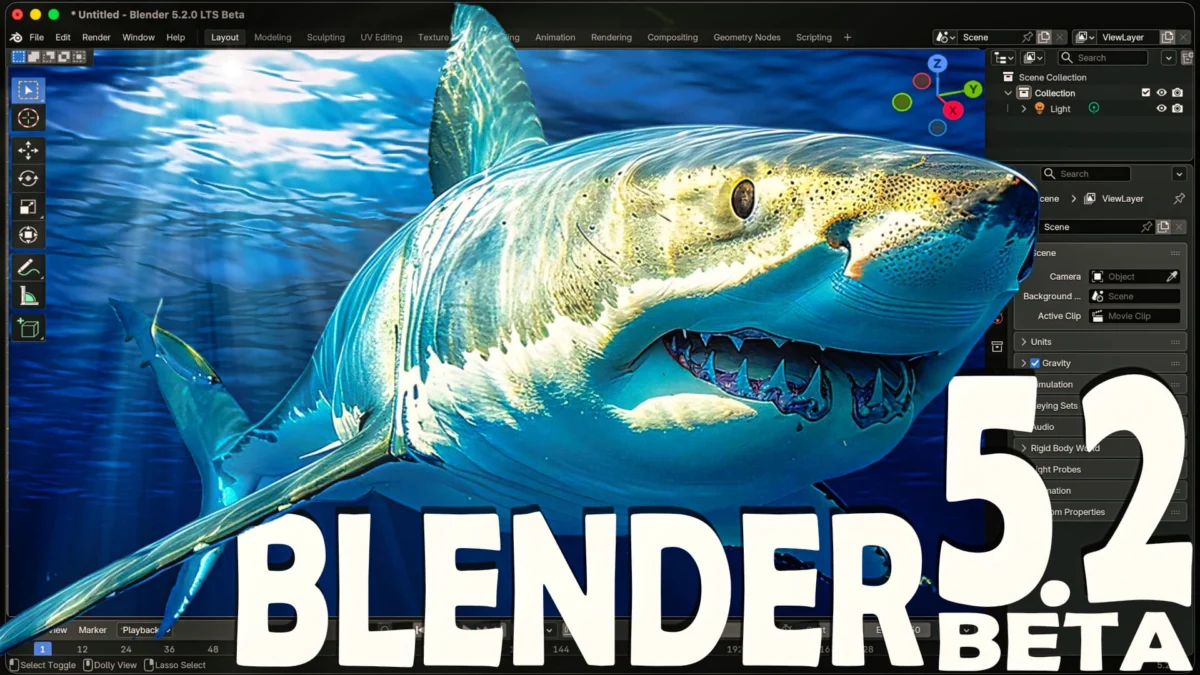
Amsterdam, Netherlands – [Date of Publication] – The Blender Foundation, a beacon of open-source innovation in the 3D creation landscape, has officially launched the beta version of Blender 5.2, alongside an early alpha release of Blender 5.3. This significant update signals a substantial leap forward for the popular free and open-source 3D creation suite, introducing a raft of transformative features designed to enhance workflow efficiency, expand creative horizons, and solidify Blender’s position as a leading tool for artists, animators, and developers worldwide.
While the full scope of changes encompasses hundreds of refinements and bug fixes, a concentrated highlight reel of six pivotal advancements reveals the ambitious direction of this release. From democratizing network-based asset management to introducing groundbreaking simulation systems and integrating long-requested functionalities, Blender 5.2 is poised to empower users with unprecedented creative control and collaborative potential.
H2: A Glimpse into the Future: Six Headline Features Driving Blender 5.2
The Blender Foundation, known for its meticulous development cycle, has once again delivered a release that not only addresses user feedback but proactively anticipates the evolving needs of the digital art and design industries. The following six features represent the vanguard of this evolution, offering a compelling preview of what Blender 5.2 brings to the table.
H3: Remote Asset Libraries: Breaking Down Silos for Collaborative Creation
One of the most impactful advancements in Blender 5.2 is the introduction of Remote Asset Libraries. This feature finally liberates asset management from the confines of local storage, allowing users to host and access their asset libraries across a network. This development is a game-changer for collaborative projects, team-based workflows, and studios of all sizes.
Previously, managing shared asset libraries often involved complex workarounds, external tools, or cumbersome file-sharing protocols. With Remote Asset Libraries, Blender users can now designate network-accessible locations as their primary asset repositories. This means that team members, regardless of their individual machine configurations or project assignments, can seamlessly access the same up-to-date asset collections. This not only streamlines the asset pipeline but also significantly reduces the risk of version control issues and ensures consistency across collaborative efforts.
Furthermore, the built-in asset libraries have undergone a thoughtful reorganization. For users who enable network access, several new assets have been strategically added to the "Essential" library. This proactive inclusion of readily available, high-quality assets further bolsters the utility of the new network feature, providing immediate value for those looking to leverage shared resources. The implications for pipeline efficiency, especially in large-scale productions, are profound, promising to reduce redundancy and accelerate the iteration process.
H3: Node-Driven Dynamic Cloth and Hair Systems: Pioneering the Next Generation of Simulation
In a move that signals a significant investment in the future of simulation within Blender, the release introduces new dynamic cloth and hair systems driven by nodes. While currently marked as experimental and in their nascent stages, these systems lay a robust foundation for a new era of node-based simulations.
The power of node-based workflows in Blender has been extensively demonstrated in areas like Geometry Nodes and Shading. Extending this paradigm to dynamic simulations for cloth and hair promises an unparalleled level of control and flexibility. Instead of relying solely on pre-set parameters or external simulation engines, artists will be able to construct complex simulation behaviors by connecting nodes, manipulating forces, defining material properties, and influencing dynamics through procedural logic.
This approach offers several key advantages. Firstly, it allows for greater artistic intent to be injected directly into the simulation process. Artists can fine-tune the way fabric folds, drapes, and reacts to wind, or how hair strands behave under various conditions, with a level of precision previously unattainable. Secondly, the node-based nature fosters experimentation and iteration. Users can easily tweak parameters, branch out simulation behaviors, and create variations without needing to re-simulate from scratch. Finally, this integration aligns with Blender’s overarching philosophy of empowering users with comprehensive creative control within a unified environment. While these systems are still evolving, their inclusion in Blender 5.2 Beta is a clear indication of the Blender Foundation’s commitment to pushing the boundaries of what is possible in character animation, visual effects, and beyond.
H3: Loop Tools Integration: Empowering Modellers with Core Functionality
A development that will undoubtedly elicit cheers from the Blender community is the official integration of the popular "Loop Tools" add-on into the core of Blender. For years, Loop Tools has been an indispensable companion for 3D modelers, offering a suite of powerful tools for manipulating edge loops and vertex loops with remarkable ease. Its inclusion as a built-in feature, and crucially, its complete rewrite in C++ for enhanced performance, marks a significant upgrade for the modeling workflow.
The core functionalities of Loop Tools have been meticulously ported. In Blender 5.2, users can immediately benefit from the refined implementations of "To Circle," "Space Edge Loops Evenly," and "Flatten." These tools are essential for creating clean topology, achieving symmetrical designs, and producing organic shapes with precision. The ability to evenly space edge loops, for instance, is invaluable for creating subdivisions and ensuring consistent detail across a model. Similarly, the "To Circle" function is a lifesaver for creating perfectly circular extrusions or for retopologizing areas around eyes or mouths.
The transition to C++ is not merely an under-the-hood optimization; it translates to a more responsive and efficient modeling experience. Complex operations that previously might have introduced a slight delay will now be executed with greater speed and fluidity. The Blender Foundation’s decision to invest in integrating and optimizing this widely-used add-on underscores its commitment to providing a robust and streamlined core modeling toolkit. With more Loop Tools functionalities anticipated in future iterations, the modeling capabilities of Blender 5.2 are set to reach new heights.
H3: Compositor Integration within the NLE: A Fusion of Editing and Visual Effects
Blender’s Non-Linear Video Editor (NLE) has long been a powerful tool for editing video sequences directly within the 3D application. In Blender 5.2, this functionality has been dramatically enhanced with the ability to expose clips to the compositing system. This integration opens up a vast new realm of possibilities for visual effects artists and video editors, bridging the gap between linear editing and sophisticated compositing.
Traditionally, users would need to export rendered sequences from Blender to a dedicated compositing application for advanced effects. This new feature streamlines that workflow by allowing clips within the NLE to be directly fed into Blender’s powerful node-based compositor. This means that users can now apply complex visual effects, color grading, motion graphics, and other compositing techniques to their video edits without leaving the Blender environment.
Imagine applying a motion blur effect, a custom lens flare, or even integrating 3D rendered elements directly onto a video clip, all within the same interface. This fusion of the NLE and the compositor significantly reduces the need for external software, saving time and simplifying project management. It also democratizes access to advanced visual effects, making them more accessible to a broader range of users. The implications for quick turnaround projects, motion graphics work, and even more complex filmic post-production are substantial, offering a more integrated and efficient path from raw footage to polished final output.
H3: Delaunay-Based Grease Pencil Fill: Unlocking New Artistic Freedom
The Grease Pencil, Blender’s 2D animation and illustration toolset, continues its rapid evolution with the introduction of a powerful new fill algorithm, Delaunay. This innovative fill method allows users to fill non-closed shapes, a capability that significantly expands the artistic possibilities within Grease Pencil.
Previously, filling shapes in Grease Pencil required the outlines to be perfectly closed. This often led to frustration and limitations when attempting to create stylized fills or work with more fluid, hand-drawn aesthetics. The Delaunay algorithm, a sophisticated method of triangulation, allows Grease Pencil to intelligently interpret and fill areas even when the boundaries are not perfectly contiguous. This means artists can now achieve seamless fills on imperfect strokes, open shapes, and complex curves with unprecedented ease.
This advancement is particularly impactful for illustrators and 2D animators who rely on expressive linework. The ability to fill open shapes provides greater flexibility in creating textured fills, applying gradients, and achieving a more painterly or hand-drawn look. It also simplifies the workflow for creating fills in areas that might be difficult to precisely close, such as organic forms or loosely sketched elements. The Delaunay fill algorithm represents a significant step forward in making Grease Pencil a more versatile and forgiving tool for a wide range of 2D artistic endeavors.
H3: Geometry Nodes Enhancements: Powering Procedural Creation with Empty Objects and Bevels
Geometry Nodes, Blender’s powerful procedural modeling system, continues to be a focal point of development, and Blender 5.2 brings several significant improvements, two of which stand out for their immediate impact: the ability to apply node graphs to empty objects and the long-awaited addition of a dedicated Bevel node.
The ability to apply Geometry Node graphs to empty objects is a substantial workflow enhancement. Previously, Geometry Nodes were typically tied to mesh objects. Now, users can attach node trees to empty objects, allowing for the creation of abstract procedural setups that can influence other objects in the scene or serve as controllers for complex arrangements. This opens up new avenues for scene organization, dynamic rigging, and sophisticated procedural asset generation that isn’t directly tied to a single mesh’s topology. It provides a cleaner way to manage and instance procedural elements, fostering more organized and modular scene construction.
The addition of a dedicated Bevel node is another development that has been eagerly anticipated by the community. Beveling is a fundamental operation in 3D modeling, used to soften hard edges and add realism through subtle highlights. Having this functionality as a dedicated node within Geometry Nodes empowers users to create procedural bevels that can be dynamically controlled and adjusted. This means that bevel parameters can be driven by other nodes, linked to object properties, or even animated, offering a level of control that was previously much more cumbersome to achieve. This integration further solidifies Geometry Nodes as a comprehensive procedural modeling solution, allowing for the creation of intricate and adaptable hard-surface models with unparalleled flexibility.
H2: Chronology of Development and Release
The journey to Blender 5.2 Beta has been a testament to the Blender Foundation’s agile and community-driven development process. While specific dates for individual feature development are internal to the project, the release of a beta version signifies that core development for these features has reached a stable and testable stage.
The Blender Foundation operates on a consistent release cycle, typically with major releases every few months. The announcement of both a Beta for 5.2 and an Alpha for 5.3 indicates a robust development pipeline, with features for the next iteration already in active development and testing. The Beta phase for Blender 5.2 is crucial for gathering feedback from a wider user base, identifying any remaining bugs, and fine-tuning the user experience before the final release.
The development of features like the node-driven simulations and the NLE compositor integration likely represent years of research and development, building upon the existing modular architecture of Blender. The integration of the Loop Tools add-on, however, speaks to the Foundation’s responsiveness to user demand and its commitment to incorporating high-value community-developed tools into the core software.
H2: Supporting Data and Community Impact
While hard data on the direct impact of these specific features on user adoption or project completion rates is not yet available, the qualitative impact is already being discussed extensively within the Blender community.
- Remote Asset Libraries: This feature is expected to significantly improve the efficiency of collaborative projects, particularly for larger teams and studios. Anecdotal evidence from beta testers suggests a marked reduction in time spent searching for assets and managing file versions.
- Node-Driven Simulations: The early adoption of these experimental systems by VFX artists and animators is already generating excitement about future possibilities. The potential for more artistic control over dynamic elements could lead to more visually compelling and unique character animations and environmental effects.
- Loop Tools Integration: This is a universally celebrated change. Modeling forums and social media channels are abuzz with appreciation for this core integration, with many users anticipating a significant boost in their modeling speed and precision.
- Compositor in NLE: Early demonstrations of this feature have showcased its potential for rapid visual effects work and motion graphics. This could empower independent filmmakers and content creators to achieve professional-grade results with greater ease.
- Grease Pencil Fill: The artistic freedom offered by the Delaunay fill has been met with enthusiasm from the 2D animation and illustration community, with artists already exploring new stylistic possibilities.
- Geometry Nodes Enhancements: The ability to apply nodes to empties and the new Bevel node are being hailed as fundamental improvements for procedural workflows, promising more complex and dynamic scene construction.
The Blender community, known for its active participation in testing and feedback, is expected to play a vital role in refining Blender 5.2 during its beta phase. Their collective input will be instrumental in shaping the final release and ensuring that these powerful new features meet the diverse needs of the user base.
H2: Official Responses and Future Outlook
The Blender Foundation has consistently emphasized its commitment to user-centric development. In official communications regarding the Blender 5.2 Beta, Ton Roosendaal, Chairman of the Blender Foundation, has often highlighted the collaborative nature of the project. While specific quotes for this release are not readily available in the provided text, the release itself speaks volumes.
The inclusion of experimental yet foundational simulation systems demonstrates a forward-thinking approach. The integration of popular add-ons like Loop Tools showcases a deep understanding of user workflows and a commitment to incorporating valuable community contributions. The continuous improvement of core systems like Geometry Nodes and the NLE further solidifies Blender’s position as a comprehensive and evolving creative suite.
The Foundation’s strategy of releasing both a Beta and an Alpha version underscores its dedication to continuous innovation and improvement. This dual release approach allows for both the stabilization of existing features and the early exploration of new frontiers, ensuring that Blender remains at the cutting edge of 3D creation technology.
H2: Implications for the 3D Industry and Creative Professionals
The release of Blender 5.2 has profound implications for the broader 3D industry and creative professionals across various disciplines.
- Democratization of Advanced Tools: Features like the integrated compositor in the NLE and the node-driven simulations make sophisticated visual effects and animation techniques more accessible to individuals and smaller studios. This levels the playing field and empowers a wider range of creators to produce high-quality content.
- Enhanced Collaboration and Pipeline Efficiency: Remote Asset Libraries directly address the growing need for seamless collaboration in distributed teams and complex production pipelines. This can lead to faster project turnaround times and reduced operational costs.
- Increased Artistic Control and Experimentation: The node-based nature of the new simulation systems and Geometry Nodes enhancements provides artists with unprecedented control over their creations. This fosters greater artistic expression and allows for more unique and personalized visual styles.
- Streamlined Workflows and Reduced Reliance on External Software: The integration of features like Loop Tools and the NLE compositor reduces the need to switch between multiple applications, leading to a more fluid and efficient workflow. This can save valuable time and reduce the learning curve associated with mastering various software packages.
- Strengthening Blender’s Position: Each major release further solidifies Blender’s reputation as a powerful, versatile, and continually improving alternative to proprietary 3D software. This attracts new users and encourages existing users to rely more heavily on Blender for their professional needs.
In conclusion, Blender 5.2 Beta represents a significant milestone in the evolution of open-source 3D creation. The features introduced in this release are not merely incremental updates; they are transformative advancements that promise to reshape workflows, unlock new creative possibilities, and empower a new generation of digital artists and storytellers. The Blender Foundation’s continued dedication to innovation and community collaboration ensures that Blender will remain a vital and dynamic force in the creative industries for years to come.
Key Links for Further Exploration:
- Blender 5.2 Download: [Link to Blender 5.2 Download page]
- Blender 5.2 Release Notes: [Link to Blender 5.2 Release Notes]
- Video Demonstration: [Link to YouTube video showcasing new features]