"Spaghettin" Review: A Tangled Tale in Alley Cat Games’ Dexterity Series
MAIN FACTS
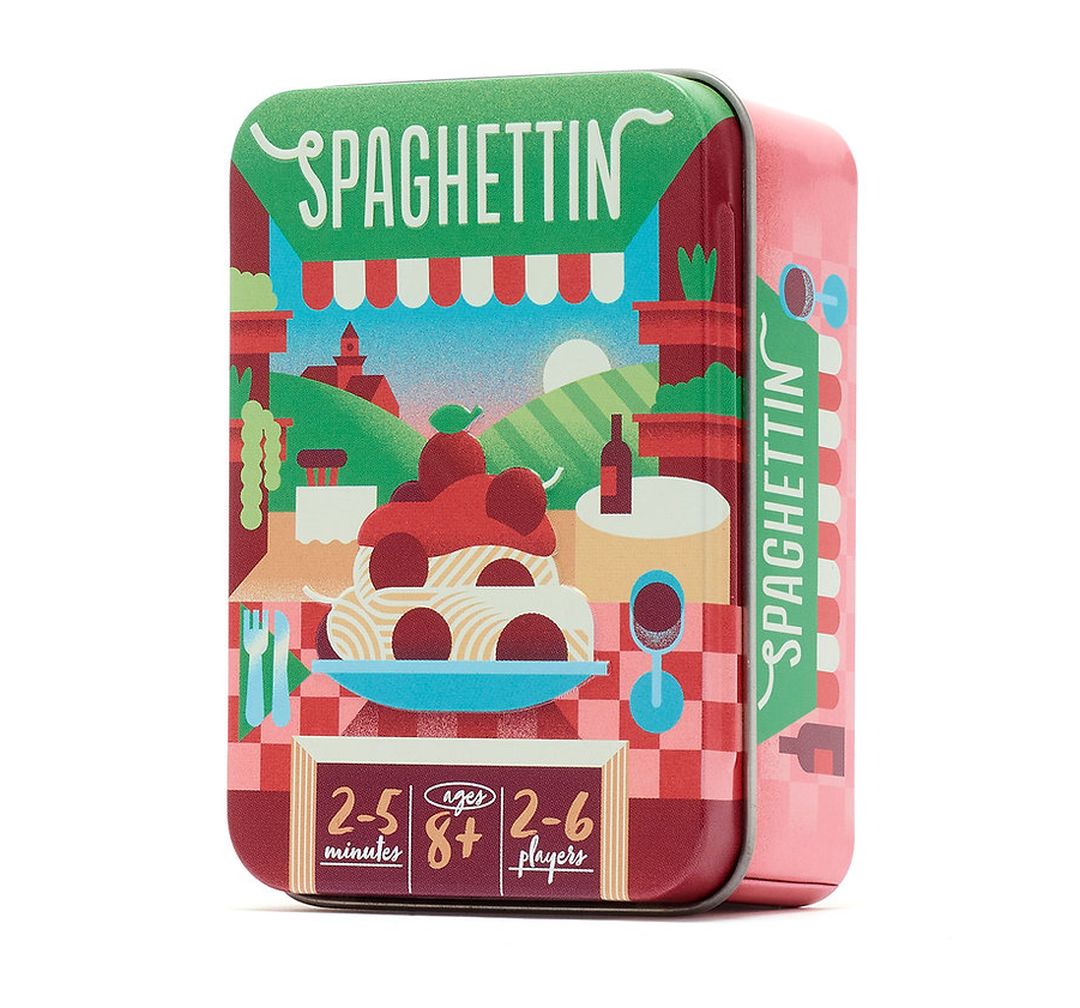
Alley Cat Games, a publisher renowned for its innovative and often compact tabletop experiences, has recently unveiled "Spaghettin," the latest addition to its celebrated "tin-pun" series of dexterity games. Following in the footsteps of critically acclaimed titles like "Tinderblox" and "Kittin," "Spaghettin" aims to capture the same blend of charm, portability, and engaging physical challenge that has defined its predecessors. Designed by Franco Sardo, this family and party game invites 2-6 players aged 8 and up to engage in a delicate culinary-themed challenge, attempting to extract spaghetti strings from a tin without dislodging accompanying toppings. With an RRP of £11.99 and an estimated playtime of a mere five minutes, "Spaghettin" positions itself as a quick, accessible, and visually appealing diversion.
However, initial assessments suggest that "Spaghettin" struggles to live up to the high bar set by its esteemed lineage. While visually appealing and undeniably simple to grasp, the game’s core mechanics, particularly its resolution of player elimination, have been described as "fiddly" and "anticlimactic." Unlike the decisive, dramatic failures that characterize many popular dexterity games, "Spaghettin" often devolves into moments of squinting and uncertainty, undermining the quick-fire fun it promises. This early critical reception raises questions about the game’s long-term appeal and its standing within Alley Cat Games’ otherwise lauded series.
CHRONOLOGY
The Genesis of a Dexterity Dynasty: Alley Cat Games’ Tin Series
Alley Cat Games has, over the past several years, carved out a distinctive niche in the board gaming landscape, particularly with its line of compact, tin-packaged dexterity games. This series began with a clear vision: to deliver highly replayable, accessible, and portable gaming experiences. The initial entries, "Tinderblox" and "Kittin," quickly became fan favorites, setting a high standard for what a small-format dexterity game could achieve.
"Tinderblox," which challenges players to stack miniature wooden blocks to construct a precarious campfire, was lauded for its tactile components, intuitive rules, and the inherent tension of its stacking mechanic. Its success stemmed from the immediate visual feedback of failure – a collapsing campfire is unmistakably dramatic – and the satisfying precision required to succeed. Similarly, "Kittin," with its adorable kitten-shaped blocks, embraced a similar stacking premise but injected it with a charming thematic twist, further solidifying the series’ reputation for combining simple mechanics with delightful aesthetics. Both games exemplified the series’ core tenets: pocket-sized fun, bright and striking components, and a surprising depth of engagement for their modest format. They managed to squeeze a significant amount of charm and replayability into their compact, travel-sized tins, making them ideal for casual play, travel, or as filler games between longer sessions. The consistent quality and innovative designs of these early titles created a strong sense of anticipation for any new entry into the "tin-pun" collection.
Spaghettin’s Conception: A New Flavor of Fiddliness
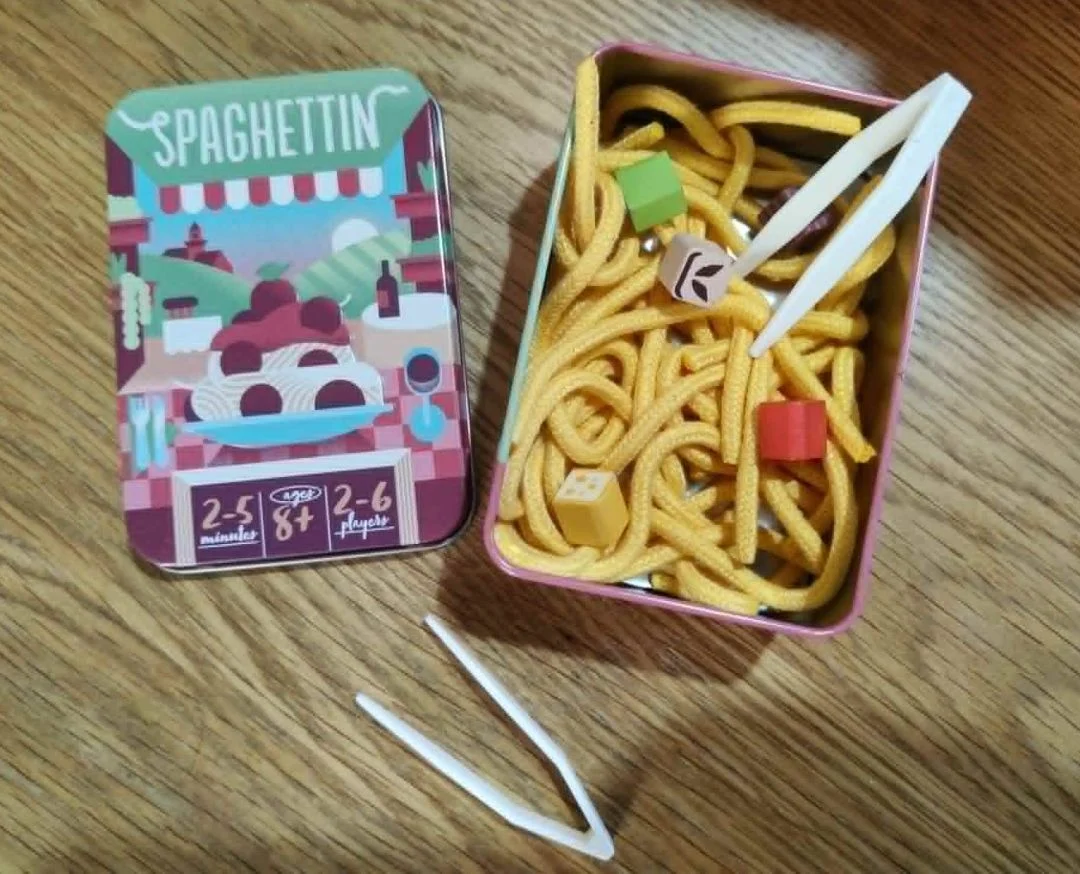
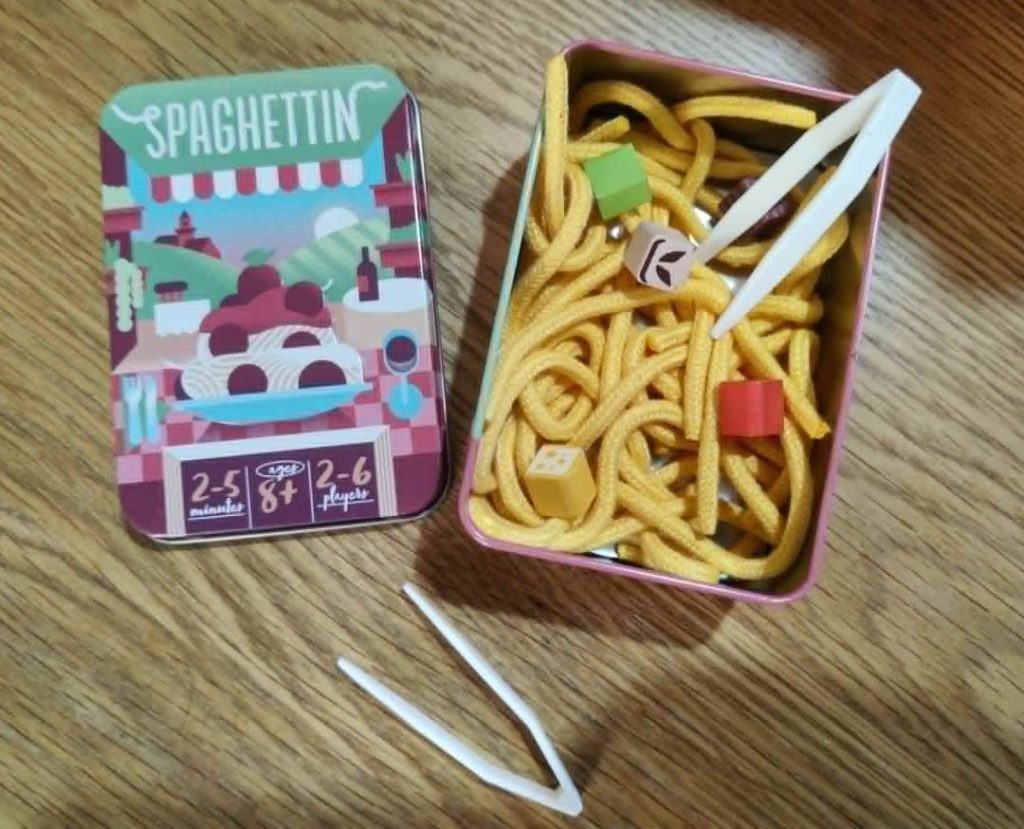
It was against this backdrop of established success that "Spaghettin" was conceived. Designed by Franco Sardo, the game leans into the series’ characteristic pun-based title, offering a culinary twist on the dexterity genre. The concept is refreshingly straightforward: a tin full of spaghetti strings, varying in length, upon which sit five wooden topping blocks – a red tomato, a chunk of cheese, and other familiar Italian fare. Players, armed with tweezers, take turns carefully extracting a single strand of spaghetti, aiming to avoid disturbing the toppings. The thematic connection to a classic Italian dish, combined with the series’ track record, promised a game that would be both charming and engaging. The design goal appeared to be maximum simplicity and speed, making it accessible to the widest possible audience, from casual gamers to families with younger children. The choice of tweezers as the primary interaction tool further emphasized the game’s focus on fine motor skills and careful precision, aligning with the dexterity theme.
Launch and Initial Critical Reception
While the exact release date is not specified in the provided review, the article frames "Spaghettin" as a recent or upcoming title (the image timestamp of "2026" suggests a review preceding wide release, or a future-dated publication). Initial critical assessment, as detailed by reviewer Tim Clare, suggests a departure from the series’ usual triumphs. Despite its visual appeal and the accessible nature of its rules – described as "practically non-existent" – "Spaghettin" is unequivocally branded as "the weakest of Alley Cat’s dexterity game tins."
The core criticism zeroes in on the game’s failure condition: a player is eliminated if a topping falls and lands "completely flat against the bottom of the tin." This specific and somewhat ambiguous criterion leads to what Clare calls "fiddly, anticlimactic conclusions." Rather than the satisfying "Oh no!" moment of a dramatic collapse, players are often left "pausing and squinting" into the tin, unsure if a topping has truly met the elimination condition. This lack of clear, immediate feedback significantly detracts from the game’s flow and excitement, turning what should be a moment of tension into one of uncertainty and scrutiny. The review highlights that while a "dink" might sometimes confirm a fall, often it does not, leading to a frustrating lack of definitive resolution. This critical feedback suggests that while the premise held promise, its execution in practice undermined the very essence of what makes dexterity games enjoyable.
SUPPORTING DATA
Deconstructing the Gameplay Mechanics: Simplicity’s Double Edge
At its heart, "Spaghettin" embodies an extreme minimalist approach to game design. The rulebook, as implied by the reviewer, is likely very brief, perhaps even a single page, reflecting the game’s immediate learnability. The core components are elegantly simple: a collection of spaghetti strings of varying lengths, five distinct wooden topping blocks (a red tomato, a chunk of cheese, etc.), and two sets of tweezers. These components are housed within the series’ signature compact tin, designed for portability and quick setup.
A game round unfolds with striking simplicity: players take turns selecting a single strand of "spaghetti" from the tangled pile within the tin. Using the provided tweezers – a tool that immediately signals the need for fine motor control – they attempt to carefully extract their chosen strand. The goal is clear: remove the spaghetti without causing any of the toppings to fall. The critical moment, and indeed the game’s central conceit, revolves around the precise definition of failure. A player is eliminated not merely if a topping moves or even falls slightly, but specifically if it "falls and hits the bottom of the tin" with "one face completely flat." This seemingly minor detail is where the game’s elegant simplicity begins to unravel. While aiming for precision, it introduces an element of ambiguity that proves detrimental to the player experience.
The Promise vs. The Reality: A Mismatched Expectation
The promise of "Spaghettin" lies in its quick, accessible nature. The estimated maximum five-minute playtime is a testament to its intended role as a "filler" game or a brief diversion. However, the reality, particularly with fewer players, can be even more fleeting. The reviewer notes that a two-player game "might be over in 10 seconds." While brevity can be a virtue in party games, such extreme shortness, especially when coupled with an unsatisfying conclusion, raises questions about value for money and replayability. A game that consistently ends in seconds, lacking a memorable climax, struggles to justify its purchase, even at a modest £11.99 RRP.
The fundamental issue, as articulated in the review, is the stark contrast between "Spaghettin’s" failure condition and those found in successful dexterity games like "Rhino Hero" or "Jenga." In these stalwarts of the genre, failure is undeniably dramatic and immediately apparent. A teetering Jenga tower crashing down or a multi-story card-house collapsing elicits a collective "Oh no!" – a clear, decisive, and often humorous moment that marks the end of a player’s turn or the game itself. These moments are part of the fun, adding to the tension and providing a satisfying resolution to the build-up.
"Spaghettin," conversely, offers a less defined, more ambiguous endpoint. The requirement for a topping to lie "completely flat" against the bottom of the tin necessitates pausing the game, peering closely into the tangle of strings and blocks, and collectively determining if the condition has been met. This transition from active play to forensic examination strips the game of its momentum and excitement. The "Am I out? Oh, I am" reaction described by the reviewer speaks to a profound lack of impact, a quiet fizzle rather than an explosive finish. This "experiment that doesn’t quite land" highlights a critical design flaw: a failure to translate a precise physical condition into a clear, engaging player experience. The intended precision becomes a source of frustration and anti-climax, leaving players unsatisfied rather than exhilarated.
Aesthetic Appeal and Accessibility: The Series’ Enduring Strengths
Despite its mechanical shortcomings, "Spaghettin" does retain some of the inherent strengths of Alley Cat Games’ tin series. Visually, the game is appealing. The compact tin, a hallmark of the series, is instantly recognizable and promises portability. The wooden topping blocks are likely brightly colored and tactile, adhering to the "bright, striking components" standard set by "Tinderblox" and "Kittin." The "spaghetti" strings, varying in length, also contribute to the game’s thematic immersion and visual texture. This attention to aesthetic detail ensures that "Spaghettin" looks inviting on a shelf or tabletop, drawing players in with its charming presentation.
Furthermore, the game’s accessibility remains a strong point. The "rules so simple as to be practically non-existent" ensure that "Spaghettin" can be taught and understood in seconds by players of almost any age. Its 8+ age recommendation is well-justified, and the game’s core dexterity challenge is universally understandable. This low barrier to entry is a core tenet of the family and party game categories, making it easy for diverse groups to pick up and play without extensive rule explanations. This ease of access is a valuable asset, especially for games intended for casual social gatherings or as a light activity between more complex endeavors.
OFFICIAL RESPONSES
As the provided review does not include direct official responses from Alley Cat Games or designer Franco Sardo, we must infer the publisher’s philosophy and potential considerations that might have led to "Spaghettin’s" design. Alley Cat Games has established itself as a publisher committed to diversity in its catalog, ranging from complex strategy games to light, accessible party titles. Their "tin-pun" series, in particular, showcases a dedication to creating compact, travel-friendly games that offer quick, engaging experiences.
The intent behind "Spaghettin" likely aligns with this broader vision: to deliver a highly portable, instantly playable dexterity game with a charming theme. Franco Sardo’s design would have aimed for maximum simplicity, minimizing rules overhead to ensure universal appeal and rapid deployment. The choice of a delicate "tweezer-pulling" mechanic, rather than a more robust stacking challenge, might have been an attempt to explore a different facet of dexterity – one focused on precise extraction rather than precarious construction. This could be seen as an experimental step within the series, pushing the boundaries of what constitutes a "dexterity game" in a micro-format.
Publishers in the board game industry often receive a wide spectrum of feedback. While a review like this highlights specific shortcomings, Alley Cat Games, like many agile publishers, would likely view such critique as valuable data for future designs. The commitment to innovation often involves taking calculated risks, and not every experiment will achieve universal acclaim. The consistent success of other titles in the tin series suggests that the publisher is generally adept at identifying and nurturing compelling game designs. Their continued emphasis on unique mechanics and accessible gameplay implies an ongoing process of refinement and adaptation based on player and critical reception.
IMPLICATIONS
Impact on the "Tin-Pun" Series’ Legacy
The lukewarm reception of "Spaghettin" carries significant implications for the future of Alley Cat Games’ otherwise highly regarded "tin-pun" series. "Tinderblox" and "Kittin" established a benchmark for charm, portability, and satisfying dexterity challenges. "Spaghettin’s" perceived failure to deliver decisive gameplay could potentially dampen enthusiasm for future entries. While one less successful title is unlikely to derail an entire series, it underscores the importance of maintaining consistent quality and innovative execution, especially when working within a well-loved brand. Future designs will likely be scrutinized more closely, with fans and critics eager to see if the series can return to its established standard of excellence, or if "Spaghettin" represents a new, less impactful direction. The challenge for Alley Cat Games will be to learn from this experience and ensure that subsequent releases reinforce the series’ reputation for engaging, well-executed micro-games.
Broader Industry Context: The Art of Engaging Dexterity Games
"Spaghettin’s" reception also offers a valuable case study within the broader context of dexterity games. The genre thrives on clear stakes, satisfying physical interaction, and, crucially, definitive moments of success or failure. Games like "Jenga," "Rhino Hero," "Operation," or even "Crokinole" succeed because their mechanics provide immediate, unambiguous feedback. A piece is placed, a tower stands or falls, a disc lands in a hole or misses. These interactions are inherently dramatic and visually clear, making them engaging for both players and observers.
"Spaghettin’s" "fiddly, anticlimactic conclusions" highlight a fundamental challenge in dexterity game design: how to translate a precise physical act into a compelling game state. The subjective nature of "completely flat against the bottom" removes the visceral, instant feedback that is the hallmark of the genre. This suggests that while minimalism can be a strength, it must not come at the expense of clarity and impact in the game’s most critical moments. The industry continues to innovate with dexterity mechanics, but "Spaghettin" serves as a reminder that the elegance of a design often lies in the unambiguous resolution of its central challenge.
Consumer Considerations and Value Proposition
For consumers, the review of "Spaghettin" offers critical guidance. At an RRP of £11.99, the game falls into an accessible price bracket, often considered an impulse buy. However, the prospect of a game that can be "over in 10 seconds" for two players, culminating in an unsatisfying "pausing and squinting" resolution, significantly impacts its perceived value. While portability and quick setup are desirable, they may not compensate for a lack of engaging gameplay and replayability. Consumers are increasingly discerning, even with budget-friendly games, expecting a certain level of entertainment and satisfaction for their investment.
The reviewer’s direct recommendation to "Try This Instead" with "BEAKS" – another tin-based party game from Alley Cat Games – is particularly telling. "BEAKS," described as a "fun, accessible tin-based party game where you play as seagulls using tweezers to grab chips," immediately evokes a more dynamic and potentially more satisfying dexterity challenge. This comparison highlights that the issue may not be with the format or the publisher, but specifically with "Spaghettin’s" execution. For potential buyers, this review effectively steers them towards other, more proven options within the same family of games, demonstrating the powerful role of critical reviews in shaping purchasing decisions for compact, easily overlooked titles.
The Future of Micro-Games: A Balancing Act
Finally, "Spaghettin" contributes to the ongoing conversation about the viability and challenges of micro-games. These small-footprint games are designed for brevity and portability, but they must still deliver sufficient depth and enjoyment to justify their existence. The balancing act involves distilling core gameplay into its most essential elements without stripping away the fun, tension, or meaningful player interaction. "Spaghettin" exemplifies the risks inherent in this design philosophy. While its simplicity makes it highly accessible, it arguably sacrifices too much in terms of decisive outcomes and engaging tension. The lesson here for designers and publishers of micro-games is clear: brevity is a virtue, but clarity of purpose and impactful resolution are paramount to creating lasting appeal, even in the smallest of packages.