TypeScript 7 Unleashed: A Monumental Leap in Compilation Speed and Developer Experience

TypeScript 7 has arrived, heralding a new era for web and application development with a staggering 8-12x improvement in compilation performance. This revolutionary upgrade, achieved through a strategic rewrite of the TypeScript compiler (tsc) in the Go programming language, promises to fundamentally reshape the developer workflow, offering unprecedented speed and responsiveness.
The core of this dramatic enhancement lies in a bold, almost paradoxical, decision: to leverage the performance advantages of Go to rebuild the very engine that powers TypeScript development. This migration from its original JavaScript-based implementation to a native Go compiler represents a significant architectural shift, a testament to the TypeScript team’s commitment to pushing the boundaries of developer productivity.
While the headline-grabbing 8-12x figure might initially suggest faster runtime execution of TypeScript code, it’s crucial to clarify that this performance boost is squarely focused on the compilation process. This distinction, however, does not diminish its profound impact. Faster compilation translates directly into a more fluid, responsive, and efficient development experience, touching nearly every aspect of a developer’s daily routine.
The Tangible Impact: A Smoother, Faster Development Cycle
The implications of a significantly faster TypeScript compiler are far-reaching and deeply felt across the entire development lifecycle. Imagine a typical workday:
- Instantaneous Editor Load Times: The days of patiently waiting for your Integrated Development Environment (IDE) to fully index and load large TypeScript projects are drawing to a close. With TypeScript 7, this initial setup phase should feel virtually instantaneous, allowing developers to dive straight into their work.
- Real-time Feedback, Amplified: Features that rely on the compiler’s understanding of your code, such as "find all references," auto-completion suggestions, and on-the-fly error highlighting (those familiar red squiggles), will now operate with a responsiveness that borders on magical. Delays that once interrupted the creative flow will be drastically reduced, enabling developers to make edits and receive immediate, accurate feedback.
- Accelerated Build Processes: The
tsccommand, whether run for a full project build or in--watchmode for incremental updates, will now complete in a fraction of the time. This significantly tightens the feedback loop, allowing developers to iterate faster, experiment more freely, and deploy changes with greater agility. Even AI agents assisting in code generation will benefit from this speedup, providing more immediate and actionable results.
This transformation is not merely theoretical. The TypeScript team has provided compelling real-world data, showcasing the dramatic improvements observed on several prominent open-source projects.
Data Speaks Louder: Quantifying the Performance Gains
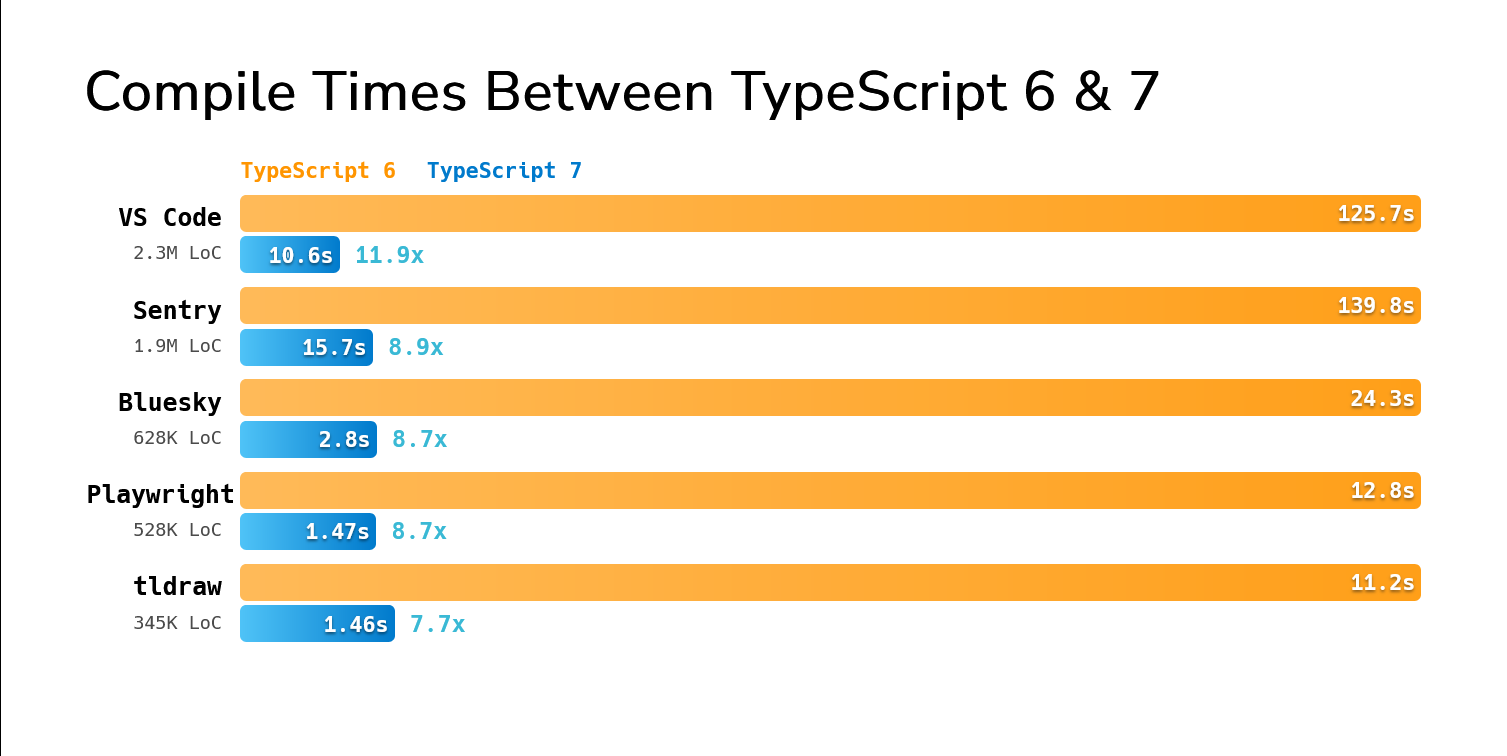
The following tables illustrate the stark contrast in compilation times and memory consumption between TypeScript 6 and the newly released TypeScript 7 across various large-scale codebases.
Table 1: Compilation Time Comparison
| Codebase | TypeScript 6 (s) | TypeScript 7 (s) | Speedup |
|---|---|---|---|
| vscode | 125.7 | 10.6 | 11.9x |
| sentry | 139.8 | 15.7 | 8.9x |
| bluesky | 24.3 | 2.8 | 8.7x |
| playwright | 12.8 | 1.47 | 8.7x |
| tldraw | 11.2 | 1.46 | 7.7x |
(Source: TypeScript Team Benchmarks)

The data clearly demonstrates a consistent and significant performance uplift across all tested projects, with some experiencing speedups exceeding 11 times their previous compilation times. This translates to hours saved per week for developers working on large codebases, allowing for more time dedicated to feature development and problem-solving.
Beyond raw speed, TypeScript 7 also exhibits a more efficient use of system resources. The following table highlights the reduction in aggregate memory consumption during builds.
Table 2: Memory Consumption Comparison
| Codebase | TypeScript 6 (GB) | TypeScript 7 (GB) | Memory Delta |
|---|---|---|---|
| vscode | 5.2 | 4.2 | -18% |
| sentry | 4.9 | 4.6 | -6% |
| bluesky | 1.8 | 1.3 | -26% |
| playwright | 1.0 | 0.9 | -11% |
| tldraw | 0.6 | 0.5 | -15% |
(Source: TypeScript Team Benchmarks)
This reduction in memory footprint is another crucial benefit, particularly for developers working on machines with limited resources or for large-scale CI/CD pipelines where resource efficiency can translate into significant cost savings.
The impact is not confined to full project builds. Even granular operations, like opening a file with an error in a large codebase like VS Code, have seen a dramatic improvement. Previously, this could take upwards of 17.5 seconds from editor launch to the first error appearing. With TypeScript 7, this process is now completed in under 1.3 seconds, a remarkable improvement of over 13 times.
A Chronology of Innovation: The Road to TypeScript 7
The journey to TypeScript 7’s performance revolution has been a long and considered one. While the specific internal development timeline leading to the Go rewrite isn’t publicly detailed in this announcement, the history of TypeScript development itself provides context.
TypeScript, initially conceived and built by Microsoft, has always aimed to bring static typing to JavaScript, enhancing code quality and maintainability. Over the years, its compiler, tsc, written in TypeScript itself, has undergone continuous improvements and optimizations. However, as JavaScript projects grew in size and complexity, the inherent limitations of a JavaScript-based compiler in terms of raw performance and resource management became increasingly apparent.
The decision to rewrite tsc in Go is a strategic pivot, likely stemming from extensive research and benchmarking into alternative language implementations for compiler construction. Go, with its built-in concurrency features, efficient garbage collection, and strong performance characteristics, has become a popular choice for building high-performance systems and tooling. This move signifies a maturation of the TypeScript project, acknowledging that the underlying implementation technology might need to evolve to meet the demands of modern software development.
The "Announcing TypeScript 7.0" blog post, a key official resource, likely details the technical challenges and triumphs involved in this significant undertaking. It is anticipated that this rewrite involved not just a language change but also a fundamental re-evaluation of the compiler’s architecture and algorithms to fully capitalize on the strengths of Go.
Official Endorsements and Vision
While the provided text focuses on the technical aspects and data, official statements from the TypeScript team at Microsoft underscore the significance of this release. The announcement of TypeScript 7.0 on the official TypeScript blog (linked as a key resource) is the primary source for these pronouncements.
It’s highly probable that key figures within the TypeScript project, such as lead engineers or program managers, have articulated the vision behind this ambitious rewrite. Their statements would likely emphasize:
- Commitment to Developer Experience: The primary driver for this performance upgrade is to create a more enjoyable and productive environment for developers worldwide.
- Scalability for the Future: The move to Go is a strategic investment in ensuring TypeScript can scale effectively with the ever-increasing complexity and size of modern applications.
- Open Source Collaboration: The TypeScript team has consistently fostered a collaborative open-source community, and this release, like its predecessors, is a product of that collective effort.
Further insights can be gleaned from accompanying video resources, such as the one linked in the article, which often feature interviews with the core development team, providing a deeper understanding of their motivations and the technical nuances of the release.
Implications Beyond Compilation: A Ripple Effect on the Ecosystem
The impact of TypeScript 7’s performance gains extends far beyond the immediate compilation speed. This fundamental improvement will have a ripple effect across the entire TypeScript ecosystem and beyond.
- Enhanced IDE Capabilities: As mentioned, IDEs will become more responsive. This could lead to the development of even more sophisticated real-time features, such as advanced refactoring tools, more intelligent code generation, and richer interactive debugging experiences.
- Boost for Large-Scale Applications: Developers working on massive monorepos or complex enterprise-level applications will experience the most significant benefits. Reduced build times can dramatically shorten development cycles, leading to faster feature delivery and quicker bug fixes.
- Democratization of Performance: With faster compilation and lower memory usage, developers on less powerful hardware will find it easier to work with TypeScript effectively. This can broaden the accessibility of the language and its ecosystem.
- Impact on CI/CD Pipelines: The efficiency gains translate directly to faster and potentially cheaper CI/CD processes. Shorter build and test cycles mean faster feedback on code changes, leading to more robust and reliable deployments.
- Influence on Tooling: The success of this rewrite might inspire other language tooling projects to explore similar architectural shifts. It validates the approach of using high-performance languages like Go for building critical developer tools.
- New Possibilities for Game Development: The article specifically mentions the relevance for 2D and 3D game engines. Faster compilation can be a critical factor in game development workflows, where rapid iteration and testing are essential for creative progress. This improvement could make TypeScript a more attractive option for game developers seeking the benefits of static typing without significant performance penalties.
In conclusion, TypeScript 7 is not just an incremental update; it represents a paradigm shift in how developers interact with their code. By embracing a foundational rewrite in Go, the TypeScript team has delivered a product that significantly accelerates the development process, enhances resource efficiency, and sets a new standard for performance in the world of programming languages. This release is a testament to continuous innovation and a clear commitment to empowering developers with the tools they need to build the future.