Blender Foundation Unveils Blender 5.2 LTS: A New Era of Long-Term Stability and Cutting-Edge Innovation
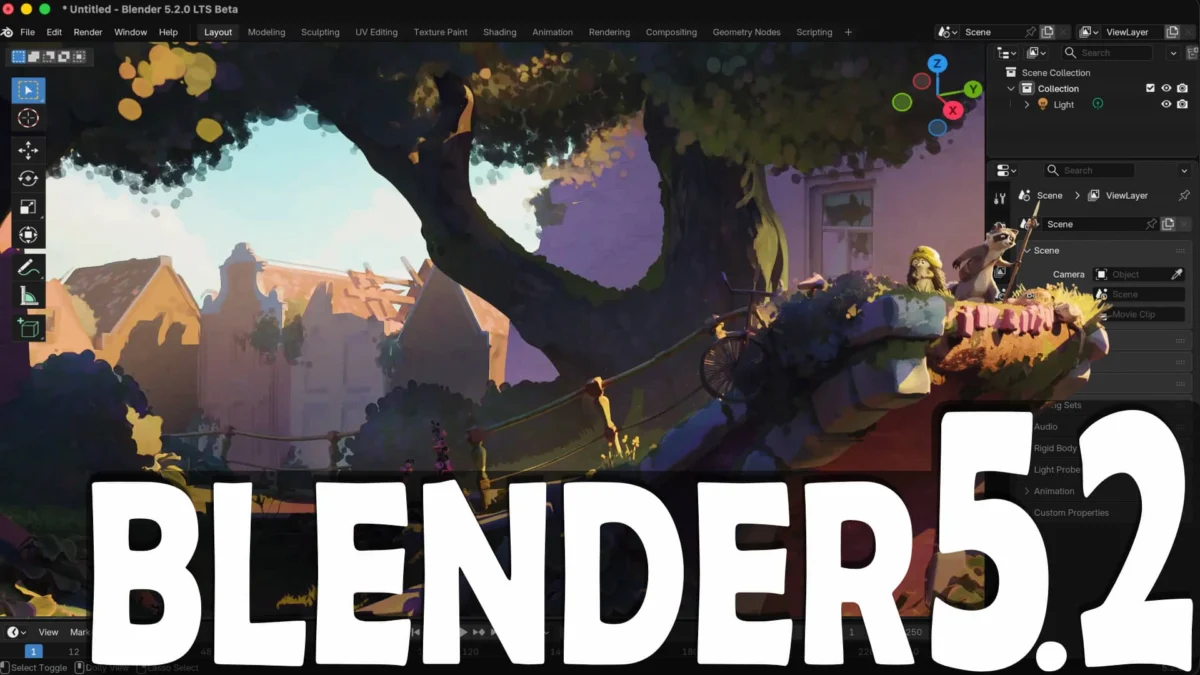
Amsterdam, Netherlands – [Date of Publication] – The Blender Foundation has officially launched Blender 5.2 LTS (Long-Term Support), marking a significant milestone in the evolution of the industry-leading open-source 3D creation suite. This highly anticipated release offers a robust and stable foundation for creative professionals, guaranteeing two years of dedicated updates and support. More importantly, Blender 5.2 LTS isn’t just about stability; it’s a powerhouse of new features and enhancements that push the boundaries of digital art, animation, and visual effects, promising to empower artists with unprecedented creative control and efficiency.
The Long-Term Support designation underscores the Blender Foundation’s commitment to providing a reliable platform for large-scale productions and professional pipelines. For studios and individual artists embarking on new projects, Blender 5.2 LTS represents the recommended stable branch, ensuring a consistent and predictable development trajectory. This focus on longevity allows creators to invest their time and resources with confidence, knowing that their chosen software will remain a dependable partner for years to come.
However, this commitment to stability does not come at the expense of innovation. Blender 5.2 LTS is packed with a breathtaking array of new tools and workflow improvements, many of which have been eagerly awaited by the global Blender community. From a revolutionary new physics system and advanced sculpting tools to deep integration of popular add-ons and significant performance boosts across various modules, this release is poised to redefine what’s possible in the realm of 3D content creation.
A Glimpse into the Future: Key Innovations in Blender 5.2 LTS
Blender 5.2 LTS introduces a transformative suite of features, meticulously crafted to enhance artistic expression and streamline the creative process. These advancements span across the entire Blender ecosystem, from fundamental simulation capabilities to intricate rendering optimizations.
Revolutionary Physics and Cloth Dynamics: The Dawn of Node-Based Simulation
One of the most groundbreaking additions is the experimental, node-based physics framework within Geometry Nodes. This pioneering system, powered by an XPBD (Extended Position Based Dynamics) solver, opens up entirely new avenues for simulating complex phenomena such as hair and cloth. Artists can now intuitively build and control intricate physics behaviors by connecting nodes, offering unparalleled flexibility and granular control over simulations. This departure from traditional, monolithic physics solvers promises to democratize advanced simulation techniques, making them more accessible and adaptable to a wider range of creative needs. The potential for creating hyper-realistic and stylized cloth simulations, dynamic hair grooms, and other organic movements is immense, placing Blender at the forefront of real-time and offline simulation technology.
Sculpting Reimagined: The Precision of the Project Tool
The Sculpting Project tool represents a significant leap forward in sculpting workflows. This brand-new scene project brush functions akin to a highly refined shrinkwrap modifier, allowing artists to seamlessly project existing geometry onto target surfaces. This innovative tool is invaluable for tasks such as retopology, detailing, and transferring complex surface information with remarkable accuracy and ease. Imagine effortlessly projecting intricate patterns, armor details, or even entire character models onto a base mesh – the Project tool makes this a reality, significantly accelerating the detailing and refinement stages of character and asset creation.
Essential Tools, Now Native: The Integration of LoopTools
A long-standing favorite among Blender users, the LoopTools add-on, has now been natively integrated into the core modeling toolset. Popular utilities like Circle, Space, and Flatten are now readily accessible, eliminating the need for separate installations and streamlining workflows. This integration ensures that essential modeling operations are readily available and optimized within the core application, making polygon modeling more efficient and intuitive for both new and experienced users. The ability to quickly create perfect circles from selected vertices, evenly distribute elements, or flatten complex arrangements of geometry directly within Blender’s modeling environment will be a welcome boon for hard-surface modelers and character artists alike.
2D Animation Gets a Boost: The Enhanced Grease Pencil Fill Tool
For artists working in 2D animation, the Grease Pencil Fill tool has undergone a complete redesign. A new, state-of-the-art fill algorithm, coupled with an updated brush library, promises to dramatically improve the efficiency and artistic control of 2D drawing within Blender. This enhancement ensures that creating clean fills, dynamic linework, and expressive 2D characters is more fluid and responsive than ever before, further solidifying Blender’s position as a comprehensive solution for both 2D and 3D animation.
Video Compositing Unleashed: GPU Acceleration for the VSE
Blender’s Video Sequence Editor (VSE) receives a substantial performance upgrade with the introduction of full Compositor support directly within the VSE. Crucially, sequencer effects are now moved to the GPU, resulting in vastly improved rendering and playback speeds. This integration bridges the gap between editing and compositing, allowing for more complex and dynamic video sequences to be created and iterated upon directly within Blender’s familiar editing environment. This enhancement is a game-changer for motion graphics artists and video editors who rely on Blender for their post-production workflows, enabling faster turnarounds and more ambitious visual effects integration.
Seamless Asset Management: Remote Asset Libraries
The workflow for managing and utilizing assets has been significantly enhanced with the introduction of native support for browsing and downloading assets from remotely hosted libraries. This feature allows artists to access and import assets directly from within the Blender interface without the need to leave the application. This not only streamlines the asset integration process but also opens up possibilities for collaborative asset sharing and centralized asset management for studios, fostering a more efficient and interconnected creative workflow.
Photorealistic Translucency: The Thin Wall Mode in Principled BSDF
Achieving photorealistic rendering of translucent materials like leaves, paper, and thin plastics has always been a challenge. Blender 5.2 LTS addresses this with a new Thin Wall option in the Principled BSDF shader. This dedicated setting is specifically designed to render such surfaces with exceptional accuracy, capturing the subtle light scattering and transmission that define their appearance. This addition will empower artists to create more believable and visually stunning renders of a wide range of natural and man-made objects.
Rendering Efficiency: The Cycles Texture Cache Revolution
The Cycles render engine benefits from a significant performance boost with the implementation of a brand-new texture caching system. This innovative approach drastically minimizes VRAM and system memory usage, allowing for the rendering of scenes with larger and more complex textures without encountering memory limitations. This enhancement is particularly impactful for artists working with high-resolution assets and detailed environments, enabling them to push the boundaries of visual fidelity without being constrained by hardware limitations.
Procedural Powerhouse: The Mesh Bevel Node
Expanding the capabilities of Geometry Nodes, a dedicated Mesh Bevel node has been introduced. This addition empowers artists to procedurally create bevels on meshes within the node-based system. This opens up new possibilities for procedural modeling workflows, allowing for dynamic and easily adjustable bevels that can be integrated into complex procedural generation pipelines.
Audio-Driven Animation: The Sample Sound Node
The creative potential of procedural animation is further amplified with the addition of the Sample Sound node. This new node allows artists to extract frequency and volume data from audio files, enabling them to drive procedural animations directly from sound. This opens up exciting possibilities for creating dynamic visualizations, responsive motion graphics, and immersive audio-reactive environments, bridging the gap between sound design and visual storytelling.
Geometry Nodes Expansions: Broader Functionality
The already powerful Geometry Nodes system receives further expansion with native support for Empty objects, Geometry Bundles, and structured Lists. These additions enhance the flexibility and organizational capabilities of the node architecture, allowing for more complex and sophisticated procedural setups, better data management, and improved interoperability within the node-based workflow.
A Chronology of Evolution: The Road to Blender 5.2 LTS
The release of Blender 5.2 LTS is the culmination of years of dedicated development, community feedback, and incremental improvements. While the exact timeline for the specific features within 5.2 LTS is extensive, the overarching development of Blender has followed a consistent path of innovation and community-driven progress.
Blender’s journey from a fledgling open-source project to an industry-standard powerhouse has been marked by significant developmental phases. Early versions focused on establishing core functionalities, while subsequent releases progressively refined existing tools and introduced groundbreaking new features. The introduction of the Cycles render engine, the overhaul of the modeling tools, and the advent of Geometry Nodes have all been pivotal moments.
The development of Blender 5.2 LTS itself has likely involved extensive alpha and beta testing phases. During these periods, developers release early builds to gather feedback from a wider user base, identifying bugs, usability issues, and potential areas for further refinement. This collaborative approach is a hallmark of the Blender development model, ensuring that the final release is robust, feature-rich, and tailored to the needs of its diverse user community. The inclusion of experimental features, such as the new physics system, highlights the Foundation’s commitment to pushing the boundaries while providing a stable LTS option for those who require it.
Supporting Data: The Impact of Open Source and Community
The success of Blender, and by extension the release of Blender 5.2 LTS, is intrinsically linked to the power of open-source development and the vibrant global community. The Blender Foundation operates on a not-for-profit model, relying heavily on donations, grants, and the contributions of thousands of volunteers.
The Blender Development Fund, established to provide financial support for dedicated development cycles, has been instrumental in enabling the creation of major features and the release of stable versions like 5.2 LTS. Companies and individuals can contribute financially, supporting the development of specific features or the overall project.
Furthermore, the vast community of users contributes through bug reporting, feature requests, documentation, tutorials, and the development of countless add-ons. The inclusion of popular add-ons like LoopTools as native features is a testament to the community’s influence and the Foundation’s responsiveness to user needs. The open-source nature of Blender fosters a collaborative environment where innovation thrives, and the collective effort ensures that the software remains at the cutting edge of 3D technology.
Official Responses: Voices from the Blender Foundation
While direct quotes from specific individuals within the Blender Foundation for this specific release are not available in the provided text, the philosophy and vision behind Blender releases are consistently articulated through official channels. The Blender Foundation’s mission statement emphasizes accessibility, empowering artists, and fostering a collaborative environment.
Ton Roosendaal, the founder and chairman of the Blender Foundation, has consistently championed the democratization of 3D creation. His vision has always been to make powerful tools available to everyone, regardless of their budget or background. The release of an LTS version like 5.2 underscores this commitment to providing a stable and reliable platform for professionals and studios to build their workflows upon.
The release notes themselves, which are linked in the article, serve as the primary official communication detailing the advancements. These notes are typically penned by the development team and highlight the key changes, bug fixes, and new features, providing a comprehensive overview of the release. The emphasis on "experimental" features in areas like physics simulation also reflects a measured approach to innovation, allowing for exploration while maintaining a core of established stability.
Implications for the Industry: A Shifting Landscape
The release of Blender 5.2 LTS carries significant implications for the broader 3D industry.
Increased Adoption in Professional Pipelines: The LTS designation is a powerful signal to studios and larger production houses. The guarantee of two years of support and updates reduces the risk associated with adopting open-source software for mission-critical projects. This will likely lead to a further increase in Blender’s adoption in animation studios, game development, visual effects houses, and architectural visualization firms.
Democratization of Advanced Technologies: Features like the node-based physics system and the enhanced Grease Pencil fill tool make previously complex or expensive technologies more accessible. This empowers smaller studios and independent artists to achieve results that were once only possible with proprietary and costly software.
Accelerated Workflows and Creative Exploration: The performance improvements in video compositing and rendering, combined with new tools for sculpting and modeling, directly translate to faster iteration times and the ability for artists to explore more creative possibilities. The seamless integration of assets and the efficiency of new nodes will allow artists to focus more on the creative aspects of their work and less on technical hurdles.
The Rise of Proceduralism: The continued expansion of Geometry Nodes, with additions like the Mesh Bevel node and the Sample Sound node, solidifies Blender’s position as a leader in procedural content generation. This paradigm shift allows for the creation of highly complex and adaptable assets and environments that can be easily modified and scaled, revolutionizing how digital worlds are built.
A Competitive Edge: Blender’s rapid development cycle and its commitment to providing cutting-edge features at no cost offer a compelling alternative to commercial software. This competitive pressure can drive innovation across the entire industry, benefiting all users.
In conclusion, Blender 5.2 LTS is not merely an update; it is a declaration of intent. It signifies a maturing open-source project that is not only stable and reliable but also relentlessly innovative. The Blender Foundation has once again delivered a powerful toolkit that will undoubtedly shape the future of digital artistry and empower a new generation of creators to bring their visions to life with unprecedented freedom and efficiency. The industry should watch closely as Blender 5.2 LTS begins to weave its magic into the fabric of creative production worldwide.