The Bloom of Intuition: Andrew Salgado’s Radical Shift Toward the Still Life in ‘Glory!’
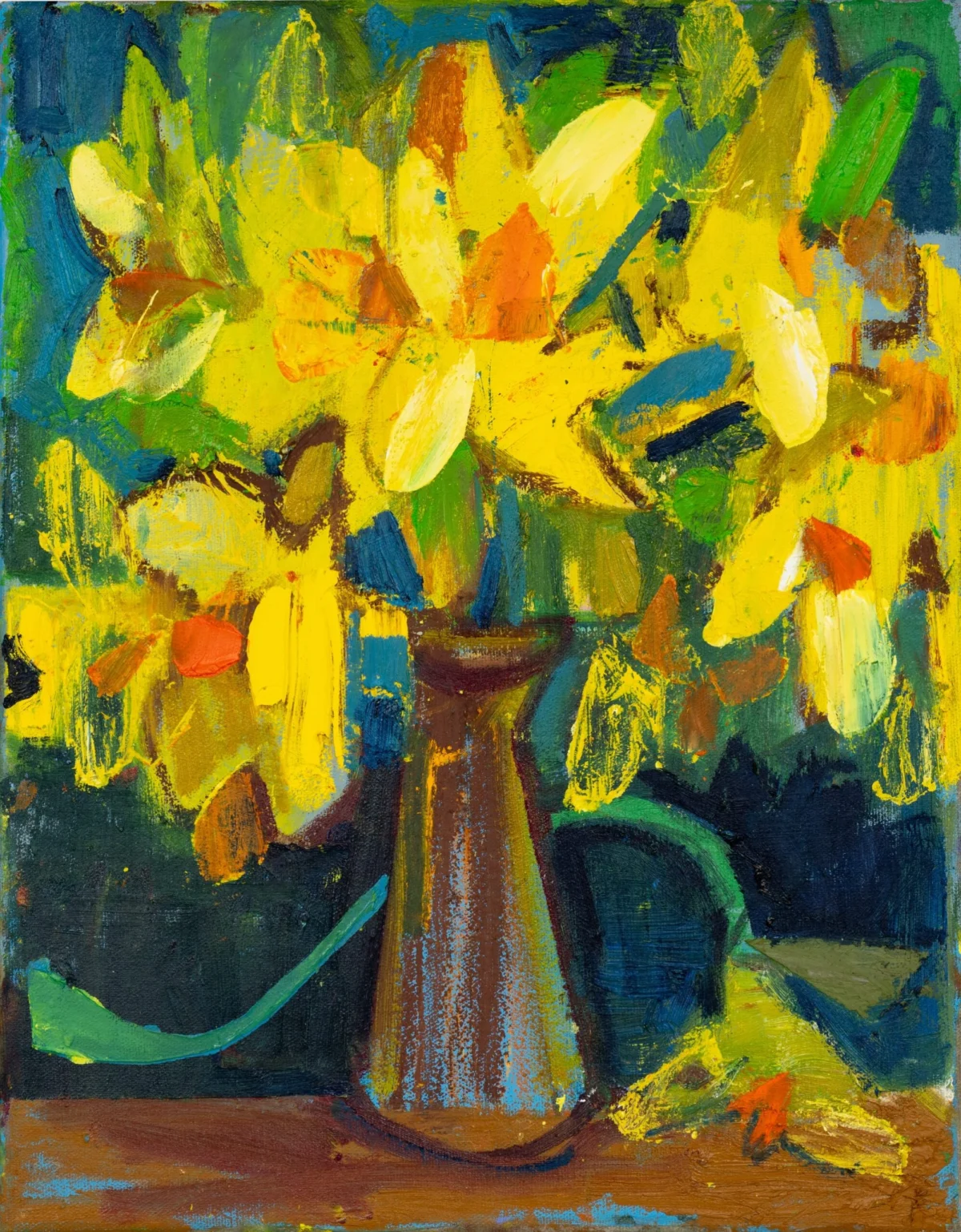
The contemporary art world has long recognized Andrew Salgado as a master of narrative-driven figurative painting. His canvases, often populated by complex characters and layered with dense literary and historical references, have earned him a reputation as an artist of profound intellectual rigor. However, in his latest body of work, titled Glory!, Salgado has embarked on a surprising and vibrant departure. Shifting his gaze from the human form to the botanical, the artist explores the traditional still life through a lens of spontaneous gesture and visceral emotion.
Currently on display at BEERS London from July 16 to August 15, 2026, Glory! represents a pivotal moment in Salgado’s career—a move away from the premeditated and toward the intuitive.
Main Facts: A New Direction for a Figurative Icon
Andrew Salgado’s Glory! is an exploration of the floral still life, yet it bears little resemblance to the static, meticulously rendered arrangements of the Dutch Golden Age. Instead, Salgado utilizes the bouquet as a vehicle for his signature gestural marks, allowing color and texture to take precedence over literal representation.
The exhibition features a series of large-scale canvases where vibrant bouquets are rendered in various states of "blossom and decay." The work is characterized by a "rippling" effect of color across the canvas, where the boundaries between the subject and the background often blur into a singular, energetic field of pigment. While the human figure—long the centerpiece of Salgado’s practice—is absent, the works remain deeply psychological. Through his use of "stylized florals," Salgado captures the frenetic energy of life and the inevitable slide into obsolescence.

The transition is not merely thematic but methodological. Salgado has explicitly stated a desire to move away from a process that was historically "narrative-driven." In his previous collections, every stroke often served a specific story or a predetermined intellectual concept. In Glory!, the artist prioritizes "intuition and spontaneity," allowing the act of painting itself to dictate the final composition.
Chronology: From Narrative Figuration to Spontaneous Still Life
To understand the weight of this shift, one must look at the trajectory of Salgado’s career over the past decade.
The Era of the Literary Figure (2014–2022)
For much of his early and mid-career, Salgado was celebrated for his ability to weave complex stories into portraiture. His work often functioned as a dialogue between the canvas and the library. He drew heavily from the works of authors like James Baldwin, Yukio Mishima, and various classical poets. During this period, his process was rigorous and research-heavy. Each painting was a puzzle of symbols, where the sitter’s identity was intertwined with external narratives. This era solidified his status as a "figurative painter with a penchant for literary citation."
The Search for Freedom (2023–2025)
In the years leading up to the creation of Glory!, Salgado began to express a growing restlessness with the "rigid, predetermined path" of narrative painting. While his work remained successful, the artist sought a more direct connection to the medium of paint. He began experimenting with more abstract backgrounds and looser brushwork, testing the limits of how much information a viewer needs to identify a subject. This period served as the gestation for his current aesthetic, where the "thought or association" is allowed to lead the hand, rather than a fixed storyboard.

The Birth of ‘Glory!’ (2026)
The culmination of this evolution is the current exhibition at BEERS London. By choosing the still life—a genre often dismissed as "quiet" or "academic"—Salgado has found a playground for pure expression. The "glory" referred to in the title suggests both the peak of a flower’s bloom and the spiritual, almost religious intensity with which the artist approaches the canvas.
Supporting Data: Literary Roots and Art-Historical Echoes
Despite Salgado’s move toward spontaneity, his identity as an "avid, eclectic reader" remains visible in the DNA of Glory!. The works may operate at a remove from his typically reference-rich compositions, but they are far from hollow. They contain what critics describe as "snippets of texts and art history" that ground the abstraction in a broader cultural context.
Case Study: ‘The Prince’
One of the standout pieces in the exhibition, "The Prince" (2026), exemplifies Salgado’s ability to translate literary mood into visual energy. The painting is "awash in blues of all shades," creating a monochromatic intensity that is both beautiful and unsettling. The work draws inspiration from Thomas Bernhard’s novel Gargoyles, which follows an aristocratic protagonist’s descent into paranoia and obsession.
In Salgado’s hands, the flowers are not merely decorative; they are "splayed in every direction," mirroring the "frenetic energy of a message left on the table." The singular color palette reinforces the obsessive nature of Bernhard’s protagonist, suggesting that even in the absence of a human face, the painting can convey a specific state of mind.

Case Study: ‘Dear Theo’
Perhaps the most direct nod to art history is "Dear Theo" (2026). The painting centers on a "bright cluster of sunflowers," a subject forever linked to Vincent van Gogh. Salgado includes a "scribbled note at the bottom right" addressed to Theo, Van Gogh’s brother.
The painting serves as a meta-commentary on the act of creation. It references Van Gogh’s famous letter to Theo, in which he wrote: "To be sufficiently heated up to melt those golds and those flower tones, not just anybody can do that. It takes an individual’s whole and entire energy and attention." By referencing this quote, Salgado aligns his own "gestural marks" with Van Gogh’s emotional intensity, suggesting that the still life is a high-stakes arena for an artist’s "energy and attention."
Aesthetic Analysis
The collection features other evocative titles such as "Narcissus Wept," "For Myra," "Funeral," and "Better in the Shade." Across these works, several data points emerge regarding Salgado’s current style:
- Chromatism: A move toward bold, saturated palettes that define the mood of the piece (e.g., the heavy blues of "The Prince" vs. the "melted golds" of "Dear Theo").
- Temporality: A focus on the lifecycle of the subject. The flowers are shown in "various states of blossom and decay," a classic vanitas theme updated for the 21st century.
- Mark-Making: The use of "signature gestural marks" that emphasize the physicality of the paint, moving the work closer to Abstract Expressionism than traditional realism.
Official Responses: The Gallery and the Artist’s Perspective
The reception from the art community and the hosting institution, BEERS London, has been overwhelmingly positive, viewing the shift as a sign of artistic maturity.

In a statement regarding the exhibition, the gallery highlighted Salgado’s newfound "freedom." The gallery notes that rather than following a "rigid, predetermined path," the artist opted to "latch onto a thought or association and allow it, and the paint, to lead." This endorsement suggests that the market is ready for a Salgado that is less concerned with literal storytelling and more focused on the "visceral experience" of the medium.
Salgado himself has reflected on this transition as a necessary evolution. He describes the process of Glory! as being "attuned to one’s energy and attention." For Salgado, the still life provided the perfect "subject matter allowing for greater intuition." By removing the pressure of the human narrative, he has found a way to make the paint itself the protagonist. "It’s about the ability to let the paint lead," Salgado noted in a recent social media update, emphasizing that the spontaneity of the work is its greatest strength.
Implications: The Future of the Modern Still Life
The implications of Salgado’s Glory! extend beyond his own portfolio. This body of work contributes to a broader resurgence of the still life in contemporary art, where artists are reclaiming the genre to explore identity, climate change, and the passage of time.
Redefining the Genre
Salgado proves that the still life does not have to be "still." By infusing the compositions with "frenetic energy" and literary weight, he elevates the floral arrangement to a psychological portrait. This suggests that the future of the genre may lie in its ability to act as a mirror for human emotion, rather than just a study of form and light.

Impact on Salgado’s Legacy
For Salgado, Glory! is a "risk-taking" exhibition. By stepping away from the narrative figuration that made him famous, he is challenging his collectors and critics to follow him into more abstract territory. If successful, this move could expand his reach into the world of contemporary abstraction, positioning him as a versatile artist capable of navigating multiple genres with equal intensity.
The Collector’s Market
From a commercial standpoint, the move to still life often opens an artist up to a wider range of collectors. While figurative work can sometimes be "challenging" or "confrontational," the universal beauty of florals—especially when rendered with Salgado’s "vibrant" and "gestural" flair—offers a more accessible entry point into his complex intellectual world.
As Glory! continues its run at BEERS London, it stands as a testament to the power of artistic reinvention. Andrew Salgado has shown that by looking away from the face and toward the flower, an artist can find a different, perhaps more honest, kind of truth. In the "blossom and decay" of his bouquets, we find a reflection of our own fleeting, glorious existence.