The Visual Philosophy of Christian Quintin: Mapping the Intersection of Psyche and Landscape
In an era of contemporary art often dominated by rapid-fire digital aesthetics, social commentary, and conceptual irony, the work of Christian Quintin stands as a deliberate, meticulous, and profoundly poetic outlier. A French-born artist who has spent over four decades rooted in the rugged beauty of Northern California, Quintin does not merely paint what is visible to the eye; he translates the "déjà vu" of the soul. His canvases—ranging from surrealist ink drawings that take half a year to complete to luminous pastel landscapes—act as a bridge between the classical discipline of the Old World and the expansive, spiritual ecology of the New World.
As his career enters a period of significant international resurgence, with recent and upcoming exhibitions in Paris, Seoul, Hong Kong, and Los Angeles, Quintin’s work invites a re-examination of the role of beauty, intuition, and technical mastery in the 21st-century visionary continuum.
Main Facts: A Unified Vision of Two Worlds
Christian Quintin’s practice is defined by a "kaleidoscopic consciousness," a term used to describe his ability to dissolve the boundaries between the human form and the natural world. Born in 1957 in Saint Brieuc, Brittany, and educated at the prestigious Beaux-Arts Academy in Paris, Quintin’s technical foundation is rooted in the rigorous traditions of French draftsmanship. However, his move to Northern California in 1981 provided the atmospheric catalyst that would transform his work from academic exercise into a deeply personal visual philosophy.

Quintin’s oeuvre is divided into two primary modes that, upon closer inspection, are revealed to be mirrors of one another:
- Surrealist Compositions: Intricate works in pen, ink, or oil that explore the architecture of memory and the subconscious.
- Romantic Landscapes: Emotive renderings of the California and Brittany coastlines that imbue nature with human sentiment and movement.
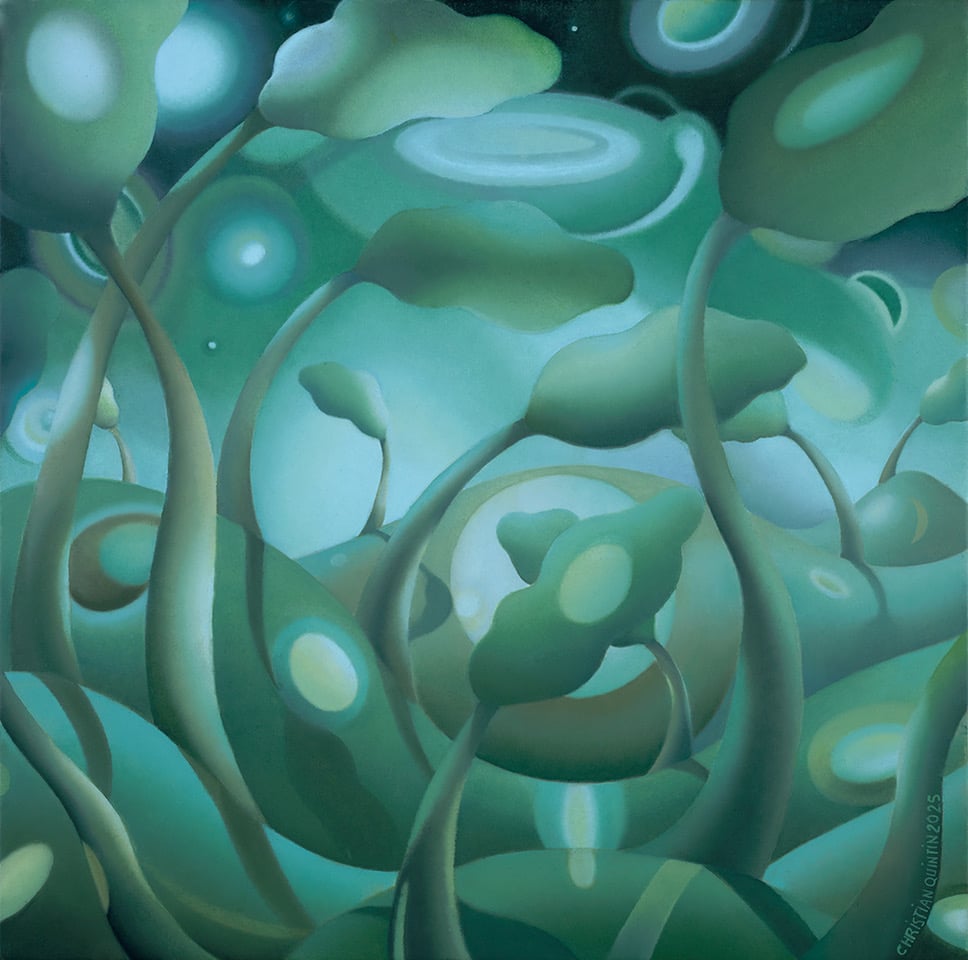
The central fact of Quintin’s career is his refusal to adhere to the "shock" tactics of traditional Surrealism. While artists like Salvador Dalí or René Magritte sought to unsettle the viewer through displacement and the uncanny, Quintin seeks to "awaken" the viewer to a pre-verbal state of feeling. His work is characterized by an absence of slogans or manifestos, replaced instead by a singular invitation: to read his imagery as one would read poetry.
Chronology: From the Moody Cliffs of Brittany to the Valleys of Sonoma
The evolution of Quintin’s art is a narrative of geographical and spiritual migration. His life and work can be traced through four distinct chapters:

1957–1975: The Breton Foundation
Quintin’s earliest visual memories were formed on the "moody" northern coast of Brittany. Growing up in Saint Brieuc, he was surrounded by a landscape of storm-lashed cliffs, ruined castles, and a pervasive sense of maritime melancholy. A pivotal influence was the L’Île de la Comtesse, a small island that would later appear as a recurring motif in his work—a symbol of solitude, sanctuary, and the mythic past. This period instilled in him a sensitivity to the "grandeur" of nature that would remain the bedrock of his career.
1975–1981: The Parisian Discipline
At the age of 18, Quintin moved to Paris to study at the École des Beaux-Arts. This was a period of intense technical refinement. Under the guidance of master instructors, he mastered the control of form, materials, and precise draftsmanship. While he absorbed the legacy of French Surrealism and Symbolism, he found himself more aligned with the Romantic painters who sought to reveal the sublime rather than the grotesque. His time in Paris provided the "classical temper" that allows his most surreal images to maintain a sense of structural logic and grace.
1981–1999: The California Convergence
The most significant turning point in Quintin’s life occurred in 1981 when he relocated to Northern California. Settling in the vineyards and rolling hills of Sonoma County, he found a landscape that resonated with his Breton roots but offered a new, sacred ecology. In California, Quintin’s philosophy matured; he began to see the "spirit in a tree" as an extension of his own consciousness. During these decades, he worked steadily, producing public commissions for hospital lobbies and city murals, and winning accolades such as the Grumbacher Award (1987) and the California State Fair Award of Excellence (1990).

1999–Present: The International Ascent
In 1999, Quintin began an association with the Vorpal Gallery, the institution famously responsible for introducing M.C. Escher to the American public. This partnership validated Quintin’s position within a lineage of artists who combine meticulous technique with mind-bending concepts. Since 2020, represented by Lorin Gallery (Los Angeles/Paris), Quintin’s work has reached a global stage, appearing at major international art fairs including KIAF in Seoul and Art Central in Hong Kong.
Supporting Data: The Mechanics of Slow Art
To understand the depth of Quintin’s work, one must look at the data of his production. Quintin is a practitioner of "slow art" in an age of instant gratification. His process is a negotiation between spirit and hand, often requiring months of daily labor for a single piece.
- Labor Intensity: His masterpiece The Aviary, a surrealist self-portrait where the face emerges from a crystal and hair transforms into a leafy canopy, took six months of continuous work to complete.
- Symbolic Duration: La Porte Ouverte (The Open Door), inspired by the poetry of Rumi, required seven months of cross-hatched pen-and-ink work. This level of technical commitment ensures that every stroke is intentional, moving the work beyond "automatism" into the realm of "constructed dreaming."
- Medium as Instrument: Quintin selects his medium—pastel, oil, graphite, or ink—based on the "tone" of the piece, much like a musician chooses an instrument. His pastels are known for their luminosity and "humming" life, while his ink works provide the sharp, neurological detail of the psyche.
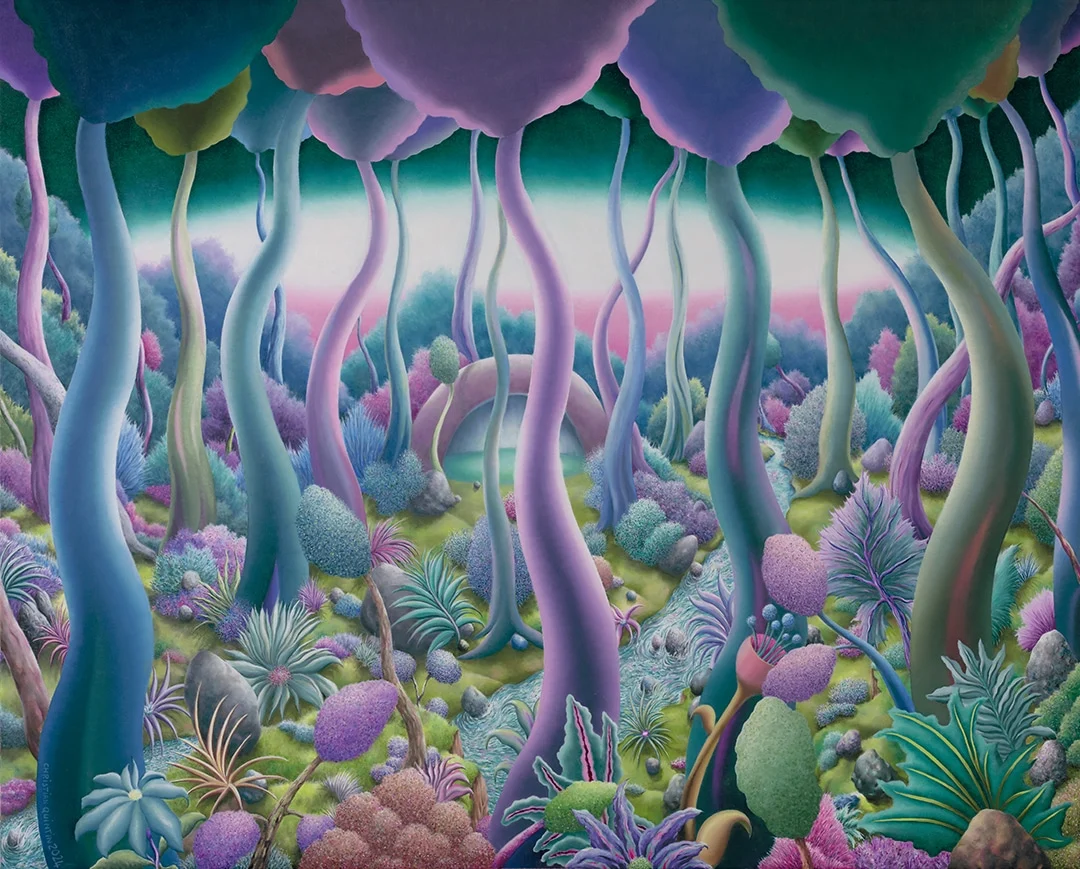
His landscapes, which he calls "emotional terrains," often feature trees that sway like dancers or embrace like lovers. In works like A Lake Color of Emeralds, Quintin uses a non-literal palette—orange skies and emerald lakes—to prioritize emotional resonance over topographical accuracy.

Official Responses: Critical Acclaim and the "Beauty Gap"
The critical reception of Christian Quintin’s work has been remarkably consistent over four decades, with reviewers often noting that his work fills a specific psychological gap in the modern art world.
- Alhia Warren described his work as a "beautiful intimate mystery," highlighting the way his pieces draw the viewer into a private, meditative space.
- Suzanne Munich, writing for various art journals, coined the term "Mental Landscapes" to describe his ability to map the interior world onto the exterior environment.
- The Press Democrat’s Dan Taylor noted the "emerging beauty" of his work, suggesting a slow-burning revelation that reveals itself over time.
A particularly poignant review from the Calabi Gallery in 2022 stated: "In an era largely devoid of it, his work is beautiful. We could all use more beauty in our lives." This critique suggests that Quintin’s work acts as a form of cultural diagnosis—a remedy for the cynicism and irony that often dominate contemporary galleries. Critics argue that Quintin does not use beauty as an escape, but as a "form of resistance" against the fragmentation of modern life.
Implications: A Bridge Between Tradition and Visionary Art
The implications of Quintin’s career extend beyond his individual success; he represents a vital bridge in the "visionary continuum." While he is technically a surrealist, his work deviates from the movement’s Freudian roots. Instead of focusing on repressed trauma or the "uncanny," Quintin aligns himself with the Visionary Art movement of Northern California—a lineage that includes the psychedelic spiritualists of the 1960s.

However, Quintin provides a "classical" anchor to this movement. Where visionary art can sometimes be chaotic or unstructured, Quintin’s work is governed by a "sacred geometry" of thought. He proves that the surreal does not have to be jarring; it can be a "wondrous sanctuary for the soul."
As his work moves toward upcoming exhibitions at the Morrison Gallery in Connecticut and continues to gain traction in European and Asian markets, the broader implication is clear: the global art world is catching up to a man who refused to change his pace. In a culture of speed and spectacle, Quintin’s legacy will likely be defined by his commitment to the "slow reveal"—reminding us that art, when made with enough care, becomes a permanent reentry point into the hidden dimensions of reality.
Where to Experience the Work
For those seeking to engage with Quintin’s "visual philosophy," his current representation includes:
- Lorin Gallery (Los Angeles and Paris)
- Morrison Gallery (Kent, Connecticut)
- Online Archive: christianquintin.com
In conclusion, Christian Quintin’s art serves as a sanctuary. It is a reminder that beneath the words we use to describe our world lies a deeper, more symbolic language of feeling—a language that Quintin has spent a lifetime learning to speak.