The Hidden Anatomy of Nostalgia: Jason Limon’s Trompe-l’œil Revelations
In the quiet corners of San Antonio, Texas, artist Jason Limon is performing a delicate, visual autopsy on the artifacts of the past. Known for his uncanny ability to blend the macabre with the whimsical, Limon’s recent body of work explores a world where the colorful veneer of vintage advertisements and biological illustrations is literally being stripped away. What lies beneath these tattered matchboxes and faded circus posters is not the void, but a vibrant, three-dimensional universe populated by anonymous skeletons—entities that serve as both a reminder of our shared mortality and a playful exploration of what survives when identity is removed.
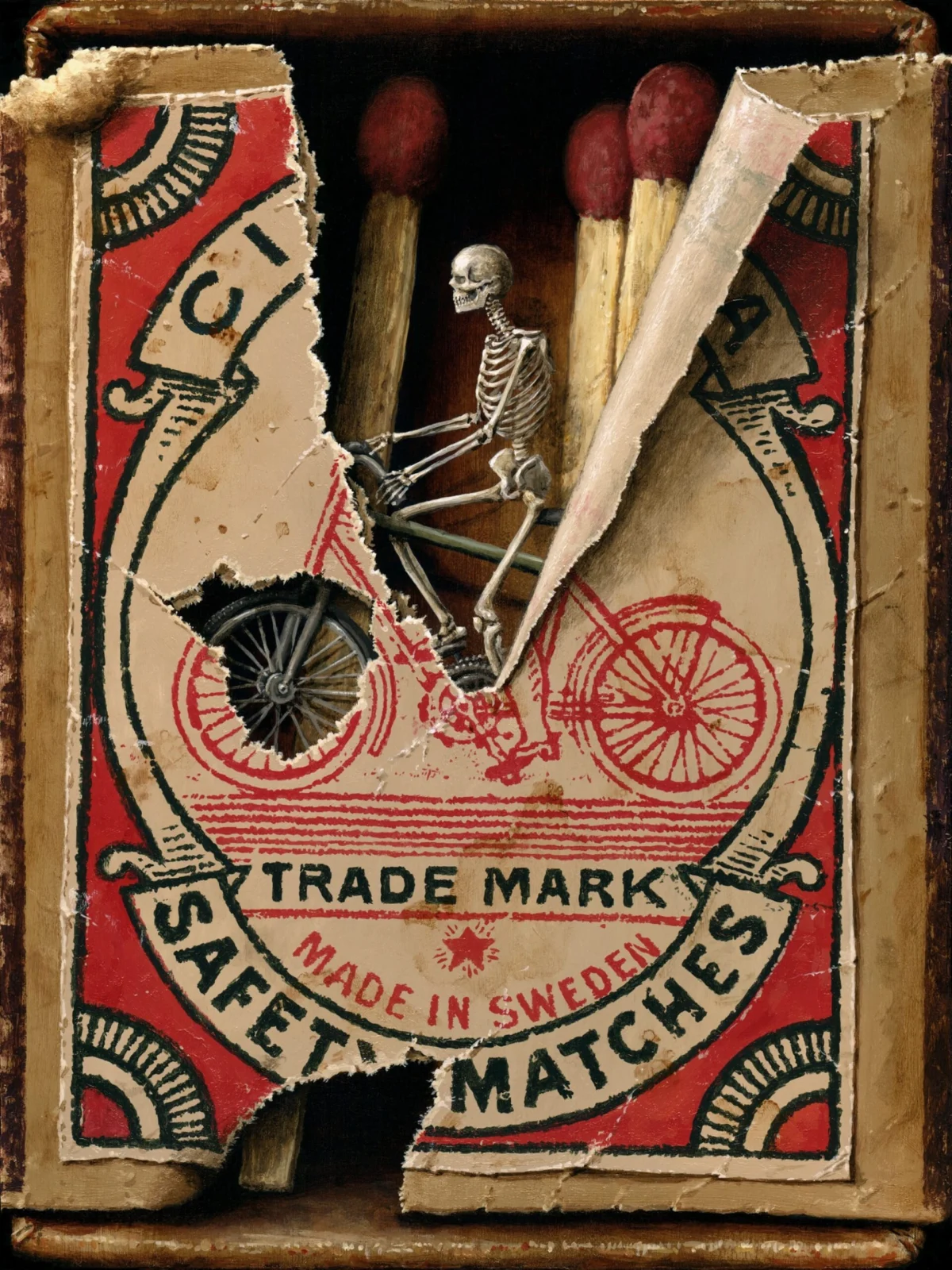
Limon’s latest series, which masterfully utilizes the trompe-l’œil (trick of the eye) technique, challenges the viewer to look past the surface. By painting hyper-realistic "tears" and "rips" into his canvases, Limon creates the illusion that the physical medium of the artwork is failing, revealing a skeletal subterranean world that is as meticulously rendered as the "paper" that supposedly conceals it.

Main Facts: The Intersection of Memento Mori and Vintage Ephemera
Jason Limon has spent years refining a style that bridges the gap between the "lowbrow" art movement and high-concept surrealism. His primary focus remains the skeletal form—a universal symbol that he treats not with dread, but with a sense of "cheeky" curiosity. In his most recent works, such as Matchbook Tiger and Matchbox Cyclist, Limon utilizes a sophisticated blend of acrylic and oil paints to simulate the textures of aged cardboard, weathered paper, and rusted metal.
The core of Limon’s current thematic exploration is the "torn element." In pieces like Torn Rabbit I and Torn Rabbit II, the viewer sees a classic biological rendering of a hare. However, a jagged rip across the center of the image exposes a deep, shadowed cavity where a miniature skeleton resides, mirroring the pose of the creature on the surface. This technique suggests a dual reality: the external world we project through media and art, and the internal, structural truth that remains constant.

Limon’s skeletons are rarely depicted in positions of agony. Instead, they are shown performing mundane or whimsical tasks. In Circus Clown, a 11 x 14-inch masterpiece, a skeleton takes on the role of a performer, donning the identity of a jester. In Seen and Hush, tiny skeletal figures are depicted interacting with larger skulls, decorating them or standing in quiet contemplation. This shift from the frightening to the familiar is a hallmark of Limon’s contribution to the contemporary "New Contemporary" art scene.
Chronology: The Evolution of a Skeletal Aesthetic
The trajectory of Jason Limon’s career is one of intentional slowing and deepening. Originally coming from a background in commercial graphic design and illustration, Limon’s early work was characterized by a more graphic, flat aesthetic. However, his move into fine art allowed for an exploration of depth—both literal and metaphorical.

- The Early 2000s: The Graphic Foundation. During this period, Limon’s work was heavily influenced by his commercial roots. His characters were often more stylized, and his palettes were bright, though the seeds of the otherworldly were already present.
- The Mid-2010s: The Rise of the Anonymous Entity. Limon began to move away from specific characters toward the skeletal figures that define his current work. He started exploring the idea of life after death as a state of anonymity, where the "bony figures are stripped of their identities."
- The Late 2010s: Texture and Illusion. Limon began experimenting with trompe-l’œil. He moved away from standard portraiture and toward the "object-as-art" concept, painting his scenes as if they were found objects or weathered signs.
- 2024-Present: The "Torn" Series. This current phase represents a synthesis of his previous experiments. By incorporating the torn paper effect, Limon has found a way to merge the two identities of his work: the vintage-inspired surface and the surreal, skeletal background. As he notes, he has intentionally "pressed the brakes" on his production speed to focus on the intricate details required for hyper-realistic illusions.
Supporting Data: Technical Precision and the Art of the Illusion
Limon’s ability to fool the eye is backed by a rigorous technical approach. The use of both acrylic and oil paints allows him to achieve a specific balance of matte and gloss finishes.
- Acrylics: Used primarily for the base layers and the "vintage" surfaces, acrylics allow for the quick building of texture and the simulation of dry, aged paper.
- Oils: Employed for the skeletal figures and the shadows within the "rips," oils provide the depth and blending necessary to create a three-dimensional feel.
The dimensions of Limon’s work are also significant. Most of his pieces are relatively intimate, ranging from 8 x 8 inches (like Seen) to 12 x 12 inches (like Fading Feline). This small scale forces the viewer to move closer to the canvas, enhancing the trompe-l’œil effect. When viewed from a distance, the "rips" appear entirely real; it is only upon close inspection that the brushstrokes reveal the artifice.

In terms of market presence, Limon has become a staple of the San Antonio art community while gaining international recognition through platforms like Colossal and various galleries in Los Angeles and New York. His ability to sell both high-end originals and accessible prints has made him a significant figure in the "pop-surrealist" economy, where collectors value both the technical skill of the Old Masters and the subcultural grit of modern illustration.
Official Responses: Insights from the Artist
In discussing his process, Jason Limon provides a glimpse into the psychological motivations behind his "slow art" movement. He describes his current phase as one of experimentation and creative liberation.

"It took a bit to press the brakes on how I work, but I intentionally decided to slow the pace of how I create the art while also trying to keep a little bit of playfulness," Limon stated in a recent interview. This slowing down is evident in the level of detail found in the shadows of the torn edges—where one can see the "thickness" of the painted paper and the subtle gradient of the void behind it.
Limon also highlights the educational aspect of his current work: "As I play with painting in the background, it has taught me to loosen up in a variety of ways." This "loosening up" refers to the creative freedom found in the skeletal world. While the vintage surfaces must adhere to a certain historical aesthetic (typography, color palettes of the 1940s and 50s), the world beneath the tear is governed only by Limon’s imagination.

The artist envisions a future where these two distinct layers of his practice—the historical and the surreal—eventually become indistinguishable. "At some point in the future, the two identities will creatively and visually merge as one," he predicts. This suggests that his future work may move beyond the "torn" gimmick into a more integrated form of surrealism where the boundaries between the real and the skeletal are entirely erased.
Implications: The Cultural Significance of Playful Mortality
Jason Limon’s work arrives at a time when contemporary culture is increasingly preoccupied with nostalgia and the "analog" past. By using matchboxes and old advertisements, he taps into a collective memory of a pre-digital age. However, by inserting skeletons into these memories, he prevents the work from becoming mere kitsch.

The "New Contemporary" and the Macabre
Limon is part of a broader movement that seeks to reclaim the skeletal form from the realms of horror. In the tradition of the Mexican Día de los Muertos (Day of the Dead)—which undoubtedly influences his San Antonio-based practice—the skeleton is a figure of celebration and continuity rather than an omen of doom. Limon’s work implies that death is not the end of the story, but rather a different kind of "background" that exists alongside our daily lives.
Psychological Comfort in the Uncanny
There is a profound psychological implication in Limon’s "cheeky" approach to death. By presenting the skeleton as a playful, anonymous entity, he offers a form of comfort. In a world characterized by identity politics and the hyper-curation of the self, Limon’s skeletons represent the ultimate "level playing field." They are anonymous, yet they possess a personality through their actions—decorating a skull, riding a bicycle, or performing as a clown.

The Future of Trompe-l’œil
Technically, Limon’s work signals a revival of trompe-l’œil in a contemporary context. While the technique has often been dismissed as a mere "parlor trick" in the history of fine art, Limon proves that it can be a powerful narrative tool. The "tear" is a metaphor for the fragility of the physical world. It suggests that our reality is only a thin sheet of paper, and that with just a little bit of curiosity, we can peek behind it to find a universe that is far more complex and enduring than the one we see on the surface.
As Jason Limon continues to bridge the gap between his commercial heritage and his surrealist future, his work stands as a testament to the power of slowing down. In the tattered corners of his painted matchboxes, we find not just a skeleton, but a reflection of the enduring, playful spirit that persists long after the advertisements have faded.