The Great Architectural Pivot: TypeScript 7.0 Reinvents Itself with 12x Performance Boost

The landscape of modern web development has shifted. In a move that is being hailed as both a technical masterstroke and a poetic irony, Microsoft has announced the release of TypeScript 7.0. The headline achievement is a staggering 8-to-12-fold increase in performance, a leap rarely seen in mature software ecosystems. However, the method by which this was achieved has sent shockwaves through the community: the TypeScript team has transitioned the core compiler from TypeScript itself to Go, creating a native version of the tsc toolchain.
Main Facts: A Native Rebirth
TypeScript 7.0 is not a mere incremental update; it represents a fundamental overhaul of the language’s infrastructure. Since its inception in 2012, TypeScript has been "self-hosted," meaning the compiler was written in TypeScript and executed via the Node.js runtime. While this served as a testament to the language’s capabilities, the overhead of the JavaScript engine (V8) and the inherent limitations of single-threaded execution began to bottleneck development for massive enterprise codebases.
The transition to Go—a language designed by Google for systems programming and high-concurrency tasks—allows the TypeScript compiler to run as a native binary. This move bypasses the Just-In-Time (JIT) compilation and garbage collection overhead of Node.js, providing the "10x" experience that developers have long craved.
Key Highlights of the Release:
- Performance Scaling: Build times have been reduced by nearly 90% in some of the world’s largest open-source projects.
- Architectural Shift: The compiler (
tsc) is now a native Go-based executable, though it maintains 100% compatibility with existing TypeScript syntax and configurations. - IDE Responsiveness: Features like "Find All References," auto-completion, and real-time error reporting (red squiggles) now operate with near-zero latency.
- Memory Efficiency: Despite the massive speed increase, the new compiler typically uses 10% to 25% less memory during peak operations.
Chronology: The Road to Native Performance
To understand the gravity of TypeScript 7.0, one must look at the evolution of the JavaScript ecosystem over the last decade.
2012–2018: The Era of Self-Hosting
When Anders Hejlsberg first introduced TypeScript, the primary goal was to prove that JavaScript could scale. Writing the compiler in TypeScript was a strategic move to dogfood the language. During this era, performance was adequate for the medium-sized projects of the time.
2019–2023: The Scaling Crisis and the Rise of Rust/Go
As projects like Visual Studio Code, Sentry, and various massive monorepos grew to millions of lines of code, the limitations of a JavaScript-based compiler became apparent. Developers began turning to third-party native tools like esbuild (written in Go) and swc (written in Rust) to handle transpilation. However, these tools often lacked the full type-checking capabilities of the official tsc, leading to a fragmented workflow where developers used native tools for speed but still relied on the slower tsc for type safety.
2024–2025: The Secret Development of TypeScript 7.0
Recognizing that the community was gravitating toward native tooling, the Microsoft TypeScript team began a quiet but ambitious project to port the core type-checking logic—one of the most complex pieces of software in the JS ecosystem—to a native language. The choice of Go over Rust was likely driven by Go’s simpler concurrency model and faster compilation times, which aligned with the team’s goal of extreme developer productivity.
Supporting Data: Benchmarking the Revolution
The performance gains in TypeScript 7.0 are not merely theoretical. Microsoft has provided extensive benchmarking data from several high-profile, real-world projects to demonstrate the impact of the new native compiler.

Build Time Comparisons (TypeScript 6 vs. 7)
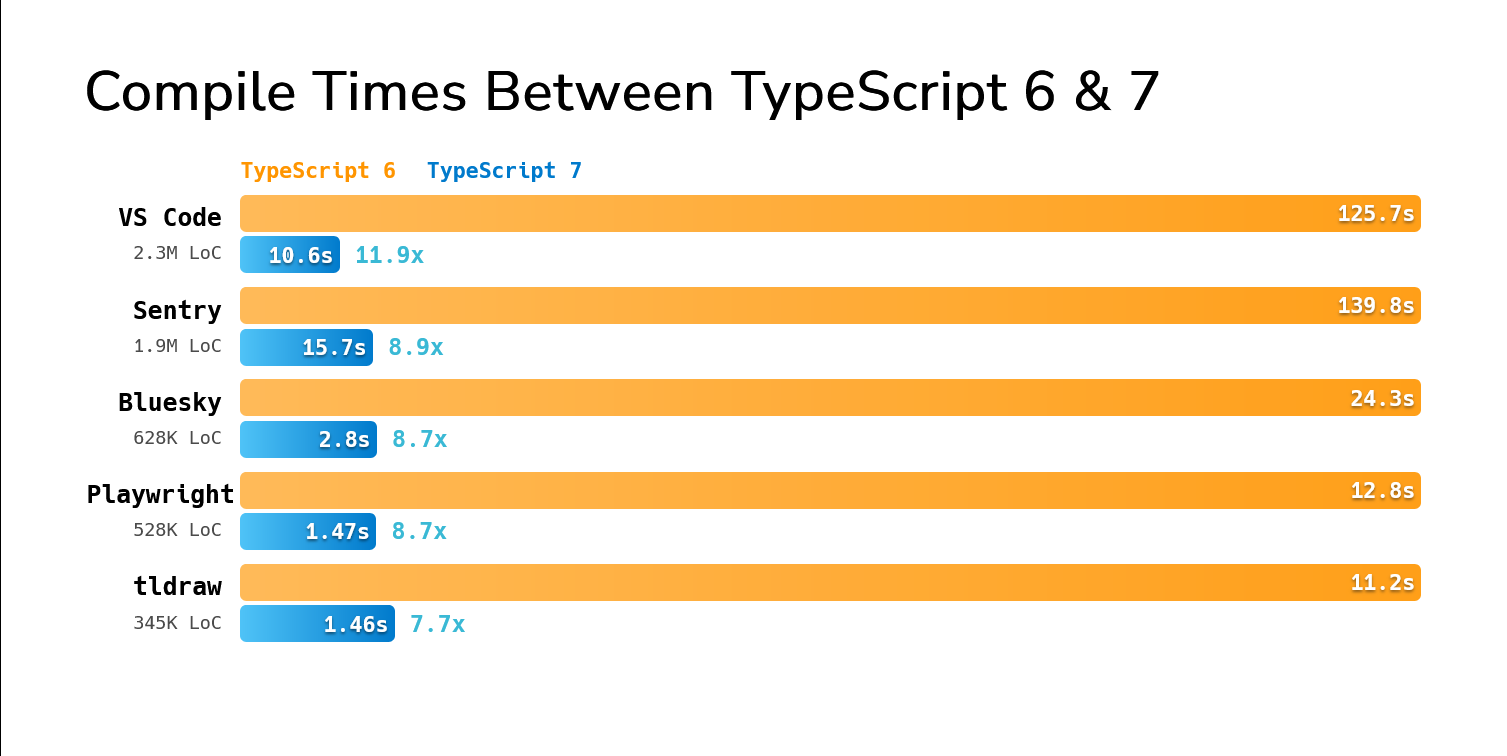
The following table illustrates the reduction in time required for a full cold build:
| Codebase | TypeScript 6 (Seconds) | TypeScript 7 (Seconds) | Speedup Factor |
|---|---|---|---|
| VS Code | 125.7s | 10.6s | 11.9x |
| Sentry | 139.8s | 15.7s | 8.9x |
| Bluesky | 24.3s | 2.8s | 8.7x |
| Playwright | 12.8s | 1.47s | 8.7x |
| tldraw | 11.2s | 1.46s | 7.7x |
The data shows that for a project as massive as Visual Studio Code, a build that once took over two minutes—long enough for a developer to lose focus—now completes in just over ten seconds.
Memory Utilization Improvements
One of the common trade-offs for speed is increased resource consumption. However, the Go-based compiler manages memory more efficiently than the previous Node.js implementation.
| Codebase | TS 6 Memory | TS 7 Memory | Change (%) |
|---|---|---|---|
| VS Code | 5.2 GB | 4.2 GB | -18% |
| Bluesky | 1.8 GB | 1.3 GB | -26% |
| tldraw | 0.6 GB | 0.5 GB | -15% |
The reduction in memory footprint is particularly beneficial for Continuous Integration (CI) environments and developers working on machines with limited RAM, where large TypeScript builds were previously prone to "Out of Memory" crashes.
Official Responses: What a Faster TypeScript Means for Developers
In the official announcement, the TypeScript team emphasized that this update is about more than just numbers; it is about the "human element" of programming.
"A faster TypeScript sounds great on paper, but what does it mean in practice?" the team noted. "It helps to think about where TypeScript comes up at every stage of development. Waiting for your editor to fully load your project will now feel instantaneous. Delays on find-all-references, auto-completion, and diagnostics should take a fraction of the time they used to."
The team highlighted a specific "quality of life" metric: in the VS Code codebase, opening a file with an error previously took 17.5 seconds for the "red squiggle" to appear. In TypeScript 7.0, that time has been slashed to 1.3 seconds—a 13x improvement in feedback latency.
Industry leaders have also weighed in. "This effectively eliminates the ‘compilation tax’ that has plagued large-scale frontend development for years," said one senior software architect. "The tight feedback loop is the holy grail of developer experience, and TypeScript 7.0 delivers it."
Implications: A New Era for Web and Game Development
The ripple effects of TypeScript 7.0 will be felt far beyond simple web applications.
1. The Transformation of CI/CD Pipelines
For enterprise companies, the 10x speedup translates directly into cost savings. CI/CD pipelines that previously ran for 20 minutes per pull request can now potentially finish in under five minutes. This increases deployment frequency and reduces the "idle time" for engineering teams, potentially saving large organizations millions of dollars in compute costs and developer hours.
2. High-Performance Web Graphics and Gaming
The prompt mentions the impact on 2D and 3D game engines. Engines such as Babylon.js, Cocos, and Phaser—which rely heavily on TypeScript for their logic—will see a massive boost in developer productivity. Game development involves frequent iterations and "hot-reloading." With the speed of TypeScript 7.0, developers can see changes in complex 3D scenes almost instantly, bridging the gap between web-based engines and native counterparts like Unity or Unreal.
3. The "Native" Trend in Web Tooling
TypeScript 7.0 solidifies a growing trend: the "Great Migration" of web tooling to native languages. With the core of the ecosystem (the compiler) now written in Go, it is likely that other tools in the stack—linters, bundlers, and test runners—will feel increased pressure to move away from Node.js-based implementations to maintain parity with the compiler’s speed.
4. The Future of the Language
Critics of the move argue that by moving the compiler to Go, TypeScript is no longer "self-documented" for the average JavaScript developer. However, the consensus among the community seems to be that the performance gains far outweigh the loss of "self-hosting" purity. The move signals that Microsoft views TypeScript not just as a language, but as a critical piece of global industrial infrastructure that requires the highest level of performance.
Conclusion
TypeScript 7.0 is a landmark release that addresses the single greatest complaint about the language: its speed. By embracing the irony of using another language to power its own, the TypeScript team has ensured the language’s dominance for the next decade. For developers, the "10x speedup" isn’t just a marketing slogan—it’s a fundamental change in how they will interact with their code every single day. The era of the "compilation coffee break" is officially over.