The Shapeless Codex: Unveiling Jubilex, The Faceless Lord, Harbinger of Total Dissolution
ALEXANDRIA, [Current Date] – In a development that has sent ripples of concern through arcane academies and scholarly circles, a newly compiled codex has brought to light an exhaustive collection of lore concerning one of the most enigmatic and terrifying entities among the dread Galchutt: Jubilex the Shapeless. Known by many ominous titles, including "The Faceless Lord" and "The End of All Forms," this primal entity represents a threat not merely of destruction, but of fundamental unmaking, promising a grotesque form of equality through absolute dissolution.
The release of this comprehensive codex, part of an ongoing series aimed at cataloging the entities of chaos, offers unprecedented insight into Jubilex’s nature, philosophy, and the profound existential terror it embodies. While tales of such primordial horrors often remain confined to forgotten grimoires and hushed whispers, the consolidation of this knowledge into a single, accessible volume underscores the growing need to understand and potentially confront the forces that threaten the very fabric of reality.
Main Facts: A Portrait of Dissolution
Jubilex stands apart even among the horrific pantheon of the Galchutt, distinguished by a philosophy that is as insidious as its physical manifestation is repulsive. The codex meticulously details the core tenets of its existence, its abhorrent form, and the insidious marks it leaves upon the world.
The Philosophy of Formlessness: Equality Through Annihilation
At the heart of Jubilex’s being lies a radical and terrifying philosophy: the belief that all substance, form, and structure are inherently flawed, leading to separation and, consequently, inequality. According to the codex, Jubilex is revered by its adherents as the ultimate agent of dissolution, a force destined to dismantle all distinctions.
"The strictures of society are unjust, and he will unmake them. The limitations of our fated physical form are unfair, and they can be undone," the codex states, summarizing the core dogma. This is not merely a call for revolution or change, but for a complete erasure of individual identity and physical manifestation. In Jubilex’s grotesque vision, the "end of all substance and form" will result in a state where "all things shall be made as one and all things shall be made equal and all things shall be made just."
This chilling promise of ultimate equality through absolute entropy presents a profound challenge to any organized society or belief system. It preys on the innate human desire for fairness, twisting it into a nihilistic pursuit of non-existence, where distinctions of power, wealth, and even biological form are eradicated not by elevation, but by pulverization into a homogenous, shapeless void. Scholars warn that this ideology, however abhorrent, holds a perverse allure for those disenfranchised or burdened by their existence, making Jubilex a spiritual as well as a physical threat.
Manifestation: The Slime of All Ends
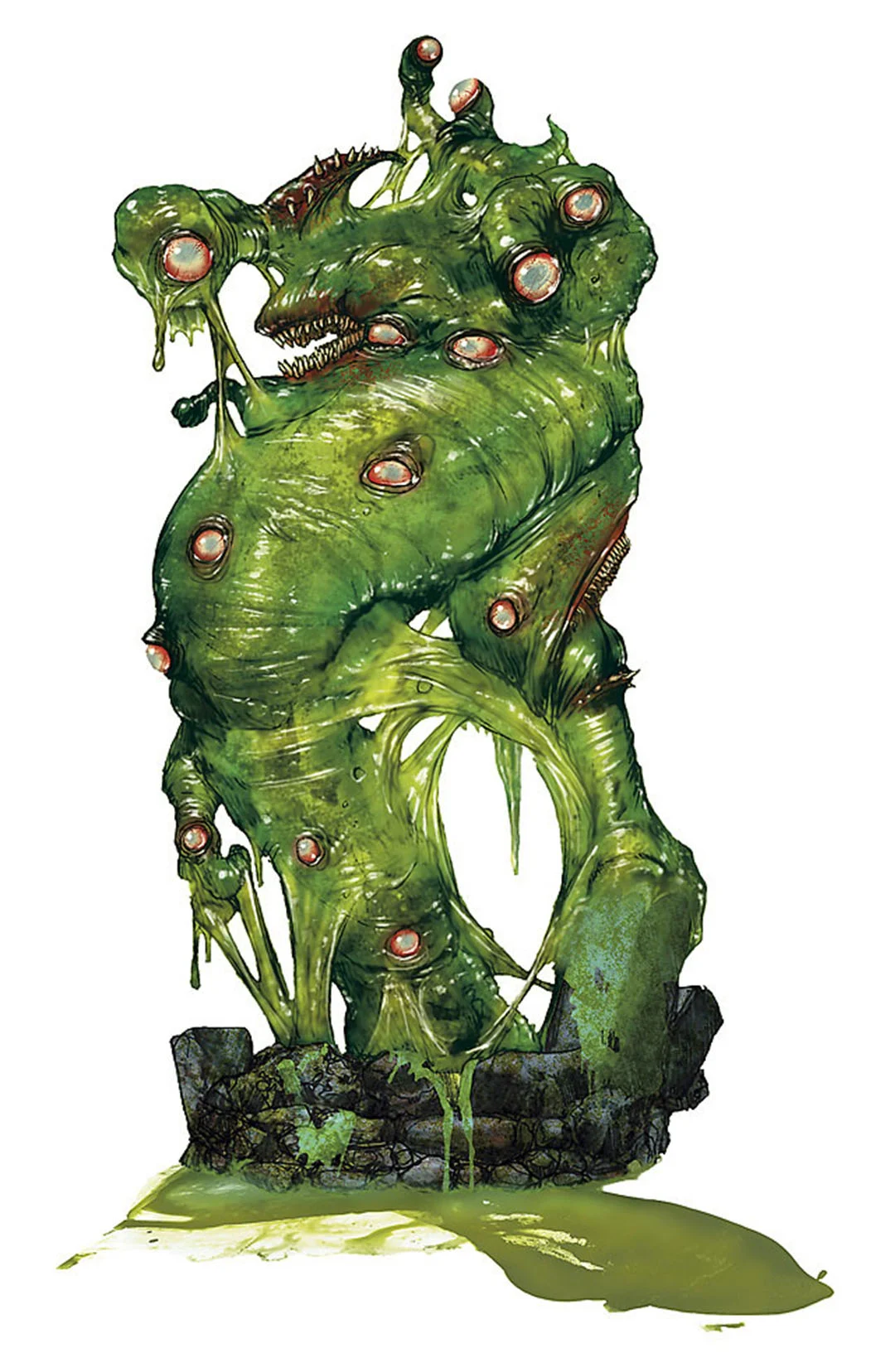
The physical manifestation of Jubilex is described in the codex with vivid, nauseating detail. It is a being of pure slime and ooze, a grotesque mockery of life that defies conventional understanding of form. Its very presence is said to inspire an innate revulsion, so potent that even other Galchutt, beings of immense evil and chaos, reportedly shun it.
"Its foul and nauseating body is without set form," the codex elaborates, painting a picture of an entity constantly in flux. It can appear as an impossibly vast, stagnant pool of putrid goo, spreading like an unstoppable contagion, or it can coalesce, rising into a towering column of "disgusting ordure." This fluidity underscores its fundamental nature as the "End of All Forms," constantly demonstrating its ability to defy and unmake any fixed shape.
While amorphous, ancient texts and eyewitness accounts, now compiled, frequently describe a more specific, albeit equally repulsive, recurring manifestation. Many texts depict Jubilex as a tall, cone-like heap, its surface grotesquely "striated in disgusting blackish-greens, foul browns and yellows, and sickly translucent grays and ambers." This vile palette further emphasizes its association with decay, corruption, and the putrescence of unmaking, an anti-life force that consumes and transforms all into its own repulsive essence. The sheer sensory assault of its appearance—the viscous texture, the putrid colors, the implied stench—is designed to overwhelm and break the spirit before any physical confrontation can even begin.
The All-Seeing Red Eyes: Glimpsing Creation and Annihilation
Regardless of the particular form Jubilex assumes, one feature remains constant and universally noted across all lore: the presence of "pulsating, red eyes that look in all directions from his undulating form." These eyes are not merely organs of sight; they are portals to a terrifying cosmic perception.
The codex reveals that these crimson orbs are said to "see the making and unmaking of all things." This unique ability implies a profound connection to the fundamental processes of creation and destruction, suggesting Jubilex possesses a panoramic awareness that transcends linear time and conventional causality. It is theorized that these eyes allow Jubilex to perceive the inherent structures and forms of existence, enabling its insidious work of dissolution. To gaze into these eyes, it is whispered, is to witness the fragile impermanence of all things, to see one’s own form dissolve into the primordial soup from which it arose, accelerating the psychological breakdown of any observer. They are the ultimate instrument of its philosophy, observing the dance of creation and the inevitable march towards its own desired state of formless unity.
The Effluence of Chaos and Its Lingering Scars
Jubilex’s destructive influence extends beyond its direct physical presence through a vile byproduct: "the verdigris ichorous" that it continually "spews forth." This effluence is not merely waste; it is a potent manifestation of its essence, a corrosive agent of unmaking that leaves lasting scars on the world.
Described as a "green, slimish ichor," these remnants are said to "still lurk in the dark places of the world." Their properties are deeply antithetical to life and vitality: they "shun forever sources of light and heat," which are "anathema to it." This aversion to fundamental forces of life suggests a deep-seated opposition to creation itself. The ichor acts as a slow-acting poison, contaminating environments, warping natural laws, and slowly degrading any matter it comes into contact with. Areas afflicted by this ichor become blighted zones, shunned and feared, where life struggles to take hold and existing forms are gradually reduced to their constituent, unstable elements. The persistent nature of this effluence means that even after Jubilex’s retreat or dormancy, its corrupting influence can linger for centuries, a festering wound in the fabric of reality.
Servants of Entropy: The Darkness Given Hunger
Jubilex is not entirely alone in its mission of dissolution; it is served by a terrifying entity known as "The Darkness Given Hunger." This creature is described as a "black and pulsing creature of nether destruction," an embodiment of pure, consuming void, loyal to its formless master.
The origins of The Darkness Given Hunger are subject to conflicting accounts within the compiled texts, hinting at the elusive nature of such primordial beings. Some records suggest it was "ripped from the depths of the Formless Form," implying it was exuded directly from Jubilex’s own undulating body, a living extension of its will. Other theories propose its creation through a "demonic infusion," suggesting a deliberate act of dark alchemy or pacts with other infernal powers. A third, equally chilling account postulates that it was "independently spawned in stygian pits of ever-dark," hinting at a primordial lineage separate yet aligned with Jubilex’s nihilistic goals.
Regardless of its true origin, The Darkness Given Hunger serves as Jubilex’s active agent, a mobile force of entropy capable of enacting its master’s will across the planes. It represents the active, predatory aspect of unmaking, capable of direct destruction and the spread of chaos where its master’s ooze might not yet reach. Its very existence is a testament to Jubilex’s power to not only dissolve but also to create entities dedicated to its abhorrent cause.
Chronology: Tracing the Whispers of Annihilation
The history of entities like Jubilex is not a linear march of events but a fragmented tapestry woven from ancient myths, forgotten prophecies, and the occasional, terrifying re-emergence. The newly compiled codex attempts to piece together this elusive chronology, revealing a pattern of ancient influence, periods of dormancy, and the unsettling stirrings of modern interest.
Ancient Terrors and Forgotten Texts
The earliest mentions of Jubilex place it firmly within the pre-history of the cosmos, a contemporary of the other Galchutt, predating most mortal civilizations. Legends from primordial eras speak of a time when the universe was less defined, and the boundaries between form and formlessness were dangerously thin. It is in these mythic epochs that Jubilex is believed to have first manifested its dreadful presence, actively working to prevent the solidification of creation, or to unmake nascent forms as they emerged.
Early cryptic fragments, unearthed from the ruins of civilizations long turned to dust, describe "the creeping blight" or "the consuming void" that would seep into the foundations of reality. These texts, often penned by hermetic scholars or despairing priests, offer veiled warnings of a shapeless terror that sought to reclaim all existence into a unified, undifferentiated state. Prophecies from these periods often alluded to a "great equalizing," misinterpreted by some as a golden age, but understood by the truly wise as the cessation of all distinct being. Knowledge of Jubilex, therefore, has long been preserved in fragmented oral traditions, forbidden grimoires locked away in secure vaults, and the desperate, often mad, scribblings of those who encountered its influence.
Periods of Dormancy and Resurgence
Like many primordial evils, Jubilex is not believed to be a constantly active force. The codex suggests that its history is punctuated by vast periods of dormancy, perhaps due to the ebb and flow of cosmic energies, or due to concerted efforts by ancient entities of order to contain its influence. During these "Great Slumbers," knowledge of Jubilex would fade into obscure myth, its ichor receding to the deepest, darkest corners of the world, its cults dwindling into isolated, forgotten pockets.
However, these periods of quietude are invariably followed by unsettling resurgences. The codex points to cyclical patterns, often coinciding with moments of great societal upheaval, existential despair, or the weakening of dimensional barriers. During these times, the "Slime of All Ends" would stir, its ichor spreading anew, and the whispers of its nihilistic philosophy would begin to corrupt susceptible minds. These resurgences are rarely heralded by overt displays of power; rather, they begin subtly, with unexplained disappearances, strange environmental contaminations, and a pervasive sense of dread creeping into the collective consciousness. The codex cites several historical periods where documented "blights of formlessness" or "epidemics of despair" align eerily with the projected cycles of Jubilex’s awakening.
Modern Re-emergence and Scholarly Interest
The compilation of the current codex itself signifies a modern re-emergence of Jubilex’s influence, or at least a heightened awareness of its potential threat. Arcane researchers and historical archivists have noted an increase in fragmented reports and anomalous phenomena that bear the hallmarks of Jubilex’s activity. The decision to gather and synthesize centuries of disparate lore into a single, accessible volume is a direct response to this perceived resurgence.
This contemporary effort marks a shift from mere archival preservation to active study and dissemination. The goal is not just to understand Jubilex for academic purposes but to arm those who might one day stand against it. This new codex serves as a critical resource for contemporary scholars, diviners, and even adventurers, providing the most comprehensive understanding of the entity available in modern times, signaling that the threat of the Faceless Lord is no longer a matter of ancient history, but a pressing concern for the present and future.
Supporting Data: The Lorebook’s Context and Scholarly Insights
The "Shapeless Codex" is not an isolated work but a crucial component of a larger initiative, offering valuable insights not only into Jubilex but also into the very process of world-building and narrative enrichment within complex fantasy settings.
The Alexandrian’s "Chaos Lorebooks" Initiative
This particular codex is presented as part of "Chaos Lorebooks," a broader project originating from the esteemed Alexandrian archives. This initiative is dedicated to systematically compiling and detailing the vast and often contradictory lore surrounding entities of chaos, particularly the Galchutt and other primordial threats that defy conventional understanding. The aim is to create a comprehensive library of knowledge, making obscure and scattered information accessible to those who need to understand the true nature of these existential dangers.
The "Chaos Lorebooks" project serves a dual purpose: it enriches the fictional universe by providing depth and consistency to its most terrifying antagonists, and it offers practical tools for storytellers and game masters to integrate these entities into their narratives. By meticulously detailing the powers, philosophies, and histories of such beings, the initiative transforms vague threats into tangible, multifaceted adversaries, enhancing the sense of dread and complexity within the setting.
The "Campaign Stitch" and Narrative Integration
A significant aspect highlighted in the design notes accompanying the codex is the concept of the "campaign stitch." This methodology, detailed by the Alexandrian, involves adapting existing published adventures or lore and seamlessly integrating them into an ongoing campaign narrative. The inclusion of Jubilex into the ranks of the Galchutt, for instance, was partly driven by the practical need to adapt a published adventure featuring the entity into a "Ptolus campaign."
This approach demonstrates how existing material, even if originally conceived for a different context, can be creatively re-contextualized to enrich a bespoke world. By "stitching" Jubilex into the Galchutt mythos, the entity gains immediate lineage and a predefined role within a larger cosmological framework. This not only expands the number of known Galchutt but also provides a concrete example of how world-builders can leverage external content to deepen their own narratives, creating a more robust and interconnected fictional reality. The success of such a "stitch" lies in making the adapted content feel organic and essential to the existing world, rather than a tacked-on element.
Comparative Analysis with Other Galchutt: A Spectrum of Chaos
While the codex focuses on Jubilex, its integration into the Galchutt pantheon invites comparative analysis with other known entities of this dread lineage. The Galchutt, as a collective, represent primordial chaos, often embodying fundamental destructive principles. However, their methods and ultimate goals can vary significantly.
For instance, some Galchutt might embody raw, indiscriminate destruction, seeking to shatter and obliterate through force. Others might represent corruption and manipulation, twisting existing forms into monstrous parodies. Jubilex, however, offers a unique vector of threat: the dissolution of form itself. Its goal is not mere destruction or corruption, but the eradication of distinctness, the return to a primordial, undifferentiated state. This places Jubilex at the extreme end of the entropic spectrum, an entity that seeks to undo the very act of creation by eradicating the concept of individual form. This philosophical distinction makes Jubilex a particularly insidious threat, as it targets not just life or order, but the fundamental principles of identity and differentiation that underpin existence. Understanding these nuances allows for a more sophisticated appreciation of the diverse threats posed by the Galchutt.
Official Responses and Esoteric Warnings
Given the profound and existential nature of the threat posed by Jubilex, various scholarly and arcane institutions have taken notice, issuing both official pronouncements and esoteric warnings to safeguard against its insidious influence.
The Sages of Xylos and the Arcane Orders
The esteemed Sages of Xylos, a venerable collective of arcane scholars and planar geographers, have been at the forefront of studying entities like Jubilex. Their initial response to the compiled codex has been one of grave concern, emphasizing the need for meticulous observation and, where possible, containment. While direct confrontation with a Galchutt is often deemed suicidal, the Sages advocate for proactive measures to understand its cycles of activity and to identify potential points of ingress or influence.
Parallel to the Sages, various arcane orders, such as the Veiled Sentinels and the Keepers of the Cosmic Balance, have issued internal directives. These orders, dedicated to protecting the fabric of reality, have long monitored signs of primordial unrest. Their warnings primarily focus on the insidious nature of Jubilex’s ichor, advising strict protocols for handling suspected contaminated materials or environments. They also highlight the danger of the philosophical allure of Jubilex, cautioning against texts or individuals espousing the "equality through unmaking" doctrine, which they identify as a gateway to nihilistic cults. Their response is characterized by a blend of scholarly rigor and practical, defensive magic, seeking to understand the threat while simultaneously bolstering spiritual and material defenses against it.
Theological and Philosophical Rebuttals
The emergence of a coherent understanding of Jubilex’s philosophy has also provoked strong reactions from established theological and philosophical schools of thought. Most mainstream religions, which often posit a divine creator and the inherent value of individual life and form, find Jubilex’s tenets utterly anathema. The concept of "equality through unmaking" is seen as a perversion of justice and a direct assault on the sanctity of creation.
Theological scholars from institutions like the Grand Cathedral of Aethel and the Temples of the Celestial Weave have issued treatises condemning Jubilex’s nihilistic vision. They argue that true equality lies in the recognition and celebration of diverse forms and individual worth within a benevolent cosmic order, not in their eradication. Philosophers, particularly those advocating for existentialism or humanism, counter Jubilex’s promise by emphasizing the inherent meaning and purpose found in individual striving, self-definition, and the unique experiences afforded by distinct form. They warn that surrendering to Jubilex’s vision is not liberation, but a capitulation to oblivion, a denial of the very essence of being. These intellectual and spiritual rebuttals form a crucial bulwark against the ideological corruption that Jubilex seeks to spread, offering alternative frameworks for understanding justice and purpose.
Implications: The Shadow of Formlessness over the World
The implications of Jubilex’s existence and its potential resurgence are profound, extending far beyond mere physical threat to challenge the very foundations of civilization, identity, and reality itself.
Existential Threats to Civilization
Jubilex’s core philosophy—the dissolution of structure and form—poses an existential threat to all organized civilization. Society, by its very definition, relies on established structures: laws, hierarchies, communal agreements, and shared identities. Jubilex’s influence seeks to unravel these fundamental threads, promising a chaotic "equality" achieved by stripping away all differentiation. Should its influence grow unchecked, the consequences would be catastrophic: the collapse of governance, the erosion of social cohesion, and the descent into a primordial state where individual identity holds no meaning. This is not merely societal breakdown; it is the philosophical justification for total anarchy and the eradication of the very concept of community. The ultimate victory of Jubilex would mean the end of all distinct cultures, histories, and individual narratives, dissolving them into a featureless, undifferentiated void.
Cults of the Shapeless and Agents of Entropy
The insidious promise of "equality through unmaking" holds a perverse allure, particularly for those who feel marginalized, oppressed, or burdened by their individual forms and societal roles. This ideological vulnerability fuels the formation of "Cults of the Shapeless," dedicated to hastening Jubilex’s agenda. These cults are not necessarily violent in the conventional sense, but rather work towards dismantling order, encouraging anarchy, and spreading the corrosive ichor of their master. Their methods might include sabotage, psychological warfare aimed at eroding faith in institutions, and the ritualistic unmaking of objects and even individuals, all in the name of a grotesque "liberation."
The "Darkness Given Hunger" serves as a crucial active agent for these cults, a harbinger of nether destruction that can be summoned or directed to accelerate the unmaking process. These creatures act as mobile vectors of entropy, embodying the consuming void that Jubilex champions. The threat of these cults is not merely their numbers, but their ideological fervor and their willingness to embrace total nihilism, making them exceptionally dangerous and difficult to counter through conventional means.
Environmental Contamination and Aberrant Zones
The constant "spewing forth" of Jubilex’s "verdigris ichorous" represents a persistent environmental threat. These remnants, which shun light and heat, create blighted zones where natural laws begin to fray. Areas saturated with this ichor become "aberrant zones," where plant life withers, animals sicken or mutate grotesquely, and the very ground itself loses cohesion. Such zones are pockets of anti-life, slowly expanding and corroding the healthy environment around them. They serve as tangible manifestations of Jubilex’s influence, physical scars on the world that reflect its desire to reduce all form to a state of undifferentiated, corrupted slime. These areas can also serve as conduits for Jubilex’s power, weakening the veil between dimensions and allowing its influence to seep further into reality.
The End of All Forms: A Philosophical Dread
Ultimately, the most profound implication of Jubilex is the philosophical dread it inspires. Its existence and aims challenge not just physical life, but the very concept of being. The "End of All Forms" is not merely death; it is the cessation of individuality, of distinction, of purpose. It is the ultimate annihilation of self, reducing everything unique and beautiful into a homogenous, repulsive nothingness. This fundamental assault on identity makes Jubilex a terror unlike many others, for it seeks to erase the very meaning of existence, leaving behind only the cold, indifferent, shapeless void. The compiled codex serves as a stark warning, urging vigilance against an entity that promises a horrific form of peace through total, irreversible non-being. The fight against Jubilex is not just a battle for survival, but a struggle for the preservation of identity, meaning, and the very concept of form itself.