The Giants Among Us: Ella & Pitr’s Monumental Murals and the Reimagining of Urban Space
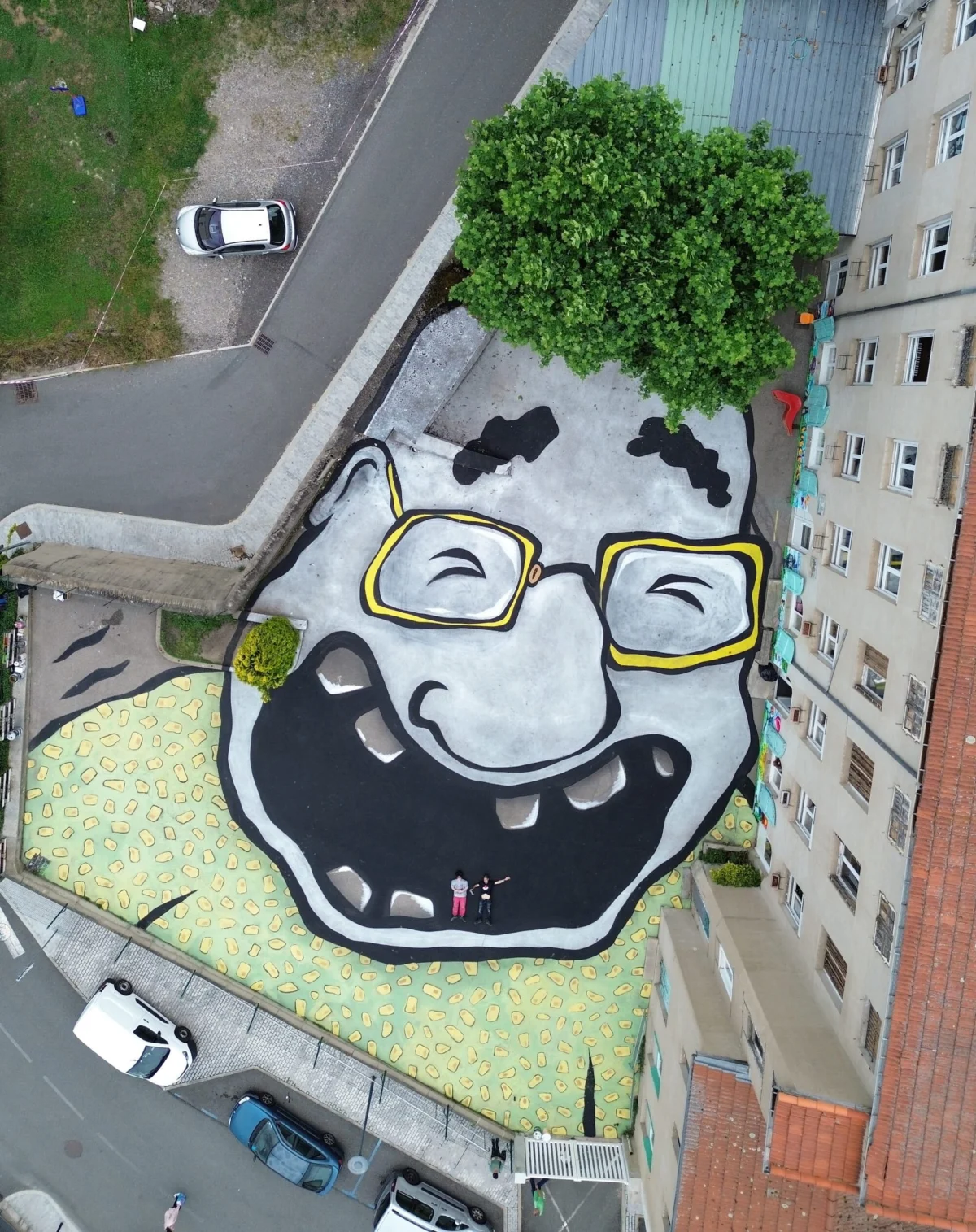
In the sprawling concrete landscapes of modern cities, where gray bitumen and functional architecture often stifle the human spirit, a French duo is reclaiming the urban narrative one giant at a time. Ella & Pitr, the Saint-Étienne-based artists renowned for their "Colosses" (Giants), have spent the better part of two decades transforming rooftops, public squares, and abandoned runways into canvases for massive, slumbering, or laughing figures. Their work, which can often only be fully appreciated from the heavens, serves as a poignant reminder of the humanity tucked away in the corners of our industrial world.
As the duo prepares for their upcoming solo exhibition, Points de Suspension, at Galerie Jonathan Roze in Rennes, France, the art world is once again turning its gaze toward their unique blend of street art, social commentary, and anamorphic play. This exhibition marks a significant moment in their career, transitioning the scale of their monumental outdoor interventions into the intimate setting of a gallery, while maintaining the emotional gravity that has made them a global phenomenon.

Main Facts: The Scale of Joy and Resilience
Ella & Pitr’s work is defined by its sheer, staggering scale. While many street artists vie for eye-level attention on brick walls, this duo looks to the ground and the sky. Their murals frequently span thousands of square meters, utilizing rooftops, parking lots, and even expansive playing fields as their medium.
The subjects of these murals are rarely the heroic figures found in classical monuments. Instead, Ella & Pitr focus on the "invisible" members of society: the elderly, the homeless, and refugees. These figures are often depicted in states of quietude—sleeping, dreaming, or simply passing time. By rendering marginalized individuals as giants, the artists flip the social script; those who are usually overlooked by passersby become so large that they cannot be ignored, even if their presence requires a drone or a satellite to be fully perceived.

The upcoming exhibition, Points de Suspension, promises to explore these themes through a more concentrated lens. The title itself—referring to the ellipsis in French—suggests a pause, a moment of breath, or an unfinished thought, echoing the "suspended" state of the figures in their murals.
Chronology: From the Streets of Saint-Étienne to Global Renown
The partnership between Ella and Pitr began in 2007 in Saint-Étienne, a city with a rich industrial history that provided the perfect backdrop for their early experiments.

- 2007–2010: The Formative Years. The duo began by pasting paper drawings on the walls of their hometown. These early works already showcased their signature "cartoonish" yet emotionally resonant style, characterized by thick black outlines and a limited, high-contrast color palette.
- 2013: The Birth of the Giants. Seeking more space, the duo transitioned from vertical walls to horizontal surfaces. They realized that the "fifth facade" of a building—the roof—offered an untapped canvas. This led to the creation of their first massive sleeping figures, designed to be seen from the hills surrounding the city or by pilots flying overhead.
- 2015: Breaking Records in Norway. Ella & Pitr gained international headlines for "Lilith and Olaf," a 21,000-square-meter mural painted for the Nuart Festival in Stavanger, Norway. At the time, it was the largest outdoor mural in the world, depicting a curled-up woman dropping a small king from her hand.
- 2017: The Refugee Crisis. In a more overtly political turn, the duo created a massive mural in France depicting a refugee seeking passage. This work solidified their reputation not just as muralists, but as social advocates using public space to demand empathy for those in transit.
- 2019: The Paris Rooftop Project. Atop the Paris Expo Porte de Versailles, the duo completed a 2.5-hectare mural—the largest in Europe—featuring an elderly grandmother (Le Naufrage de Verone) being swept away by a sea of cars.
- 2024: Points de Suspension. The current year sees them focusing on internalizing their message, bringing the "suspension" of their giant figures into the gallery space in Rennes, bridging the gap between public intervention and fine art.
Supporting Data: The Technicality of Perspective
The impact of Ella & Pitr’s work is rooted in technical precision and the clever use of anamorphic perspective. Because their "canvases" are often uneven—curving around fountains, wedging into parking stalls, or spanning multiple buildings—the artists must calculate how a figure will look from a specific aerial vantage point.
- Surface Diversity: Their work has been documented on bitumen, grass, sand, and roof membranes. Each surface requires different paint compositions to ensure longevity and color vibrance against the elements.
- The Drone Revolution: Before the widespread availability of commercial drones, Ella & Pitr relied on high-altitude photography and intuition. The integration of drone technology has allowed them to refine their proportions, ensuring that a giant’s arm or leg correctly "folds" over an urban obstacle when viewed from above.
- Symbolic Posture: A recurring data point in their portfolio is the "fetal position." By curling their giants into balls, the artists allow the figures to fit into cramped urban spaces (like small courtyards), symbolizing the way society "cramps" the lives of the marginalized.
Official Responses and Critical Reception
The response to Ella & Pitr’s work from municipal authorities and the art world has been overwhelmingly positive, though not without the logistical hurdles inherent in large-scale public art.

Municipal Collaboration: Unlike many "guerrilla" street artists, Ella & Pitr often work with city planners. In Saint-Étienne and Paris, officials have praised the duo for revitalizing "dead zones" within the city. By painting on rooftops or neglected lots, they provide a sense of identity to neighborhoods that might otherwise feel anonymous.
Art Critics’ View: Critics often highlight the duo’s ability to balance the grotesque with the tender. Art historian and critic Paul Ardenne has noted that their work functions as a "humanization of the infrastructure." By placing a sleeping grandfather on a cold, asphalt parking lot, they inject a sense of vulnerability into a space designed for machines.

Public Reaction: Residents of buildings featuring their murals often report a sense of "guardianship." There is a psychological comfort in knowing a giant is "sleeping" on your roof, a whimsical protection that fosters community pride and turns local residents into the custodians of the artwork.
Implications: Art as Urban Empathy
The work of Ella & Pitr has profound implications for the future of urban planning and the role of art in social justice.

1. Visibility for the Invisible
By choosing refugees and the elderly as their "giants," Ella & Pitr force a confrontation with ageism and the global migration crisis. In a world that prizes youth and productivity, their giants are often idle—sleeping, laughing, or dreaming. This challenges the capitalist notion that a person’s value is tied to their utility. Their work suggests that even in a state of "suspension" or rest, a human being is monumental.
2. The "Fifth Facade" and Urban Greenery
Their focus on rooftops has opened up a dialogue about the "fifth facade" of cities. As urban areas become more crowded, the use of roofs for art, gardens, and community spaces becomes vital. Ella & Pitr have shown that these forgotten spaces can be transformed into cultural landmarks without requiring expensive structural renovations.

3. The Gallery Transition
The Points de Suspension exhibition at Galerie Jonathan Roze signifies a shift in how street art is preserved. While their outdoor murals are temporary—subject to weather, urban redevelopment, and the wear of time—their gallery work allows for a permanent record of their philosophical inquiries. It poses the question: can the "eccentric joy" of a 20,000-square-meter mural be captured on a canvas?
Conclusion
Ella & Pitr have redefined the boundaries of street art, moving beyond the "tag" or the "mural" into the realm of landscape intervention. Their giants are not just paintings; they are placeholders for the human soul in an increasingly mechanized world. Whether it is a refugee seeking passage or an elderly woman laughing in a courtyard, these figures remind us that every individual carries a weight and a history that is, in its own way, monumental.

As Points de Suspension opens in Rennes, it offers a rare opportunity to see the minds behind the giants up close. In the silence of the gallery, the "suspension" of their characters becomes a mirror for our own lives—a reminder to pause, to breathe, and to recognize the giants walking (or sleeping) among us.
Exhibition Details:
- Points de Suspension
- Artists: Ella & Pitr
- Location: Galerie Jonathan Roze, Rennes, France
- Further Information: Available via the artists’ Instagram and the gallery’s official website.