Re-entering the "Weird": H.G. Wells’ The Island of Doctor Moreau and the Dawn of Modern Horror
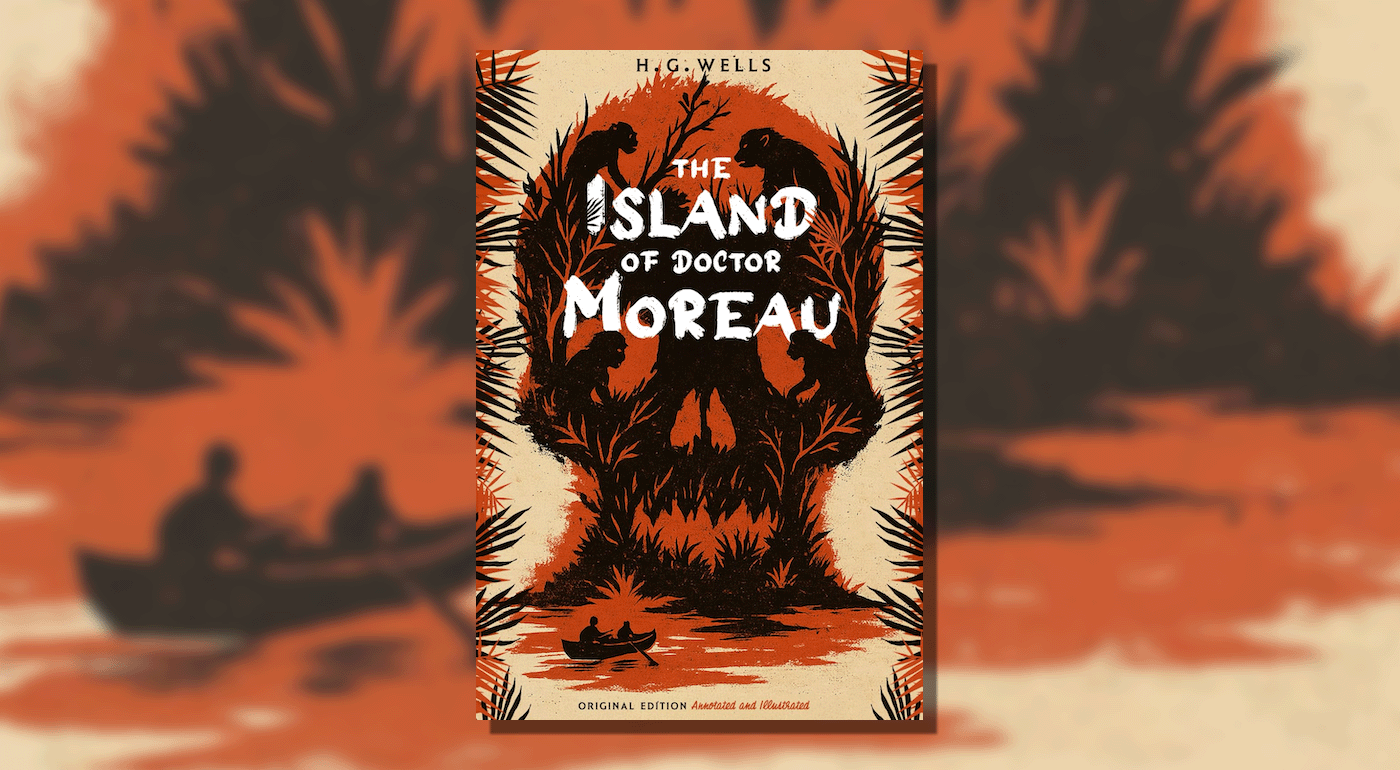
Welcome back to "Reading the Weird," the column where we delve into the unsettling depths of weird fiction, cosmic horror, and Lovecraftiana, tracing its lineage from historical roots to contemporary branches. This week, our journey into the macabre begins with H.G. Wells’ seminal work, The Island of Doctor Moreau, examining its initial chapters (1-3) and the chilling stage they set. First published in 1896, this novel quickly established itself as a landmark in science fiction and a provocative commentary on humanity’s place in the natural world. Spoilers for these opening chapters are, naturally, ahead.
H.G. Wells, a titan of early science fiction, penned The Island of Doctor Moreau at a time of profound scientific and social upheaval. The late Victorian era was grappling with the implications of Darwinian evolution, the ethics of scientific experimentation, and the very definition of what it meant to be human. Wells, ever the visionary and social critic, seized upon these anxieties to craft a narrative that was not only a thrilling adventure but also a deeply disturbing philosophical inquiry. The novel’s initial reception was, to put it mildly, explosive, cementing its reputation as a work that dared to confront society’s most uncomfortable truths.
The Unveiling: Plot Synopsis of Chapters 1-3
The narrative is framed as a posthumous account, discovered and presented by Edward Prendick’s nephew, Charles Prendick. Charles, finding his uncle’s papers detailing a horrifying ordeal, believes it is his duty to share this "strange story" with the public, hinting at the profound impact it had on Edward and, by extension, the world. This framing device immediately lends an air of authenticity and urgency to the fantastical events that are about to unfold.
A Legacy Revealed: Charles Prendick’s Preface
Charles Prendick introduces his uncle Edward Prendick’s startling account, detailing the events that transpired after the shipwreck of the Lady Vain on February 1, 1887, somewhere in the vast and unforgiving South Pacific. Discovered among Edward’s personal effects, the manuscript offers no explicit instructions for its publication. However, Charles, sensing the profound significance and perhaps the inherent desire of his late uncle to disseminate this extraordinary tale, takes it upon himself to bring the narrative to public light. His preface serves as an initial anchor, grounding the reader in a semblance of reality before plunging into the bizarre and terrifying. The implication is clear: what follows is not mere fiction, but a harrowing testament to human endurance and the unraveling of sanity in the face of the unknown.
Chapter I: Survival and Savagery on the Lady Vain
Edward Prendick begins his account by acknowledging the widely known tragedy of the Lady Vain, a vessel that, ten days out from Callao, Peru, fatally collided with a derelict ship. While seven crewmembers managed to survive for eighteen days in a longboat before their rescue, Edward’s own story unfolds within the confines of a smaller dingey. Four men initially escaped in this smaller craft, but Edward starkly states that only three made it aboard – himself, a fellow passenger named Helmar, and an unnamed seaman. The fourth, presumably, perished in the immediate aftermath of the collision.
The descent into desperation is swift and brutal. With food and water quickly depleted, the three survivors languish under the relentless sun. On the seventh day, driven by Helmar’s grim suggestion, they resort to the ultimate act of survival: drawing lots to determine who among them will be sacrificed to sustain the others. The unnamed seaman draws the short straw, but his will to live is stronger than his acceptance of fate. A desperate struggle ensues between him and Helmar. Before Edward, weakened and perhaps morally paralyzed, can intervene, the two combatants fall overboard, sinking together into the vast, indifferent ocean.
Left utterly alone, Edward succumbs to extreme weakness, barely registering the approach of a sail. He watches listlessly, too far gone to signal for help. His memory of rescue is fragmented and dreamlike: a boat alongside, being carried up a gangway, and a fleeting, nightmarish glimpse of "a dark face, with extraordinary eyes." Oblivion then claims him, marking the end of his ordeal at sea and the beginning of a far more sinister journey. This opening chapter masterfully strips away the veneer of civilization, showing how quickly humans can regress to primal savagery under extreme duress.
Chapter II: Rescue and Enigma aboard the Ipecacuanha
Edward awakens to a stark, small cabin, disoriented and weak. A youngish man, flaxen-haired with a perpetually "dropping nether lip" and "watery grey eyes," watches over him. This is Montgomery, who introduces himself as a medical man and reveals that Edward is aboard the Ipecacuanha. The ship, he explains, is captained by its perpetually inebriated owner, Davies. From overhead, a disturbing cacophony permeates the cabin: the sounds of metal scraping, angry growling, and the insistent howling of dogs. When Montgomery shouts up, a response comes only in unintelligible gibberish, adding to the unsettling atmosphere.
Edward, with a concise frankness born of his recent trauma, recounts his harrowing tale. He reveals his financial independence, which allows him to pursue his passion for Natural History—a detail that will become ironically poignant later. Montgomery, in turn, offers a brief, enigmatic glimpse into his own past, admitting to having been a medical student in London until he "made a young ass of [himself] — played [himself] out before [he] was twenty-one." His vague confession hints at a shadowed history, suggesting a man who has fled a past disgrace.
As Edward slowly regains strength, he dresses in borrowed clothes. Montgomery informs him of the ship’s trajectory: ostensibly bound for Hawaii, but with a planned stop to drop Montgomery off at an unnamed island where he resides. The casualness of this revelation, coupled with the ship’s peculiar cargo and Montgomery’s guarded demeanor, creates an immediate sense of unease and foreboding.
Chapter III: The First Glimpse of the Grotesque
Leaving their cabin, Edward and Montgomery attempt to ascend to the deck, but their path is blocked by a figure on the ladder. This individual is profoundly misshapen: "short, broad and clumsy, with a crooked back and a head sunk between his shoulders." Dressed in blue serge, his "peculiarly thick, coarse, black hair" frames a face that, when he turns "with animal swiftness," profoundly shocks Edward. It is "singularly deformed," its lower half projecting like a muzzle, revealing a huge mouth filled with big white teeth. Hazel irises gleam within nearly whiteless, bloodshot eyes, burning with "curious excitement." The visage is grotesquely ugly, yet Edward feels an unsettling half-recognition, later realizing it was the nightmare face he glimpsed during his rescue. More disturbingly, he swears he has seen such a countenance even before his shipwreck, hinting at a suppressed memory or an archetypal horror.
Montgomery chastises the man, demanding he return to his place forward. The creature cowers, speaking hoarsely, "They won’t have him forward." He retreats below as Edward and Montgomery climb to the schooner’s deck. The scene above is chaotic and squalid: littered with food scraps and filth, muzzled staghounds are chained to the mainmast, barking furiously. Nearby, tightly-caged animals—a puma and a llama—are held alongside hutches of rabbits, creating a bizarre menagerie. A lone sailor mans the wheel, seemingly oblivious to the unsettling cargo.
Suddenly, propelled by a "volley of furious blasphemy," the black-faced man dashes onto the deck, pursued by a heavy, red-haired individual who knocks him down amidst the snarling dogs. The black-faced man staggers, frantic pawing threatening him. Montgomery intervenes, confronting his attacker, who is revealed to be Captain Davies. Davies, drunk and laughing, curses Montgomery as a "blasted sawbones," demanding he leave "his man" alone. Davies rages against Montgomery’s "infernal island" and his "lunatic of an attendant," complaining about the disruption and filth his cargo has brought to his otherwise "clean, respectable ship."
Montgomery stands his ground, his "pertinacious temper" evident. Before a full scuffle can erupt, Edward intervenes, drawing Davies’s ire onto himself. Davies, dismissing Prendick as "a bit of human flotsam" who has paid no fare, unleashes a torrent of insults. Despite the verbal lashing, Edward is relieved to have defused Montgomery’s anger, perceiving it as a slow-burning, dangerous rage that, once ignited, would "never again cool to forgiveness." The chapter concludes with the uneasy alliance of Prendick and Montgomery firmly established, sailing towards an island shrouded in mystery and populated by an increasingly bizarre cast of characters and creatures. The significance of the ship’s name, Ipecacuanha, an emetic root, serves as a dark foreshadowing of the horrors that are destined to be purged, or perhaps induced, on their destination.
Supporting Data and Thematic Undercurrents
Wells’ opening chapters are not merely a thrilling adventure but a carefully constructed foundation for a profound exploration of scientific ethics, human nature, and the thin veneer of civilization. The immediate context of the novel’s publication in 1896 is crucial for understanding its shock value and enduring power.
The Victorian Context: Science, Society, and Savagery
- Darwinism and Degeneration: The latter half of the 19th century was profoundly shaped by Charles Darwin’s On the Origin of Species (1859). The concept of evolution, while revolutionary, also sparked anxieties about "degeneration" – the fear that humanity could regress, physically and morally, to a more primitive state. The Island of Doctor Moreau taps directly into this societal unease, presenting a terrifying vision of deliberate de-evolution and the blurring of species boundaries. The very existence of the "ape-man" and the implied experiments challenge the perceived hierarchy of life, forcing Victorians to confront their own animalistic origins and potential future.
- The Vivisection Debate: Perhaps the most direct real-world inspiration for Moreau‘s horror was the intense and highly emotional debate surrounding vivisection (animal experimentation) in Victorian Britain. Animal welfare advocates fiercely opposed the practice, viewing it as cruel and immoral, while medical researchers defended it as essential for scientific progress. Wells’ novel serves as a grotesque allegory for these debates, pushing the concept of vivisection to its most extreme and horrifying conclusion. Moreau’s "human-animal hybrids" are the ultimate, monstrous outcome of unchecked scientific curiosity and the disregard for suffering.
- Colonialism and the "Savage Other": While Wells carefully avoids explicit racist portrayals of the ape-man, the underlying themes of encountering "savagery" on a remote, unnamed island resonate with the prevalent colonial attitudes of the British Empire. The idea of "civilizing" or transforming indigenous populations, often viewed as less evolved, mirrors Moreau’s attempts to impose humanity upon his creations. The fear of the "savage other" returning to its "natural" state is a dark undercurrent.
Unsettling Humanity: Early Thematic Explorations
- Humanity’s Thin Veneer: Edward Prendick’s ordeal in the dingey of the Lady Vain is a chilling microcosm of the novel’s central theme. Stripped of societal constraints, food, and water, humans quickly revert to primal instincts. The suggestion of cannibalism and the brutal fight over lots underscore the fragility of civilization. Prendick, while outwardly "civilized," is a passive witness to this regression, suggesting that the beast lies dormant within all.
- The Nature of Monstrosity: The misshapen, black-faced man encountered on the Ipecacuanha is the first overt manifestation of the island’s horrors. His physical deformities and animalistic speed challenge Prendick’s understanding of humanity. Wells deliberately describes his skin as "black" but emphasizes his deformation as the source of horror, consciously sidestepping overt racial caricature while still exploiting societal fears of the "other." This creature is a harbinger of Moreau’s experiments, forcing Prendick (and the reader) to question the very definition of a human being.
- Montgomery’s Ambiguity: Montgomery is introduced as a complex, morally ambiguous character. A disgraced medical student, he exhibits both a quick temper and a strange protectiveness over his "man." His past, his association with the mysterious island, and his casual acceptance of the peculiar cargo all paint him as a key, unsettling figure. He acts as the intermediary between Prendick’s "civilized" world and the "weird" horrors of Moreau’s domain.
- Symbolism of the Ipecacuanha: The ship’s name itself, Ipecacuanha, is highly symbolic. An ipecacuanha root is known as a powerful emetic, inducing vomiting. This name foreshadows the physically and morally nauseating revelations that await Prendick on the island. The ship, literally a vessel for purging, carries the protagonist towards a place where the boundaries of life are violently distorted and perhaps, where humanity itself is to be purged or transformed. The menagerie of caged animals – puma, llama, rabbits, staghounds – is not just cargo; it is a preview of Moreau’s raw materials, hinting at the unnatural experiments to come.
Critical Reception and Authorial Intent
Upon its release, The Island of Doctor Moreau was met with a storm of controversy, a testament to its unsettling themes and graphic depictions.
A Shocking Debut: Contemporary Outcry
The critics of 1896 were not prepared for the visceral horror and challenging philosophical questions posed by Moreau. April Snelling’s article in Mental Floss concisely summarizes the prevailing outrage. London’s Saturday Review, for instance, condemned the novel for its "cheap horrors" and accused Wells of pursuing "revolting details with the zeal of a sanitary inspector probing a crowded graveyard." The Daily Chronicle expressed an even more dramatic concern, fearing the book might cause "real injury" if it fell "into the hands of a child or a nervous woman," highlighting the perceived vulnerability of the Victorian sensibility. The Daily Telegraph dismissed it as simply "a morbid aberration of scientific curiosity."
Perhaps the most pointed criticism came from the highly regarded zoologist Peter Chalmers Mitchell, also writing for the Saturday Review. He labeled Wells a "scientific heretic," arguing that Moreau’s fictional experiments were deeply implausible, especially the notion of combining "living material from different creatures." Beyond the scientific inaccuracies, Mitchell found the body horror excessive, declaring Wells’ "physically disgusting details" of vivisection "unworthy of restrained art." The novel was seen not just as shocking, but as a transgression against both scientific realism and aesthetic sensibilities.
Wells’ Unapologetic Vision
H.G. Wells, however, remained largely unapologetic for the novel’s confrontational nature. Reflecting on Moreau later in his career, he famously described it as "a theological grotesque," acknowledging the clear influence of Jonathan Swift. He specifically linked its creation to the "scandalous trial about that time, the graceless and pitiful downfall of a man of genius [Oscar Wilde]," which served as a stark "reminder that humanity is but animal rough-hewn to a reasonable shape and in perpetual internal conflict between instinct and injunction." For Wells, the novel was a direct artistic response to this profound observation, embodying the "ideal… of men as hewn and confused and tormented beasts." He explicitly stated that it "has no allegorical quality" beyond this embodiment, aimed solely "to give the utmost possible vividness to that conception."
Wells’ earlier article for the Saturday Review, titled "The Limits of Individual Plasticity" (1895), provides crucial insight into the scientific thought underpinning Moreau. In it, he posited that "a living thing is at the utmost nothing more than the complete realization of its birth possibilities, and so heredity becomes confused with theological predestination." However, he challenged this, arguing that "a living being may also be regarded as raw material, as something plastic, something that may be shaped and altered, that this, possibly, may be added and that eliminated, and the organism as a whole developed far beyond its apparent possibilities." More startlingly, he extended this concept beyond the physical: "The thing does not stop at a mere physical metamorphosis. In our growing science of hypnotism we find the promise of a possibility of replacing old inherent instincts by new suggestions, grafting upon or replacing the inherited fixed ideas. Very much indeed of what we call moral education is such an artificial modification and perversion of instinct; pugnacity is trained into courageous self-sacrifice, and suppressed sexuality into pseudo-religious emotion." This philosophical stance directly foreshadows Moreau’s horrifying ambition to physically and morally reshape animals into pseudo-humans, highlighting Wells’ conviction that human nature itself is a malleable construct, perpetually at war with its animalistic core.
Implications: The Enduring Legacy of the Beast Folk
The opening chapters of The Island of Doctor Moreau brilliantly lay the groundwork for one of science fiction’s most enduring and unsettling narratives. Wells’ masterful construction of suspense, the immediate descent into savagery, and the gradual introduction of the bizarre combine to create a deeply unsettling atmosphere that continues to resonate with readers over a century later.
A Foundation of "Weird" Fiction
Moreau is a foundational text in "weird fiction" precisely because it undermines fundamental assumptions about reality and human identity. It explores forbidden knowledge, bodily horror, and the fragility of the human form and mind. The novel’s ability to disturb goes beyond mere gore; it taps into a primal fear of losing one’s humanity, of being reduced to a beast, or of having one’s very essence irrevocably altered. In this sense, it stands as an early progenitor of the psychological and existential terrors later explored by authors like H.P. Lovecraft, unsettling readers by challenging the supposed superiority and stability of the human species.
Enduring Relevance and Moral Questions
The moral and ethical questions posed by Moreau remain acutely relevant today, particularly in the age of genetic engineering, cloning, and advanced biotechnology. The vivisection debates of Wells’ time have morphed into complex discussions about designer babies, animal testing, and the ethical boundaries of scientific manipulation of life. The novel forces us to confront questions about the definition of personhood, the responsibilities of scientific discovery, and the inherent dangers of unchecked ambition. Prendick’s unreliable narration and his own rapid regression in the lifeboat also remind us that the "beast" is not just on Moreau’s island, but within humanity itself.
As Prendick sails towards the mysterious island, carried by a ship named for an emetic, and accompanied by a morally compromised doctor and a grotesque, animalistic "attendant," the stage is set for a horrifying exploration of humanity’s darkest impulses and scientific hubris. The naive assumption that "relying on the reasonable kindness of strangers always works out" will soon be shattered.
Next week, we turn our attention to Rabindranath Tagore’s evocative "The Hungry Stones," an early work in translation, which readers can find on Project Gutenberg or within The Weird anthology. The journey into the bizarre continues.