The Rise of the Efficient AI Scientist: How London’s Inherent is Challenging the Hegemony of Frontier Models
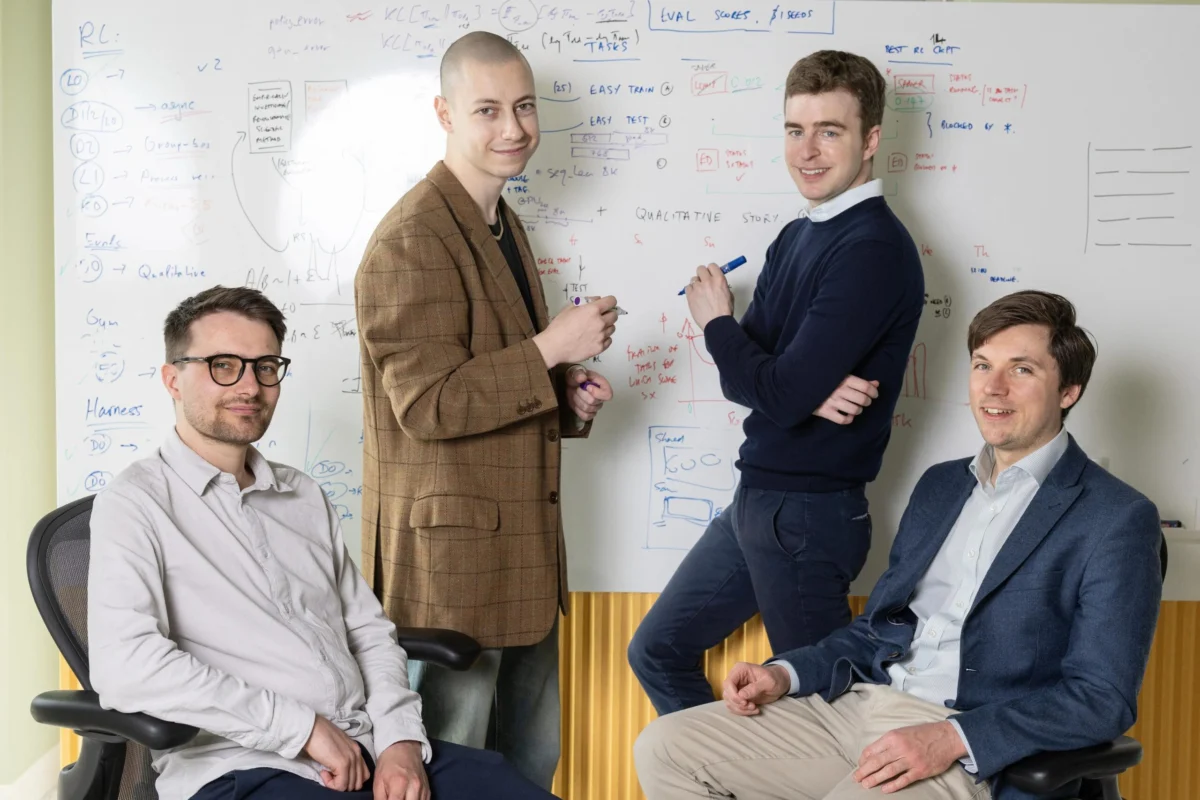
In the rapidly evolving landscape of artificial intelligence, the prevailing wisdom has long suggested that "bigger is better." The race toward trillions of parameters, powered by billions of dollars in compute, has defined the strategies of Silicon Valley titans like OpenAI and Anthropic. However, a quiet revolution is brewing in London’s King’s Cross.
Inherent, a nascent AI laboratory founded by a cohort of Google DeepMind alumni, has recently emerged from stealth with a provocative claim: their specialized AI agent, Faraday, has outperformed the industry’s most formidable frontier models—including OpenAI’s GPT-5.5 and Anthropic’s Claude 4.8—while utilizing only a fraction of the computational scale. This development marks a significant shift in the AI arms race, moving the focus from raw brute force to algorithmic efficiency and specialized "scientific taste."
Main Facts: Efficiency Over Scale
The core of Inherent’s announcement lies in the performance of Faraday, an AI agent designed specifically for scientific inquiry. In a series of rigorous benchmarks, Faraday demonstrated the ability to independently reproduce the findings of published scientific papers without prior access to the results. This task, often used as a litmus test for doctoral students, requires more than just text generation; it demands a deep understanding of experimental design, data interpretation, and logical synthesis.
The most striking aspect of this achievement is the disparity in model size. While GPT-5.5 and Claude 4.8 are believed to operate on "frontier-scale" architectures (likely exceeding a trillion parameters), Faraday is built upon Qwen 3.6, a model with a relatively modest 27 billion parameters.
Key Technical Breakthroughs:
- Parameter Efficiency: Faraday achieved superior results in scientific replication despite being orders of magnitude smaller than its competitors.
- The "Research Taste" Metric: Unlike traditional models that prioritize accuracy through statistical probability, Inherent has focused on "research taste"—the heuristic ability to discern which experiments are worth pursuing.
- Reinforcement Learning Focus: The team utilized advanced reinforcement learning (RL) to reward the agent for successful outcomes and sound methodology, rather than merely training it to predict the next word in a sequence.
- Collaborative Architecture: Rather than reinventing every wheel, Faraday utilizes existing tools, such as OpenAI’s GPT-5.5 Codex, for specialized coding tasks, mimicking the way human scientists use specialized software.
Chronology: From DeepMind to Stealth Success
The journey of Inherent is emblematic of the "DeepMind Diaspora"—a phenomenon where former employees of Google’s premier AI lab depart to found their own ventures, fueled by the desire for greater agility and focused research goals.
2024 – Early 2025: The Genesis
Founded by Edward Hughes, Louis Kirsch, Kaloyan Aleksiev, and Tantum Collins, Inherent was born out of a shared vision to move beyond general-purpose chatbots and toward "AI Scientists." The founding team brought years of experience from DeepMind, a lab synonymous with breakthroughs like AlphaFold and AlphaGo.
May 2026: Emerging from Stealth
Inherent officially emerged from stealth with a $50 million seed round. The funding was a testament to the pedigree of the founders and the high-conviction bet that investors are placing on the London AI ecosystem. Despite the high valuation, the company maintained a low profile, focusing on internal development rather than public relations.
Mid-2026: The Faraday Breakthrough
Weeks after the funding announcement, Inherent released the results of its Faraday agent. By successfully replicating complex scientific findings, the team proved that their "reward-based" training approach could yield agents capable of high-level cognitive tasks that even the largest general-purpose models struggle to execute consistently.
The Present: Expansion and Advocacy
Currently, the company operates with a lean team of 12 employees based in King’s Cross, London. They have announced plans to double their headcount by the end of the year, targeting top-tier talent from both academia and established AI giants.
Supporting Data: Decoding the Performance Gap
To understand why Inherent’s achievement is significant, one must look at the data surrounding the "scaling laws" of AI. For years, the industry has followed the principle that increasing data and compute leads to linear improvements in intelligence. Inherent’s results suggest a "plateau" in general models that specialized agents can overcome.
Benchmark Comparison
In the task of independent paper replication, Inherent provided the following comparative data:
| Model | Parameter Count (Est.) | Task: Scientific Replication |
|---|---|---|
| Inherent Faraday | 27 Billion | Superior/High Accuracy |
| OpenAI GPT-5.5 | 1 Trillion+ | High/Moderate |
| Claude 4.8 Opus | 1 Trillion+ | High/Moderate |
The Cost of Intelligence
The implications of using a 27B parameter model are primarily economic and environmental. A smaller model requires significantly less electricity to train and, more importantly, much less latency and cost to run (inference). For scientific institutions and R&D departments, an agent like Faraday could potentially be deployed at a tenth of the cost of a frontier-scale API, making "AI-driven discovery" accessible to a broader range of laboratories.
Training Methodology: Reinforcement Learning (RL)
Inherent’s chief scientist, Edward Hughes, emphasized that the secret sauce is not the data itself, but the reward structure. By using reinforcement learning, Inherent "imbues" the agent with a sense of "taste." In this context, "taste" refers to the ability to:
- Identify high-impact variables in a dataset.
- Design experiments that minimize noise.
- Self-correct when preliminary data contradicts the hypothesis.
Official Responses: The Philosophy of the Founders
In discussions regarding their recent success, the leadership at Inherent has remained grounded, emphasizing that their goal is not to "beat" OpenAI, but to redefine what an AI teammate looks like.
Edward Hughes, Co-founder and Chief Scientist, noted that the replication of papers is merely the first step. "Many PhD students start by doing this," Hughes explained. "It’s about building the muscle of scientific inquiry. We aren’t just looking for accuracy; we are looking for agents that show ‘research taste’—an instinct for what is worth running."
Hughes also addressed the company’s decision to remain in London, a city he describes as "the place to be" for AI. However, he has been vocal about the regulatory hurdles facing the UK tech sector. Specifically, he has criticized the British practice of "garden leave"—contractual clauses that prevent departing employees from joining competitors for several months.
"I was personally affected by the garden leave problem," Hughes stated, highlighting that such restrictions give US-based startups a competitive advantage in the talent war, as American researchers (particularly in California) generally do not face such non-compete barriers.
The company’s ethos is further reflected in its office culture. Despite the post-pandemic trend toward remote work, Inherent’s dozen employees work in person. They believe that the "density of talent" in King’s Cross—the same neighborhood that houses DeepMind and the Alan Turing Institute—is vital for the serendipitous breakthroughs required in scientific AI.
Implications: A New Era for Scientific Discovery
The success of Inherent’s Faraday agent has far-reaching implications for the future of the AI industry and the scientific community at large.
1. The End of "Size Over Everything"
If a 27B parameter model can outperform a 1T+ parameter model in specialized reasoning, the "moat" held by companies like OpenAI may be shallower than previously thought. This suggests a future where "Expert Agents"—highly tuned, smaller models—are more valuable than "General Agents" for professional and academic applications.
2. Solving the "Reproducibility Crisis"
Science has long been plagued by a reproducibility crisis, where a significant percentage of published studies cannot be replicated by other researchers. An AI agent capable of independently verifying results at scale could serve as a "truth layer" for global science, flagging inconsistencies and strengthening the integrity of published research.
3. The "Autonomous Scientist"
Inherent’s long-term "north star" is an agent that doesn’t just verify existing knowledge but discovers new knowledge. This would involve the AI proposing its own hypotheses and potentially directing robotic lab equipment to conduct physical experiments. The transition from "Generative AI" (which creates content) to "Agentic AI" (which performs tasks) is the next frontier, and Inherent is positioned at the vanguard of this shift.
4. Talent Magnetism in London
As Google DeepMind undergoes structural changes under Demis Hassabis’s new leadership, some staff have reportedly felt "unsettled." Inherent, with its $50 million war chest and its base in King’s Cross, is perfectly positioned to absorb "refugee" talent from DeepMind. This could solidify London’s status as the global capital for AI-for-Science, even as the US dominates the consumer AI space.
Conclusion
Inherent’s Faraday is more than just a successful benchmark; it is a proof of concept for a more efficient, more thoughtful approach to artificial intelligence. By prioritizing "taste" and "curiosity" over raw scale, the London-based lab is challenging the industry to rethink the trajectory of AI development. As they expand their team and move toward the discovery of new scientific knowledge, the world will be watching to see if this "small" model can continue to deliver big results in the quest to unlock the secrets of the universe.