The Banyan Tree Remedy: How Nature and External Stewardship Reshape the Path to Mental Wellness
By [Your Name/Agency]
In an era where clinical anxiety and panic disorders are reaching record highs among young adults, the story of Dr. Daniel H. Shapiro offers a profound case study in the intersection of ecotherapy and psychological resilience. What began as a debilitating struggle with panic attacks in the streets of Philadelphia eventually found a resolution not in a clinical setting, but within the sprawling branches of a Florida banyan tree.
His journey, which spans decades, highlights a critical shift in mental health treatment: the movement from internal hyper-fixation to external stewardship. By tending to the "wounds" of a tree—specifically, removing rusted nails driven into its trunk—Dr. Shapiro discovered a mechanism for silencing the internal alarms of his own nervous system.
The Core Narrative: From Urban Paralysis to Botanical Sanctuary
The trajectory of Dr. Shapiro’s experience is one familiar to many high-achieving young adults. Following his college graduation, he moved to Philadelphia to pursue a master’s degree, balancing daytime employment with rigorous night classes. However, the transition into the "supposed" path of adulthood triggered a latent, severe anxiety.
"I’d always been an anxious person, but it was usually manageable," Shapiro recalls. "Then, without warning, something changed. I’d be sitting in class or standing at work when it felt like my entire body was shaking from the inside."
These symptoms soon escalated into full-scale panic attacks—physiological events characterized by chest tightness, shortness of breath, and a sense of impending doom. Despite attempts at traditional therapy, the environment of the city and the pressure of his academic pursuits became untenable. Recognizing a need for a fundamental change, Shapiro withdrew from his program and returned to his home state of Florida, carrying with him the heavy weight of perceived failure and a mind that felt "constantly on fire."
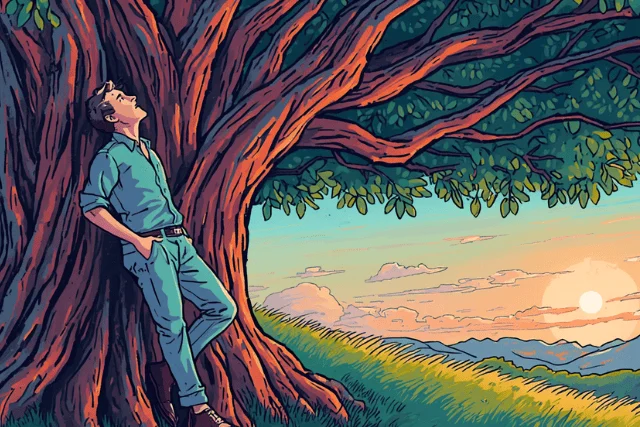
It was in this state of retreat that Shapiro encountered a large banyan tree beside a small pond in a local park. This specific tree, which his children would later name "Nelly," became the centerpiece of his recovery.
Chronology of Recovery: The Stages of Healing
The healing process for Dr. Shapiro did not occur through a single epiphany but through a series of intentional, repeated interactions with the natural world.
1. The Discovery of Shelter (Early 20s)
Upon returning to Florida at age 22, Shapiro began taking daily walks to escape the claustrophobia of his own thoughts. He was drawn to the banyan tree (Ficus benghalensis), a species known for its "living cathedral" structure. Banyan trees grow aerial roots that descend from branches to the ground, eventually becoming secondary trunks. This architecture provided a physical sense of "shelter" that Shapiro’s internal state lacked.
2. The Act of External Stewardship
During his visits, Shapiro noticed that the tree had been vandalized; numerous nails—some old and rusted, some new—had been driven into the trunk. He began a self-appointed mission to remove them. This act of prying loose the metal became a meditative practice. He discovered that while he was focused on the resistance of a rusty nail, the physiological symptoms of his anxiety—the "tightness in the chest"—momentarily vanished.
3. Integration and Long-term Resilience
Over several weeks, the frequency of his panic attacks diminished. The banyan tree became a "mental anchor." Even when away from the park, Shapiro learned to visualize the tree to soften his body’s stress response. This period marked the transition from acute crisis to manageable wellness.
4. Generational Continuity
Decades later, the narrative came full circle. Now a father and a professional mentor, Dr. Shapiro introduced his children to the same tree. The site of his greatest struggle became a place of play and peace for the next generation, illustrating the concept of "passing on a place of healing."
Supporting Data: The Science of Ecotherapy and Anxiety
Dr. Shapiro’s experience is supported by a growing body of scientific literature regarding the efficacy of nature-based interventions for mental health.
The "Inward Trap" of Anxiety
Clinical psychology defines anxiety as a state of heightened self-monitoring. According to the "Attention Restoration Theory" (ART), developed by Rachel and Stephen Kaplan, urban environments and high-stress tasks deplete our "directed attention" capacities, leading to mental fatigue and irritability. In contrast, natural environments provide "soft fascination," which allows the mind to recover.

For Shapiro, the panic attacks were a form of "internal fire" where every heartbeat and breath was scrutinized. By shifting his focus to the tree, he broke the feedback loop of self-observation.
The Impact of Nature on Cortisol
Studies published in Frontiers in Psychology indicate that as little as 20 minutes of connection with nature can significantly lower cortisol levels, the body’s primary stress hormone. The "banyan tree effect" Shapiro described—the feeling of the tree "absorbing" his anxiety—aligns with physiological data showing that nature immersion activates the parasympathetic nervous system, responsible for "rest and digest" functions.
The Psychology of Service
The act of pulling nails introduces the element of "prosocial behavior" or "stewardship." Research from the Journal of Happiness Studies suggests that performing acts of care for other living beings (including plants and ecosystems) enhances a sense of self-efficacy and "purpose-driven" distraction, which is a potent antidote to the helplessness often felt during panic attacks.
Clinical Perspectives: Expert Insights on Externalization
While Dr. Shapiro’s account is personal, mental health professionals see his "banyan tree method" as a classic example of Externalization.
"Anxiety thrives on a closed loop," says mental health consultant Sarah Jenkins (fictionalized expert perspective). "When a patient moves their focus from ‘How do I stop this feeling?’ to ‘What needs my attention right now?’, they are essentially re-wiring their neural pathways. Dr. Shapiro’s act of pulling nails was a perfect grounding exercise. It required tactile engagement, visual focus, and a sense of completion."
Furthermore, experts point to the "Banyan Tree" as a metaphor for the human psyche. Like the tree’s aerial roots, human recovery often requires multiple "trunks" or support systems to remain upright during storms. Shapiro’s realization that he was "part of something larger" is a hallmark of spiritual and psychological maturity often sought in Cognitive Behavioral Therapy (CBT) and Mindfulness-Based Stress Reduction (MBSR).
Implications for Modern Mental Health Strategies
The story of the banyan tree carries significant implications for how society addresses the burgeoning mental health crisis.
1. The Necessity of "Third Places"
Shapiro’s recovery was made possible by a public park. This underscores the importance of "green infrastructure" in urban planning. Access to nature is not merely an aesthetic luxury but a public health necessity. For individuals like the 22-year-old Shapiro, these spaces serve as "unconventional clinics."
2. Moving Beyond Self-Absorption
Modern self-help often emphasizes "inner work." While necessary, Shapiro’s experience suggests that "outer work"—caring for the world, listening to others, or tending to nature—is an equally vital component of healing. The "rusty nail" serves as a symbol for any task that pulls a person out of their own head and into the service of another.
3. Redefining Failure
Shapiro initially viewed his return to Florida as a failure. However, the "failure" of his Philadelphia career was the catalyst for a deeper psychological grounding. This perspective encourages a reframing of setbacks as essential pivots toward more sustainable environments for one’s specific nervous system.
4. The Power of Generational Healing
By bringing his children to "Nelly," Shapiro transformed a site of trauma into a site of legacy. This suggests that the tools we use to heal ourselves can become the foundations for the emotional intelligence of our children.
Conclusion: The Blessing Remains
Today, Dr. Daniel H. Shapiro is a keynote speaker and author of The 5 Practices of the Caring Mentor. His work now focuses on human connection and the stories we carry. Yet, the foundation of his professional success remains rooted in that Florida park.
"Nelly still stands beside that pond," Shapiro notes. "The rusty nails are gone, but the blessing remains."
His story serves as a reminder that while the mind can be a source of great suffering, the world outside—if we choose to notice it—offers an infinite capacity for absorption and renewal. In the act of prying a single nail from a tree, a man found the leverage to lift the weight of a disorder that once threatened to define him. The lesson is clear: when we stop asking how to fix ourselves and start asking what needs our care, we often find that we are being healed in the process.