The Purgatory of Empire: Martin McDonagh’s ‘Wild Horse Nine’ Reimagines the Western on the Shores of Rapa Nui
VENICE — The 2026 Venice Film Festival has long been a harbor for the melancholic and the macabre, but few films this year have sparked as much divisive conversation as Martin McDonagh’s latest offering, Wild Horse Nine. A spiritual, if not literal, successor to the "banter-mad" energy of In Bruges and the "splenetic" isolation of The Banshees of Inisherin, McDonagh’s new feature attempts a high-wire act of tonal dissonance. It seeks to transpose the snappy, post-Guy Ritchie dialogue of his early career onto the haunting landscape of Easter Island (Rapa Nui), all while set against the grim backdrop of Augusto Pinochet’s 1973 rise to power.
While the film has garnered a respectable, if lukewarm, Grade B- from early screenings, its ambitions are undeniably vast. Distributed by Searchlight Pictures and slated for a theatrical release on November 6, Wild Horse Nine is a film that wrestles with the weight of history, the erosion of memory, and the "blithe imperiousness" of American interventionism.
Main Facts: A Boys’ Trip to the End of the World
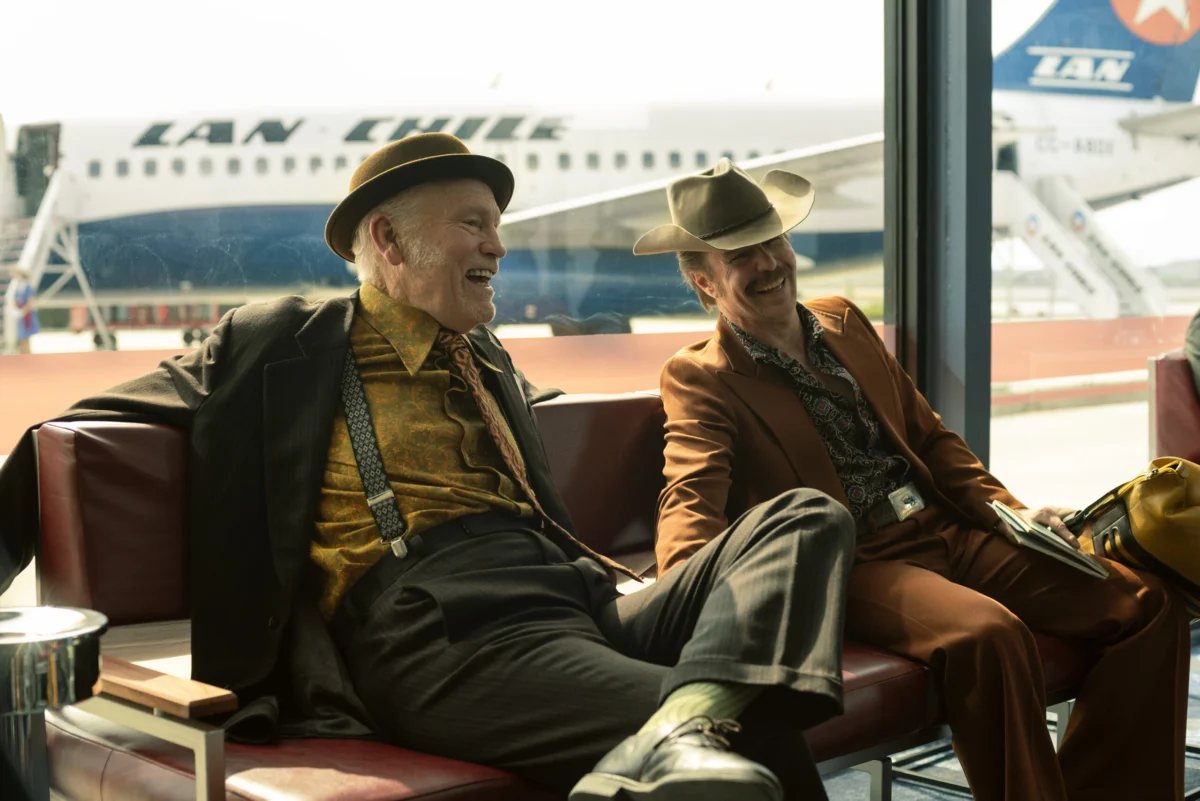
At its core, Wild Horse Nine is a two-hander featuring two of McDonagh’s most reliable archetypes: the weary veteran and the exasperated sidekick. John Malkovich stars as Chris, a "Company man" whose resume reads like a redacted history of 20th-century geopolitical destabilization. Opposite him is Sam Rockwell as Lee, Chris’s "office husband" and platonic life partner, a man whose loyalty is tested by Chris’s declining mental faculties and the moral rot of their profession.
The narrative follows the duo to Chile in the fall of 1973. As CIA operatives, they are the architects of the September 11th coup that would topple the democratically elected socialist president Salvador Allende. However, before the blood begins to flow in Santiago, the pair embarks on a "PTO" (Paid Time Off) excursion to Rapa Nui, 2,300 miles off the Chilean coast.
The film functions as a "purgatorial Western," where the traditional desert plains are replaced by sun-bleached volcanic slopes and the iconic moai statues. As they wait for the "death" of a democracy to find them, they search their souls, argue over the theology of Nazi salvation, and flirt with local leftists—most notably a character played by Mariana di Girolamo—all while the specter of their own crimes looms over the horizon.

Chronology: From the Streets of Bruges to the Statues of Rapa Nui
To understand the DNA of Wild Horse Nine, one must look at the evolution of Martin McDonagh’s filmography. The director has spent decades refining a specific brand of "seriocomic absurdity," beginning with the 2008 cult classic In Bruges.
- 2008–2022: McDonagh establishes a trope of two men trapped in a picturesque location, forced to confront a singular violent act (the accidental killing of a child in Bruges) or a sudden existential rift (the broken friendship in Banshees).
- The 1973 Setting: Wild Horse Nine departs from the fictional or localized stakes of his previous work by anchoring the narrative in a "real and terrible event." The fall of 1973 serves as a ticking clock for the protagonists’ morality.
- Production on Rapa Nui: Filmed on location, Wild Horse Nine is only the second major feature to be shot on the remote island, following Kevin Reynolds’ 1994 epic Rapa Nui. The production utilized the island’s ancient landscape to provide a sense of "sacred charge" that contrasts with the "profane" nature of the CIA agents.
- The Venice Premiere (2026): The film’s debut at Venice marked a turning point in the festival’s reception of McDonagh, with critics noting a shift from his usual "pure invention" toward a more "transparently manufactured" historical critique.
Supporting Data: The Mechanics of Guilt and Memory
The film’s technical and thematic weight is carried largely by Malkovich’s performance and Ben Davis’s cinematography. Malkovich, described as being more "locked in" than he has been since Burn After Reading, portrays Chris as the living personification of American destabilization.
The Resume of a Hitman
The script grants Chris a terrifyingly expansive backstory, suggesting his involvement in:
- The execution of Congolese leader Patrice Lumumba.
- The failed 1961 Bay of Pigs invasion in Cuba.
- The assassination of John F. Kennedy in Dallas (a point of contention his boss, played by Steve Buscemi, would prefer he kept secret).
Chris claims to have killed 68 people, a number he offers with a nonchalance that suggests the true tally could be double that without affecting his conscience. However, the "double-edged sword" of the film is Chris’s failing memory. As he struggles with a Memento-like reliance on jacket-pocket notes, the film explores the "ambient tension between memory and erasure."
Visual Language
Ben Davis, a frequent collaborator of McDonagh, uses sun-bleached cinematography to render Rapa Nui as a "lost idyll." The 750-year-old moai statues serve as silent witnesses to the rise and fall of empires. The film uses these statues to dwarf the characters’ petty bickering, suggesting that while American interventionism may feel all-consuming in 1973, it is merely a "tear in the rain" when measured against the ancestors of Polynesia.

Official Responses and Critical Reception
The reaction to Wild Horse Nine has been a mixture of admiration for its craft and skepticism regarding its "glib" tone. The decision to juxtapose the "post-Guy Ritchie bark" of McDonagh’s dialogue with the deaths of thousands under Pinochet has been the primary point of critical friction.
The "Glibness" Debate
Critics have pointed out that while the humor provides the film’s few "solid laughs," it also makes the narrative feel "as transparently manufactured as the CIA-backed overthrow of a foreign democracy." The skepticism centers on the "come-to-Jesus moment" of a veteran agent. While audiences could accept the "dark night of the soul" of a hitman in In Bruges, they find it harder to swallow the moral awakening of a man who orchestrated the demise of Allende.
The Grade: B-
The consensus among Venice critics is that the film is "freighted with sadness" but suffers from a "general listlessness" in its first half. The second half, described as "busy and madcap," sees the "PTO" turn into a matter of national security involving gunfire, hostages, and the word "fuck" used as a ubiquitous punctuation mark. Despite these flaws, the film is praised for not being "Catholic enough to offer a big moment of divine expiation," opting instead for a more cynical, muted conclusion.
Implications: The Ethics of Historical Fiction
Wild Horse Nine raises significant questions about the responsibility of filmmakers when dealing with "real and terrible events." By recasting a "same old script" against the backdrop of the Chilean coup, McDonagh has granted his characters a "welcome sense of scale," but at the cost of emotional credibility.
The Erasure of History
The film’s most successful moments are those that deal with the "erasure of memory." The CIA’s desire to "make sure that Chris doesn’t share whatever it is that he still remembers" serves as a metaphor for how empires manage their legacies. In this context, American interventionism is treated not just as a tragedy, but as a "punchline" to a joke that the rest of the world has been in on for centuries.

A New Direction for McDonagh?
The film suggests that McDonagh is moving away from the "world of pure invention" toward a more grounded, though still sardonic, exploration of history. Whether this transition is successful remains a point of debate. By turning a major asshole into a "wayward hero," McDonagh challenges the audience to root for the "bad guys"—a tactic the film explicitly links to the cornerstone of post-war American foreign policy.
As Wild Horse Nine prepares for its November 6 theatrical release, it stands as a testament to the enduring power of the "purgatorial" narrative. It is a film that asks whether a change of heart matters when the heart in question is already mottled by decades of state-sanctioned violence. For some, the film’s "sardonic" laughter will be enough; for others, the reality of 1973 will continue to bleed into the edges of the frame, demanding a gravity that the script isn’t always willing to provide.
Film Details:
- Wild Horse Nine
- Director/Writer: Martin McDonagh
- Cast: John Malkovich, Sam Rockwell, Steve Buscemi, Mariana di Girolamo
- Cinematography: Ben Davis
- Studio: Searchlight Pictures
- Release Date: November 6, 2026