Embracing the Full Spectrum: The Transformative Power of Gratitude and Authenticity
A profound journey of self-discovery and connection often begins with a single, conscious step. For many, this journey is distilled into a focused period of introspection and practice. As we arrive at "Day 7" of a purported "7 Days of Gratitude" initiative, the twin pillars of gratitude and authenticity emerge not merely as virtues, but as fundamental pathways to a life of profound meaning and genuine connection. This final day serves as a powerful synthesis, urging participants to externalize their inner work through acts of generosity, while simultaneously inviting a deeper understanding of the self.
Introduction: A Week Towards Profound Change
The promise is bold: "One week that can change your life!" Such an assertion might seem hyperbolic, yet the cumulative effect of consistent, intentional practice can indeed catalyse significant personal transformation. The "7 Days of Gratitude" program, culminating in its seventh day, is designed to guide individuals through a systematic exploration of thankfulness, moving from simple recognition to a more expansive, integrated state of being. Day 7, specifically, broadens the scope, interweaving the practice of gratitude with the profound challenge and reward of living authentically. It’s a call to move beyond mere acknowledgment of blessings, to actively embody gratitude through selfless acts and, critically, to align one’s outer expressions with inner truths.
Day 7: The Alchemy of Giving and Receiving
The seventh day of this gratitude journey pivots from internal reflection to external action, proposing a compelling exercise in generosity. This shift is not arbitrary; it represents a natural progression where cultivated inner states seek outward expression, solidifying new patterns of thought and behavior.
Main Facts: The Generosity Challenge
The core directive for Day 7 is twofold: "Give an anonymous gift to someone. Leave a gift for someone where they will find it, with their name on it. Discover how good that feels!" This simple instruction encapsulates a sophisticated understanding of human psychology and the reciprocal nature of giving.
The act of giving an anonymous gift, devoid of expectation for recognition or reciprocation, taps into a purer form of altruism. It removes the ego from the equation, allowing the giver to focus solely on the potential joy or benefit of the recipient. This selflessness is often deeply rewarding, producing a warmth and satisfaction that stems from contributing positively to another’s experience without personal gain.
The second part of the challenge—leaving a named gift for someone to discover—introduces a layer of personal connection without direct confrontation. It’s a gesture that says, "I see you, I appreciate you," allowing the recipient to feel acknowledged and valued. The surprise element, coupled with the personalization, enhances the emotional impact for both parties, even if the interaction is indirect. The emphasis on "Discover how good that feels!" underscores the intrinsic reward of such acts, highlighting that generosity is not just about the recipient, but also about the profound positive feedback loop it creates within the giver.
Chronology: A Culmination of Practice
Day 7 is not an isolated event but the culmination of a week-long immersion in gratitude. The preceding six days would have likely involved daily prompts, reflections, and exercises designed to shift one’s perspective towards appreciation. By this point, participants would have honed their ability to identify and acknowledge sources of gratitude in their lives, both large and small. The act of giving on Day 7, therefore, becomes a practical application of this cultivated mindset. It’s an external manifestation of an internal shift, demonstrating how a heart opened by gratitude naturally seeks to share its abundance. This chronological progression suggests that consistent internal work paves the way for meaningful external action, transforming gratitude from a passive feeling into an active force for good.
Supporting Data: The Neuroscience of Altruism
Modern neuroscience and positive psychology offer compelling evidence for the benefits of altruism, validating the sentiment that giving "feels good." Research has consistently shown that acts of kindness, whether anonymous or acknowledged, activate the brain’s reward centers, releasing neurochemicals like dopamine, oxytocin, and endorphins. This phenomenon, often referred to as the "helper’s high," creates a positive feedback loop, reinforcing prosocial behavior and fostering a desire to engage in further acts of generosity.
Studies have linked altruism to increased happiness, reduced stress, improved physical health, and longer lifespans. For instance, a landmark study published in the Journal of Personality and Social Psychology found that individuals who regularly engaged in helping others reported greater overall life satisfaction and lower rates of depression. The connection between generosity and well-being is robust, suggesting that the Day 7 challenge is not just a spiritual exercise but a scientifically sound method for enhancing one’s emotional and psychological health. By encouraging participants to experience this intrinsic reward firsthand, the program effectively reinforces the transformative power of compassionate action.
Gratitude: An Invitation to Embrace All of Life
Beyond the specific challenge of giving, Day 7 delves deeper into the essence of gratitude itself, redefining it as a radical openness to all of life’s experiences, not just the pleasant ones.
Main Facts: Beyond Superficial Thanks
The article challenges conventional notions of gratitude with a profound statement: "So gratitude becomes this invitation to be open to feeling what’s here and available to feel. Even if it’s sad, or mad, or anything it turns out." This expands gratitude beyond a mere acknowledgment of positive circumstances to an embracing of the full spectrum of human emotion. It suggests that true gratitude is not about being thankful for pain or sadness, but about being thankful for the capacity to feel them, for the rich tapestry of experience that life offers, in its entirety. This perspective encourages a non-judgmental acceptance of one’s inner landscape, recognizing that all emotions serve a purpose and contribute to a deeper understanding of self and existence. It’s about being present with what is, rather than resisting or selectively appreciating.
Supporting Data: The Broadening and Building Theory
This expansive view of gratitude aligns with contemporary psychological theories. Dr. Barbara Fredrickson’s "Broaden-and-Build Theory" of positive emotions suggests that positive emotions like joy, interest, contentment, and gratitude broaden an individual’s momentary thought-action repertoires, leading to the discovery of novel and creative actions. Over time, these broadened repertoires build enduring personal resources, ranging from physical and intellectual resources to social and psychological resources.
While Fredrickson’s initial work focused primarily on positive emotions, the implication of the article’s statement is that an openness to all emotions, facilitated by a foundation of gratitude, can similarly broaden one’s capacity for resilience and understanding. By not shying away from "sad, or mad, or anything it turns out," individuals develop a greater emotional intelligence and a more robust psychological framework to navigate life’s inevitable challenges. General research on gratitude further supports its myriad benefits, including improved physical health (lower blood pressure, stronger immune system), better sleep quality, increased empathy, stronger relationships, and enhanced overall happiness and life satisfaction. These benefits are not contingent on a life devoid of hardship but rather on the capacity to find meaning and appreciation amidst it all.
Daily Experience: Cultivating a Grateful Mindset
The program emphasizes a continuous, mindful inquiry: "Ask yourself, ‘What am I grateful for right now?’ Throughout the day, continue to ask yourself, ‘What am I grateful for right now?’" This practice transforms gratitude from a fleeting thought into a sustained mode of perception. By repeatedly posing this question, individuals train their minds to actively seek out and acknowledge sources of appreciation in their immediate environment and internal state. This consistent inquiry acts as a powerful cognitive reframing tool, shifting focus away from deficiencies or frustrations towards abundance and blessing. Journaling is presented as a vital companion to this daily inquiry, allowing participants to record their discoveries, track their emotional shifts, and deepen their understanding of how gratitude impacts their inner and outer worlds. The written word solidifies thoughts, making ephemeral feelings tangible and allowing for later reflection on the progress made.
Ten-Minute Meditation: Deepening the Connection
A structured meditation practice is integrated to further anchor the experience of gratitude. The steps are designed to be accessible yet profound:
- Comfort and Breath: "Make yourself comfortable, take 3 deep breaths, feel your body, and invite yourself to relax with each exhalation." This initial stage grounds the individual in the present moment, calming the nervous system and preparing the mind for deeper introspection.
- Finding One Thing: "Find just one thing you are genuinely grateful for right now and write down what you are feeling in your journal." This simple step builds confidence and initiates the discovery process. The emphasis on "genuinely" ensures the gratitude is heartfelt, not superficial.
- Expanding to Two: "Find a second thing you are genuinely grateful for right now. Notice the feelings of gratitude in your body. Write down what you are feeling in your journal." This step builds on the first, demonstrating the brain’s capacity to find more once the search begins. Noticing bodily sensations connects the cognitive aspect of gratitude with its somatic experience, making it more visceral.
- The Multiplier Effect: "Find a third thing you are genuinely grateful for right now. If you can find one thing, you can find two. If you can find two things, you can find three. If you can find three things, you can find ten thousand." This powerful affirmation reinforces the idea that gratitude is not a finite resource but an ever-expanding wellspring. It encourages participants to push beyond initial discoveries, recognizing the infinite potential for appreciation in their lives.
- Curiosity and Vibration: "Bring curiosity to your current experience as you notice the frequency and vibrations of gratitude moving through your whole being. Write down what you notice as you continue to feel gratitude. Keep noticing all the things you are grateful for." This final stage invites a deeper, more energetic awareness. The concept of "frequency and vibrations" speaks to the subtle yet potent energetic shifts that accompany profound gratitude, impacting one’s entire being. Curiosity fosters a non-judgmental exploration, allowing the experience to unfold naturally.
Authenticity: The Courage to Be You
The article then seamlessly transitions to the intrinsic link between gratitude and authenticity, revealing how one cannot truly flourish without the other. Authenticity is presented not as a simple choice, but as a journey of overcoming ingrained patterns.
Main Facts: The Peril and Promise of Self
The reflection on authenticity is remarkably candid: "I noticed that there were many, many, many, many, many, many, many times in my life when it seemed wise to not be authentic, many times when it seemed wise to get along and not rock the boat." This resonates deeply with the universal human experience of conforming to societal expectations, fearing judgment, or prioritizing harmony over personal truth. The article acknowledges the perceived "problematic" nature of authenticity in certain contexts, where fitting in often feels safer and more expedient than standing out.

However, it quickly pivots to the profound question, "What does that have to do with gratitude?" The answer is illuminating: "Well, to really feel gratitude, you have to know what you’re grateful for, know what you like, and know what you value… And be willing to feel yourself, willing to be vulnerable to not just the joy of having or being, but the pain of losing, the grief of losing something." This establishes a direct, undeniable link: authenticity is the prerequisite for genuine gratitude. One cannot truly appreciate what one values unless one first knows what those values are, and has the courage to acknowledge them, even if it means embracing vulnerability. The inherent human quest, as stated, is for "communion and connection and authenticity," a deep-seated desire to be seen, heard, and accepted for who one truly is.
Chronology: Unpacking a Lifetime of Conditioning
The journey towards authenticity is depicted as a process of peeling back layers: "And my conditioning has been: keep it on the down low. Keep your head down. Don’t make eye contact. Keep your thoughts to yourself. Keep your hands to yourself. Find out what is wanted and conform to that." This vividly describes the societal and personal pressures that often shape individuals into conforming shells, suppressing their true selves for the sake of acceptance or safety.
The text emphasizes that overcoming this conditioning is not a quick fix but a sustained effort: "Over the years of inquiry and inquiry and inquiry, the layers of conditioning come up and wash away." This "chronology" of self-discovery highlights the iterative nature of personal growth, where persistent introspection gradually dismantles learned behaviors and beliefs that obscure one’s authentic self. It’s a testament to the power of consistent self-examination and the courage required to confront and release these ingrained patterns.
Supporting Data: The Psychological Need for Congruence
From a psychological perspective, the struggle for authenticity is often understood through the lens of Carl Rogers’ humanistic theory, particularly the concept of congruence. Rogers posited that psychological well-being is fostered when there is a high degree of congruence between one’s ideal self (who one wishes to be), one’s self-image (who one perceives oneself to be), and one’s actual experience. When individuals live inauthentically, there is a discrepancy between their true feelings and their outward expressions, leading to a state of incongruence. This can manifest as anxiety, stress, feelings of emptiness, and even depression, as the constant effort to maintain a false persona drains mental and emotional resources.
Conversely, embracing authenticity leads to greater self-acceptance, self-esteem, and a deeper sense of meaning and purpose. Research indicates that authentic individuals tend to have stronger, more satisfying relationships, as they foster genuine connection based on mutual understanding rather than superficial pretense. They also exhibit greater resilience in the face of adversity, possessing a clearer sense of their values and strengths. The article’s journey of "inquiry" echoes therapeutic processes aimed at helping individuals identify and express their true selves, thereby fostering greater psychological integration and well-being.
Implications: The "Greatest Treasure" of Being Oneself
The profound outcome of this journey is articulated with striking simplicity: "And there are moments of deep and powerful gratitude to just be here, how I am, without trying to do it any different inside or outside." This is the pinnacle of authenticity – a state of radical self-acceptance that transcends external validation or internal self-criticism. It’s the liberation of simply being, unburdened by the need to perform or conform.
The article celebrates this state as "the greatest treasure that I can find: to just be myself, even if it’s ___ fill in the blank." The blank space powerfully invites readers to acknowledge their own perceived flaws, imperfections, or vulnerabilities, and to embrace them as integral parts of their authentic self. "Just be myself. What a gift. What a great starting place. What a great baseline. Maybe you can dance to it." These concluding lines underscore the profound freedom and joy that come from self-acceptance, positioning authenticity not as an endpoint, but as the fundamental foundation from which a truly grateful and fulfilling life can emerge. It’s a call to celebrate one’s unique existence, flaws and all, as the ultimate act of gratitude for the gift of life itself.
The Symbiotic Dance: Gratitude and Authenticity Intertwined
The true genius of this "Day 7" reflection lies in its masterful weaving together of gratitude and authenticity, demonstrating their inseparable nature. They are not independent virtues but two sides of the same coin, each enhancing and enabling the other.
Main Facts: A Reciprocal Relationship
The article clearly states the foundational connection: "to really feel gratitude, you have to know what you’re grateful for, know what you like, and know what you value, and things of that nature." This self-knowledge is precisely what authenticity cultivates. Without an honest understanding of one’s own desires, preferences, and core values—an understanding fostered by shedding conditioning and embracing one’s true self—gratitude remains superficial. How can one genuinely appreciate something if one is unsure whether it truly aligns with one’s authentic being? Authenticity provides the clarity of self that allows gratitude to take root deeply and genuinely. Conversely, a practice of gratitude, by constantly focusing on what is positive and valuable in life, can strengthen one’s resolve to live in alignment with those values, thereby reinforcing authenticity.
Implications: Vulnerability as Strength
The interplay between gratitude and authenticity also highlights the critical role of vulnerability. "And be willing to feel yourself, willing to be vulnerable to not just the joy of having or being, but the pain of losing, the grief of losing something." True gratitude requires an open heart, one that is brave enough to fully experience the joys of life, knowing that such openness also carries the risk of pain and loss. An inauthentic self, shielded by layers of pretense, often struggles with this vulnerability. It may suppress joy out of fear of future sorrow, or deny pain to maintain a facade of strength.
Authenticity, by encouraging an acceptance of one’s entire emotional landscape, provides the courage to be vulnerable. When one is authentic, there is less energy expended on maintaining an image and more capacity to simply feel. This allows for a deeper experience of gratitude, as it is rooted in an honest, unvarnished appreciation for existence, acknowledging both its light and shadow. The capacity to embrace "what’s here and available to feel," even if it’s "sad, or mad," is a testament to the strength that authenticity bestows. It transforms vulnerability from a weakness into a profound source of emotional resilience and depth.
Practical Applications and Ongoing Engagement
The article concludes by offering tangible ways to integrate these principles into daily life, moving beyond theoretical understanding to sustained practice and communal impact.
Tools for Sustained Practice
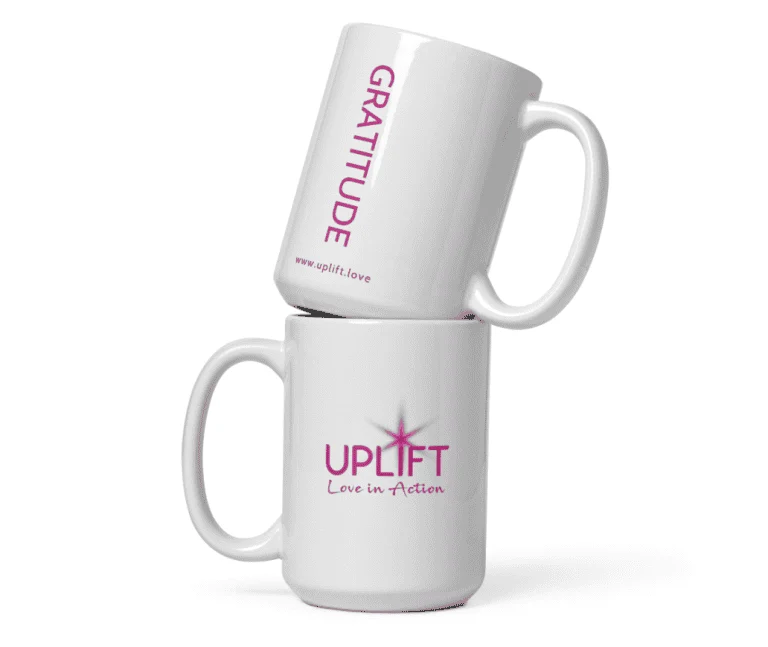
The mention of "UPLIFT Mugs" and the accompanying "Special Offer" serves as a practical example of how physical tools can support an ongoing commitment to gratitude. Framed as items "in 3 sizes, 6 colors, and many different intentions," these mugs are more than mere merchandise; they function as daily reminders, prompts for mindfulness, and symbols of the journey towards a more grateful and authentic life. The offer of "20% OFF on any 2 or more MUGS* & FREE SHIPPING" encourages not just individual adoption, but also sharing, potentially fostering a ripple effect of gratitude within communities and relationships.
Extending the Practice Beyond Self
The article broadens the scope of engagement by including sections that encourage collective action and support:
- "Take 5 Deep Breaths": This simple, accessible practice reiterates the importance of mindfulness and self-care. It’s a moment to "honor yourself" and, by extension, implies that a grounded, grateful individual can positively "impact the world" through their presence and actions.
- "Financial Contribution": The statement "100% of your contributions go towards supporting our Love in Action projects" links personal gratitude to a larger mission of collective well-being. It provides an avenue for individuals to translate their internal abundance into tangible support for initiatives that spread love and positive change, aligning with the Day 7 challenge of giving.
- "Send a Blessing": This offers a digital portal for expressing positive intentions and love. It’s a modern way to extend the spirit of the anonymous or named gift, allowing individuals to send messages of support and appreciation to others, further reinforcing the communal aspect of gratitude and connection.
These sections effectively demonstrate that the journey of gratitude and authenticity, while deeply personal, is not meant to be solitary. It encourages individuals to leverage their personal growth for the greater good, fostering a sense of interconnectedness and collective upliftment.
Conclusion: A Continual Journey of Self-Discovery
The "7 Days of Gratitude" initiative, particularly its culminating Day 7, offers a powerful framework for personal transformation. By intertwining the profound practice of gratitude with the courageous pursuit of authenticity, it illuminates a path towards a life lived with greater meaning, joy, and genuine connection. From the simple yet impactful act of giving, to the radical acceptance of one’s full emotional spectrum, and the arduous but ultimately liberating journey of shedding societal conditioning, the message is clear: true well-being stems from an honest engagement with oneself and the world.
The journey towards being "just myself" is presented not as a destination, but as a "great starting place" and an enduring "baseline" from which one can truly live, love, and "dance." It is a continual quest, one that promises not an absence of challenges, but the inner resources—forged in gratitude and authenticity—to meet them with an open heart and a resilient spirit. In embracing the full spectrum of life, individuals unlock their greatest treasure: the unwavering gift of their authentic self.