The Price of Attention: Inside the High-Stakes World of ‘Cash-First’ Movie Marketing
In the hyper-saturated landscape of the 2020s, movie marketing has evolved into a full-court offensive that frequently blurs the line between promotion and performance art. From "clipfarming" on TikTok and carefully curated influencer screenings to the viral obsession with "meme-bait" popcorn buckets, the industry’s struggle to capture the public’s dwindling attention span has never been more desperate. However, as the fall 2026 theatrical season reaches its peak, a new, more blunt strategy has emerged: the direct distribution of currency.
Two major studios—Amazon MGM and Skydance—have recently made headlines by leaning into modern civilization’s oldest method for seeking attention: dangling cold, hard cash in front of potential audiences. The campaigns for the heist thriller How to Rob a Bank and the Johnny Depp-led holiday feature Ebenezer represent a shift toward "MrBeast-ian" stunts, where the product being sold is inextricably linked to the financial desperation or curiosity of the consumer.
Main Facts: The Financial Mechanics of Modern Hype
The marketing teams behind How to Rob a Bank and Ebenezer synchronized their efforts leading up to their shared November 13 release date in North American theaters. While both utilized financial incentives, their executions reflected the distinct tones of their respective films.
The ‘How to Rob a Bank’ ATM
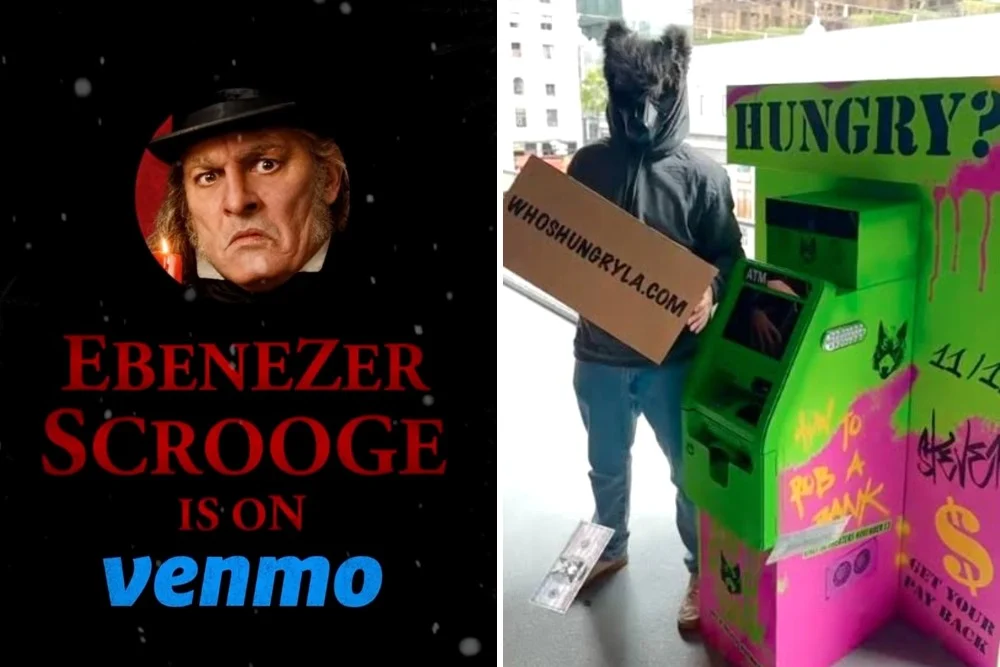
For Amazon MGM’s How to Rob a Bank, an ensemble heist thriller that frames bank robbery as a form of social justice, the marketing was literal. A branded, fully functional ATM was transported between various multiplexes across the Los Angeles metropolitan area over a four-day period. To interact with the machine, fans had to follow the film’s social media channels to decode clues regarding the ATM’s location and a specific PIN. Those successful in the "heist" were rewarded with a single one-hundred-dollar bill.
The ‘Ebenezer’ Venmo Campaign
Conversely, Skydance’s Ebenezer—a modern, slightly darker take on Charles Dickens’ A Christmas Carol—opted for a digital approach. Promoting an official Venmo account for Johnny Depp’s titular character, the studio invited users to request funds from the legendary miser. In a move that stayed true to the character’s penny-pinching roots, the account only fulfilled requests for exactly one cent. Despite the nominal payout, the stunt generated significant traffic, with reports indicating the account briefly crashed under the weight of thousands of incoming requests.
Chronology: A Multi-Week Blitz
The rollout of these campaigns followed a strategic timeline designed to peak just as advance ticket sales went live.
Late October 2026: Paramount and Skydance began teasing the @Ebenezer Venmo account through cryptic Instagram posts. Simultaneously, Amazon MGM began a "social listening" campaign, identifying users who expressed financial frustration and responding with emojis of safes and money bags.
November 1–4, 2026: The How to Rob a Bank ATM appeared in Los Angeles.
- Day 1: The ATM was spotted at a Regal cinema in Sherman Oaks. Clues were released via X (formerly Twitter).
- Day 2: The machine moved to a location in Santa Monica.
- Day 3: The hunt moved inland to Pasadena.
- Day 4: The final location was kept secret until an hour before activation, causing a minor traffic jam near a Hollywood multiplex.
November 6, 2026: The @Ebenezer Venmo account went live for a three-hour window. During this time, the account engaged in "micro-payouts" of $0.01. Interestingly, some fans reversed the dynamic by sending money to the account as a sign of support for Johnny Depp, leading to a logistical headache for the studio’s accounting department.

November 8, 2026: Paramount issued a "check back" teaser on Instagram, suggesting that Ebenezer Scrooge might "feel generous" again closer to the November 13 release date.
Supporting Data: Costs, Reach, and Viral Impact
While these stunts feel like massive expenditures, the data suggests they are remarkably cost-effective compared to traditional television or billboard advertising.
Budgetary Efficiency
According to the promotional website for How to Rob a Bank, each ATM location was capped at a specific prize pool: ten $100 bills and twenty $20 bills, totaling $1,400 per location. Over four days, the direct cash outlay was approximately $5,600. When factoring in the cost of the specialized ATM casing and staffing, the total spend for the four-day LA activation likely stayed under $25,000. In contrast, a single 30-second local TV spot in the LA market can cost significantly more while offering less "shareable" engagement.
The Ebenezer campaign was even more frugal. Outside of the labor hours required to manage the Venmo account, the total "payout" of one-cent transactions likely amounted to less than $500, yet it generated top-tier placement on news aggregation accounts like Culture Crave and DiscussingFilm, which reach millions of followers.
Comparative Campaigns
The trend of "cash-first" marketing has been accelerating throughout 2025 and 2026:
- April 2025: Lionsgate reportedly distributed $250,000 to fans who texted a number displayed in Times Square to promote Now You See Me: Now You Don’t.
- May 2026: Neon’s I Love Boosters campaign saw stars KeKe Palmer and LaKeith Stanfield take over a Shell station in Los Angeles to provide free gas to the first 70 cars. This stunt was particularly resonant as it coincided with a fuel crisis sparked by geopolitical tensions in the Strait of Hormuz.
Official Responses: Studios and Participants
The reaction to these stunts has been a mix of corporate silence and fan enthusiasm.
The Studio Stance
Amazon MGM declined to comment on the specifics of the ATM’s algorithm, though an employee at the Regal Sherman Oaks noted that the machine seemed to dispense rewards randomly rather than to the first people in line. Stellar Agency Inc., the firm responsible for administering the How to Rob a Bank promotion, did not respond to requests for comment regarding the security measures taken for a machine filled with cash.
Paramount, representing Ebenezer, declined to confirm if the Venmo account "crashed" or was simply throttled by the platform. However, an individual with knowledge of the account clarified that all funds sent to the Scrooge account by fans were eventually returned via private transactions.
The Fan Perspective
Krystyna Ursta, a 27-year-old actress and Depp fan in Los Angeles, became a mini-celebrity within the campaign when she sent $30 to the Ebenezer account. "I kind of figured they would return it," Ursta said. "I’m such a big fan, I was happy to support the film." Not only did Paramount return her money, they added an extra penny and invited her to a special screening in New York.

Others were more cynical. Scott, a 35-year-old from Atlanta, engaged with the Venmo account but described the experience as part of a "boring dystopia."
"The idea of a fictional character from a 200-year-old story being commercialized on Venmo shows how dumb Hollywood can be," Scott remarked. "It’s like McDonald’s Monopoly: take our slop and we might give you money."
Implications: The Intersection of Marketing and Economic Anxiety
The rise of financial-incentive marketing cannot be viewed in a vacuum. It is a direct reflection of the current socio-economic climate, where "money-mindset" content dominates social media feeds.
The ‘MrBeast’ Influence
The influence of YouTube creator MrBeast, whose entire brand is built on large-scale philanthropy and cash giveaways, is evident here. Studios have realized that audiences are no longer content to simply watch a trailer; they want to participate in a "moment" that has tangible, real-world value. By gamifying the act of being a fan, studios are turning audiences into active participants in the marketing machine.
The Political Parallel
The tackiness of these stunts mirrors a broader trend in American public life. The article notes that the Ebenezer and Bank campaigns coincide with a political environment where direct financial promises are becoming standard. President Trump’s recent promise of $5,000 checks to every adult U.S. citizen—contingent on the GOP retaining control of Congress in the midterm elections—represents the ultimate version of this "cash-for-attention" strategy.
Just as a studio uses a $100 bill to lure a viewer to a heist movie, political entities are using the promise of direct liquidity to bolster dismal approval ratings. In both cases, the offer is often dubious or carries a "catch," but the cost of floating the idea is zero, while the media coverage it generates is priceless.
Conclusion: A New Standard?
As How to Rob a Bank and Ebenezer head into their opening weekends, the success of these campaigns will be measured not just in box office receipts, but in the "earned media" they generated. If a $5,000 investment in an ATM can generate more buzz than a $5 million digital ad buy, the industry may be entering an era where the "movie star" is less important than the "movie stunt."
For the average consumer, this means the line between entertainment and the economy will continue to thin. In the "boring dystopia" of 2026, the best way to get someone to watch a story about a man who hates money is, ironically, to offer them a penny for their thoughts—and their data.