The Intersection of Ludology and Epidemiology: How a Game Design Sketch Predicted the Pandemic’s Toll
Six years after the onset of the COVID-19 pandemic, the global community continues to grapple with the long-term socio-economic and public health consequences of the crisis. While the initial discourse was dominated by confusion and skepticism, a subset of professionals—statisticians, quants, and game designers—found themselves uniquely equipped to interpret the looming threat through the lens of exponential growth. Among them was veteran game designer Raph Koster, whose early warnings and subsequent open-source design sketch sparked a grassroots movement in "serious gaming" that aimed to educate the public on the mechanics of viral transmission.
Main Facts: A Blueprint for Public Understanding
In the early months of 2020, as the world teetered on the edge of a global lockdown, Raph Koster—renowned for his work on Ultima Online and Star Wars Galaxies—published a conceptual framework for a simulation game. His goal was not entertainment, but the translation of complex epidemiological data into a "visceral" experience that the average person could comprehend.
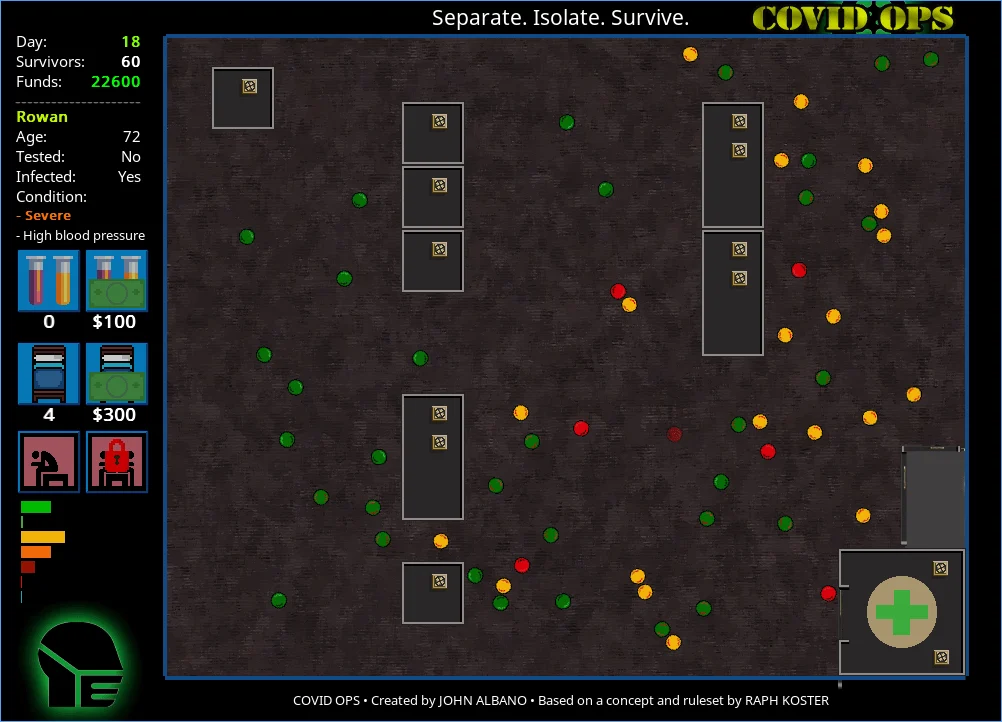
The "Koster Sketch," as it came to be known, proposed a simple yet scientifically rigorous simulation: little circles (representing people) bouncing in a field, each assigned a name, an age, and a statistically accurate probability of having comorbidities such as hypertension or diabetes. The simulation tracked the progression of a virus through various states: healthy, asymptomatic, symptomatic, hospitalized, and deceased.
This design served as the foundation for two significant independent projects: Covid Ops, developed by John Albano, and In the Time of Pandemia, created by a 48-person Filipino team led by Khail Santia. These games were not merely academic exercises; they were validated by medical professionals and mathematical biologists, eventually reaching tens of thousands of players and finding their way into university classrooms as educational tools.
Chronology: From Rumors to Simulation
The timeline of Koster’s involvement mirrors the escalating tension of the early pandemic.
- Late 2019: Koster began tracking reports of a novel respiratory illness in China. By November 2019, he was already posting warnings on social media, noting that the mathematics of the virus suggested a catastrophic global event.
- Early 2020: As the virus spread, Koster engaged in heated debates on social media platforms. He argued that the public—and even many "numerate" individuals—failed to grasp the implications of the Infection Fatality Rate (IFR) and the R value (the basic reproduction number). While critics laughed at predictions of millions dead, Koster’s internal spreadsheets, based on a conservative 0.4% IFR and 60% herd immunity threshold, consistently pointed toward a massive death toll.
- March 24, 2020: Frustrated by the "wall" of public denial, Koster posted his game design sketch to Facebook. He argued that game designers, who live and work with exponential curves in game economies and progression systems, were uniquely positioned to help the public "feel the challenges in their bones."
- March 30, 2020: Just six days after the post, developer John Albano released Covid Ops on Itch.io. The game was a faithful adaptation of Koster’s sketch, incorporating real-world comorbidity data and resource management mechanics.
- April – July 2020: Khail Santia and his team in the Philippines began work on In the Time of Pandemia during a strict community quarantine in Cebu City. The project grew from a game jam entry into a full-scale simulation.
- July 2020: In the Time of Pandemia launched on Newgrounds, where it topped the charts and received widespread international press coverage.
Supporting Data: The Mathematics of Mortality
The core of Koster’s argument—and the engine behind the games—was rooted in hard data that many chose to ignore at the time. Koster’s early projections assumed an average death estimate of 0.4%, which he noted was a "low assumption." In hindsight, the actual toll surpassed even some of his more sobering estimates.
The current estimated death toll in the United States stands between 1.2 and 1.4 million. Globally, estimates of excess mortality range from 15 million to as high as 28.5 million. These figures align closely with the "worst-case" scenarios Koster was calculating in his spreadsheets in early 2020.
A critical component of the simulation was the inclusion of comorbidities. Koster emphasized that the "at-risk" population was far larger than the public perceived. Supporting data cited in his research included:
- Hypertension: According to the American Heart Association, nearly 46% of adults in the U.S. have high blood pressure, a major risk factor for COVID-19 complications.
- Diabetes: The American Diabetes Association notes that over 10% of the U.S. population has diabetes, with an additional 34.5% of adults being pre-diabetic.
- Obesity: Studies published in JAMA indicate that obesity (BMI > 30) significantly increases the risk of hospitalization and death from the virus.
The games utilized these statistics to show that "protecting the vulnerable" was not a matter of isolating a small sliver of the population, but rather required broad, systemic interventions, as the at-risk group constituted a near-majority of the adult population.
Official Responses and Expert Validation
The impact of these simulations was amplified by the involvement of the medical and academic communities. Unlike many "pandemic simulators" that focused on the thrill of global infection (such as Plague Inc.), these games were designed to model the burden on the healthcare system and the efficacy of public health policy.
Dr. Mariane Faye Acma, a resident physician who consulted on In the Time of Pandemia, praised the game for its ability to develop critical thinking and multitasking skills in a crisis context. "You decide who are the high risks, who needs to be tested and isolated, where to focus, and how much funds to allocate," she stated. "The game will make players realize how challenging the work of the health sector is."
In the Philippines, Gregg Victor Gabison, Dean of the University of San Jose-Recoletos College of Information, Computer & Communications Technology, integrated the game into his curriculum. He noted that the game possessed a "storyline that connects with reality," providing students with a mindful way to engage with the pandemic’s complexities.
The press response was equally significant. In the Time of Pandemia went viral across the Pacific Rim, receiving coverage from IGN, Yahoo News, and The Star Malaysia. The media highlighted the game’s "local flavor," as the developers created levels representing specific neighborhoods in Cebu City, making the abstract math of the pandemic feel personal and immediate for local players.
Implications: Preparing for the Next "Exponential Curve"
Reflecting on the project years later, Koster and his collaborators view the experience as a testament to the power of games as a medium for social good. While some critics on platforms like Reddit dismissed Koster’s inclusion of these projects on his CV, the designer remains steadfast in their value.
"I’m proud of what a little design sketch turned into," Koster noted. "It was vetted and validated by multiple experts in the field and made a difference, however slight."
The implications of this work extend beyond the COVID-19 era. As of late 2024, the emergence of the first human cases of H5N1 (bird flu) has reignited fears of a new pandemic. The lessons learned from the 2020 simulations—specifically the difficulty of communicating exponential growth to a skeptical public—remain more relevant than ever.
The legacy of Covid Ops and In the Time of Pandemia suggests that when traditional communication fails, interactive simulations can bridge the gap. By allowing players to fail in a safe environment, these games foster a deeper understanding of why "soft" health responses and "lenient" lockdowns often lead to worse outcomes for both the economy and public health.
In the words of Khail Santia, the process of making the game provided a "thread connecting a diversity of talents" during a time of extreme isolation. For the designers, the math was a way to find order in the chaos. For the players, the games were a way to understand the invisible forces shaping their lives. As the world faces future biological threats, the intersection of game design and epidemiology may prove to be one of our most vital tools for survival.