The Metamorphosis of Julianne Moore: Inside Jesse Eisenberg’s ‘The Debut’ and the Race for Oscar Glory
MIDDLEBURG, VA — As the elevator doors opened at the Salamander Resort in Middleburg, Virginia, the figure that stepped out was unmistakable, yet strikingly vibrant. Julianne Moore, a titan of American cinema, greeted the room with a radiant warmth that belied the nervous, anxious character she portrays in her latest film. Dressed in a gold-yellow gown that contrasted sharply with her signature red hair and porcelain skin, Moore was fresh from a rapturous reception at the Middleburg Film Festival.
The occasion was the screening of The Debut, an A24 musical comedy that has rapidly ascended from a festival darling at Telluride to a bona fide Academy Award heavyweight. Directed by Jesse Eisenberg, the film marks a pivotal moment for both the filmmaker and his lead actress, positioning Moore as the definitive frontrunner for the Best Actress Oscar—a feat that would mark her sixth nomination and potentially her second win.
I. Main Facts: A New Jersey Community Theater as the Stage for a Masterclass
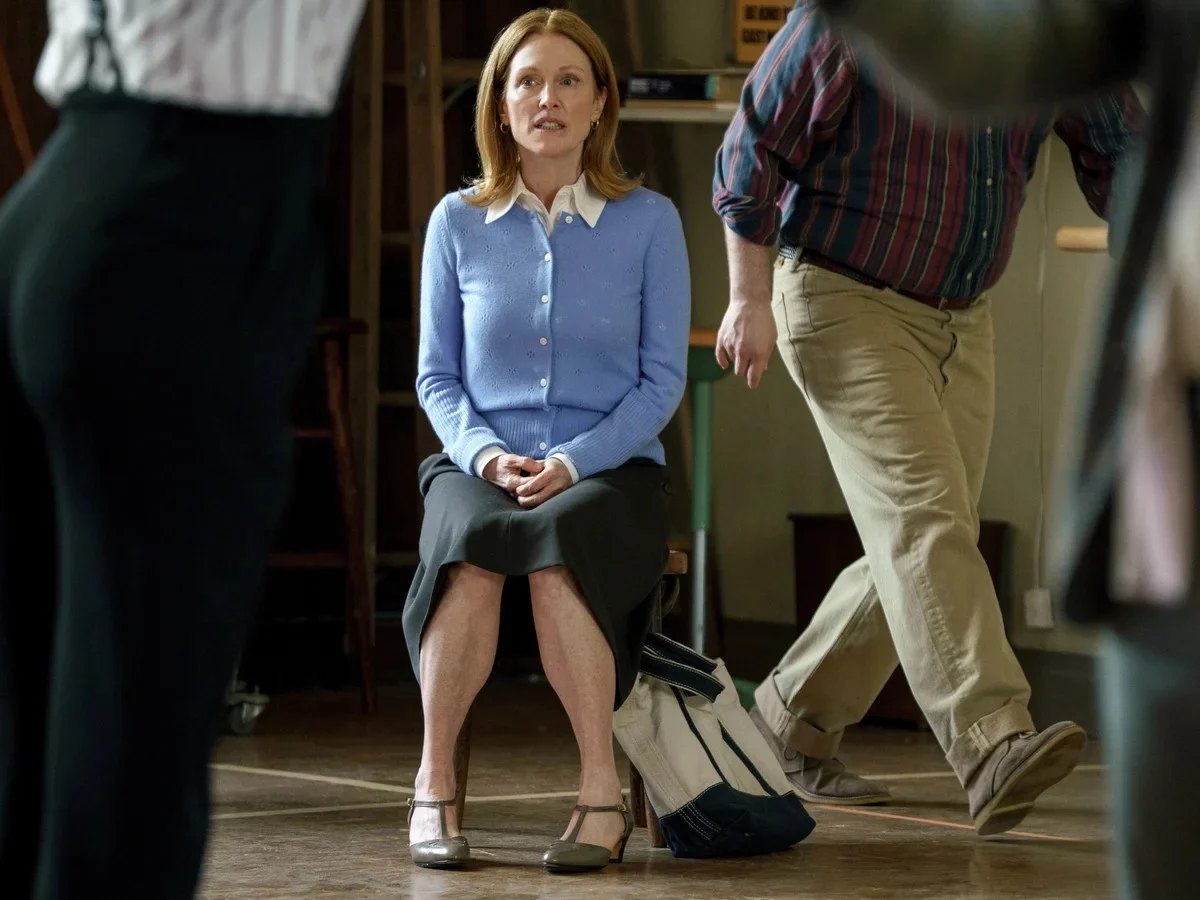
The Debut, scheduled for a wide release on December 11, is more than just a "crowdpleaser"; it is a surgical examination of the creative spirit. The film stars Moore as Mona, a "sad suburban homemaker" whose life has been defined by invisibility and domestic routine. In an effort to reclaim a sense of self, she wanders into the eccentric, often ego-driven world of New Jersey community theater.
The film’s narrative engine is fueled by the friction between Mona and Jerry, played by Paul Giamatti, an overbearing and pedantic local director who reluctantly takes Mona under his wing. What follows is a transformation—not just of a character, but of an actress. Moore’s performance has been hailed by critics as "undeniable," capturing the literal, childlike way an adult must learn to mimic emotion before they can truly feel it.

Key Production Details:
- Studio: A24
- Release Date: December 11
- Director/Writer: Jesse Eisenberg
- Starring: Julianne Moore, Paul Giamatti, Danny Burstein, Bonnie Tillman
- Genre: Musical Comedy
- Key Musical Number: "This City May Have Chewed Me Up (But It Hasn’t Spit Me Out)"
II. Chronology: From ‘Still Alice’ to the Eisenberg Collaboration
To understand the weight of The Debut, one must look at the trajectory of Moore’s storied career and her burgeoning creative partnership with Jesse Eisenberg.
Moore first garnered widespread acclaim and an eventual Oscar for Still Alice in 2015, but her roots trace back to the 1988 soap opera As the World Turns. Over the decades, she has become synonymous with "suffering mother" roles or high-stakes dramas. However, during the production of Eisenberg’s directorial debut, When You Finish Saving the World (2022), Moore expressed a desire for a change in direction.
"I told him that I would love to do more comedy," Moore recalled during our discussion in a quiet hotel meeting room. "I didn’t want to play some suffering mom. I had just done Dear Evan Hansen, and I loved singing; I wanted another opportunity to do that."
Eisenberg took these requests to heart. He began writing The Debut with Moore specifically in mind as his "muse." While the character of Mona is a middle-aged woman, Eisenberg revealed a surprising chronological inspiration: the character is essentially a version of himself as a seven-year-old in 1990, discovering the magic and terror of community theater for the first time.

The film’s journey began in earnest at the Telluride Film Festival earlier this year, where it was immediately identified as a major awards contender. From there, it wowed audiences at the Virginia Film Festival before arriving in Middleburg, building a momentum that A24 hopes to carry through the winter.
III. Supporting Data: The Craft of a "Monster" in One Take
The production of The Debut was characterized by its speed and the extraordinary preparation of its lead actors. Despite the film’s musical complexity and heavy dialogue, Eisenberg operated on a lean independent budget, often requiring his cast to deliver perfection on the first attempt.
The Efficiency of the Shoot
According to Eisenberg, the efficiency of Moore and Giamatti was "embarrassing" in its brilliance. The production schedule originally allocated two days for the film’s major ensemble musical numbers. However, because the actors arrived fully prepared and delivered "perfect" first takes, the crew managed to film both days’ worth of material in a single day.
The Eight-Page Confrontation
One of the film’s most discussed sequences is an eight-page "showstopper" where Giamatti’s character forces Mona to reach an emotional breaking point on an empty stage. To mitigate the "volume of language" that often freezes actors, Eisenberg offered Moore a safety net: a teleprompter.

"I didn’t want her to lose her mind drilling it," Eisenberg explained. However, Moore’s veteran instincts took over. She memorized the entire scene, rendering the teleprompter unnecessary. This scene serves as the emotional fulcrum of the film, where Mona stops "mimicking" acting and begins to attach her own subjective reality to her performance.
The Aesthetic Transformation
Mona’s evolution is mirrored in her physical appearance. She begins the film in "childlike" attire—skirts, blouses, and cardigans. However, after a plot point involving an accidental electrocution (a detail Moore and Eisenberg expanded upon), Mona undergoes a radical makeover. Moore chose to dye her hair dark and adopt a sharp, short cut as an "Easter egg" homage to Broadway legends like Liza Minnelli, Chita Rivera, and Patti LuPone.
IV. Official Responses: A Collaboration of Generosity
The feedback from the set suggests a rare level of synergy between director and cast. Moore was effusive in her praise for Eisenberg’s directorial style, noting that his background as an actor makes him uniquely empathetic to the needs of his performers.
"He’s maybe the most collaborative person I’ve ever worked with in my entire life," Moore said. "He listens to everyone. He’ll ask people for notes in a way that I would tell him, ‘You don’t have to do that. This is your movie.’ But he is fascinating in his generosity."

Eisenberg, for his part, views Moore as the essential vessel for his most personal story. "It’s my point of view through somebody I consider a muse," he said. He described Mona’s journey as that of a "kid who found friends for the first time," only to be told she is failing. The decision Mona makes to "show up" rather than quit is what Eisenberg describes as the moment she "begins to turn into a monster"—a performer who demands the spotlight.
Paul Giamatti’s contribution was also highlighted as vital. Despite having never worked together before—their only prior interaction was a shy introduction in a Montauk bookstore—Moore and Giamatti developed an "electric" rhythm. "You throw something, he hits it right back," Moore said. "He is the greatest scene partner… present, incredibly modest, and so available."
V. Implications: The Oscar Race and the Future of the Musical Comedy
The success of The Debut has significant implications for the upcoming awards season and the broader film industry.
The Best Actress Frontrunner
While winning a previous Oscar (as Moore did for Still Alice) can sometimes be a disadvantage due to "voter fatigue," the industry consensus is that Moore’s performance in The Debut is "undeniable." If she wins, she joins an elite echelon of multi-time winners including Meryl Streep and Frances McDormand. The "degree of difficulty"—combining comedy, singing, and a complex character arc—gives her a distinct edge over more traditional dramatic performances.

Eisenberg’s Directorial Ascent
For Jesse Eisenberg, The Debut confirms that his success with A Real Pain (which secured an Oscar for Kieran Culkin) was no fluke. He is carving out a niche as a writer-director who specializes in "joyful and life-affirming" stories that don’t shy away from the anxieties of the human condition. His ability to draw career-best work out of veterans like Moore and Giamatti marks him as one of the most exciting filmmakers of his generation.
The Resurgence of A24
For A24, The Debut represents another potential "crowdpleaser" that bridges the gap between high-art indie film and mainstream accessibility. By leaning into the "community theater" subgenre, the film taps into a universal nostalgia for finding community and the transformative power of creativity.
As the interview concluded and Moore prepared to head back to the festival circuit, she reflected on the film’s central song: "This City May Have Chewed Me Up (But It Hasn’t Spit Me Out)." It is a sentiment that reflects Mona’s resilience, but perhaps also Moore’s own enduring place at the top of her craft. In The Debut, she hasn’t just found a new character; she has found a new way to surprise us.