
Christopher Buehlman Unveils "The Daughters’ War": A Harrowing Prequel Forging Hope in a World Besieged
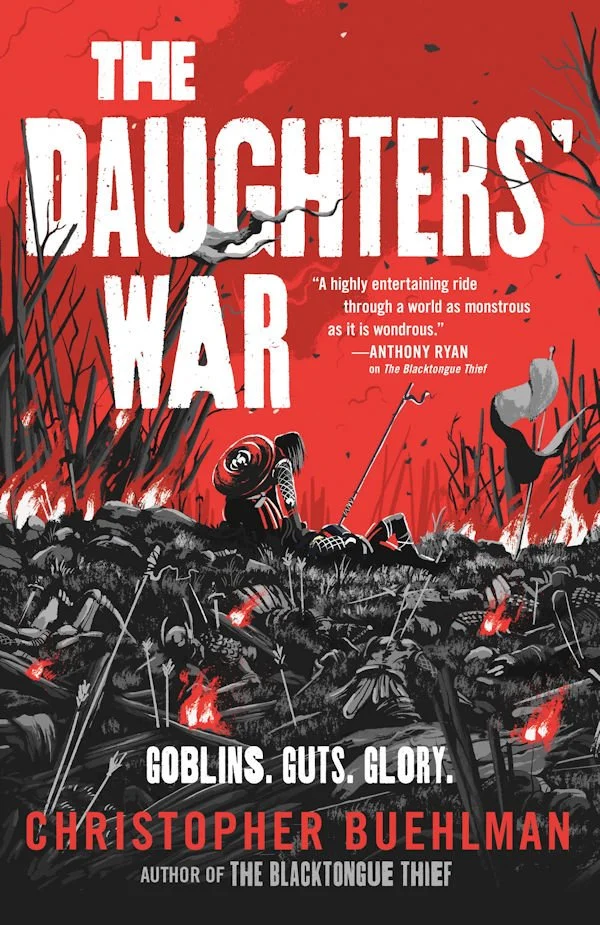
A new chapter in grimdark fantasy opens as acclaimed author Christopher Buehlman delves deeper into the brutal world of his bestselling The Blacktongue Thief. His latest novel, The Daughters’ War, serves as a harrowing prequel, chronicling humanity’s desperate struggle against an unrelenting goblin horde and the rise of an unlikely, all-female fighting force known as the Raven Knights.
Main Facts
A World on the Brink: Introducing "The Daughters’ War"
Christopher Buehlman’s The Daughters’ War plunges readers into a world teetering on the precipice of annihilation. Before the events of The Blacktongue Thief, humanity faces an existential threat from the grotesque and merciless goblin race, known colloquially as the Biters. These creatures have systematically dismantled human civilization, leaving a trail of devastation that includes slaughtered livestock, enslaved populations, and scorched farmlands. The very fabric of human society has been torn asunder, forcing an unprecedented and desperate response: the enlistment of daughters into the war effort.
At the heart of this grim narrative is Galva, or Galvicha to her family, a young woman from the powerful Dom Braga lineage who defies societal expectations and her family’s fervent wishes. Instead of adhering to traditional roles, Galva volunteers for the Raven Knights, an untested, all-female military unit. This specialized corps represents a radical new strategy in a war where conventional tactics have failed. Their mission is as perilous as it is vital: to march towards a once-beautiful city now swallowed by the goblin tide, aiming to reclaim what was lost and, perhaps, turn the tide of a seemingly unwinnable war.
What distinguishes the Raven Knights, and indeed the entire human resistance, is their formidable, albeit unsettling, allies: scores of giant war corvids. These fearsome black birds are not merely animals; they are products of "darkest magics," engineered for combat and imbued with an unnatural intelligence. They are a weapon of last resort, a gamble that might just hold the key to stopping the goblins’ horrifying ambition to reduce humankind to mere cattle. The Daughters’ War promises a journey that is not only bloody and brutal but also deeply introspective, exploring the bonds of family, the wisdom of leaders, and the ever-present danger that lurks both within the enemy ranks and among their own ranks.
Christopher Buehlman’s Dark Vision Expands
Buehlman, renowned for his unflinching approach to grimdark fantasy and horror, expands his richly detailed and often terrifying universe with The Daughters’ War. This prequel offers readers an origin story for the grim realities encountered in The Blacktongue Thief, providing crucial context and deepening the lore. The novel vividly portrays a world where hope is a fragile commodity, clinging to the desperate measures undertaken by a besieged humanity.
The narrative is steeped in an atmosphere of dread and desperation, a hallmark of Buehlman’s distinctive style. He doesn’t shy away from the visceral realities of war, painting a stark picture of a conflict where humanity is consistently on the back foot. The "darkest magics" employed to create the war corvids highlight the extreme measures to which humans have been driven. These "fearsome black birds" embody both the potential for salvation and the inherent dangers of dabbling with forces beyond ordinary comprehension, adding layers of tension and moral ambiguity to the unfolding saga. Buehlman’s vision is one where survival demands not just courage and skill, but also a willingness to confront the deepest horrors, both external and internal.
Chronology
The Unfolding Cataclysm: A Timeline of Despair
The narrative of The Daughters’ War is rooted in a cataclysmic history, one that has systematically eroded human civilization. The opening lines of the original account paint a chilling picture: "The goblins have killed all of our horses and most of our men. They have enslaved our cities, burned our fields, and still they wage war." This stark declaration sets the stage for a prolonged and devastating conflict that has pushed humanity to the brink of collapse. For generations, the goblins have maintained a relentless offensive, their tactics brutal and effective, leaving little room for human recovery or resurgence.
The chronology of despair has followed a grim pattern: initial incursions leading to widespread destruction, followed by the systematic enslavement of populations and the decimation of resources. Cities, once vibrant centers of human culture, have become mere outposts for the goblin horde, their inhabitants reduced to servitude or worse. The continuous nature of the war, "still they wage war," underscores the relentless pressure on human societies, stripping away their resilience and forcing them into increasingly desperate strategies.
The turning point, or rather the moment of desperate innovation, arrives when traditional male-dominated armies are no longer sufficient to stem the tide. "Now, our daughters take up arms" signifies a profound societal shift, a breaking of ancient traditions in the face of absolute necessity. This is not a choice born of feminist ideals, but a stark reality of survival, where every able-bodied individual, regardless of gender, must contribute to the fight. Galva’s personal journey mirrors this societal pivot, as she defies her family’s wishes, leaving the relative safety and privilege of her noble house to join the burgeoning war effort. Her enlistment in the Raven Knights marks the immediate operational phase of this new, radical approach to combat, as they are quickly dispatched on a critical mission: to reclaim a goblin-overrun city. This prequel meticulously details the "before" – the origins of the characters, the nature of the conflict, and the nascent strategies that will ultimately define the world readers encounter in The Blacktongue Thief.
Galva’s Genesis: From Noble House to Killing Ground
Galva’s genesis as a warrior is central to The Daughters’ War. Born into the formidable Dom Braga family, a lineage presumably accustomed to power and prestige, Galva is expected to uphold her family’s name through conventional means. However, the pervasive shadow of the goblin war renders such expectations meaningless. Her decision to forsake her birthright is not merely an act of rebellion but a profound commitment to face the "brutal reality of war at the front, in the killing grounds." This choice immediately sets her apart, defining her as a character of extraordinary courage and conviction, willing to sacrifice comfort and status for the slim hope of survival for her people.
Her journey into the military is intertwined with the formation of the Knight Ravens, a unique and unprecedented unit. Described as an "all-female unit forged as a unique weapon against the goblins," the Knight Ravens represent a strategic innovation born of desperation. This unit is not just composed of women; it is designed to leverage a distinctive, powerful asset: "warriors who fight not only with blades, but alongside magically imbued war birds known as corvids. Enormous, intelligent, and created to kill." The creation of such a unit, combining human skill with engineered monstrous allies, speaks volumes about the dire straits of humanity. It suggests that traditional military structures and methodologies have failed so catastrophically that radical, almost arcane, solutions are now embraced. Galva’s integration into this unit places her at the forefront of a new kind of warfare, where the line between natural and unnatural, human and beast, becomes increasingly blurred, forging her into the hardened, resolute figure seen in later narratives.
Supporting Data
The Anatomy of a Nightmare: Buehlman’s Goblins
One of Christopher Buehlman’s most impactful contributions to contemporary fantasy is his redefinition of the goblin. In The Daughters’ War, these creatures, known as the Biters, are stripped of any comedic or simplistic fantasy tropes, emerging as a genuinely terrifying force. They are depicted not as mere antagonists, but as "grotesque creatures drawn from folklore," conjuring images of ancient, primal evils rather than typical fantasy fodder. This return to their mythical roots transforms them into a "true medieval nightmare," a monstrous embodiment of fear and brutality that resonates deeply with the human subconscious.
Buehlman meticulously details their horrifying disregard for human life. Humans, referred to as "kynd," are treated "like cattle. Animals to be caged, butchered, and consumed." This chilling comparison underscores the goblins’ complete dehumanization of their prey, highlighting their alien and utterly merciless nature. Their "complete disregard for sentience" is perhaps their most unsettling trait, elevating them beyond mere antagonists to a force of pure, unthinking destruction. This inherent savagery and lack of empathy make them a "constant oppressive threat" throughout the novel. Every encounter, every glimpse, every mention of the Biters serves to remind Galva and the reader of the ever-present danger, forcing Galva to draw upon "every ounce of courage and resolve" to simply survive, let alone fight back. Unlike many fantasy narratives where goblins are often cannon fodder, Buehlman’s Biters are a pervasive, existential terror that grounds the grim reality of the war.
Corvids: Wings of Desperation and Hope
The war corvids are undoubtedly one of the most compelling and unique elements of The Daughters’ War. These "magically engineered war birds, related to crows," are presented as humanity’s last, desperate hope against the overwhelming goblin threat. Their formidable nature is consistently emphasized: "Enormous, intelligent, and created to kill." Their sheer size and innate predatory instincts, combined with the dark magic woven into their being, make them terrifyingly effective instruments of war. They represent a significant technological and magical leap for humanity, a testament to the dire circumstances that necessitate their creation.
However, the corvids embody a profound duality. While they are humanity’s best chance, they also introduce an element of danger and uncertainty. The original text notes the "dangerous war birds at their side," hinting at the inherent risks of allying with creatures forged from "darkest magics." This ambiguity adds a layer of tension to Galva’s journey; the line between ally and threat is constantly blurred, echoing the moral compromises made in total war. For Galva, these corvids become more than just weapons; they anchor her story through a "deeply intense and protective bond." This relationship is not merely strategic; it’s emotional, providing a unique dimension to her character development. The corvids, therefore, symbolize both the fragile hope for victory and the pervasive "fear of the unknown" that runs throughout Galva’s journey – a fear that resonates universally with readers confronting new and unforeseen challenges.
Narrative Craft: Perspective, Pacing, and Emotional Resonance
Buehlman’s narrative craft in The Daughters’ War is exceptional, contributing significantly to its impact. The story is told "almost entirely through Galva’s perspective," which immerses the reader directly into her experiences, fears, and evolving understanding of the war. This first-person viewpoint makes her arc – from a potentially "one-dimensional" protagonist to a "deeply human" character – all the more compelling and believable. Readers witness her transformation firsthand, feeling her hardening resolve and the subtle softening of her character through crucial interactions.
Occasional "interludes in the form of journal entries from her younger brother, Amiel," serve as a brilliant counterpoint to Galva’s often "harsh and resolute voice." Amiel, described as "more sensitive and introspective," offers a "more romanticised view of the war," providing a crucial emotional and philosophical contrast. This dual perspective enriches the narrative, allowing Buehlman to explore different facets of the human experience during conflict.
The "exceptional pacing" of the book is another standout feature. Unlike many fantasy novels that rely on "constant escalation, epic battles, relentless action, and rapid reveals," Buehlman adopts a "more measured approach." He masterfully "inserts quieter moments where everything slows, allowing the reader to reflect and fully absorb the intensity of what surrounds them." This strategic balance prevents reader fatigue and lends greater weight to both the brutal action sequences and the moments of profound stillness. These quieter scenes are also pivotal for character development, revealing "Galva’s more empathetic side" and making her journey of personal growth all the more poignant and relatable. The novel’s emotional depth, expressed through "unconditional love, fierce pride, deep pity, and bitter hate," is delivered in its "rawest form," particularly through Galva’s evolving relationships with her brothers, her corvids, and her exploration of her own sexuality, making her evolution feel authentically human.
Brutality and Authenticity: The Battlefield Unveiled
Where The Daughters’ War truly distinguishes itself within the grimdark genre is in its unflinching depiction of combat. "Brutality is where the novel truly shines, particularly on the battlefield." Buehlman’s combat scenes are not merely violent; they are "visceral enough to make even seasoned grimdark readers wince." This isn’t achieved through gratuitous gore for its own sake, but through a focus on "sheer carnage and vivid detail" that creates something both "gripping and disturbingly authentic."
The author consciously avoids overly technical or strategy-heavy battle descriptions, instead focusing on the raw, chaotic, and horrifying experience of fighting for survival. This approach allows the reader to feel the terror, the desperation, and the sheer physical toll of close-quarters combat against the grotesque Biters. The authenticity stems from this intense focus on the sensory and emotional impact of the battlefield, making every blow, every injury, and every death profoundly felt. This commitment to portraying the stark realities of war, devoid of romanticism or sanitization, cements The Daughters’ War as a powerful entry in the grimdark canon, appealing to readers who appreciate a truly uncompromising and immersive experience of conflict.
Official Responses
Critical Acclaim and Reader Engagement
While "official responses" in the sense of governmental or institutional statements are not applicable to a novel, the critical reception and reader engagement for The Daughters’ War serve as its most significant endorsement. The review consistently highlights the novel’s profound impact, describing it as "deeply harrowing" and evoking a "persistent sense of dread throughout." This atmosphere, Buehlman’s meticulous world-building, and his portrayal of a "world besieged by such relentless and overwhelming conflict" are universally praised for their authenticity and immersive quality.
Initially, some readers, including the reviewer, might find "the opening somewhat slow" and Galva "slightly one-dimensional." However, this initial perception is strategically leveraged by Buehlman to make her eventual character arc "more compelling." As the narrative progresses, characters "deepen," leading to increasing reader investment – "almost as if I had become part of her journey." This organic character development, combined with the novel’s relentless tension, ensures a powerful reading experience, culminating in an "ending to this story [that] is a true high point, building to a peak of intensity, violence, and emotion." The conclusion is described as "deeply satisfying," leaving readers "completely absorbed, unable to put the book down."
Crucially, as a prequel to The Blacktongue Thief, The Daughters’ War successfully achieves its objective: "to build a compelling foundation for Galva, to give her actions and temperament greater weight and meaning." The consensus is that Galva is "more than worthy of her own narrative," suggesting that the book not only stands alone but also enriches the understanding of her character in subsequent readings of The Blacktongue Thief. The overall sentiment points to a novel that is not just a grimdark fantasy but a complex and emotionally resonant journey that leaves a lasting "impression that is difficult to shake."
Implications
The Enduring Legacy of "The Daughters’ War"
The Daughters’ War is poised to leave an enduring legacy, not only as a compelling prequel but as a significant contribution to the grimdark fantasy genre. Its implications stretch beyond the immediate narrative, influencing how readers perceive the world of The Blacktongue Thief and redefining the expectations for dark fantasy. The novel is more than just a tale of war; it’s "a complex story of resilience, personal discovery, and companionship" forged in the crucible of extreme adversity.
Buehlman masterfully "drags you into the blood-soaked mire of the battlefield," ensuring that the reader is not a passive observer but an active participant in the horrors. The persistent presence of the Biters "leaves you trembling," a testament to their chilling portrayal. Yet, amidst this despair, the story "pulls at your emotions through the bonds between family, companions, and lovers," highlighting the enduring power of human connection even in the darkest times. This balance between visceral horror and profound emotional depth is a hallmark of its lasting impact.
The quote, "Short life, bloody hand," attributed to Galva, encapsulates the very essence of the novel’s thematic core. It is "less a warning than a promise. One forged in war and survival. A promise to yourself, to others, and to your enemies." This mantra echoes the brutal, unflinching, and quietly devastating nature of Buehlman’s work, imprinting itself upon the reader’s mind long after the final page. The Daughters’ War deepens the lore of Buehlman’s world, providing invaluable context for Galva’s character and actions in The Blacktongue Thief, making a re-read of the latter a potentially richer experience. Its success lies in its ability to be a complete, satisfying story in its own right, while simultaneously enriching a broader narrative tapestry.
Looking Ahead: The Future of Buehlman’s Saga
The release of The Daughters’ War not only satisfies the immediate craving for more of Christopher Buehlman’s distinctive storytelling but also sets a formidable stage for future installments. With the announcement that The Thrice-Bound Fool is "releasing in October later this year," anticipation among fans is naturally heightened. This prequel has successfully reignited interest in the series, drawing in new readers while offering existing fans a deeper, more nuanced understanding of a beloved character.
The events of The Daughters’ War and the profound character development Galva undergoes will undoubtedly influence the trajectory of Buehlman’s ongoing saga. Her experiences on the "killing grounds," her leadership within the Raven Knights, her bond with the terrifying corvids, and the emotional scars she accrues will shape her temperament and decisions in future narratives. Readers will now approach The Blacktongue Thief and subsequent novels with an enriched perspective on Galva’s motivations and resilience, appreciating the crucible from which she emerged.
Buehlman’s commitment to a "harsh, grounded, and deeply harrowing" world, coupled with his masterful blend of horror, grimdark fantasy, and profound emotionality, ensures that his saga will continue to resonate. The Daughters’ War is a testament to the enduring power of his storytelling, promising that the future of this world, though bleak, will remain captivating, brutal, and utterly compelling. As readers eagerly await The Thrice-Bound Fool, the echoes of Galva’s promise – "Short life, bloody hand" – serve as a stark reminder of the sacrifices and resolve that define this unforgettable universe.


Leave a Comment