
Headline: The Rise of the ‘Cosy’ Sim: Trash Goblin Surpasses Funding Goals as Spilt Milk Studios Enters Final 24 Hours of Kickstarter Campaign
By Digital Industry Correspondent
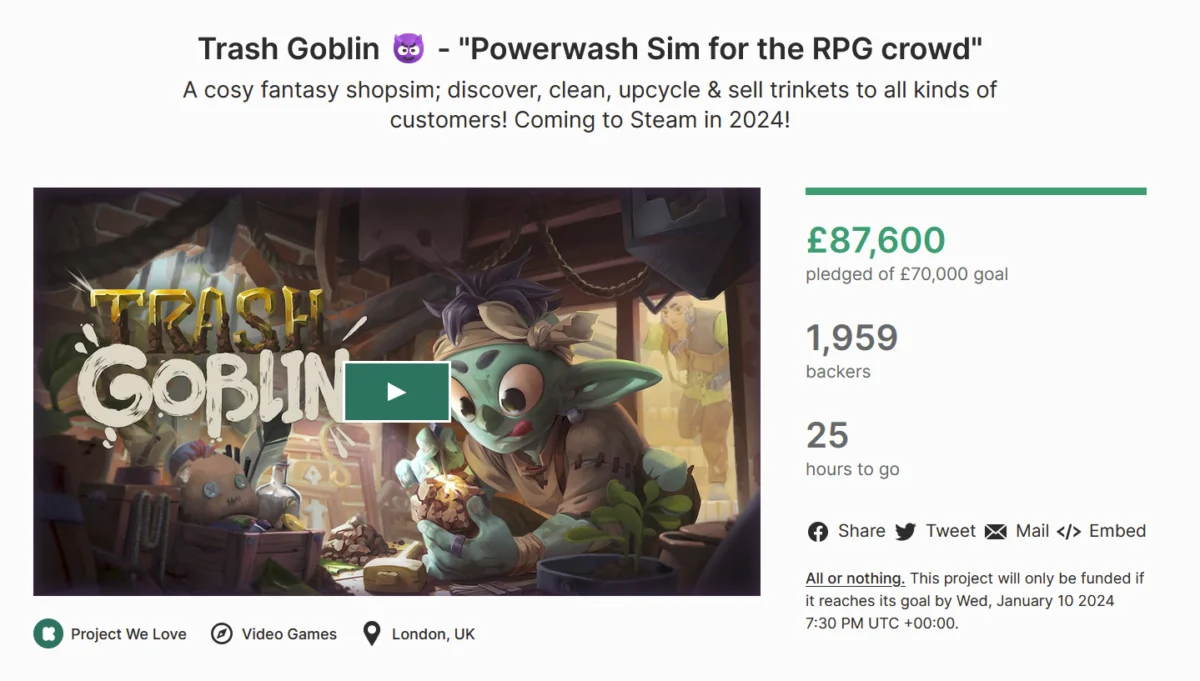
The independent gaming landscape is witnessing a significant milestone as Trash Goblin, a "cosy" trinket-cleaning simulator developed by Spilt Milk Studios, has officially surged past its primary funding target on Kickstarter. As of January 9, 2024, the project has secured 124% of its initial goal with only 24 hours remaining in the campaign. This success marks a pivotal moment for the London-based studio and highlights the burgeoning market for low-stress, "wholesome" gaming experiences that prioritize tactile satisfaction over high-stakes combat.
Led by industry veteran Nicholas Lovell, who recently transitioned from a non-executive to an executive role within the company, the campaign is now making a final push toward a "magic" stretch goal of £100,000. The project’s success reflects a broader trend in the games industry where niche, high-fidelity simulation games are finding massive audiences through community-led crowdfunding.
Main Facts: A New Contender in the Wholesome Gaming Space
Trash Goblin is described by its creators as a "cosy trinket-cleaning game," a description that succinctly captures its appeal to a specific but rapidly growing demographic. Often likened to a fantasy-themed Powerwash Simulator, the game tasks players with the meticulous cleaning, repair, and upcycling of discarded items found in a vibrant RPG-inspired world.
The core gameplay loop revolves around the "zen-like" satisfaction of restoration. Players take on the role of a goblin shopkeeper who discovers encrusted, dirt-covered artifacts. Using a variety of tools, players must carefully chip away grime, polish surfaces, and occasionally customize items to meet the requests of a quirky cast of customers.
The Kickstarter campaign was launched to bridge the gap between initial development and a full-scale release. Having reached 124% of its goal, the studio has confirmed that the base version of the game is fully funded. However, the final 24 hours are being utilized to secure additional resources for "stretch goals"—enhanced features that could include expanded item libraries, deeper narrative paths, or porting the title to additional platforms beyond its confirmed Steam release.
Chronology: From Concept to Crowdfunding Success
The journey of Trash Goblin began within the creative halls of Spilt Milk Studios, a developer known for its eclectic portfolio and commitment to independent publishing. The studio’s trajectory shifted significantly in late 2023 when Nicholas Lovell, a renowned strategist and author of The Curve, increased his involvement in the firm.
The Pre-Launch Phase:
Throughout 2023, the development team focused on refining the "tactile" feel of the game. In simulation titles, the physics of cleaning and the visual feedback of restoration are paramount. The team utilized early demos and social media teasers to gauge interest, finding a particularly strong resonance within the "Wholesome Games" community—a subculture that gained massive traction during the pandemic.
The Kickstarter Launch (December 2023):
The campaign launched in the final weeks of 2023. Unlike many high-profile "triple-A" Kickstarters that rely on cinematic trailers, Spilt Milk focused on gameplay transparency. They showcased the core mechanics: the scraping of rust, the sponge-work, and the satisfying "ding" of a cleaned item. This approach resonated with fans of the "cosy" genre, which values transparency and developer-player intimacy.
Post-New Year Surge (January 2024):
Funding reached its 100% milestone shortly after the New Year. This timing is often considered risky in the industry, as consumer spending typically dips after the holiday season. However, Trash Goblin defied the trend, reaching 124% by January 9th. The momentum was sustained by a dedicated community of "trinket-collectors" and fans of the studio’s previous work.
The Final 24 Hours:
Entering the final day of the campaign, the studio has set its sights on the £100,000 mark. This figure represents more than just a financial milestone; it serves as a proof of concept for the studio’s self-publishing model in a year that has otherwise been difficult for the global gaming industry.

Supporting Data: The Economic Logic of "Cosy" Games
The success of Trash Goblin is not an isolated incident but rather a data point in a shifting market. According to industry analysts, the "Cosy Gaming" genre—defined by non-violent gameplay, soothing aesthetics, and domestic tasks—has seen a 30% year-on-year growth in Steam tags and social media engagement.
- The "Powerwash" Effect: Powerwash Simulator, a primary inspiration for Trash Goblin, has amassed over 7 million players across all platforms. It proved that "mundane" tasks, when gamified with high-fidelity feedback, have massive commercial potential.
- Kickstarter Resilience: While overall crowdfunding for technology saw a slight dip in 2023, the "Games" category remains the most funded sector on Kickstarter. Projects that offer a "vertical slice" (a playable or highly demonstrable portion of the game) are 60% more likely to reach their goals.
- Steam Wishlisting: Alongside the 124% funding, Spilt Milk Studios reported a significant uptick in Steam wishlists. In the modern indie ecosystem, a "wishlist" is a critical leading indicator of future sales, often carrying as much weight as upfront funding for long-term sustainability.
For Spilt Milk Studios, the financial backing of nearly £100,000 provides the necessary runway to maintain creative independence. By avoiding traditional publisher routes for this specific title, the studio retains 100% of the IP rights and creative control, a move that Nicholas Lovell has long advocated for in his business literature.
Official Responses: Leadership and Vision
Nicholas Lovell’s transition into an executive role at Spilt Milk Studios brings a unique perspective to the project. Known for his expertise in the "freemium" model and digital economics, Lovell’s move into the "cosy" premium indie space is a notable pivot.
In a personal statement regarding the campaign’s success, Lovell expressed both professional pride and personal resilience. "I’m so excited that the Kickstarter I’m part of has funded," Lovell noted. He also touched upon the personal challenges of working while managing "Long Covid," explaining that while he remains part-time, his involvement has become "much more involved" as the studio moves toward the executive execution of Trash Goblin.
"We funded just after New Year, and are currently 124% funded," Lovell stated. "It would be amazing if we could get over that magic £100,000."
The studio’s broader message to the community has been one of gratitude. They have framed the Kickstarter not just as a fundraiser, but as a "co-creation" process. Backers have been invited to suggest item types and provide feedback on the "feel" of the cleaning tools, ensuring that the final product aligns perfectly with the expectations of the "RPG crowd" it seeks to serve.
Implications: The Future of Self-Publishing and Genre Blending
The success of Trash Goblin carries several implications for the wider indie development community:
1. The Viability of "Niche-Plus" Games:
Trash Goblin succeeds by blending two distinct niches: the cleaning simulator and the fantasy RPG. By targeting the "RPG crowd" with a non-combat mechanic, Spilt Milk is tapping into a market of players who love the world-building of fantasy games but may be fatigued by traditional combat loops. This "genre-blending" is likely to become a dominant strategy for indie developers looking to stand out in a crowded marketplace.
2. The Strength of the "Long-Tail" Strategy:
Nicholas Lovell’s involvement suggests a business strategy focused on "The Curve"—a theory he popularized where a small group of super-fans (the Kickstarter backers) provide the foundational revenue that allows a product to later reach a mass audience. This model reduces reliance on predatory monetization and focuses on high-value engagement.
3. The Rise of "Tactile Gaming":
As graphics reach a point of diminishing returns, developers are focusing on "feel." Trash Goblin represents a move toward sensory-focused gaming. The focus on the sound of a brush, the visual disappearance of dirt, and the physical "weight" of objects suggests that the next frontier of immersion is not just visual, but haptic and auditory.
4. A Beacon for UK Indie Development:
At a time when the UK games industry is navigating post-Brexit economic shifts and global tech layoffs, the success of a London-based studio like Spilt Milk is a positive signal. It demonstrates that there is still a robust appetite for British-made creative content and that crowdfunding remains a viable alternative to traditional venture capital.
Conclusion
As the clock ticks down on the Trash Goblin Kickstarter, the atmosphere at Spilt Milk Studios is one of cautious triumph. With 124% of the goal secured and the £100,000 milestone within reach, the project has already proven its market fit. For Nicholas Lovell and the rest of the team, the real work begins tomorrow, as they transition from a successful campaign into the rigorous phase of full-scale production. For the "cosy" gaming community, a new and uniquely satisfying experience is officially on the horizon.

Leave a Comment