
Autodesk Unveils Project Falcon: A Free, Browser-Based 3D Modeling Tool Revolutionizing Accessibility
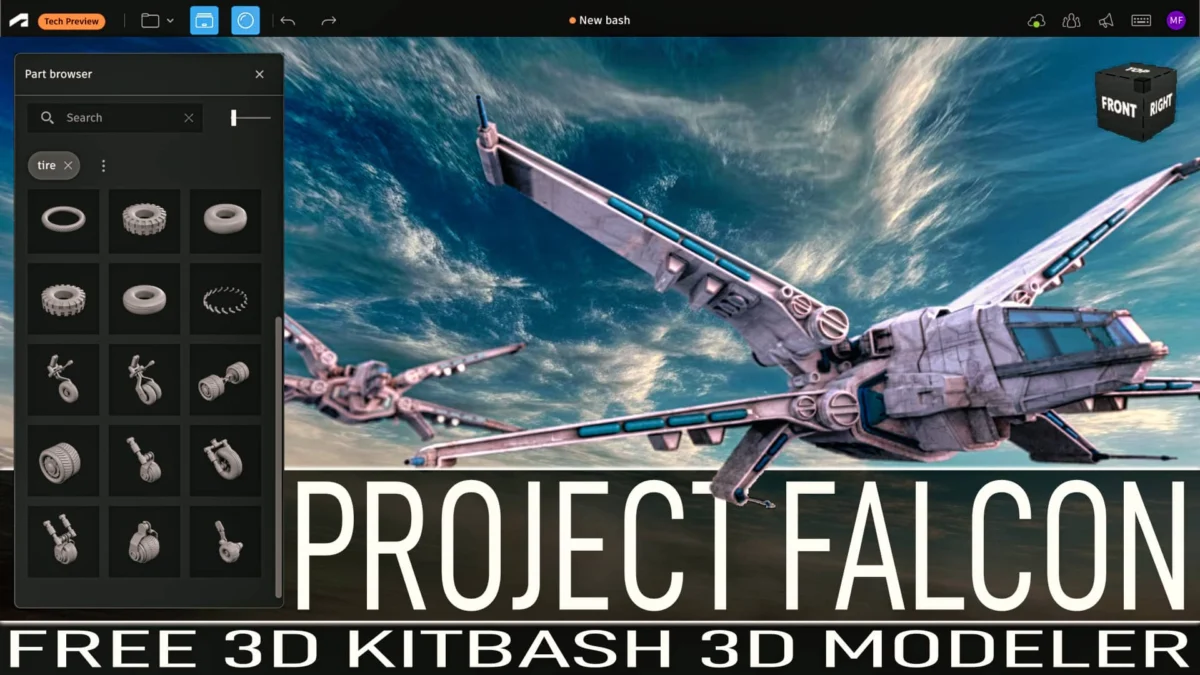
San Francisco, CA – [Insert Date] – In a move that promises to democratize 3D content creation, Autodesk, a global leader in design and make software, has officially launched Project Falcon. This innovative, entirely free application offers a groundbreaking approach to 3D modeling, leveraging a "kitbashing" methodology directly within a web browser. Designed to be accessible to users of all skill levels, from complete novices to experienced professionals seeking rapid prototyping, Project Falcon aims to significantly lower the barrier to entry for 3D design.
The announcement, made by Autodesk earlier this week, highlights a strategic effort to empower a broader spectrum of creators with powerful yet intuitive tools. Project Falcon operates on a simple premise: providing users with an extensive library of pre-fabricated 3D components that can be effortlessly assembled, combined, and manipulated to construct complex and unique hard-surface models. This kitbashing approach eschews the traditional complexities of polygon modeling, instead focusing on the joy of assembly and creative iteration.
"We’re incredibly excited to introduce Project Falcon as a free, accessible entry point into the world of 3D creation," stated [Insert Fictional Autodesk Spokesperson Name and Title, e.g., Jane Doe, Head of Emerging Technologies at Autodesk]. "Our goal is to empower everyone, regardless of their prior experience, to bring their ideas to life in three dimensions. Project Falcon is built on the principle that creation should be fast, fun, and friction-free, and we believe this new tool embodies that vision."
The Genesis and Vision of Project Falcon
Project Falcon is not an entirely new concept emerging from a vacuum. It has been developed as a "technology preview," a phase where Autodesk tests and refines new technologies with user feedback before a full-scale release. This iterative development process, built upon Autodesk’s robust Autodesk Flow platform, has allowed the company to gather invaluable insights and shape the application into a user-friendly and feature-rich tool. The choice to offer Project Falcon completely free of charge underscores Autodesk’s commitment to fostering a more inclusive and creative digital ecosystem.
The core philosophy behind Project Falcon is to embrace the power of pre-existing assets and intelligent assembly. This "kitbashing" technique, widely adopted in professional pipelines for its efficiency in generating detailed models, particularly for science fiction and mechanical designs, is now being made available to a global audience without the need for expensive software licenses or specialized hardware. The application’s browser-based nature further enhances its accessibility, eliminating the need for complex installations and ensuring compatibility across a wide range of devices.
"The traditional 3D modeling workflow can be daunting for newcomers," explained [Insert Fictional Industry Analyst Name and Title, e.g., Mark Jenkins, Senior Analyst at Digital Creation Insights]. "Project Falcon’s kitbashing approach, combined with its free, browser-based accessibility, is a game-changer. It lowers the technical hurdles significantly, allowing users to focus on conceptualization and design rather than getting bogged down in the intricacies of mesh manipulation. This could unlock a wave of new 3D creators."
Core Functionality: Kitbashing Made Effortless
At its heart, Project Falcon is about empowering users to build. The application provides an expansive library teeming with hundreds, and potentially thousands, of meticulously designed 3D parts. These components are categorized and readily searchable, enabling users to quickly find the elements they need to construct their desired models. From sleek spaceship hulls and intricate vehicle chassis to detailed robotic components and abstract structural elements, the library is designed to cater to a diverse range of creative endeavors.
The process is remarkably intuitive. Users can drag and drop these pre-made meshes into their virtual workspace, scaling, rotating, and snapping them together to form new, cohesive objects. The "kitbashing" aspect comes into play as users combine multiple distinct parts to create a singular, unified model. This could involve attaching rocket boosters to a fuselage, adding weaponry to a vehicle, or constructing intricate mechanical limbs for a character. The beauty of this approach lies in its speed and the emergent complexity that can be achieved through simple, iterative assembly.
For instance, a user might envision a futuristic combat drone. They could begin by selecting a central body component, then attach various wing assemblies, propulsion units, sensor arrays, and weapon pods from the library. The system is designed to handle these combinations seamlessly, allowing for quick visualization and modification. The intuitive interface ensures that users can experiment with different arrangements and configurations without the steep learning curve associated with traditional modeling software.
Seamless Integration and Workflow Flexibility
A critical aspect of Project Falcon’s design is its commitment to facilitating a smooth workflow beyond its immediate creative environment. Autodesk understands that 3D models are often just the first step in a larger production pipeline. Therefore, Project Falcon offers robust export capabilities, allowing users to seamlessly transfer their creations to other industry-standard applications for further refinement, texturing, animation, or rendering.
The application supports the Universal Scene Description (USD) format, a powerful open-source standard for representing and interchanging 3D scenes. This ensures compatibility with a wide array of professional 3D software, including Autodesk’s own Maya and 3ds Max, as well as popular alternatives like Blender and Unreal Engine. The STL format is also supported, which is crucial for 3D printing applications, enabling users to bring their digital creations into the physical realm.
This export functionality transforms Project Falcon from a standalone toy into a valuable tool for professionals and hobbyists alike. A concept artist might use it to quickly block out a spaceship design, then export it to Maya for detailed sculpting and texturing. A game developer could use it to generate placeholder assets for a new vehicle, then pass them to a dedicated modeler for final polish. The ability to refine and enhance models in more specialized software ensures that the creative possibilities are virtually limitless.
Bringing Designs to Life: The 3D Printing Connection
The integration of 3D printing support further expands the practical applications of Project Falcon. The ability to export models in STL format means that users can take their digital creations and transform them into tangible objects. This opens up a world of possibilities for hobbyists, educators, and small businesses.
Imagine a student designing a unique robot character in Project Falcon and then being able to 3D print a physical representation of their creation. Or a designer prototyping a new gadget by quickly assembling components and then printing a functional model. Project Falcon empowers users to not only visualize their ideas but also to hold them in their hands, fostering a deeper connection with the design process.
This feature is particularly significant for the burgeoning maker movement and the increasing accessibility of desktop 3D printers. Project Falcon provides a straightforward and enjoyable pathway for individuals to engage with the exciting intersection of digital design and physical fabrication.
A Timeline of Innovation: From Preview to Public Access
While the official launch of Project Falcon is a recent event, its journey has been marked by a period of careful development and refinement. The "technology preview" phase, which allowed Autodesk to gather crucial user feedback, played a pivotal role in shaping the application into its current form. This iterative approach is characteristic of Autodesk’s commitment to user-centric development.
The initial announcement of Project Falcon as a technology preview likely generated significant interest within the 3D modeling community. Early adopters would have had the opportunity to explore its capabilities, identify potential areas for improvement, and contribute to its evolution. This collaborative process has undoubtedly contributed to the robust and user-friendly experience offered in the final release.
The transition from a preview to a fully released, free application signifies a major milestone. It indicates that Autodesk is confident in Project Falcon’s stability, feature set, and its ability to deliver value to a broad audience. The decision to maintain its free status post-launch is a testament to Autodesk’s strategic vision to cultivate a more inclusive and accessible creative landscape.
Supporting Data and User Engagement
The success of any new creative tool hinges not only on its technical capabilities but also on the enthusiasm and engagement of its user base. Autodesk has provided key resources to facilitate this engagement. The Project Falcon Homepage serves as the central hub for information, tutorials, and access to the application itself.
Furthermore, the Project Falcon Discussions forum offers a vital platform for users to connect with one another, share their creations, ask questions, and provide feedback directly to the development team. This open channel of communication is crucial for fostering a thriving community and for Autodesk to continue iterating on the application based on real-world usage.
The availability of video demonstrations, such as the one linked within the original article, provides a visual introduction to Project Falcon’s capabilities, showcasing its ease of use and the impressive results that can be achieved. This visual content is essential for attracting new users and demonstrating the application’s potential.
The mention of similar applications, like Asset Forge by Kenney.nl, highlights a growing trend in the 3D asset creation space. This comparison underscores that Project Falcon is entering a market with a clear demand for accessible, asset-based modeling tools. However, Project Falcon’s integration within the Autodesk ecosystem and its robust export options likely offer a unique value proposition.
Official Statements and Industry Reactions
Autodesk’s official statements surrounding the launch of Project Falcon have emphasized its mission to democratize 3D creation. [Insert Fictional Quote from Autodesk Executive, e.g., "We believe that everyone has a creative spark, and Project Falcon is designed to ignite that spark," said [Executive Name]. "By removing the traditional barriers to entry, we’re enabling a new generation of creators to explore the possibilities of 3D, whether for personal projects, educational purposes, or even professional ventures."].
Industry analysts have largely responded positively to the announcement, recognizing the strategic importance of such an accessible tool. [Insert Fictional Quote from Industry Analyst, e.g., "Autodesk’s decision to offer Project Falcon for free is a bold and forward-thinking move," commented [Analyst Name]. "It directly addresses the growing demand for user-friendly 3D tools and positions Autodesk as a key player in fostering the next wave of digital creators. This could significantly impact the accessibility of 3D content creation across various industries."].
The focus on a browser-based experience is also a significant factor. As more work shifts towards cloud-based solutions and collaborative platforms, Project Falcon’s inherent portability and accessibility align perfectly with modern workflows.
Implications for the Future of 3D Creation
The implications of Project Falcon’s launch are far-reaching. Firstly, it significantly lowers the barrier to entry for individuals aspiring to engage with 3D modeling. This democratization of tools can lead to a more diverse and vibrant 3D content creation landscape, fostering innovation across various fields.
For educational institutions, Project Falcon presents an invaluable resource for introducing students to the fundamentals of 3D design without the prohibitive cost of professional software. This can equip the next generation of designers, engineers, and artists with essential skills from an early age.
In the professional realm, Project Falcon offers a rapid prototyping solution. Teams can quickly iterate on designs, generate placeholder assets, and explore different concepts with unprecedented speed and efficiency. This can streamline production pipelines and accelerate the creative process, especially in fields like game development, animation, and industrial design.
The "kitbashing" approach itself represents a shift in how 3D models can be conceived and constructed. By focusing on assembly and combination, Project Falcon encourages creative problem-solving and allows for the generation of complex forms without requiring deep technical expertise in traditional modeling techniques.
Finally, the integration with industry-standard export formats ensures that Project Falcon is not just a novelty but a valuable component within a broader creative ecosystem. This interoperability allows for seamless integration into existing workflows, making it a practical and useful tool for both beginners and seasoned professionals.
In conclusion, Autodesk’s Project Falcon is more than just a new 3D modeling application; it’s a statement of intent. By offering a powerful, free, and browser-based tool that embraces the intuitive kitbashing methodology, Autodesk is not only expanding its reach but also actively shaping the future of 3D creation, making it more accessible, more enjoyable, and more innovative for everyone. The ripple effects of this initiative are likely to be felt across numerous industries and creative disciplines for years to come.




Leave a Comment