
The Architecture of the Void: Chris Harnan’s Big Pool and the Radical Reimagining of Graphic Materiality
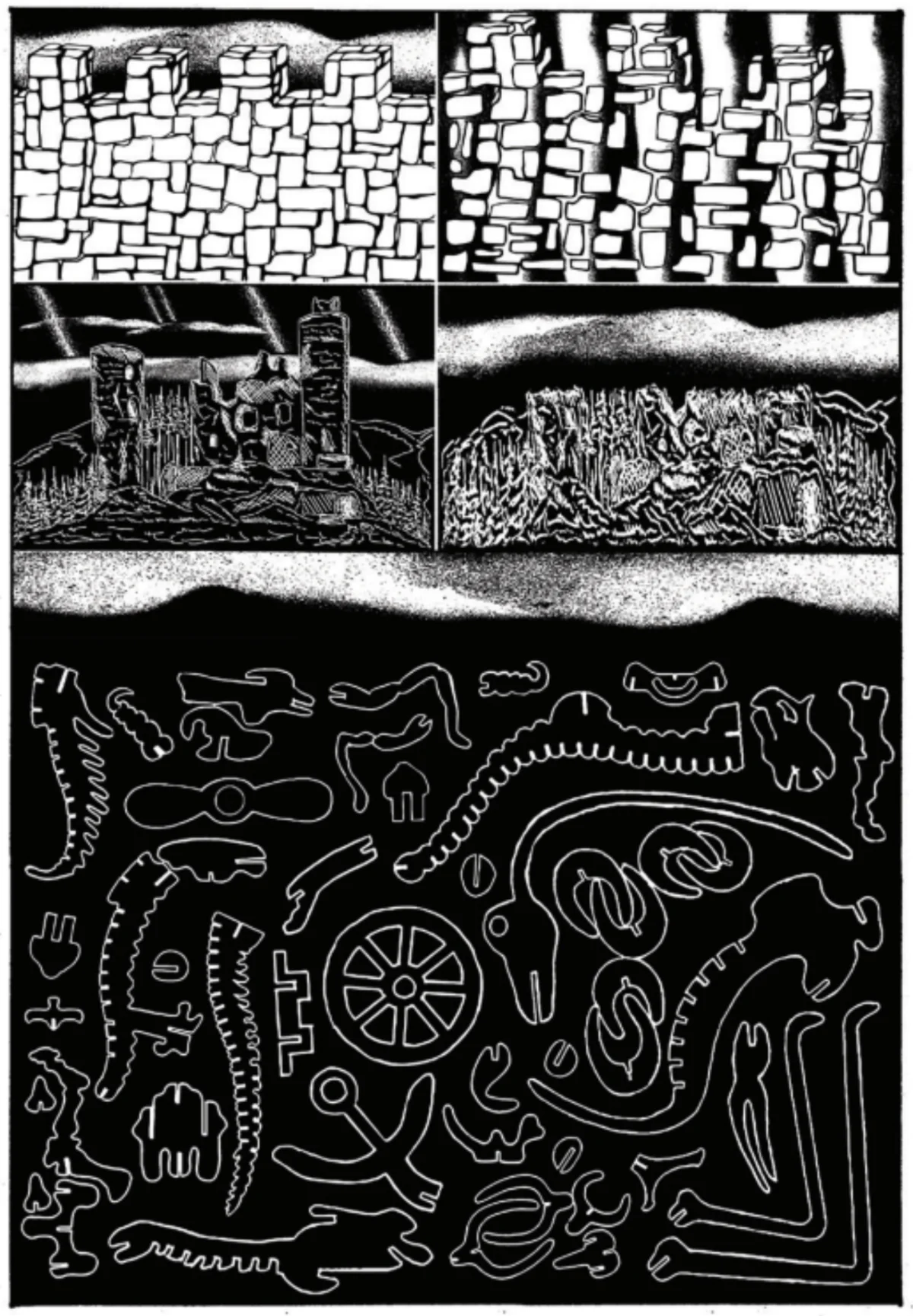
The release of Chris Harnan’s debut graphic novel, Big Pool, in July 2025, marked a significant pivot point for contemporary avant-garde comics. Published as a high-concept collaboration between the London-based Breakdown Press and the French risograph specialists Fidèle Editions, the work represents more than just a collection of illustrations; it is a rigorous interrogation of the comic medium’s physical and philosophical boundaries. By eschewing traditional narrative structures in favor of what might be termed the "poetry of form," Harnan has produced a work that demands a new kind of literacy—one rooted in the tactile and the optical rather than the purely linguistic.
Main Facts: A Convergence of Experimental Traditions
Big Pool is a synthesis of Harnan’s evolving aesthetic, incorporating and expanding upon his previous work, most notably Le Casino, which originally appeared in Marécage, an anthology by the influential French publishing collective Lagon Revue. The novel functions as a series of interconnected vignettes that explore themes of cosmic unity, the genesis of matter, and the fluid boundary between the physical and the metaphysical.
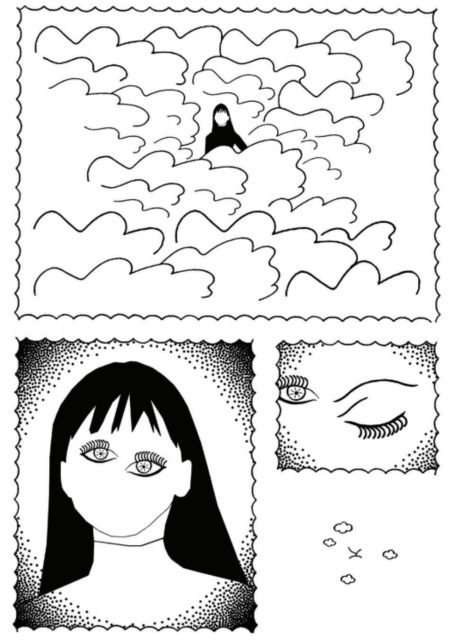
The most striking characteristic of Big Pool is its extreme linguistic economy. Harnan deliberately avoids text for the first 21 pages of the volume, forcing the reader to engage with a purely visual syntax. When text does finally appear on page 22, it is applied with an abstract, almost architectural precision. By blurring the lines between diegetic text (words spoken or read within the world of the story) and extradiegetic text (commentary or labels from outside the story), Harnan creates a unified field of meaning where the shape of a letter is as significant as the shape of a landscape.
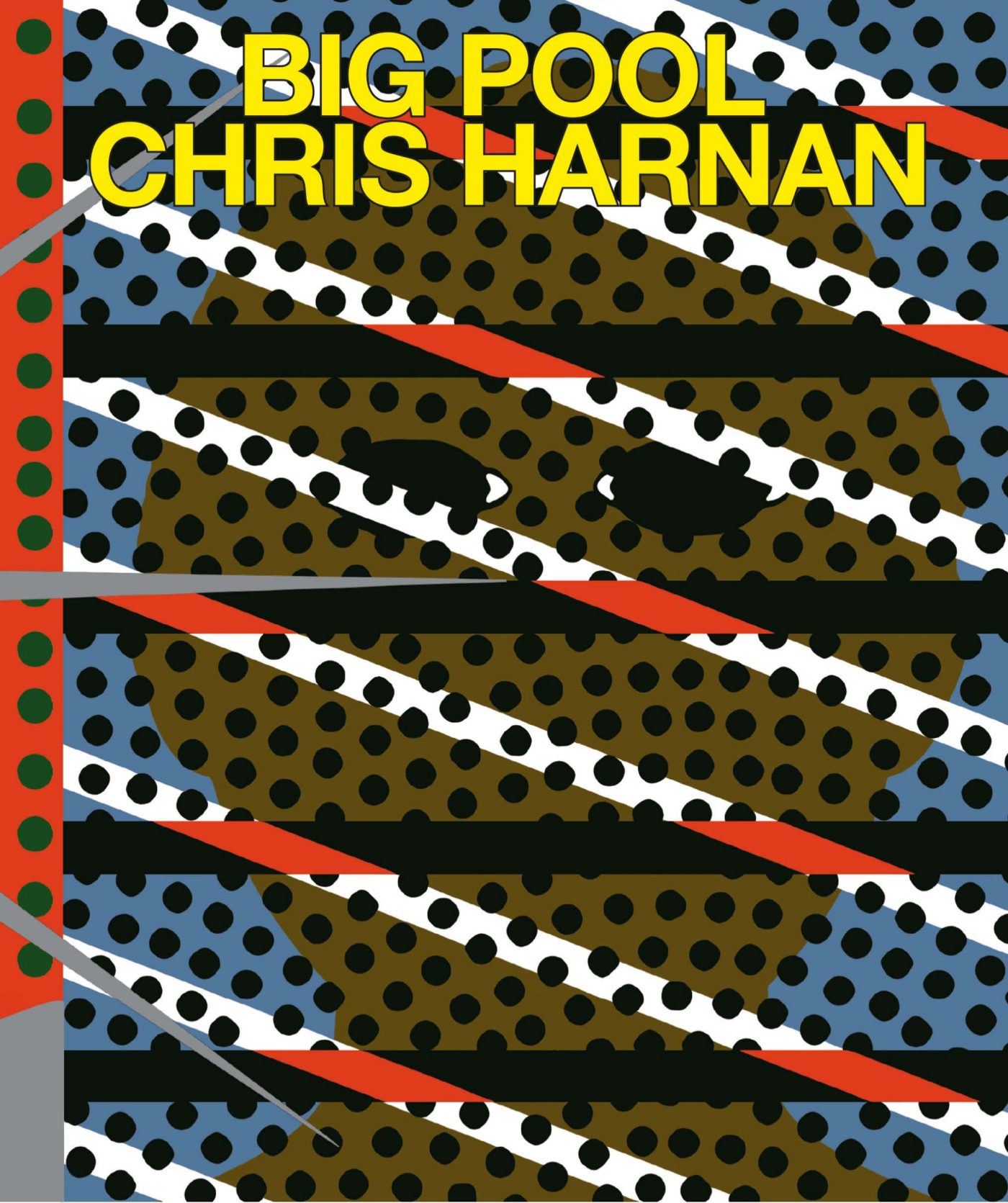
The title itself, Big Pool, serves as a metaphor for the artist’s approach to page layout. Harnan views the comic page not as a sequence of discrete moments, but as a fluid body of information. Just as individual molecules of water lose their distinct boundaries to form a pool, Harnan’s panels and symbols bleed into one another, challenging the traditional "gutter"—the white space between panels—that has long been considered the fundamental building block of comic book storytelling.
Chronology: From Anthology to Landmark Debut
The journey to Big Pool began in the experimental circles of European small-press publishing. Chris Harnan first gained recognition for his contributions to Lagon Revue, a publication known for pushing the boundaries of risograph printing and narrative abstraction. His piece Le Casino served as a proof-of-concept for the techniques that would later be perfected in his debut novel.
In early 2025, the partnership between Breakdown Press and Fidèle Editions was announced, signaling a high-water mark for "Riso-comics." Breakdown Press has long been a champion of the "British New Wave" of alternative comics, while Fidèle Editions brought the technical expertise necessary to execute Harnan’s complex optical illusions.
Upon its release in July 2025, Big Pool was immediately distinguished by its physical production. The book’s construction—utilizing a mix of collage, offset printing, and digital manipulation—was designed to reflect its internal themes of construction and reconstruction. The chronological progression of the book itself mirrors a creation myth, beginning with a blank canvas and slowly building a universe out of fundamental geometric signs.
Supporting Data: The Mechanics of the "Obtuse Meaning"
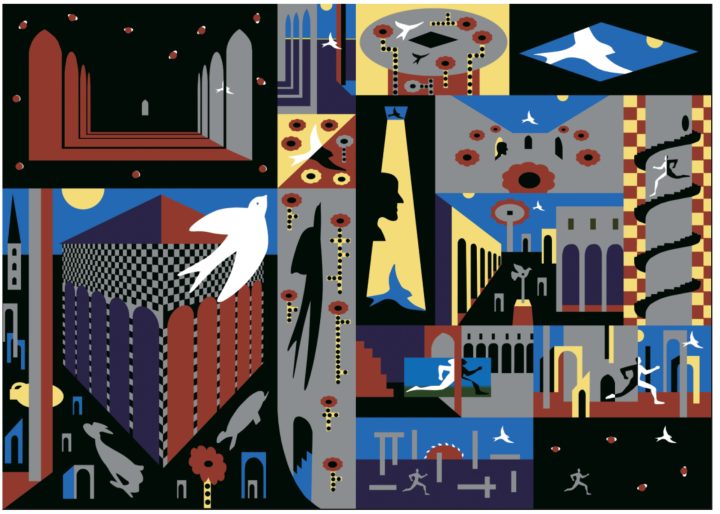
To understand the impact of Big Pool, one must look at the specific technical and semiotic strategies Harnan employs. The artist utilizes what cognitive psychologists call "peripheral flicker illusions." By overlaying high-contrast images—such as red ellipses against green figures—Harnan triggers microsaccades in the reader’s eye. This creates a literal vibration on the page, making the static image appear to flicker or breathe.
The Semiotics of the Ellipsis
The ellipsis (a simple oval or dot) is the central motif of the work. Throughout the novel, this signifier is non-static, meaning its "signified" (what it represents) changes based on context:
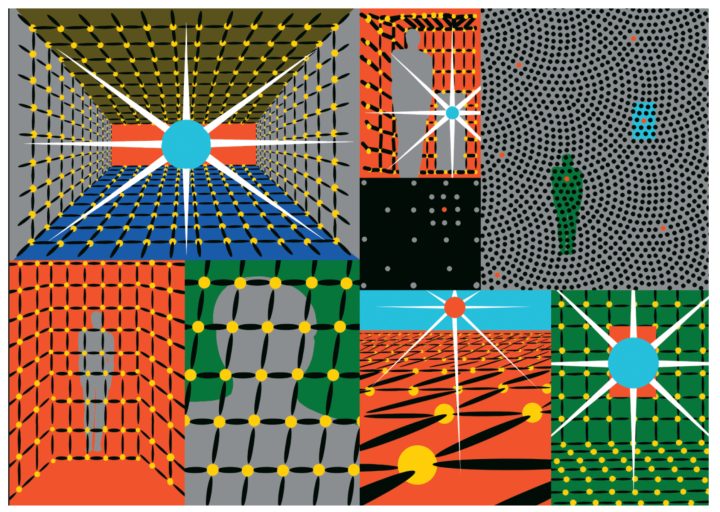
- Atoms: In early sequences, yellow ellipses represent the fundamental building blocks of matter.
- The Soul: A red ellipse placed within a green humanoid figure represents the metaphysical spark.
- Celestial Bodies: Larger ellipses are repurposed as suns or planets.
By using the same shape for the subatomic and the cosmic, Harnan reinforces the theme of "iconic solidarity"—a term used in comics theory to describe how images across a work relate to one another to create a coherent world.
The Rejection of the Gutter
Harnan’s work engages in a sophisticated dialogue with comic theory, specifically the work of Scott McCloud and Michael Nicoll Yahgulanaas. In his seminal text Understanding Comics, McCloud posits that the gutter is a "limbo" where the reader’s imagination completes the action (closure).
However, Harnan aligns more closely with Yahgulanaas’s critique of the gutter. Yahgulanaas, a Haida artist, views the empty gutter as a "colonial" space—a terra nullius or "no man’s land" that implies a vacuum. In Big Pool, Harnan eliminates the gutter in favor of conjoined panelling and contrasting color blocks. There is no empty space; every millimeter of the page is saturated with information. This forces a "sequential dynamism" where time does not pass between panels in a linear fashion, but rather exists as a simultaneous "surface experience."

Official Responses and Theoretical Frameworks
Critical analysis of Big Pool has frequently invoked the theories of Roland Barthes, specifically his concept of the "obtuse third meaning." Barthes described this as a layer of meaning that exists beyond the "obvious" message of a work—a meaning that cannot be fully articulated through language but must be experienced.
Reviewers from The Comics Journal and other academic outlets have noted that Big Pool functions as a "signifier without a signified." Because the book avoids traditional plot points, the "meaning" of the work is found in the act of reading itself. The interrogative nature of the optical illusions ensures that the reader is not a passive consumer but an active participant in the creation of the narrative.
The publishing collective at Fidèle Editions has commented on the difficulty of the printing process, noting that the "peripheral flicker illusions" required exact ink density and registration to function. The materiality of the book—the specific weight of the paper and the layered ink of the risograph—is not merely a container for the art; it is the art. The striped black-and-white pattern visible on the edges of the closed book further emphasizes the binary themes of life versus death and physical versus metaphysical.
Implications: The Future of the Graphic Object
The success and critical depth of Big Pool have several long-term implications for the medium of graphic novels:
1. The De-centering of Text
Harnan proves that a "graphic novel" can sustain complex philosophical inquiry without relying on the crutch of dialogue or narration. This opens the door for more "silent" works that communicate through the "obtuse meaning" of color, rhythm, and texture.
2. Materiality as Narrative
Big Pool suggests that the future of the physical book lies in its "objecthood." In an era of digital consumption, Harnan’s use of optical illusions that only function on the printed page provides a compelling argument for the necessity of the physical medium. The book cannot be properly "read" on a screen because the flicker illusions rely on the reflective quality of physical ink and the movement of the human eye across a tactile surface.
3. Philosophical Interconnectedness
By treating the page as a "Big Pool" where all elements are interconnected, Harnan challenges the Western individualistic approach to storytelling. His work suggests a more holistic view of narrative, where the environment, the atoms, and the characters are part of a single, shifting tapestry.
In conclusion, Chris Harnan’s Big Pool is a landmark achievement in visual storytelling. It is a work that rejects the "limbo" of the imagination in favor of a total, saturated reality. By meticulously controlling every aspect of the book’s materiality—from the lack of pagination to the vibration of contrasting colors—Harnan has created a creation myth for the 21st century: one where meaning is not found in what is said, but in the constant, flickering state of change that defines our universe.


Leave a Comment