
Publishing Landscape Under Siege: Birth Rate Collapse, AI Incursions, and Market Realignment
Week Ending May 15, 2026
The publishing industry is navigating a turbulent period, marked by a confluence of demographic shifts, unprecedented technological advancements, and evolving consumer behaviors. This week’s developments paint a stark picture of an industry grappling with fundamental challenges, from the shrinking pipeline of young readers to the pervasive influence of artificial intelligence. Major imprints have shuttered, authors are facing an onslaught of AI-generated competition, and even established platforms like X (formerly Twitter) are revealing algorithms that could reshape content discovery. Meanwhile, persistent scams and the growing commodification of content for AI training highlight a complex and often perilous environment for creators.
The Middle Grade Market’s Steep Decline: A Reader Drought and Publisher Consolidation
The vibrant world of middle-grade literature is experiencing a significant contraction, with two prominent publishing imprints, Dial Books for Young Readers (Penguin Young Readers) and Roaring Brook Press (Macmillan Children’s Publishing Group), ceasing operations. These closures, reported by Publishers Weekly on March 19 and March 31, 2026, respectively, are not isolated incidents but rather symptomatic of deeper structural pressures impacting the entire children’s book sector.
The Shrinking Pipeline of Readers: A Demographic Tsunami
At the heart of the middle-grade crisis lies a declining birth rate. Provisional CDC data for 2025 indicates 3,606,400 births in the United States, a 1% decrease from 2024 and a continuation of a downward trend from a 2007 peak of 4,316,233 births. This demographic shift directly impacts the core 8-to-12-year-old audience.
A May 8, 2026, New York Times Upshot analysis reveals that elementary school enrollment was already in decline before the pandemic due to lower fertility rates. The pandemic exacerbated this trend, with public schools losing over a million students. Since the mid-2010s, K-12 enrollment has dropped in 30 states, with major districts like Los Angeles Unified experiencing declines exceeding 20%. This steadily narrowing audience for age-appropriate books presents a significant challenge for publishers.
Adding to the complexity is a mandated shift in literacy education. A Gothamist investigation on May 9, 2026, into New York City’s "NYC Reads" initiative highlights that a focus on structured literacy curricula now expects middle school students to complete only four to seven books per year, a stark reduction from previous expectations of around 20.

Disrupted School Pipelines and Declining Literacy Scores
The educational landscape further compounds the problem. Chronic absenteeism rates reached approximately 23% in the 2024-2025 school year across 39 states and Washington D.C., according to Education Week and RAND tracking. This figure remains about 50% above pre-pandemic levels, meaning fewer children are consistently present in classrooms. This reduced presence curtails exposure to read-alouds, school libraries, and peer reading culture, all crucial for fostering early reading habits. Furthermore, enrollment-linked funding pressures impact school and library budgets, diminishing institutional purchasing power for middle-grade titles.
Literacy proficiency itself continues to erode. The 2024 Nation’s Report Card shows a decline in fourth-grade reading scores, dropping two points from 2022 and five points from 2019. Only 31% of fourth graders met or exceeded the NAEP Proficient standard, with eighth-grade scores mirroring this trend. Voluntary reading among 13-year-olds has also plummeted, falling from 27% in 2012 to 14% in 2023, as short-form digital platforms increasingly compete for sustained attention.
Publisher Responses: Consolidation and Risk Aversion
These reader-side trends are reflected in sales data and publisher strategies. Middle-grade print sales saw a 5% drop in the first half of 2024, the weakest performance across children’s segments, according to Circana BookScan. While overall children’s print sales saw a slight recovery in 2025, the persistent softness in the middle-grade category triggered imprint-level cuts in early 2026.

Retail policy changes, such as Barnes & Noble’s limited initial hardcover orders for most new middle-grade fiction since fall 2022, further exacerbate pressure. This forces more titles into lower-margin paperbacks and reduces shelf visibility for midlist works. Coupled with rising printing costs and lower price points relative to YA and adult books, profit margins are squeezed. Publishers are responding with increased caution, favoring backlist titles, established franchises, graphic novels, trend-driven concepts, and lower-risk acquisitions. The closures of Dial Books and Roaring Brook Press exemplify this trend of list rationalization across major children’s divisions.
Implications for Authors
The confluence of shrinking demographics, disrupted educational pipelines, declining literacy, reduced retail visibility, and publisher risk aversion makes traditional middle-grade acquisition increasingly selective. Debut and midlist authors face narrower pathways to success through conventional channels, with diverse or innovative projects encountering greater friction. Backlist titles and high-concept or graphic formats are positioned to gain a relative advantage. Authors are advised to adapt by targeting specific reader segments, prioritizing series potential, and exploring direct-to-reader marketing strategies.
The Perilous Rise of AI: From Cloned Books to Algorithmic Transparency
Artificial intelligence continues to be a dominant force, presenting both opportunities and existential threats to the publishing industry. This week saw dramatic revelations about AI’s capabilities and its growing integration into content creation and distribution.

AI-Generated Content Floods the Market: A Case of "Reputation Theft"
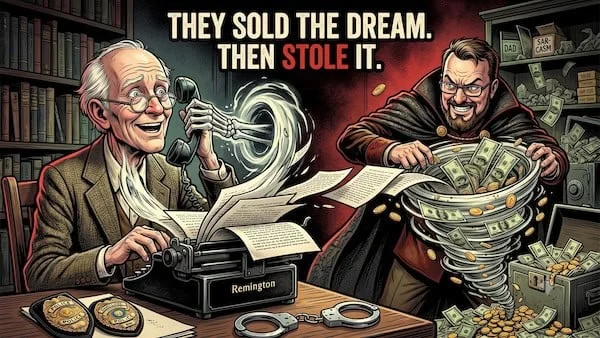
A stark example of AI’s disruptive potential emerged with the story of James Marcacci, an 80-year-old author whose historical book, Benld and the Booze Gang, was targeted by 13 AI-generated copycat books on Amazon within a single week of its launch. Many of these imitations featured near-identical covers and titles, with one even blending Marcacci’s first name with his co-author’s last name. The speed and similarity of these publications strongly suggest AI-driven content farms exploiting a niche success.
This phenomenon, termed "reputation theft" by author and commentator Thomas Umstattd Jr., involves scammers leveraging an author’s name, style, or niche authority to sell inferior work. In Marcacci’s case, the copycats hijacked his specific topic, title structure, and visual brand, flooding search results and potentially confusing readers seeking the authentic hometown account. The original author faces lost sales, diminished discoverability, and damage to the trust he built within his community.
The vulnerability of niche nonfiction and local history is particularly highlighted, as low search volumes mean a single successful launch can quickly dominate results and attract opportunistic copycats. Amazon’s algorithm, which rewarded Marcacci’s early sales velocity, inadvertently created the visibility that attracted these AI-generated knockoffs.

X Unveils Algorithm: A Glimpse into Content Discovery’s Engine
In a groundbreaking move, X (formerly Twitter) revealed its complete algorithm for the first time, offering unprecedented insight into how content is surfaced and ranked on the platform. The core production code for the "For You" feed shows a system that combines posts from followed accounts with machine-learning-retrieved content, ranked by a Grok-based transformer model.
Navigating the released code, analysts have identified 15 key signals that influence a post’s reach. Positive indicators include favorites, replies, reposts, quotes, clicks, dwell time, and follows. Conversely, negative signals like "not interested," "block author," "mute author," and "report" carry significant downward weight, with a single mute or report potentially negating multiple likes.
The "Phoenix" ranking model scores posts independently, employing an "Author Diversity Scorer" that applies exponential decay to prevent single accounts from dominating a user’s timeline. Out-of-network discovery utilizes a two-tower retrieval model to surface content from unfollowed authors based on engagement history. Visibility filters then remove spam and objectionable content.

Implications for Authors on X
This algorithmic transparency has significant implications for authors building platforms and selling books on X. The platform now favors content that fosters engagement depth, encourages conversation, and keeps users on the platform. Threads, longer original posts, and compelling visuals that increase dwell time and multi-action engagement are rewarded. Profile optimization is crucial, as profile clicks that convert to follows are directly beneficial. Posting volume needs recalibration, with one high-quality post outperforming multiple lower-effort updates due to the diversity decay. Negative feedback, even from a small percentage of viewers, can throttle distribution over time, making rage bait and shallow engagement farming risky strategies. Authors who create content worth stopping for, quoting, and following will see the algorithm work in their favor.
Publishing Scam Alert: $48 Million Fraud Targeting Senior Authors
A major publishing scam has come to light with the guilty plea of Michael Cris Traya Sordilla, a 34-year-old Filipino national, on May 7, 2026. Sordilla pleaded guilty to conspiracy to commit mail and wire fraud and money laundering conspiracy, admitting his role in a scheme that defrauded over 800 victims, primarily seniors, of more than $48 million between 2017 and 2024.
The operation utilized fake U.S. companies, including PageTurner Press and Media LLC, WP Lighthouse, and Metro Films LLC, to create an illusion of legitimacy. Sales representatives, operating from a call center in the Philippines, contacted authors with unsolicited offers, falsely claiming their work had been selected for publication or adaptation by major entities. Victims were then pressured into paying substantial upfront fees for services that never materialized. Funds were routed through U.S. bank accounts before being transferred to the Philippines.

The FBI and U.S. Postal Inspection Service investigated after receiving hundreds of complaints. Writers Beware had tracked reports about PageTurner since 2018, and the Authors Guild issued a scam alert in April 2023 after an elderly author lost $800,000. The government seized the PageTurner domain and over $6 million in assets. Sordilla is the first defendant to plead guilty, with his sentencing scheduled for July 24, 2026.
The "AI Inputs Company" Pivot: News Corp Embraces AI Monetization
In a significant strategic declaration, News Corp CEO Robert Thomson stated during the company’s Q3 fiscal 2026 earnings call on May 7, 2026, that its parent company, which includes HarperCollins and The Wall Street Journal, is now an "AI inputs company." This positioning reflects a proactive approach to monetizing intellectual property in the age of artificial intelligence.
News Corp has secured substantial AI licensing deals, including a multiyear agreement with Meta valued at up to $50 million annually and a partnership with OpenAI reportedly worth over $250 million over five years. Thomson emphasized that editorial content is an "absolutely essential input" for AI engines, requiring constant updates to remain relevant. The company also expects to benefit from the $1.5 billion Anthropic copyright settlement, viewing it as a validation of intellectual property rights.

HarperCollins reported strong financial results, with sales up 8% and profits up 14% in the quarter ending March 31, 2026, driven by digital growth and titles like Rachel Reid’s Heated Rivalry series. The publisher has also partnered with Toonstar, an AI-powered animation studio, to adapt select titles into YouTube animated series and is exploring AI for translation and audiobook creation.
AI and the Illusion of Time Savings: An Economist’s Warning
An opinion piece in The New York Times on May 11, 2026, by economist Carl Benedikt Frey, warns that artificial intelligence may not deliver the promised time savings. Instead, Frey argues, AI tools are transferring labor from paid professionals to consumers in the form of new, unpaid busywork and household chores. He draws a parallel to the washing machine, which displaced professional laundresses but shifted the labor to housewives, increasing the frequency and standards of laundry without compensation.
A study of 1.1 million ChatGPT conversations revealed that nearly three-quarters were not work-related, with users seeking practical guidance on health, household repairs, and financial decisions—tasks once handled by specialists. For indie authors, this trend is particularly relevant. The temptation to use AI to self-service tasks like editing, design, or marketing could lead to an overwhelming cumulative load of micro-tasks, potentially crowding out deep creative time. Authors who audit their workflows and selectively outsource complex or quality-sensitive work are likely to maintain a competitive edge.

The Monet Experiment: Perception vs. Reality in AI Art and Writing
A viral X post on May 14, 2026, by user @Jediwolf, highlighted the profound impact of labels on perception. An artist posted a cropped detail of a genuine Claude Monet painting, falsely claiming it was AI-generated and soliciting critiques on its inferiority. Hundreds of respondents confidently offered detailed analyses, citing weak composition, generic lighting, and soulless brushwork. The critiques vanished after the artist revealed the image was, in fact, a canonical Monet masterpiece.
This experiment demonstrates how labels can override intrinsic qualities. The identical image drew harsh technical criticism when presented as AI-generated but received more generous or silent responses when identified as a human creation. This phenomenon extends to book covers, AI-assisted writing, and marketing claims around "human-authored" books. Authors face practical questions about disclosure and how transparent tool use impacts reception. The Monet experiment underscores that perception and provenance now carry significant weight alongside the artistic merit of the work itself.
ChatGPT’s Alleged Bias Against Christian Content
Concerns have been raised about ChatGPT’s potential bias against Christian content. According to X user Sarah Fields, attempts to elicit Bible verses supporting a specific statement resulted in the model abruptly stating it was "not designed to provide this type of content." However, when asked for similar verses from the Quran, ChatGPT provided them without issue. Repeated attempts to receive full Bible verses produced identical cutoffs, with the AI attributing the failures to technical glitches and denying any intentional discrimination. This incident highlights the need for verification of AI outputs, particularly for authors dealing with faith-based topics.

Author Alerts and Industry Trends
Data Privacy Concerns with ChatGPT
A class action complaint filed on May 13, 2026, alleges that OpenAI embedded Meta’s Facebook Pixel and Google Analytics on ChatGPT.com. The suit claims these tools transmitted users’ query topics, user IDs, and hashed email addresses to Meta and Google in real time without consent. Authors using the web version of ChatGPT for research or sensitive brainstorming should be aware that standard web tracking may capture prompt topics and link them to personal accounts.
The Four Loves Driving Book Sales: A Deeper Dive
The latest episode of the Novel Marketing Podcast features an interview with bestselling novelist Angela Hunt, exploring how C.S. Lewis’s concept of "The Four Loves" (Philia, Eros, Storge, and Agape) drives deep reader loyalty and long-term sales in fiction. The discussion delves into how genres underdeliver on certain loves, the impact of the loneliness epidemic on the hunger for philia bonds, and the power of authentic agape in creating memorable climaxes. The episode also introduces a fifth Greek word for love, pragma, that Lewis did not extensively cover. Authors seeking to imbue their work with stronger emotional stakes and create books that resonate deeply with readers are encouraged to explore this discussion.
Children’s Grief Author Sentenced for Husband’s Murder
In a grim turn of events, Kouri Richins, a children’s book author who wrote about a boy coping with his father’s death, was sentenced to life in prison without parole on May 13, 2026. She was convicted of aggravated murder for poisoning her husband with a lethal dose of fentanyl. The sentencing occurred while Richins was actively marketing her book, creating a darkly ironic parallel to the subject matter. This case serves as a stark reminder of the potential for real-life tragedies to intersect with the creative endeavors of authors.

Zeitgeist: The Dichotomy of Adaptation and Creation
The cultural landscape is currently defined by a fascinating dichotomy in how beloved stories and characters are being adapted and reimagined. On one hand, there’s a trend of "defilement of the temple," where creators deconstruct and reimagine established IPs to fit contemporary worldviews, often leading to fan backlash and commercial underperformance. Examples include the perceived decline of Star Wars and Marvel’s Phase Four, the controversial rewriting of characters in Dune: Part Two, and the struggles of The Rings of Power and The Witcher.
Conversely, a growing movement emphasizes faithful adaptation that honors the original source material. This approach is exemplified by the success of Destiny 2‘s "Renegades" expansion, a beat-for-beat adaptation of Star Wars IV, and the anticipation surrounding Henry Cavill’s Warhammer 40k series, known for his dedication to source material. These successes highlight that audiences crave respect for the stories and characters they love, rather than cynical deconstruction. The critical success of The Super Mario Bros. Movie and Jorge Rivera-Hernández’s Epic: The Musical, both created with evident love for their source material and audience, further underscore this point. Authors are reminded that genuine affection for both the work and the reader is paramount for sustained success.



Leave a Comment