
Echoes of a Bygone Era: AI Revives the Vibrancy of 1917 China
May 25, 2026 – In an era where geopolitical landscapes shift with unprecedented speed, understanding the historical context of international relations is more crucial than ever. For Americans, the complexities of global engagement have often been a challenging narrative to follow. Over a century ago, a mere few months after the United States entered the global conflict now known as World War I, news emerged of a distant nation, China, joining their cause. At the time, China was largely an enigma to the Western world, its vastness and intricate society often perceived as opaque and even forbidding. Before the widespread influence of figures like Pearl S. Buck, impressions of China were pieced together from fragmented sources: missionary publications following the Opium Wars, newspaper accounts of tumultuous events like the Boxer Rebellion and the fall of the Qing dynasty, and the often-stereotypical portrayals in silent films. For most, a genuine glimpse into the “real China” remained elusive.
However, by the close of 1917, a nascent cinematic lens began to offer a more direct window into this newly allied nation. According to the National Film Preservation Foundation, at least ten documentaries were available to satiate the curiosity of a public eager to understand America’s Far Eastern ally. While many were brief shorts accompanying feature films, one production stood out for its ambition and scope: A Trip Through China. This documentary, a product of over five years of dedicated effort, was the brainchild of Benjamin Brodsky, a Russian-born businessman with a remarkable breadth of travel experience and a claimed fluency in eleven languages.
The Visionary Behind the Lens: Benjamin Brodsky’s Journey
The story of A Trip Through China is inextricably linked to the fascinating life of Benjamin Brodsky. According to a 1912 profile in Moving Picture World, Brodsky’s entrepreneurial journey brought him to China from San Francisco in the wake of the devastating 1906 earthquake. He established himself as a film exhibitor, a burgeoning industry at the time. His involvement deepened as he became the American representative for Variety Film Exchange, a significant player in film distribution. By 1909, Brodsky had expanded his operations into film production, establishing a presence in the vibrant metropolises of Shanghai and Hong Kong. While managing his diverse business interests, he meticulously documented his travels through China, capturing footage that predates not only the nation’s significant economic transformation but also the profound societal shifts brought about by the Communist Revolution. This foresight and dedication to visual documentation positioned Brodsky as a pivotal, albeit perhaps under-recognized, chronicler of early 20th-century China.
A Cinematic Expedition: The Making and Preservation of A Trip Through China
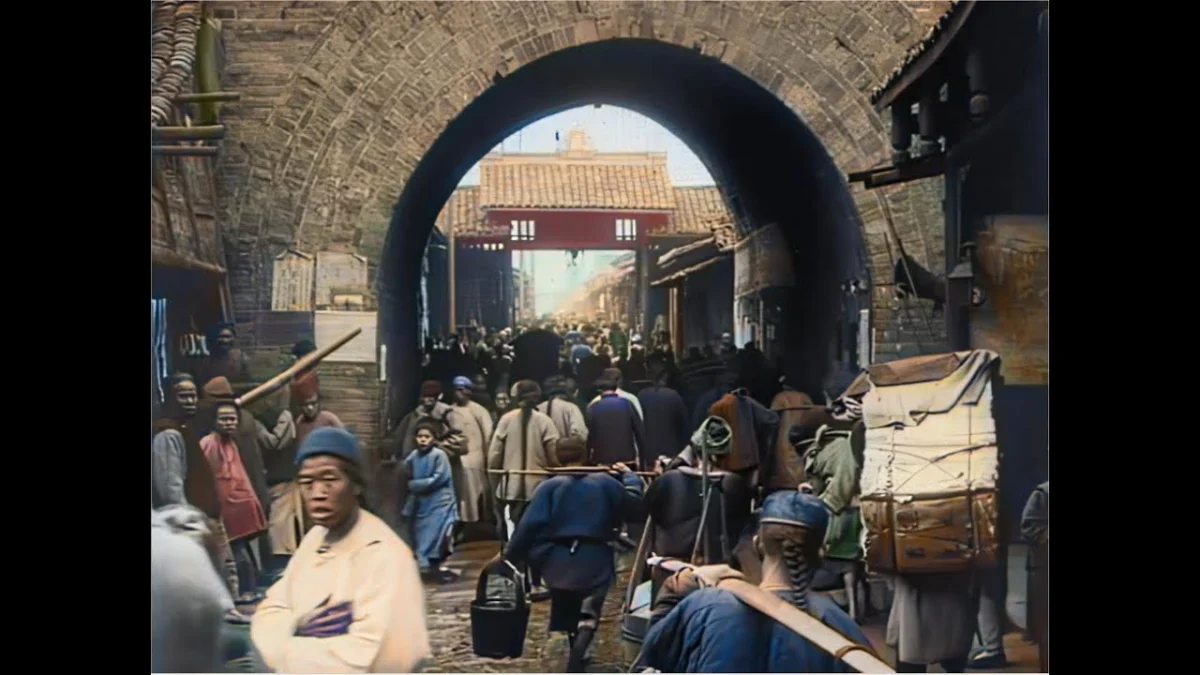
Brodsky returned to San Francisco with an impressive archive of approximately 20,000 feet of negative film. This extensive footage was eventually edited down into ten reels, creating a feature-length travelogue that would have run for roughly one hour and fifty minutes. While only select segments of this monumental work have survived the passage of time, a recent remarkable endeavor has brought its visual richness back to life. Through the application of advanced Artificial Intelligence (AI) enhancement and colorization techniques, these surviving fragments offer a stunningly vivid and immersive experience of daily life in China over a century ago.
The AI-enhanced and colorized version of A Trip Through China can be viewed in the video accompanying this article. For comparative purposes, an unenhanced black-and-white print of some of the footage is also available. It is important to approach the newly rendered colors with a nuanced understanding. The hues presented are not necessarily those that Brodsky himself would have witnessed. The AI’s interpretation of color, while sophisticated, is a modern reconstruction. Furthermore, there has been some discussion regarding the AI’s rendering of certain complexions, with concerns that they may appear unrealistically dark in specific regional contexts. This highlights a crucial point that Brodsky’s documentary implicitly underscores: China is a land of immense diversity, not only in its landscapes, climates, and cultures but also in the physiognomy of its people. This diversity was a reality that many Westerners in the 1910s may not have fully grasped, and indeed, a significant portion of the global population, even today, may not fully appreciate the multifaceted tapestry of China’s populace.
The Historical Context: China in 1917
The year 1917 marked a pivotal moment in China’s history. The Xinhai Revolution of 1911 had overthrown the millennia-old imperial system and established the Republic of China. However, the young republic was fraught with instability, facing internal power struggles, warlordism, and foreign intervention. While China officially declared war on Germany and Austria-Hungary in August 1917, joining the Allied Powers in World War I, its participation was largely symbolic, primarily involving the contribution of labor to the war effort in Europe. The global conflict, however, served as a catalyst for increased international attention on China and its strategic importance.
From a Western perspective, China in 1917 was a land of profound contrasts. The treaty ports, like Shanghai, were bustling centers of international trade and Western influence, showcasing modernity alongside traditional Chinese architecture. However, venturing inland revealed a vastly different reality, with agrarian societies, ancient customs, and a slower pace of life. The societal fabric was undergoing immense pressure from both internal reform movements and the lingering effects of foreign concessions and unequal treaties imposed after the Opium Wars. The burgeoning nationalist sentiment, fueled by resentment against foreign powers and a desire for modernization, was also a significant undercurrent.
Supporting Data: The Evolution of Cinematic Representation
The emergence of documentaries like A Trip Through China represented a significant step in the evolution of cinematic representation of foreign lands. Prior to the widespread adoption of film, information about distant cultures was largely mediated through text, illustrations, and word-of-mouth, often susceptible to bias and romanticization. Early cinema, with its ability to present moving images, offered a more immediate and seemingly authentic portrayal.
- Early Travelogues: The late 19th and early 20th centuries saw a surge in travelogues, often filmed by intrepid explorers and adventurers. These films aimed to capture the exoticism and wonder of far-off lands, catering to a public with an insatiable appetite for vicarious exploration.
- The Rise of Documentary Film: As filmmaking technology advanced, so did the ambition to create more substantive documentary content. Films began to move beyond mere spectacle to offer insights into daily life, cultural practices, and social conditions.
- AI as a Restorative Tool: The recent application of AI to historical footage, as seen with A Trip Through China, represents a new frontier in historical preservation and accessibility. AI algorithms can now reconstruct missing frames, remove artifacts, and, crucially, colorize black-and-white footage, breathing new life into dormant visual records. This technology allows for a more immersive and engaging connection with the past, potentially altering public perception and understanding of historical events and societies. The accuracy and ethical considerations of AI-driven colorization remain an active area of research and debate, particularly when dealing with the nuances of human representation.
Official Responses and Academic Reception
The National Film Preservation Foundation, as a key custodian of cinematic heritage, plays a vital role in identifying, preserving, and making accessible films of historical significance. Their endorsement and promotion of restored works like A Trip Through China underscore the film’s value not only as a historical artifact but also as a cultural document.
Academic institutions and film historians have increasingly recognized the importance of such early visual records. They provide invaluable primary source material for understanding:
- Socio-economic conditions: Insights into agriculture, urban life, trade, and living standards.
- Cultural practices: Depictions of festivals, ceremonies, daily routines, and social interactions.
- Technological development: Glimpses of transportation, infrastructure, and emerging industries.
- Intercultural perceptions: How China was portrayed to the West, and implicitly, how Westerners perceived themselves in relation to China.
The AI enhancement of A Trip Through China has also generated considerable interest within the digital humanities and AI research communities. These projects serve as compelling case studies for the capabilities and limitations of AI in historical reconstruction, prompting discussions about authenticity, interpretation, and the ethical responsibilities of employing such powerful technologies.
Implications and Future Perspectives
The revival of A Trip Through China through AI technology holds profound implications for our understanding of history and the power of visual storytelling.
- Bridging Historical Divides: By presenting historical footage in a more accessible and engaging format, AI-driven restoration can help bridge the gap between past and present generations, fostering greater empathy and understanding.
- Challenging Stereotypes: The nuanced portrayal of Chinese people and their diverse environments in the restored footage can help challenge outdated stereotypes and promote a more accurate and appreciative view of China’s rich cultural heritage.
- The Future of Archival Restoration: This project exemplifies the transformative potential of AI in the field of archival restoration. As the technology continues to evolve, we can anticipate even more sophisticated methods for bringing historical visual records to life, offering unprecedented insights into the human past.
- A Continuous Dialogue: The ongoing discussion about the AI’s colorization choices highlights the importance of critical engagement with all historical sources, including those that have been digitally enhanced. It encourages a continuous dialogue about interpretation, bias, and the ever-evolving nature of our understanding of the past.
Benjamin Brodsky’s ambitious undertaking over a century ago, combined with contemporary AI innovation, has gifted us a remarkable opportunity to revisit and re-evaluate China at a pivotal juncture. A Trip Through China, now revitalized, stands as a testament to the enduring power of film to connect us with history, offering a vibrant and evocative glimpse into a world that continues to shape our present.




Leave a Comment