Ancient Echoes, Modern Visions: "Fascinating Folklore" Unveils a World of Myth and Mystery
Main Facts
In a groundbreaking convergence of scholarly insight and visual storytelling, "Fascinating Folklore," a new compendium by acclaimed comic world luminaries John Reppion and PJ Holden, is captivating audiences with its unique exploration of global myths. This extraordinary volume, published by Liminal 11, transcends traditional formats, blending meticulously researched essays with breathtaking graphic novel segments to offer an immersive journey into the heart of humanity’s most enduring narratives. From ancient sea monsters to vengeful spirits and forgotten deities, the book illuminates the profound impact of folklore on culture, history, and the collective imagination.
John Reppion, a writer celebrated for his work in dark fantasy and horror comics, brings his sharp intellect and narrative prowess to the project, delving deep into the origins and evolution of each tale. Complementing his textual mastery is PJ Holden, an artist renowned for his dynamic and evocative work on titles such as Judge Dredd and Warhammer 40,000. Holden’s striking illustrations transform historical accounts and mythical descriptions into vivid, engaging comic sequences, making complex lore accessible and thrilling for a contemporary readership. Together, Reppion and Holden have crafted not merely a book, but an experience – a sensory feast designed to leave readers spellbound by the magic and mystery of folklore like never before. The compendium promises an unparalleled pathway into the enchanting realm of ancient wisdom, presenting well-known legends alongside obscure tales, all rendered with scholarly rigor and artistic flair.
Chronology: From a Hashtag’s Spark to a Published Masterpiece
The genesis of "Fascinating Folklore" is a testament to the power of digital communities and shared passion. What began as a creative pact between Reppion and Holden was ignited by the ever-popular #FolkloreThursday hashtag, a vibrant online movement that encourages enthusiasts to share tales, research, and discussions about folklore from around the globe every week. This dynamic online interaction provided fertile ground for the duo, sparking initial ideas and guiding their collaborative vision. The hashtag, a global phenomenon, demonstrated the immense appetite for accessible and engaging folklore content, proving that these ancient stories continue to resonate deeply in the digital age.
The collaborative process saw Reppion undertake extensive research, unearthing lesser-known aspects of popular myths and bringing to light forgotten legends. His deep dives into historical texts, ethnographic studies, and mythological compendiums provided the robust foundation for the book’s informative essays. Simultaneously, Holden translated these narratives into a powerful visual language, meticulously crafting panels that capture the essence and atmosphere of each story. This synergistic approach allowed the project to swiftly blossom from an initial concept into an extraordinary compendium. The journey from social media inspiration to a published work involved countless hours of writing, illustrating, editing, and curating, all driven by a shared commitment to presenting folklore in a fresh, compelling light. Liminal 11, known for its unique and visually rich publications in the occult, esoteric, and mythological spheres, proved to be the ideal publisher, championing the duo’s innovative approach and ensuring the book’s high production quality matched its ambitious content. The publication of "Fascinating Folklore" marks a significant moment, transforming a digital trend into a tangible, enduring work of art and scholarship.
Supporting Data: A Deep Dive into Enchanting Realms
"Fascinating Folklore" offers a rich tapestry of tales, meticulously researched and vividly illustrated. The compendium delves into a diverse array of myths, from legendary historical figures to mystical flora and terrifying specters, each presented with a depth that reveals its cultural significance and enduring power.
The Bestiary of the Bizarre: The Aspidochelone and Maritime Myths
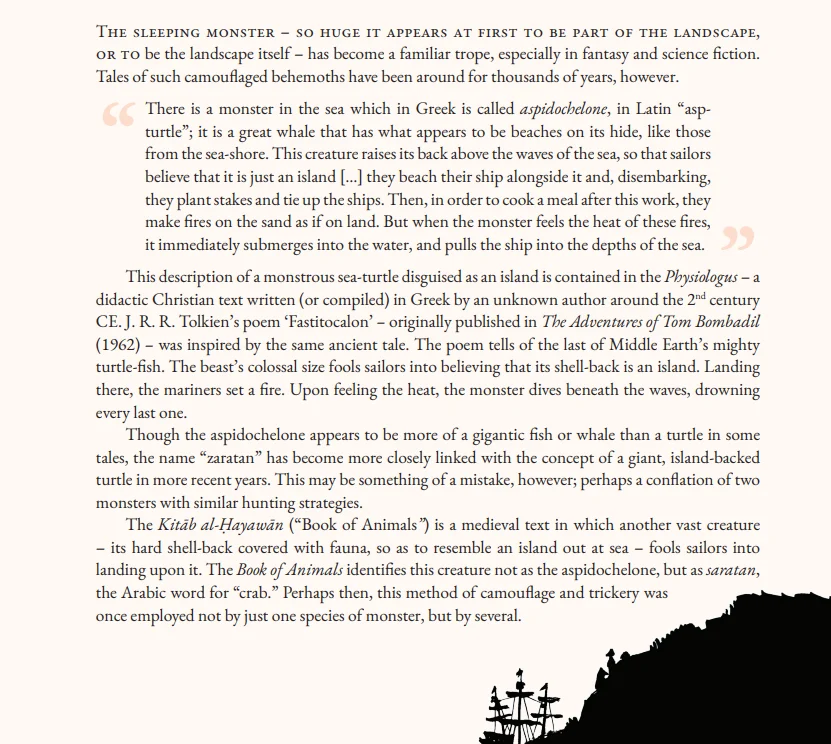
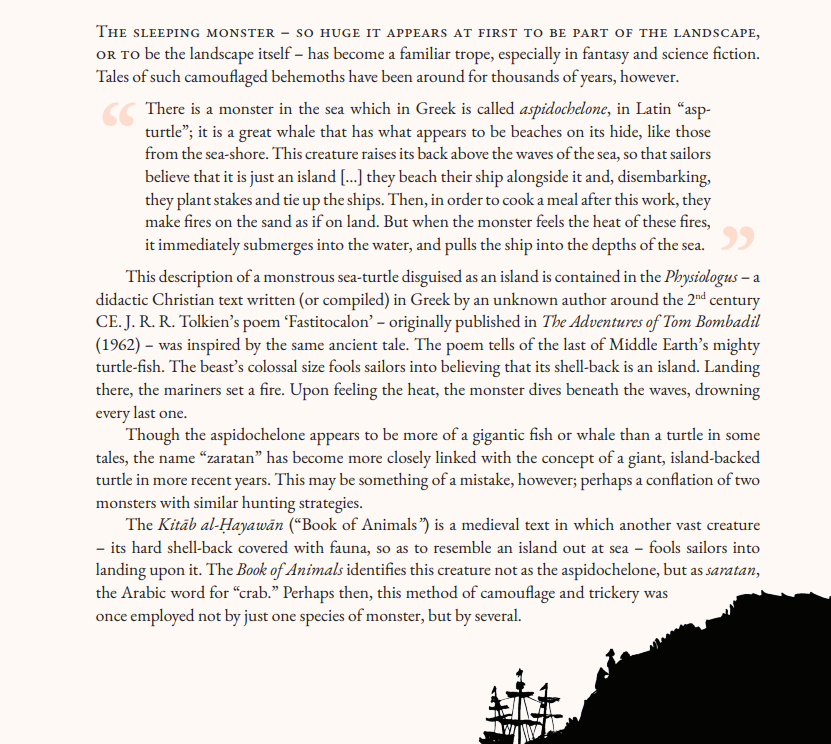
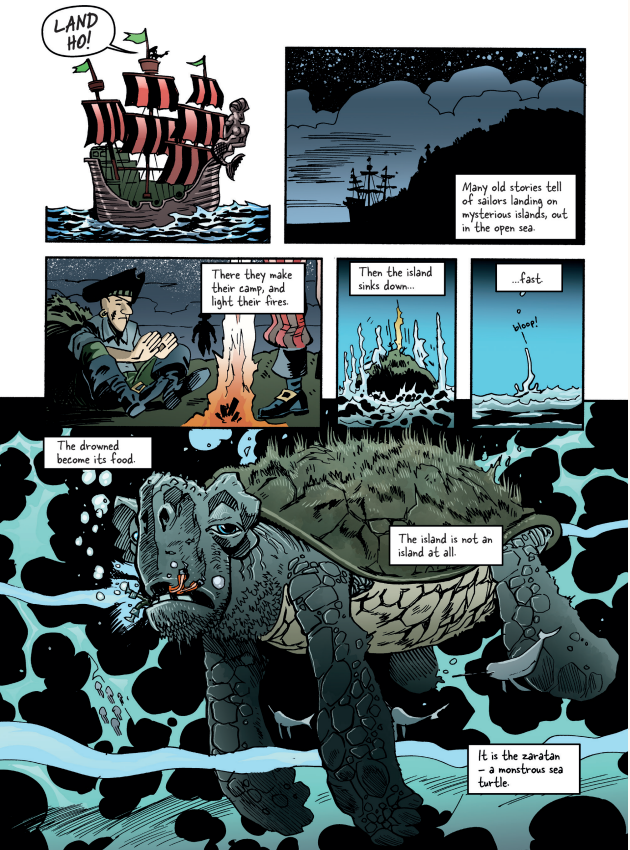
One of the most captivating entries in "Fascinating Folklore" explores the ancient myth of the aspidochelone, a monstrous sea creature often mistaken for an island. The book meticulously details this creature, known in Greek as "aspidochelone" and in Latin as "asp-turtle," describing it as a colossal whale with a hide so vast it mimics sea-shores. Sailors, deceived by its immobile appearance, would beach their vessels alongside it, plant stakes, and even light fires to cook meals, only for the monster to submerge, dragging ships and crew to the depths below.
This primordial tale finds its roots in the Physiologus, a didactic Christian text compiled by an unknown author around the 2nd century CE. This influential Greek work, which describes animals, plants, and stones, often imbues them with allegorical Christian meanings. The aspidochelone, in this context, served as a powerful metaphor for the deceptive nature of the Devil, luring the unwary to their spiritual doom. The enduring imagery of a creature so immense it becomes part of the landscape has resonated through centuries, becoming a familiar trope in fantasy and science fiction.
The compendium draws a clear line from the Physiologus to J.R.R. Tolkien’s poem "Fastitocalon," published in The Adventures of Tom Bombadil (1962). Tolkien, a scholar deeply steeped in ancient lore, masterfully reinterpreted the myth, telling of the last of Middle Earth’s mighty turtle-fish whose colossal shell-back fools mariners into believing it an island. Their tragic fate upon lighting a fire mirrors the ancient source, showcasing the timeless appeal and adaptability of such cautionary tales.
Furthermore, "Fascinating Folklore" addresses the interesting conflation of the aspidochelone with the "zaratan." While the aspidochelone often appears as a whale or giant fish, the name "zaratan" has become popularly associated with the island-backed turtle. The book clarifies this potential misconception, tracing the "saratan" (Arabic for "crab") back to the Kitāb al-Ḥayawān ("Book of Animals"), a medieval Arabic text. This work describes a vast creature whose shell-back is covered with fauna, leading sailors to mistake it for an island. The authors suggest that this method of camouflage and trickery may have been employed by not just one, but several species of mythical monsters, highlighting the fluidity and interconnectedness of folklore across cultures and time periods. The detailed exploration of the aspidochelone not only educates but also serves as a potent reminder of the perils hidden beneath the surface, both literal and metaphorical.
Deities of Reciprocity: Anteros, the God of Returned Love
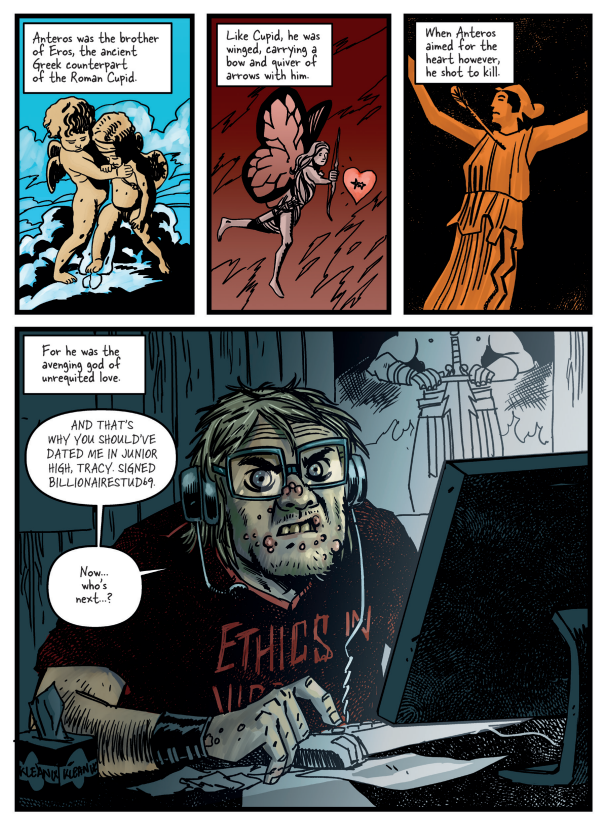
While most are familiar with Eros, the winged god of desire who evolved into the cherubic Cupid, "Fascinating Folklore" sheds a much-needed light on his significantly lesser-known brother, Anteros. The compendium positions Anteros as a fascinating counterpoint to Eros, revealing a deity whose domain is equally crucial to the human experience of love: "love returned."
Anteros, whose name literally means "love returned" or "counter-love," was charged with the vital task of punishing those who did not reciprocate the affections of another. Born from the union of Aphrodite, the goddess of love and beauty, and Ares, the god of war, Anteros was one of the Erotes, a group of winged gods who assisted their mother in her earthly duties. While Eros embodied the initial spark of love and desire, Anteros ensured its balance and equity. The book briefly touches upon his siblings: Hedylogos (sweet talk), Pothos (longing), Hymenaeus (weddings), and Hermaphroditus (fertility), illustrating the intricate pantheon of love’s various facets.
A Manual of Classical Mythology, written by Thomas Swinburne Carr and published in 1846, is cited, providing historical context for Anteros’s role as the "Deity who avenges slighted love." It also describes his symbolic contention with Eros, representing the rivalry between lovers or, paradoxically, his role in forwarding Cupid’s schemes by ensuring love’s growth. Legend has it that Eros only grew strong and his wings enlarged when Anteros was near, shrinking back to his ancient form in his brother’s absence – a powerful metaphor for the necessity of reciprocal affection for love to flourish. Anteros was often depicted armed with arrows of lead or a club of solid gold, tools reflecting the heavy consequences of unrequited love or the preciousness of its return.
One of the most intriguing revelations in the book concerns the famous statue atop the Shaftesbury Memorial Fountain in Piccadilly Circus, London. Widely known as "Eros" for decades, this iconic sculpture, cast in aluminum in 1892, is, in fact, Anteros. The book explains that the god was chosen to represent "love given blindly, or without expectation of return," as a metaphor for the philanthropy of Lord Shaftesbury, to whom the monument is dedicated. This fascinating misidentification highlights how easily mythological figures can be reinterpreted or even forgotten, and how "Fascinating Folklore" serves to correct such historical oversights, restoring Anteros to his rightful, if complex, place in our understanding of love.
Echoes from the Well: The Haunting of Okiku
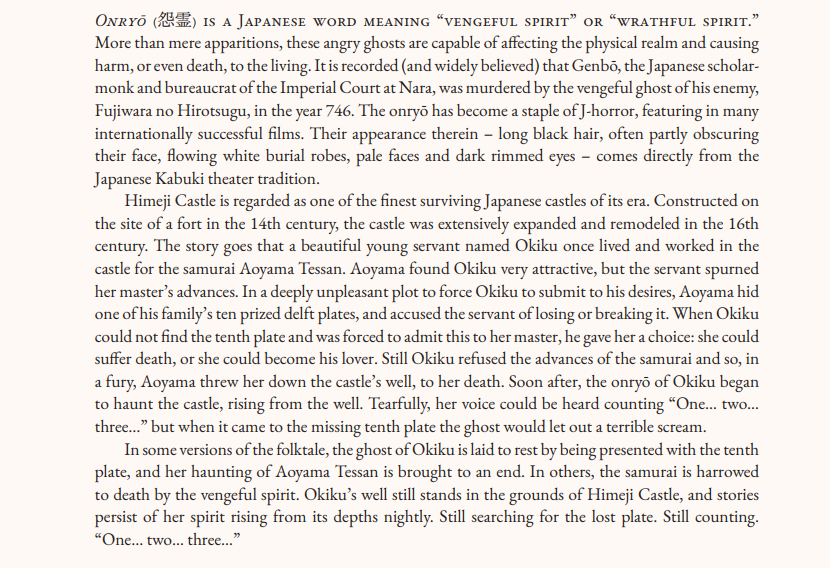
The chilling tale of Okiku, a quintessential Japanese vengeful spirit, is another compelling feature of the compendium. "Fascinating Folklore" introduces the onryō (怨霊), a Japanese word meaning "vengeful spirit" or "wrathful spirit," explaining that these are not mere apparitions but powerful ghosts capable of affecting the physical world and causing harm. The book notes that the onryō has become a staple of J-horror, with their iconic appearance – long black hair, often obscuring the face, flowing white burial robes, pale faces, and dark-rimmed eyes – stemming directly from the Japanese Kabuki theater tradition.
The story centers on Himeji Castle, one of Japan’s finest surviving castles and a UNESCO World Heritage site, where the legend of Okiku is deeply embedded. The beautiful young servant Okiku worked for the samurai Aoyama Tessan, who found her attractive but whose advances she steadfastly spurned. In a cruel act of coercion, Aoyama hid one of his family’s ten prized delft plates and accused Okiku of losing or breaking it. When she couldn’t produce the tenth plate, she was given a brutal choice: become his lover or face death. Okiku’s unwavering refusal enraged Aoyama, who then threw her down the castle’s well to her demise.

Soon after, the onryō of Okiku began to haunt the castle, rising from the well. Her tearful voice could be heard counting: "One… two… three…" but upon reaching the missing tenth plate, her count would dissolve into a terrible, agonizing scream. This repetitive, maddening count is a signature element of her haunting, symbolizing her torment and the unresolved injustice.
"Fascinating Folklore" delves into the variations of the folktale. In some versions, Okiku’s spirit is eventually laid to rest when the tenth plate is presented, bringing an end to her haunting of Aoyama. In others, the samurai is harrowed to death by the relentless vengeful spirit. The book emphasizes that Okiku’s well still stands within the grounds of Himeji Castle, a tangible link to the legend, and stories persist of her spirit rising nightly, perpetually searching for the lost plate, perpetually counting. The tale serves as a powerful narrative about betrayal, injustice, and the enduring power of a wronged spirit, resonating deeply within Japanese culture and influencing countless modern horror narratives.
A Tapestry of Tales: Other Featured Lore
Beyond these detailed explorations, "Fascinating Folklore" broadens its scope to include a rich array of other captivating narratives. Readers will learn about the legendary Boudicca, the Iceni warrior queen who led a fierce rebellion against Roman occupation in ancient Britain, symbolizing courage and resistance. The Anglo-Saxon epic hero Beowulf also features, with his legendary battles against monstrous foes like Grendel and his mother, embodying themes of heroism, fate, and the struggle against darkness.
The compendium also delves into the enchanting world of plantlore, where Mandrake, Willow, and Yedua whisper secrets of ancient wisdom. The Mandrake, with its mythical human-like scream and potent magical properties, is explored for its historical use in medicine and witchcraft. The Willow, often associated with melancholy and grace, is examined for its symbolic ties to death, rebirth, and healing in various traditions. The inclusion of Yedua, alongside other less commonly known flora, further enriches the botanical myths explored.
Finally, the book touches upon haunting ghosts like the Japanese Okiku and the Wandjing spirits of Western Australia, showcasing the diverse cultural interpretations of the spiritual realm. The Wandjing spirits, deeply rooted in Aboriginal Australian mythology, highlight the profound connection between ancestral beings, the land, and the oral traditions that preserve these sacred stories. This comprehensive approach ensures that "Fascinating Folklore" is a truly global celebration of myth and legend.
Official Responses and Anticipated Acclaim
While "Fascinating Folklore" is a relatively new release, initial reception and anticipated critical acclaim suggest it is poised to become a significant contribution to both folklore studies and the graphic novel genre. Liminal 11, the publisher, has expressed immense pride in the project, highlighting its unique blend of academic rigor and artistic innovation. A spokesperson for Liminal 11 remarked, "We believe ‘Fascinating Folklore’ is a landmark publication. John Reppion and PJ Holden have not only brought these ancient stories to life with incredible depth and beauty but have also created an accessible gateway for a new generation to connect with their cultural heritage."
The #FolkloreThursday community, which served as the initial catalyst for the project, has offered enthusiastic endorsements, with many members expressing excitement over a tangible product born from their shared online passion. Influential figures within the folklore community are expected to praise the book for its meticulous research, cross-cultural scope, and the innovative format that makes complex subjects engaging. Comic book critics are likely to commend PJ Holden’s dynamic artwork, which seamlessly integrates with Reppion’s narrative, creating a cohesive and immersive reading experience. Early reviews from pre-release readers have consistently highlighted the book’s ability to both inform and entertain, suggesting it will appeal to a broad audience ranging from academic scholars to casual readers interested in mythology and art. The collaborative nature of the project, stemming from a grassroots online movement, adds another layer of authenticity and appeal, positioning "Fascinating Folklore" as a work born directly from a genuine love for its subject matter.
Implications: The Enduring Resonance of Folklore in the Modern Age
The publication of "Fascinating Folklore" carries significant implications for how we perceive and interact with ancient stories in the 21st century.
Firstly, it underscores the enduring relevance and power of folklore as a foundational element of human culture. In an increasingly globalized and digitized world, these tales provide anchors to our collective past, offering insights into the values, fears, and aspirations of societies across millennia. The book demonstrates that myths are not merely relics but living narratives that continue to shape our understanding of identity, morality, and the unknown.
Secondly, the compendium champions innovative approaches to cultural preservation and education. By fusing scholarly essays with graphic novel elements, Reppion and Holden have created a highly accessible format that appeals to a diverse readership, including those who might typically find academic texts daunting. This artistic and narrative hybrid ensures that these rich traditions are not only preserved but actively engaged with by new audiences, bridging the gap between historical scholarship and contemporary entertainment. It highlights the potential for comics and graphic novels to serve as powerful educational tools, making complex cultural narratives approachable and captivating.
Thirdly, "Fascinating Folklore" fosters cross-cultural dialogue and understanding. By presenting tales from diverse origins—from Greek deities and Japanese ghosts to Australian Indigenous spirits—the book subtly illustrates universal human themes: the search for love, the consequences of injustice, the fear of the unknown, and the desire for meaning. This comparative approach encourages readers to recognize the shared threads of humanity woven through different cultural expressions of myth, promoting empathy and a broader global perspective.
Finally, the book reinforces the idea that folklore is a dynamic and evolving entity. The discussion of the aspidochelone’s conflation with the zaratan, or Anteros’s misidentification, illustrates how stories adapt, transform, and sometimes become obscured over time. "Fascinating Folklore" actively participates in this evolution by re-contextualizing and re-presenting these narratives for a contemporary audience, ensuring their continued vitality. It’s a reminder that engaging with folklore is not just about looking back, but about understanding its continuous presence in our present and its potential to inform our future.
Ultimately, "Fascinating Folklore" is more than just a book; it is an invitation to explore the profound depths of human imagination and collective memory. It challenges readers to look beyond the surface, to question popular narratives, and to appreciate the intricate beauty of the stories that have shaped civilizations. For anyone seeking to learn about the legends of Boudicca and Beowulf, the enthralling world of plantlore, or the haunting tales of ghosts like Okiku, this compendium offers an unparalleled journey into the magic of folklore, promising to leave every reader truly spellbound. Order your copy and embark on this extraordinary adventure today.