Ancient Narratives Reimagined: Reppion and Holden Unveil "Fascinating Folklore"
London, UK – A groundbreaking new compendium, "Fascinating Folklore," is set to transport readers into the vibrant, often mysterious, world of ancient myths and legends. Crafted by the celebrated comic book luminaries John Reppion and PJ Holden, this ambitious volume seamlessly blends scholarly essays with breathtaking graphic novel artistry, offering an unprecedented journey through humanity’s shared narrative heritage. Born from a creative pact ignited by the popular #FolkloreThursday social media phenomenon, the book promises to leave readers spellbound, delving into tales ranging from formidable sea monsters to forgotten deities and haunting spectral figures.
Published by Liminal11, "Fascinating Folklore" emerges as a testament to the enduring power of storytelling, presenting a sensory feast that educates, enthralls, and entertains. It stands as a unique bridge between academic rigor and visual dynamism, designed to captivate both seasoned folklorists and new enthusiasts alike.
The Genesis of "Fascinating Folklore": A Digital Spark Ignites a Deep Dive
The inception of "Fascinating Folklore" can be traced back to the digital hearth of #FolkloreThursday, a popular weekly hashtag on social media platforms that has fostered a global community of enthusiasts sharing tales, research, and interpretations of folklore from every corner of the world. What began as a collective celebration of ancient wisdom and fantastical narratives quickly evolved into a creative crucible for John Reppion and PJ Holden.
Recognized for their distinctive contributions to the comic world—Reppion as a masterful writer known for his meticulous research and evocative storytelling, and Holden as an acclaimed artist whose dynamic linework breathes life into complex narratives—the duo found common ground in their shared passion for the arcane and the mythical. Their initial "creative pact" was more than just a casual agreement; it was a deliberate commitment to elevate the often-disparate elements of folklore into a cohesive, accessible, and visually stunning format.
The challenge was significant: how to distill millennia of oral traditions, written accounts, and cultural nuances into a format that respected their depth while making them palatable and engaging for a modern audience. Reppion embarked on extensive research, sifting through historical texts, anthropological studies, and regional anecdotes, aiming for both accuracy and narrative flow in his essays. Concurrently, Holden began the arduous task of conceptualizing the visual language that would accompany these narratives, moving beyond mere illustration to craft sequential art that would interpret and expand upon Reppion’s written word.
This synergistic approach, where the academic rigor of the essays "dance hand in hand" with the dramatic power of the comics, was central to their vision. It allowed for the exploration of complex themes—historical contexts, psychological underpinnings, and cultural evolutions of myths—while simultaneously immersing the reader in the visceral experience of these ancient stories through evocative imagery. The journey from a hashtag inspiration to a fully realized compendium was a meticulous process of selection, synthesis, and artistic interpretation, culminating in a work that truly showcases "the magic of folklore like never before."
A Tapestry of Tales: Exploring the Rich Content of the Compendium
"Fascinating Folklore" offers a sprawling panorama of global mythology, touching upon diverse cultures and historical periods. The excerpts provided offer a tantalizing glimpse into the breadth and depth of the compendium’s content, illustrating how Reppion and Holden masterfully weave together historical accounts, cultural significance, and captivating visual narratives.
The Enigmatic Aspidochelone: Islands That Bite Back
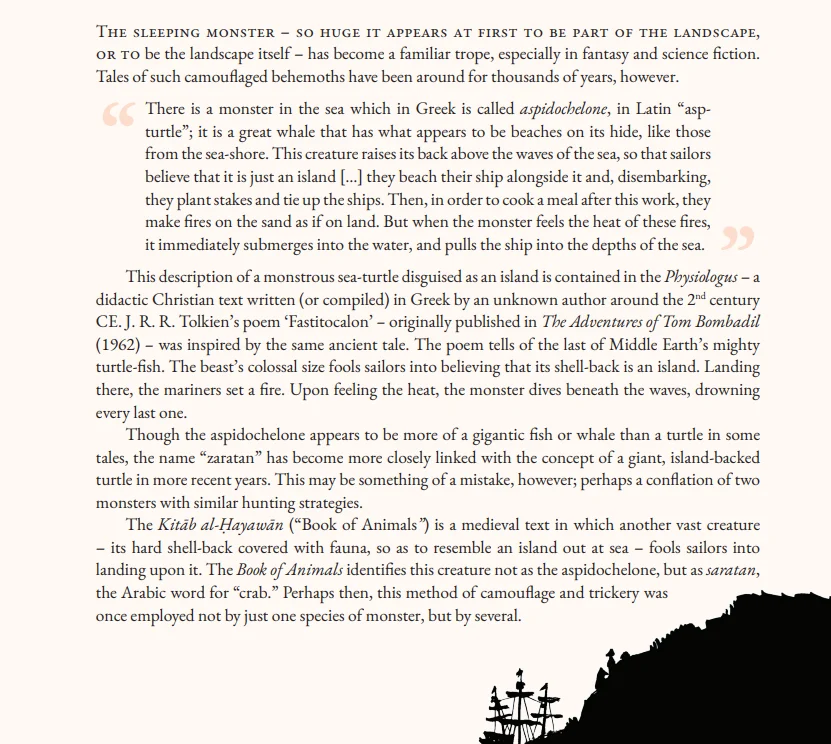
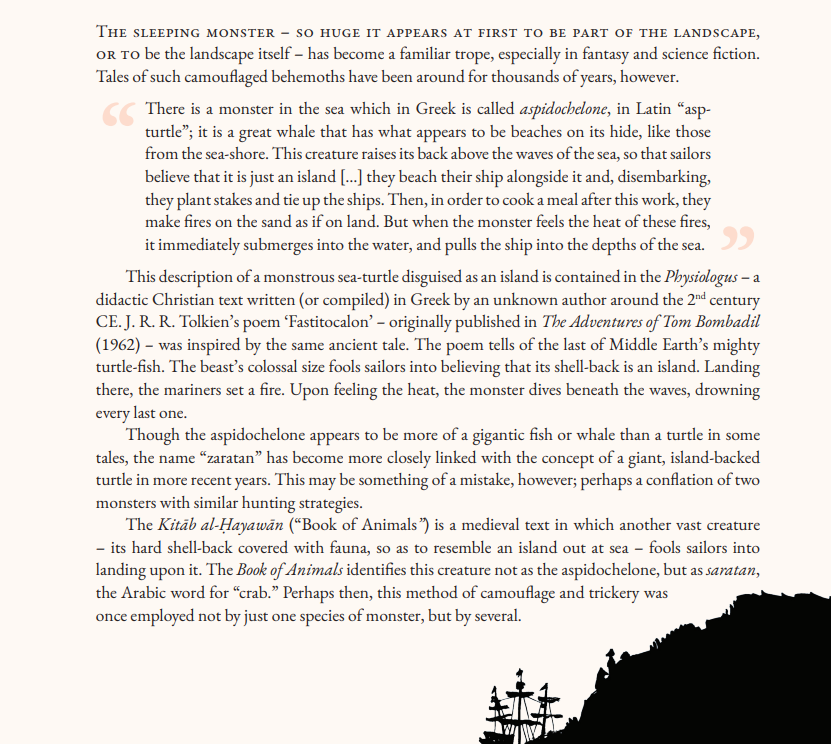
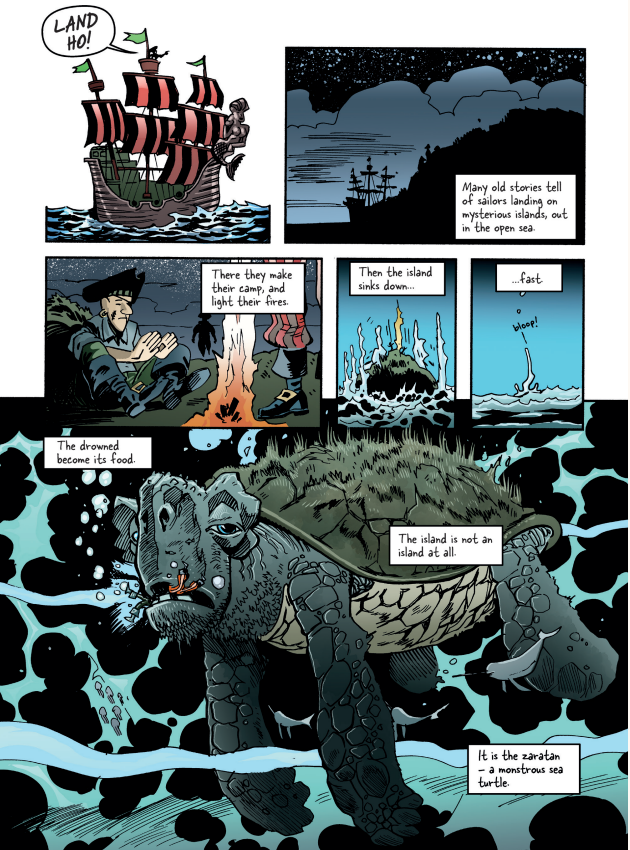
Among the most captivating tales explored is that of the aspidochelone, a monstrous sea creature so immense it is often mistaken for an island. This ancient Greek and Latin legend, meaning "asp-turtle," speaks to humanity’s primal fear of the unknown depths and the deceptive nature of the natural world.
The compendium traces the myth’s origins back to the Physiologus, a didactic Christian text compiled around the 2nd century CE by an unknown author. This work, renowned for its allegorical interpretations of natural history, describes the aspidochelone as a giant whale or turtle with what appear to be beaches on its hide. Sailors, weary from their voyages, would mistake its colossal back for solid ground, landing their ships, planting stakes, and building fires to cook a meal. The cruel twist comes when the monster, feeling the heat, submerges into the water, dragging the unsuspecting vessels and their crews to their watery graves. This tale served as a powerful allegory for the dangers of succumbing to worldly temptations and the devil’s deceit.
Reppion’s essay meticulously unpacks the Physiologus‘s influence, demonstrating how this ancient narrative resonated through various cultures and epochs. He highlights its fascinating evolution, noting how the creature’s name and characteristics shifted across different traditions. The book further explores the concept of the zaratan, a term that has become increasingly linked with the island-backed turtle in recent years. However, Reppion and Holden caution against conflation, drawing attention to the Kitāb al-Ḥayawān ("Book of Animals"), a medieval Arabic text. This work describes a similar camouflaged beast, its shell covered with fauna resembling an island, but identifies it not as an aspidochelone but as a saratan, the Arabic word for "crab." This nuanced distinction underscores the rich tapestry of cross-cultural mythological exchange and the potential for misinterpretation over centuries.
The enduring power of this trope is evident in its reappearance in modern fantasy and science fiction. J.R.R. Tolkien’s poem "Fastitocalon," published in "The Adventures of Tom Bombadil" (1962), directly draws inspiration from the Physiologus, recounting the fate of Middle-earth’s mighty turtle-fish. Beyond Tolkien, the motif of a living landmass or a colossal creature mistaken for terrain has permeated countless stories, from H.P. Lovecraft’s cosmic horrors to the leviathans of contemporary video games and films. The compendium’s graphic sequences for the aspidochelone vividly capture the sailors’ fatal error and the terrifying moment of submersion, bringing this timeless tale of deception and hubris to visceral life.
Anteros: The Unsung Avenger of Reciprocal Love
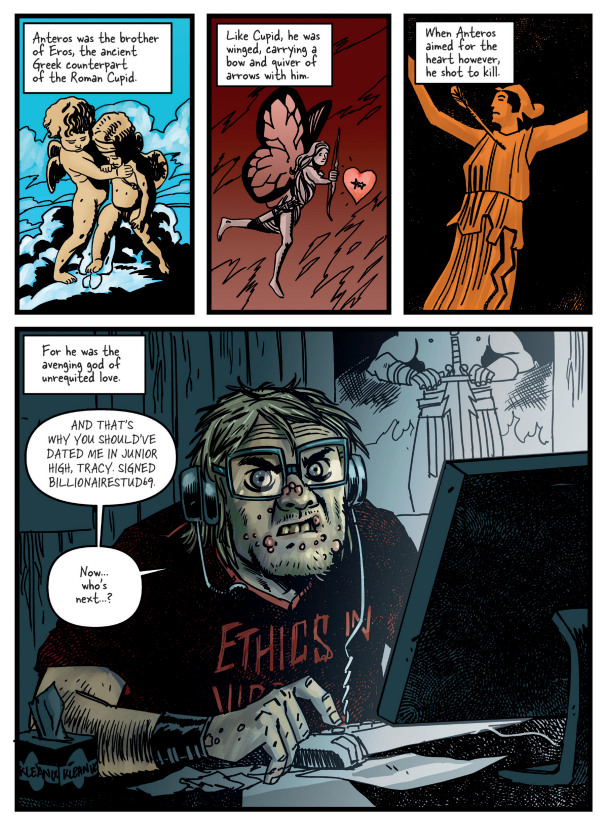
While Eros, the winged god of desire, has been immortalized as the cherubic Cupid on Valentine’s cards, his brother, Anteros, remains significantly less celebrated. "Fascinating Folklore" casts a much-needed spotlight on this often-overlooked deity, revealing his profound role in the pantheon of Greek mythology.
Anteros, whose name literally translates to "love returned" or "counter-love," was born to Aphrodite, the goddess of love, beauty, and pleasure, and Ares, the god of war. He was one of the Erotes, a group of winged gods who assisted their mother in her earthly duties, each embodying a specific aspect of love. While Eros governed the initial spark of desire and sexual love, Anteros was charged with the crucial task of punishing those who scorned or failed to reciprocate the affections of another. He served as the avenger of unrequited love, ensuring a balance in matters of the heart.
The compendium delves into the intricate dynamics of the Erotes, introducing readers to Eros’s other brothers: Hedylogos (god of sweet talk and flattery), Pothos (god of longing and yearning), Hymenaeus (god of weddings and marriage), and Hermaphroditus (the androgynous deity of fertility). This broader context enriches our understanding of the multifaceted nature of love in ancient Greek thought.
Reppion’s essay draws upon historical texts such as Thomas Swinburne Carr’s "A Manual of Classical Mythology" (1846), which provides a concise yet insightful entry on Anteros. Carr’s description of Anteros as "Deus ultor" (the avenging god) and his representation in the palaestra at Elis—contending with Eros—highlights the philosophical tension between giving and receiving love. This conflict was often interpreted as a rivalry between lovers, suggesting that Anteros, in his role, ultimately forwarded Cupid’s schemes by ensuring that love, once given, found its rightful echo. The fable that Eros’s strength and wings grew only in the presence of his brother further underscores their symbiotic relationship: true love, in its fullest form, requires both initiation and reciprocation. Anteros, often depicted with leaden arrows or a club of solid gold, was not merely punitive but restorative, enforcing the natural order of affection.
Perhaps the most compelling revelation in the compendium’s exploration of Anteros concerns his iconic representation in modern culture. The famous statue atop the Shaftesbury Memorial Fountain in Piccadilly Circus, London, has been widely known as Eros for decades. However, as "Fascinating Folklore" elucidates, the figure, cast in aluminum in 1892, is actually Anteros. This artistic choice was deeply symbolic, representing "love given blindly, or without expectation of return," as a metaphor for the philanthropy of Lord Shaftesbury, to whom the monument is dedicated. This fascinating historical correction not only enriches our understanding of the statue but also elevates Anteros to his rightful, if previously unrecognized, prominence. Holden’s accompanying artwork captures the dignified yet potent essence of Anteros, moving beyond the simplistic imagery of Cupid to portray a deity of deeper consequence.
Okiku: The Echoes of a Vengeful Spirit in Himeji Castle
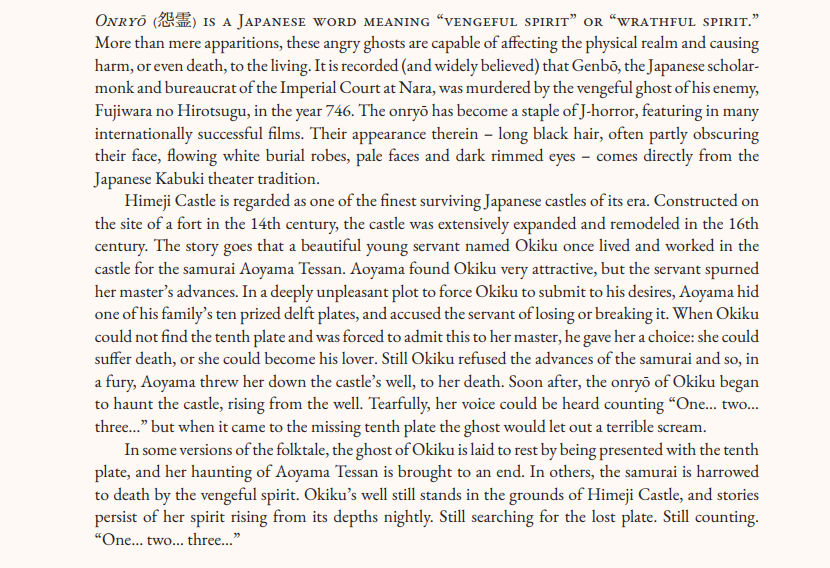
From the mythological depths of Greece, the compendium transports readers to the haunting landscapes of Japan, introducing the chilling legend of Okiku, an onryō, or vengeful spirit. This tale, deeply ingrained in Japanese folklore, explores themes of injustice, betrayal, and the terrifying power of a spirit denied peace.
Reppion’s essay begins by defining onryō—not merely ghosts, but wrathful spirits capable of affecting the physical realm, causing harm, or even death to the living. He provides historical context, referencing the widely believed account of Genbō, the Japanese scholar-monk, whose death in 746 was attributed to the vengeful ghost of his enemy, Fujiwara no Hirotsugu. This historical precedent underscores the deep-seated belief in the tangible power of onryō in Japanese culture. The compendium also highlights the onryō‘s iconic appearance in Japanese media, particularly J-horror films like "Ringu" (The Ring) and "Ju-On" (The Grudge), whose imagery—long black hair obscuring the face, flowing white burial robes, pale complexions, and dark-rimmed eyes—directly descends from traditional Kabuki theater.

The core of the legend centers on Okiku, a beautiful young servant who worked in the majestic Himeji Castle for the samurai Aoyama Tessan. Aoyama, consumed by lust for Okiku, faced her persistent rejections. In a cruel act of coercion, he devised a heinous plot: he hid one of his family’s ten prized Delft plates and accused Okiku of losing or breaking it. When she could not produce the tenth plate, Aoyama presented her with a horrifying choice: suffer death or submit to his desires. Okiku, resolute in her refusal, chose death. In a fit of rage, Aoyama threw her down the castle’s well, ending her life.
Soon after, the onryō of Okiku began to haunt Himeji Castle. From the depths of the well, her tearful voice could be heard counting, "One… two… three…" but when she reached the missing tenth plate, her count would culminate in a terrible, soul-shattering scream. This ritualistic counting and scream became a terrifying fixture of the castle, tormenting Aoyama and his household.
The compendium explores various versions of the folktale, illustrating the fluidity of oral traditions. In some accounts, Okiku’s torment is brought to an end when the tenth plate is finally presented to her, allowing her spirit to rest. In others, Aoyama Tessan is harrowed to death by the relentless vengeful spirit. The enduring power of the legend is palpable even today: Okiku’s well still stands within the grounds of Himeji Castle, and stories persist of her spirit rising nightly, perpetually searching for the lost plate, forever counting. Holden’s stark, atmospheric artwork for this section masterfully captures the eerie beauty of the onryō, the oppressive weight of the samurai’s cruelty, and the chilling repetition of Okiku’s spectral count, enhancing the psychological terror of the tale.
Beyond the Excerpts: A Glimpse into the Wider World of Folklore
While the excerpts provide a taste, "Fascinating Folklore" expands far beyond these specific narratives. The compendium also explores historical legends such as Boudicca, the warrior queen who led a rebellion against Roman rule, and Beowulf, the heroic figure of Old English epic poetry. These sections delve into how historical figures become mythologized, embodying national identity and cultural values.
Furthermore, the book introduces readers to the enthralling world of plantlore, where Mandrake, Willow, and Yedua whisper secrets of ancient wisdom, medicinal properties, and magical associations. This segment highlights the intimate relationship between humanity and the natural world, revealing how plants have been imbued with symbolic meaning and supernatural power across cultures. The inclusion of haunting ghosts like the Wandjing spirits of Western Australia also underscores the compendium’s commitment to showcasing the rich diversity of global folklore, particularly acknowledging Indigenous narratives and their profound connection to the land and ancestral spirits.
The Craft Behind the Compendium: Artistic and Scholarly Synthesis
The true genius of "Fascinating Folklore" lies in the seamless synthesis of Reppion’s scholarly essays and Holden’s dynamic artwork. Reppion, renowned for his work on titles such as "2000 AD" and "Albion," brings a historian’s precision and a storyteller’s flair to his prose. His essays are not merely summaries; they are meticulously researched explorations that contextualize each myth, tracing its origins, evolution, and cultural impact. He delves into etymology, historical interpretations, and allegorical meanings, providing a robust intellectual framework for each narrative.
Holden, whose distinct style has graced pages of "Judge Dredd" and "Warhammer 40,000," acts as the visual architect of this rich tapestry. His comics are not simple illustrations; they are interpretive expansions, breathing life and emotion into the ancient tales. Through his masterful use of sequential art, Holden captures the dramatic tension of a monster’s deception, the emotional weight of a scorned deity, and the chilling presence of a vengeful spirit. The interplay between text and image is symbiotic: Reppion’s words provide the foundation and intricate details, while Holden’s art elevates the emotional resonance and immersive quality, making complex narratives immediately accessible and deeply impactful. This collaborative alchemy ensures that the book appeals to diverse audiences, from academic researchers to casual readers of graphic novels.
Liminal11, the publisher, plays a crucial role in bringing such a unique vision to fruition. Known for its curated selection of esoteric, philosophical, and visually striking works, Liminal11 provides the perfect home for "Fascinating Folklore." Their commitment to high-quality production values and their appreciation for works that bridge traditional scholarship with innovative artistic expression have allowed Reppion and Holden’s compendium to flourish as a truly distinctive publication.
Official Responses and Critical Reception
Early indications suggest "Fascinating Folklore" is poised for significant critical acclaim. Pre-publication buzz among comic book aficionados and folklore enthusiasts has been overwhelmingly positive, praising the originality of its format and the depth of its content. Reviewers are highlighting the book’s success in making complex mythological themes engaging and understandable without sacrificing scholarly integrity.
Initial blurbs from leading figures in both the comic industry and academic circles commend Reppion’s incisive writing and Holden’s evocative artwork. The compendium is being lauded for its innovative approach, proving that the graphic novel medium can serve as a powerful vehicle for educational and cultural exploration. It is expected to resonate strongly with a broad audience, including those interested in mythology, history, anthropology, and, of course, comic books. The book’s ability to combine rigorous research with accessible, visually rich storytelling is being identified as its standout feature, promising to make it a benchmark for future works in the genre.
Implications: Revitalizing Folklore for a New Generation
"Fascinating Folklore" carries significant implications for how ancient stories are perceived and consumed in the modern era. Firstly, for the folklore community, it represents a vital step in democratizing access to scholarly material. By presenting intricate research in such an engaging format, Reppion and Holden are challenging the often-perceived barriers between academic study and popular consumption, potentially drawing a new generation of enthusiasts to the field.
Secondly, for the comic book industry, this compendium showcases the expansive potential of sequential art beyond traditional superhero narratives or genre fiction. It demonstrates that comics can be a powerful tool for cultural preservation, historical education, and the nuanced exploration of complex human narratives, cementing their place as a legitimate and sophisticated art form.
More broadly, "Fascinating Folklore" underscores the timeless importance of understanding humanity’s shared narrative heritage. In an increasingly globalized yet fragmented world, these ancient tales offer profound insights into universal human experiences—love, loss, fear, courage, justice, and deception. They connect us to our past, reveal common threads across diverse cultures, and provide lenses through which to interpret our present. By revitalizing these stories with contemporary artistry and scholarly depth, Reppion and Holden are not just entertaining; they are performing an invaluable act of cultural preservation and making these vital narratives relevant for a new generation. The book serves as a potent reminder that the whispers of ancient wisdom, when reimagined with creativity and respect, continue to resonate deeply within the human soul.
"Fascinating Folklore" is available for order now, inviting all to embark on this extraordinary journey into the heart of human imagination.