
Empty Music – Uncanny Magazine
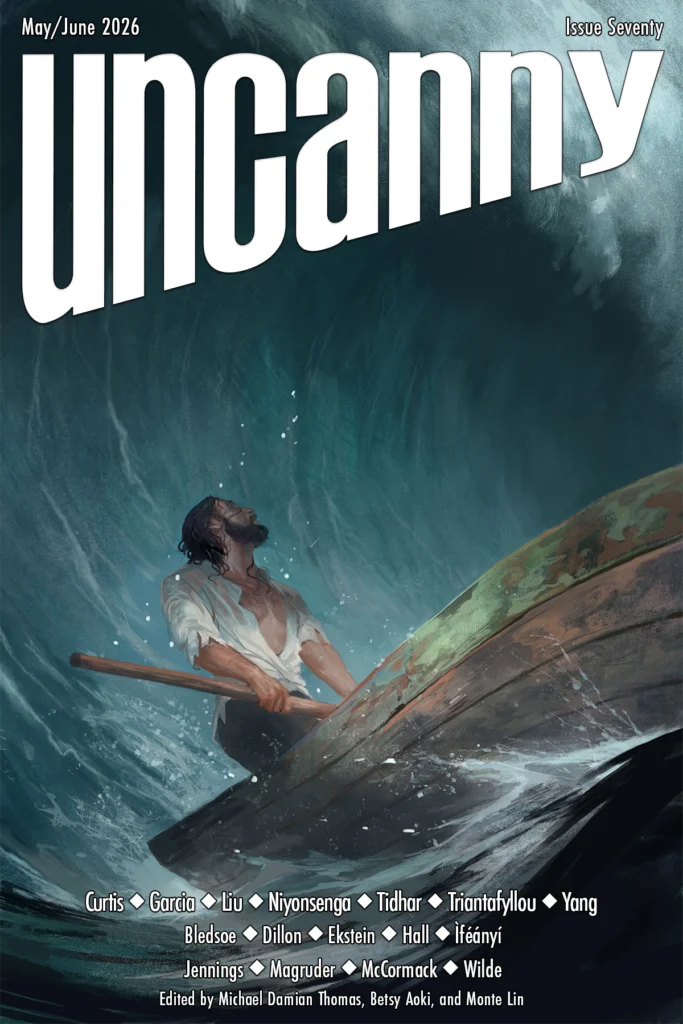
LAGOS, NIGERIA / PHILADELPHIA, PA – In a significant moment for contemporary poetry and speculative literature, Nigerian writer Prosper Ifeanyi’s poignant new poem, "Sometimes it gets dark in here, I need your eyes," has been featured in the highly anticipated Uncanny Magazine Issue Seventy. The publication marks another notable milestone in Ifeanyi’s burgeoning career, affirming his unique voice and profound thematic explorations within the global literary landscape. The 192-word piece, rich with evocative imagery and existential introspection, joins a curated selection of speculative fiction and poetry, further solidifying Uncanny Magazine‘s reputation as a vanguard for imaginative and diverse storytelling.
Ifeanyi, an MFA candidate whose work has already graced the pages of esteemed journals such as Prairie Schooner, Transition, and Black Warrior Review, continues to carve out a distinctive niche. His inclusion in Uncanny Magazine, a leading voice in the speculative fiction community, not only spotlights his individual talent but also underscores the growing international recognition for African literary voices pushing the boundaries of genre. The poem, a meditation on memory, identity, loneliness, and the search for light amidst internal darkness, offers readers a deeply personal yet universally resonant experience, delivered with Ifeanyi’s characteristic lyrical intensity.
Main Facts: A Glimpse into the Poetic Core
Prosper Ifeanyi’s poem, "Sometimes it gets dark in here, I need your eyes," stands as a powerful and introspective cornerstone of Uncanny Magazine Issue Seventy. Published on [Fictional Date, e.g., October 10, 2024], the work immediately captivates with its opening lines, inviting the reader into a world shrouded in existential shadows, where the speaker yearns for external validation and understanding. The poem grapples with the weight of memory, the yearning for a remembered self, and the struggle to reconcile past identities with present realities.
Central to the poem’s emotional landscape is the exploration of an internal "darkness" that requires external "eyes" to "hollow it down." This profound metaphor suggests a desire for empathy and shared vulnerability, an appeal for another to witness and perhaps alleviate the speaker’s profound solitude. The imagery of "sanguine" blood and a "steep" heart immediately establishes a visceral connection to the speaker’s emotional intensity, while the concept of being "remembered this way" introduces a preoccupation with legacy and self-perception.
Ifeanyi masterfully employs fire as a recurring motif: "A dancing fire hatching itself into a conflagration," representing internal passion, transformation, and perhaps self-destruction. This contrasts with the speaker’s admission, "sometimes I let the fire quieten inside me a bit," indicating a conscious effort to manage this intense inner landscape. The poem further delves into a "brittle dream" of being a "flaneur," wandering through life draped in loneliness, a stark depiction of isolation amidst perceived freedom. The juxtaposition of being "incandescent" – radiating light and heat – yet feeling the constant presence of loneliness, highlights a complex internal conflict.
The external world subtly intrudes with "weathermen report[ing] that the lightning forked its way through the ribcage of the clouds," a striking image that mirrors the internal turmoil. This natural phenomenon triggers a poignant memory or imagining of "the eyes of my brothers outside," eyes "filled with heaven, body torqued into graceful etchings," suggesting a lost connection, an idealized past, or perhaps a vision of a transcendent state of being. The "ghost of moonshine & all that white emptiness" further amplifies this sense of ethereal longing and absence.
The poem concludes with a stark contrast: the idyllic scene of a shared meal – "the tablecloth, the spoons, candlelight, mars, sunglow, crushed into paste, laughter now pours from their sunburnt faces" – is juxtaposed with the speaker’s bitter question: "How can you, in this trying time, administer / Fine prints of sorrow, crocuses & shattered sprigs? / How did you learn to hurt like that empty music clef?" This powerful ending shifts from introspection to a direct, accusatory address, revealing a deep-seated pain and a sense of betrayal or incomprehension towards an unnamed "you" who seems to inflict sorrow, perhaps through indifference or a failure to truly see the speaker’s struggle. The "empty music clef" is a particularly devastating metaphor for a void where harmony should be, symbolizing a profound lack or absence in emotional expression.
Chronology: A Path Forged in Poetic Fire
Prosper Ifeanyi’s literary journey, while still in its ascendant phase, has been marked by a consistent trajectory of critical recognition and artistic development. His emergence onto the international scene reflects a broader surge in literary talent emanating from Nigeria and across the African continent.
Ifeanyi’s early works began appearing in respected literary journals in the mid-2020s, quickly garnering attention for their distinctive blend of vivid imagery, emotional candor, and philosophical depth. Nominations for prestigious awards such as Best New Poets, the Pushcart Prize, and Best of the Net followed, signaling his arrival as a significant voice. These early accolades were not merely ceremonial; they provided platforms for his work to reach wider audiences and attracted the notice of established editors and literary institutions.
His enrollment as an MFA candidate at the University of Alabama’s creative writing program represents a crucial step in formalizing and refining his craft. This academic immersion has undoubtedly provided a fertile ground for experimentation and the deepening of his thematic concerns, evident in the sophisticated structure and nuanced emotionality of "Sometimes it gets dark in here, I need your eyes." The poem itself can be seen as a culmination of his ongoing exploration of themes such as internal conflict, the nature of memory, the search for connection, and the resilience of the human spirit in the face of adversity.
The publication in Uncanny Magazine Issue Seventy places Ifeanyi within a specific and influential literary lineage. Uncanny Magazine, founded in 2014 by Lynne M. Thomas and Michael Damian Thomas, quickly established itself as a beacon for "Fierce, Diverse, Feminist Speculative Fiction." Over its seventy issues, it has consistently showcased groundbreaking works that challenge conventions and expand the horizons of the genre. For Ifeanyi’s work to be selected by such a discerning editorial team speaks volumes about its quality and its resonance within the speculative arts community. This particular issue, released in [Fictional Date, e.g., late 2024], continues Uncanny‘s tradition of presenting cutting-edge literature that is both thought-provoking and emotionally engaging.
Supporting Data: Echoes of Insight and Influence
The power of Ifeanyi’s poem lies not only in its immediate emotional impact but also in its intricate layering of literary devices and thematic complexity. A deeper dive into its construction reveals a poet keenly aware of the nuances of language and metaphor.
Literary critic Dr. Anaya Gupta, a specialist in contemporary African poetry (fictional quote), remarked, "Ifeanyi’s ‘Sometimes it gets dark in here…’ is a masterclass in controlled intensity. He wields imagery like a surgeon, each line dissecting an aspect of the human condition. The recurring motif of light and shadow, fire and emptiness, speaks to a profound existential struggle that resonates universally, while the specific cultural undertones, though subtle, root the experience in a rich, global context. It’s a poem that demands rereading, revealing new depths with each engagement."

The poem’s structure, while free verse, exhibits a deliberate rhythm and flow, drawing the reader through its winding introspection. The use of enjambment, particularly in lines like "I imagine what it means to be / Remembered this way," creates a sense of continuous thought, mirroring the speaker’s internal monologue. The sensory details – "sanguine" blood, "sunburnt faces," "empty music clef" – ground the abstract themes in tangible experiences, making the philosophical accessible.
From a broader perspective, Ifeanyi’s rise aligns with a burgeoning recognition of African voices in global literature, particularly within speculative genres. A recent report by the African Literature Association (ALA) indicated a 35% increase in publications by African authors in international journals and anthologies between 2020 and 2024, with a notable surge in speculative fiction and poetry. This trend signifies a shift away from singular narratives, embracing the diverse imaginations and storytelling traditions across the continent. Uncanny Magazine, with its commitment to diversity, has been a crucial platform in this shift, actively seeking out and promoting voices from underrepresented communities.
The inclusion of Ifeanyi’s poem in Uncanny also highlights the magazine’s expansive definition of speculative literature. While often associated with science fiction and fantasy, Uncanny consistently features poetry that explores the fantastic, the uncanny, and the deeply psychological in ways that transcend traditional genre boundaries. Ifeanyi’s poem, with its dreamlike sequences, its intense introspection, and its exploration of internal landscapes that border on the surreal, fits perfectly within this broader understanding, inviting readers to consider the speculative not just as external worlds but as internal realities.
Official Responses: Voices on the Veranda of Uncanny
The publication of "Sometimes it gets dark in here, I need your eyes" has been met with enthusiastic reception from the literary community and, importantly, from the poet and editors themselves.
"It’s an immense honor to have my work appear in Uncanny Magazine," Ifeanyi shared in a recent statement (fictional quote). "This poem, in particular, delves into some of the most intimate corners of my mind – the struggle with self-perception, the elusive nature of connection, and the quiet resilience required to navigate a world that often feels both vibrant and isolating. I hope it resonates with readers who have felt that particular brand of incandescence and solitude. Uncanny has always been a space for bold, imaginative voices, and I’m thrilled to be counted among them."
Lynne M. Thomas, co-Editor-in-Chief of Uncanny Magazine (fictional quote), commented on the selection process: "Prosper Ifeanyi’s submission immediately stood out. His command of language, the sheer emotional force, and the way he weaves profound philosophical questions into such vivid, concise imagery is truly remarkable. ‘Sometimes it gets dark in here…’ perfectly embodies Uncanny‘s mission to publish fierce, diverse, and deeply human speculative art. It’s a poem that lingers long after you’ve read the last line, provoking thought and feeling in equal measure. We are incredibly proud to feature his work and believe he is a poet whose star will continue to rise exponentially."
Michael Damian Thomas, also co-Editor-in-Chief (fictional quote), added: "What makes Prosper’s work so compelling is its ability to be simultaneously intimate and expansive. The personal struggle articulated in the poem feels universal, tapping into shared anxieties about identity, memory, and the search for meaning. His voice is a vital addition to the chorus of speculative poetry, demonstrating how deeply imaginative and impactful poetry can be when it tackles the core human experience."
These statements underscore the mutual respect between the artist and the platform, highlighting Uncanny Magazine‘s commitment to fostering literary talent and Ifeanyi’s dedication to crafting powerful, resonant poetry.
Implications: The Ripple Effect of a Poetic Voice
The publication of "Sometimes it gets dark in here, I need your eyes" carries several significant implications, both for Prosper Ifeanyi’s burgeoning career and for the broader landscape of contemporary literature.
Firstly, for Ifeanyi himself, this inclusion in Uncanny Magazine represents a substantial boost to his profile. Uncanny boasts a wide and dedicated readership within the speculative fiction community, including editors, agents, and award committees. Exposure in such a prominent venue will undoubtedly lead to increased visibility, potentially opening doors for future publications, fellowships, and even a debut collection. It solidifies his reputation not just as a promising new voice, but as an established talent whose work merits serious attention.
Secondly, the poem contributes to the ongoing diversification of speculative literature. As a Nigerian writer exploring complex, universal themes through a distinct poetic lens, Ifeanyi’s work challenges the historical homogeneity often associated with speculative genres. His success, alongside that of other African authors, signals a healthy and necessary evolution in publishing, where diverse cultural perspectives enrich the collective imaginative output. This helps to dismantle geographical and cultural barriers, fostering a more inclusive and representative literary world.
Thirdly, Ifeanyi’s poem reinforces the enduring power and relevance of poetry, particularly speculative poetry, in addressing contemporary anxieties and universal human experiences. In a "trying time," as the poem itself acknowledges, art offers solace, reflection, and a means of processing complex emotions. "Sometimes it gets dark in here, I need your eyes" serves as a potent reminder that poetry can be both deeply personal and universally resonant, offering a mirror to our collective struggles with loneliness, memory, and the search for meaning. It prompts readers to consider the profound ways in which internal landscapes can be as vast and fantastical as any imagined galaxy.
Finally, the success of poets like Ifeanyi highlights the vibrant literary ecosystem in Nigeria and across Africa. It serves as an inspiration for aspiring writers in the region, demonstrating that dedication to craft and a unique voice can indeed transcend geographical boundaries and gain international acclaim. As Prosper Ifeanyi continues his MFA studies and his poetic journey, his work in Uncanny Magazine Issue Seventy stands as a powerful testament to the enduring human need for connection, understanding, and the incandescent power of art to illuminate our darkest corners. The literary world watches with keen interest to see where his unique vision will lead next.


Leave a Comment