In the vast and complex pantheon of ancient Mesopotamia, few deities commanded as much awe and dread as Ereshkigal, the Queen of the Dead. Known also as Irkalla and Allatu, her very name, "Queen of the Great Below" or "Lady of the Great Place," evoked the profound and inescapable nature of her dominion. Far from a realm of celestial splendor, the "great" in her title signified "vast" – an immense, shadowy expanse known as Kurnugia, the "Land of No Return." This subterranean kingdom, believed to lie beneath the western Mountains of Sunset, was the final destination for all souls, a place of perpetual gloom where the departed subsisted on muddy puddles and dust. Ereshkigal’s primary charge was absolute: to eternally confine the dead within her dark realm and to vehemently deny any living being entry, thereby safeguarding the profound, and perhaps terrifying, truths of the afterlife.
Main Facts: Dominion Over Darkness
Ereshkigal’s sovereignty was absolute, exercised from her formidable palace, Ganzir, situated strategically at the very entrance of the underworld. This gateway to the netherworld was secured by seven formidable gates, each vigilantly guarded by her loyal servant, Neti. For eons, Ereshkigal reigned alone, a solitary monarch in her somber kingdom. This changed with the arrival of the war god Nergal, also known as Erra, who, through a series of divine machinations, became her consort and co-ruler, sharing her dominion for six months of the year.
Beyond her role as the ultimate gatekeeper of souls, Ereshkigal’s familial connections placed her at the heart of key Mesopotamian narratives. She was the elder sister of the vibrant and often capricious goddess Inanna (later Ishtar), a relationship central to one of the most famous Sumerian poems, The Descent of Inanna. Her first husband was Gugalanna, the mighty Great Bull of Heaven, whose demise at the hands of the hero Enkidu in The Epic of Gilgamesh set off a chain of tragic events. She later bore a son, Ninazu, from Gugalanna. Her second consort, Enlil, bestowed upon her another son, Namtar, while an unnamed consort sired her daughter, Nungal (also Manungal), an underworld deity associated with retribution and healing, yet also punishment for the wicked. Nergal, her fourth and final consort, was unique in his agreement to perpetually reside with her in the realm of the dead, solidifying their shared rule.
Ereshkigal’s omnipresent authority and the finality of her domain rendered her the most feared deity in the Mesopotamian pantheon. She embodied the ultimate, irreversible conclusion of existence, a destination from which there was no returning, making her a formidable figure whose power permeated the very fabric of ancient Mesopotamian belief.
Chronology: The Evolution of a Dreaded Deity
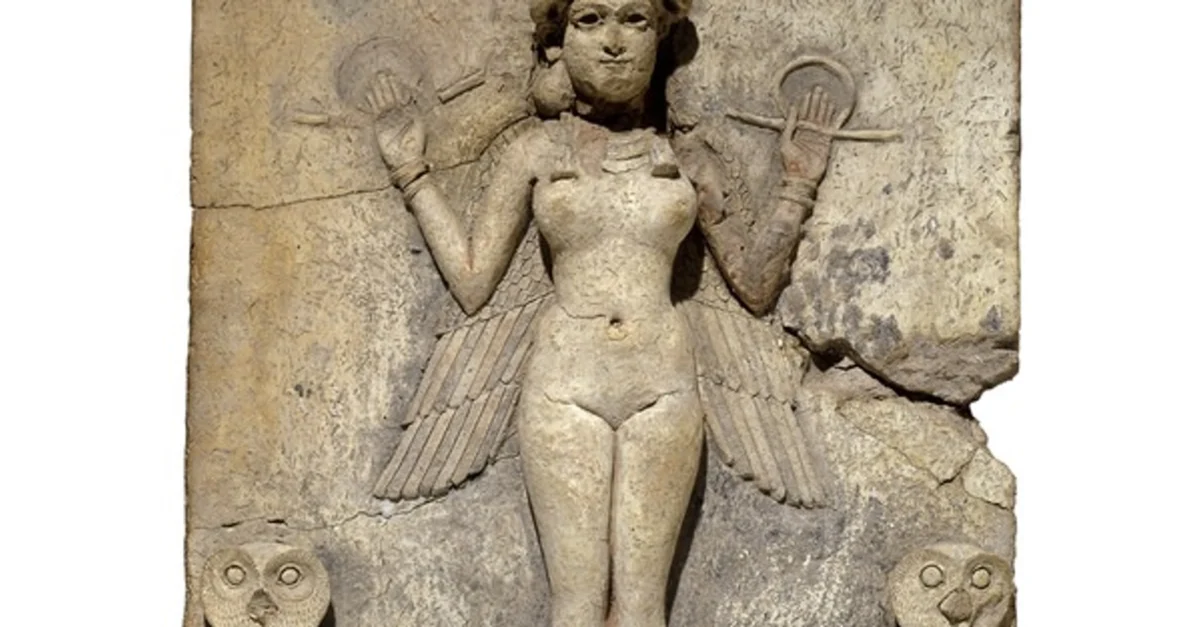
Ereshkigal’s presence in Mesopotamian literature can be traced back to the Sumerian poem The Death of Ur-Nammu, dating to the reign of Shulgi of Ur (circa 2094 to 2046 BCE). While this marks her earliest explicit mention, it is highly probable that her veneration and recognition predated this period, possibly extending into the earlier Akkadian period (2350/2334-2154 BCE), given that fragments referencing her Akkadian name, Allatu, might predate Shulgi’s reign. By the Old Babylonian period (circa 1894-1595 BCE), Ereshkigal was firmly established and widely acknowledged as the supreme Queen of the Dead, a fact that lends significant weight to interpretations identifying her as the subject of the famous Queen of the Night relief from Hammurabi’s era.
A striking aspect of Ereshkigal’s enduring power lies in her unique position among underworld rulers across ancient cultures. While many goddesses, including Inanna/Ishtar, saw their status diminish over time in Mesopotamian history, Ereshkigal maintained her absolute authority. In contrast to the underworlds of other contemporary civilizations – such as the Greek Hades, the Egyptian Osiris, or the Phoenician Mot – which were predominantly governed by male deities, Ereshkigal stood as the sole female sovereign of the realm of the dead. Even when Nergal was introduced as her consort, a clear indication of the growing prominence of male gods, Ereshkigal’s primary dominion and unassailable position remained unchallenged. This singular status underscores her immense, unwavering power and the deep-seated respect, albeit fear, she commanded.
Supporting Data: Narratives of Power, Justice, and Love
Ereshkigal’s character is vividly portrayed in two cornerstone myths: The Descent of Inanna and The Marriage of Ereshkigal and Nergal. These narratives illuminate her unwavering commitment to the cosmic order and her formidable, yet sometimes vulnerable, nature.
The Descent of Inanna: A Tale of Divine Justice
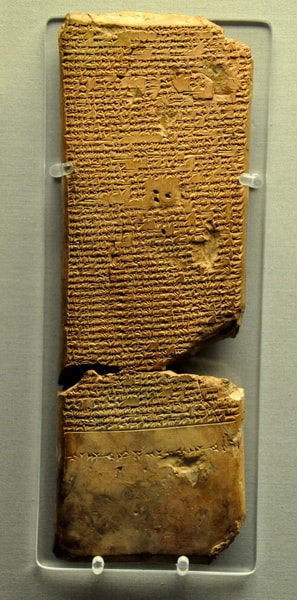
The Descent of Inanna, a Sumerian poem from circa 1900-1600 BCE, is often mistakenly interpreted in modern contexts as a journey of self-discovery. However, a closer examination reveals its true intent: to extol Ereshkigal’s role as the stern arbiter of justice and to caution against hubris, even among the gods. The poem meticulously portrays Inanna, Ereshkigal’s younger sister, not as a heroic figure, but as a self-centered deity whose actions often lead to grave consequences. This characterization aligns with other Mesopotamian literature, such as The Epic of Gilgamesh, where Inanna/Ishtar’s spurned advances lead to the rampage of Gugalanna, the Bull of Heaven, causing widespread destruction and ultimately leading to Enkidu’s death.
The poem begins with Inanna’s decision to descend to the underworld, ostensibly to attend the funeral of Gugalanna – a death she herself orchestrated. Ereshkigal, upon hearing of her sister’s arrival at the seven gates, is far from pleased. She instructs her gatekeeper, Neti, to demand that Inanna remove an article of clothing or ornament at each successive gate. By the time Inanna reaches Ereshkigal’s throne room, she stands stripped naked, vulnerable, and devoid of her divine regalia. It is then that the annuna, the venerable judges of the underworld, pass their immutable judgment against her. The text vividly describes the chilling verdict:
The annuna, the judges of the underworld, surrounded her
They passed judgment against her.
Then Ereshkigal fastened on Inanna the eye of death
She spoke against her the word of wrath
She uttered against her the cry of guilt
She struck her.
Inanna was turned into a corpse
A piece of rotting meat
And was hung from a hook on the wall.
(Wolkstein and Kramer, 60)
Inanna’s death is not an act of sibling rivalry but a divine execution, a just punishment for her transgression in causing Gugalanna’s death. Her subsequent resurrection is not a testament to her inherent virtue, but rather to her shrewd foresight. Having anticipated this grim possibility, Inanna had instructed her loyal servant Ninshubur to seek help from the gods if she did not return. Ninshubur’s desperate pleas eventually reach Enki, the god of wisdom, who dispatches two androgynous demons, the galla, to the underworld.
The galla infiltrate Kurnugia "like flies" and, adhering to Enki’s precise instructions, approach Ereshkigal during a moment of profound distress. The Queen of the Dead is depicted in a state of primal suffering, akin to labor pains:
No linen was spread over her body
Her breasts were uncovered
Her hair swirled around her head like leeks.
(Wolkstein and Kramer, 63-66)
The galla, instructed to sympathize with her pains, receive an offer of any gift they desire in gratitude. They request "the corpse that hangs from the hook on the wall," which Ereshkigal grants. Inanna is then revived with the food and water of life. However, the unbreakable law of the underworld dictates that no soul can return to the land of the living without a replacement. Inanna, ever self-serving, chooses her consort Dumuzi, who is then dragged to the underworld. His compassionate sister, Geshtinanna, volunteers to share his fate, leading to the cyclical myth where Dumuzi and Geshtinanna alternate their time in the underworld for six months each, while Inanna, the instigator of all this chaos, returns to her carefree existence.
The poem concludes not with praise for Inanna, but with a resounding affirmation of Ereshkigal’s authority and significance:
Holy Ereshkigal! Great is your renown!
Holy Ereshkigal! I sing your praises!
(Wolkstein and Kramer, 89)
This ending unequivocally positions Ereshkigal as the central figure, a powerful embodiment of justice whose suffering, both self-inflicted and endured, underscores the poem’s message: if even a goddess of Ereshkigal’s stature must confront injustice and adhere to cosmic law, then mortals too must accept their fates and strive for piety.
The Marriage of Ereshkigal and Nergal: A Pact of Power
Ereshkigal’s solitary reign in the underworld ends with the arrival of the war god Nergal. Multiple versions of their union exist, ranging from Nergal being seduced by the queen during a visit and later agreeing to return for half the year, to a more elaborate divine plot orchestrated by Enki. Versions of this myth have been unearthed across the ancient Near East, from the Amarna Letters in 15th-century BCE Egypt to the Assyrian site of Sultantepe in the 7th century BCE. However, the most complete and well-known account stems from the Neo-Babylonian period (circa 626-539 BCE).
In this version, the gods host a grand banquet, but Ereshkigal, bound to her underworld domain, cannot attend. She sends her son, Namtar, to collect her share of the feast. Upon Namtar’s arrival, all the gods rise in deference to Ereshkigal, except for the impetuous war god Nergal. Insulted, Namtar reports this slight to his mother. Enraged by Nergal’s disrespect, Ereshkigal demands his immediate dispatch to the underworld so she can exact her vengeance.
The other gods, acknowledging the legitimacy of Ereshkigal’s demand, acquiesce. However, Enki, anticipating the unfolding drama, secretly equips Nergal with fourteen demon escorts, two for each of the underworld’s seven gates, with instructions to keep them open. When Nergal arrives, Neti announces his presence, and Namtar informs Ereshkigal that the disrespectful god has come. Ereshkigal, intent on his demise, orders each gate to be barred behind him. Yet, as Nergal passes through each portal, he strategically stations two demons to keep it open, circumventing Ereshkigal’s plan. He marches directly to the throne room, overpowers Namtar, and drags Ereshkigal to the floor, raising his mighty axe to sever her head.
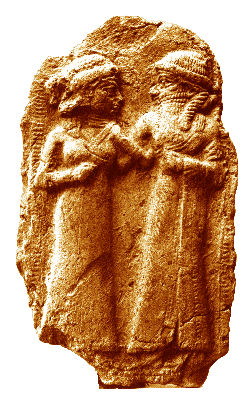
In a pivotal moment, Ereshkigal pleads for her life, offering to become his wife and share her immense power with him. Nergal, seemingly softened by her plea and perhaps remorseful for his violent intent, consents. The poem concludes with their embrace and the establishment of their enduring partnership, a unique arrangement allowing Nergal to return to the surface for six months of the year, explaining the seasons of war and conflict. This myth, much like the Greek story of Demeter and Persephone, served to explain natural cycles, in this case, the seasonal nature of warfare.
Iconography: The Unseen Queen
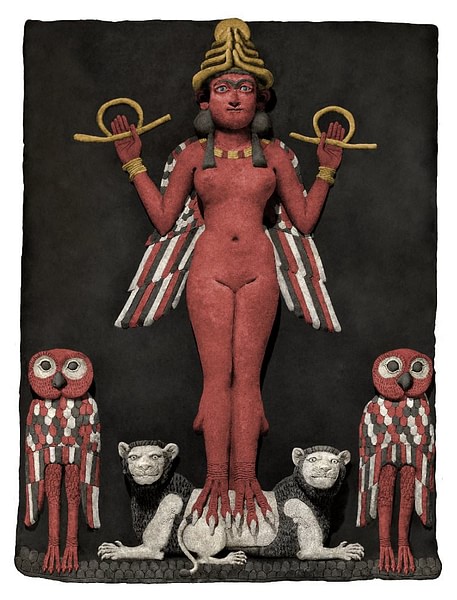
Despite her profound significance, a universally agreed-upon iconography for Ereshkigal remains elusive. The renowned Burney Relief, also known as The Queen of the Night (dating from Hammurabi’s reign, 1792-1750 BCE), is frequently interpreted as a depiction of Ereshkigal. This striking terracotta relief portrays a naked woman with distinctive downward-pointing wings, standing atop two lions, flanked by owls. She grasps symbols of power, and beneath the lions, images of mountains reinforce her connection to the underworld. While this imagery strongly suggests Ereshkigal, scholarly debate persists, with some interpreting the figure as Inanna or even the demon Lilith. However, the context of the underworld, the lions (associated with ferocity and divine power), and the owls (symbols of night and death) strongly support the Ereshkigal attribution.
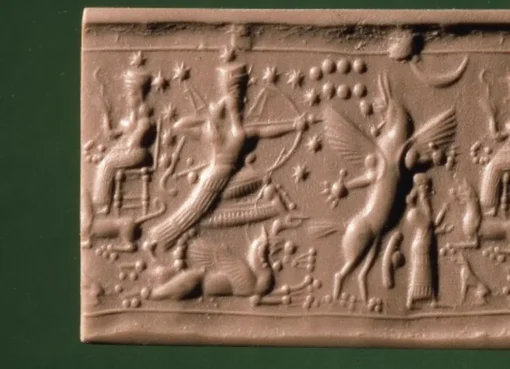
The scarcity of unambiguous depictions of Ereshkigal is not coincidental. Mesopotamian belief held that creating an image of a deity or entity invited its direct attention. Statues were believed to house the gods themselves, and images on cylinder seals were thought to possess amuletic properties. To craft an image of Ereshkigal, the formidable Queen of the Dead, would have been an act of extreme audacity, potentially directing her terrifying gaze upon the creator or owner – an attention that was unequivocally undesirable and profoundly feared. This deep-seated belief explains the reluctance of ancient artists to immortalize her form, contributing to her enigmatic visual legacy.
Official Responses: The Weight of Belief and Ritual
Ereshkigal’s existence evoked a complex "official response" within Mesopotamian society, manifesting in religious practices, moral codes, and ritualistic behaviors. She was revered not just as a formidable goddess of immense power, but also, paradoxically, as one who could forgive injustices or wrongs in the service of a greater cosmic order. This dual nature served to encourage piety and resilience among the populace: if Ereshkigal, a divine being, could suffer injustice and yet continue her sacred duties in accordance with divine will, then humans were expected to demonstrate no less fortitude in their own lives.
Her most crucial "official" function was her role as the unyielding guardian of the underworld. She was understood to mete out rewards to the virtuous and punishments to the wicked, but, more importantly, to ensure that the dead remained in their designated realm. The seven gates of Kurnugia were not merely barriers against the living; they were also impregnable walls designed to contain all who belonged within.
A vibrant cult of the dead developed around Ereshkigal, reflecting both reverence for the departed and a deep-seated fear of their return. Since the souls in Kurnugia were believed to subsist on muddy water and dust, elaborate rituals were performed to alleviate their suffering. Food offerings were placed on tombs, and fresh water was poured, believed to trickle down to the mouths of the deceased. Scholar E. A. Wallis Budge meticulously describes these practices:
The tears of the living comforted the dead and their lamentations and dirges consoled them. To satisfy the cravings of the dead these offerings were sometimes made by priests who devoted their lives to the cult of the dead, and the kinsmen of the dead often employed them to recite incantations that would have the effect of bettering the lot of the dead in the dread kingdom of Ereshkigal…The chief object of all such pious acts was to benefit the dead but underneath it all was the fervent desire of the living to keep the dead in the underworld. The living were afraid lest the dead should return to this world and it was necessary to avoid such a calamity at all costs.
(Budge, 145)
This passage highlights the dual purpose of the cult: compassion for the dead intertwined with a pragmatic, almost desperate, need to prevent their return to the world of the living.
Implications: Order, Morality, and the Human Condition
Ereshkigal, like all Mesopotamian deities, played a pivotal role in maintaining cosmic order against the ever-present threat of chaos. Her strict governance of the underworld ensured that the boundary between life and death remained inviolable. If a ghost were to haunt the living, it was rarely perceived as a random occurrence. Unless it was a restless fugitive who had somehow slipped past Irkalla’s formidable defenses, such an event was understood to occur with Ereshkigal’s explicit permission, signaling a profound imbalance.
The main reasons for such hauntings were deeply rooted in the social and moral fabric of Mesopotamia: improper burial rites, neglect of daily rituals of remembrance for the deceased, or unpunished impious acts committed by the living. As the ultimate queen and guardian of the dead, Ereshkigal served as a potent, ever-present reminder to the living to adhere to proper rites and rituals throughout their lives, and to conduct themselves in a manner that benefited their immediate families and the wider community. Her domain underscored the cyclical nature of existence, the importance of honoring the past, and the profound consequences of moral failings. She was not merely a mythological figure; she was a fundamental pillar of Mesopotamian morality, cosmic order, and the human understanding of life’s inevitable conclusion.
In essence, Ereshkigal embodied the inescapable truth of death and the immutable laws governing the afterlife. Her myths and the societal responses to her cult offered comfort in structure, fear in consequence, and a profound narrative framework for understanding the final journey of every soul in ancient Mesopotamia.
CAIRO, Egypt – Nestled in the northeastern corner of Africa, bordered by the shimmering Mediterranean Sea, lies Egypt – a land synonymous with antiquity, the cradle of one of Earth’s most enduri
Baghdad, Iraq – In the annals of ancient Mesopotamia, few deities embody the complex evolution of human civilization as profoundly as Ninurta. Known across Sumerian and Akkadian cultures, this hero-go
Main Facts In North America, the chilling claim that a supposedly haunted location rests upon an "Indian burial ground" has become a pervasive cultural touchstone. This urban legend, deeply




Leave a Comment