
Salvador Dalí’s Surrealist Tarot: Where Mysticism Meets Masterful Artistry
A Journey into the Enigmatic Visions of a Master’s Deck
Introduction: The Allure of the Arcana and the Visionary’s Touch
The realm of the Tarot, with its rich tapestry of archetypal symbolism and profound esoteric meaning, has long captivated the human imagination. While often associated with charlatans and fortune-telling, the Tarot has also found a devoted following among brilliant, unconventional thinkers – individuals who often embrace a touch of the theatrical themselves. From the poetic pronouncements of William Butler Yeats to the visionary explorations of Chilean filmmaker and artist Alejandro Jodorowsky, the Tarot’s appeal to the artistic psyche is undeniable. Jodorowsky, in particular, champions the Tarot not as a predictive tool, but as a "language that talks about the present," a powerful conduit for creative inspiration. It is within this fertile ground of artistic interpretation and mystical inquiry that the extraordinary work of Salvador Dalí, the undisputed titan of Surrealism, emerges.
Dalí, a figure whose life and art were imbued with an almost alchemical blend of genius and flamboyant self-promotion, also turned his formidable creative energies towards the ancient practice of Tarot. His personal engagement with the cards, culminating in the design of his own unique deck in the 1970s, offers a fascinating intersection of surrealistic vision, occult tradition, and artistic innovation. This exploration delves into the genesis, artistic intricacies, and enduring legacy of Salvador Dalí’s Tarot deck, revealing a profound connection between the artist’s subconscious landscapes and the timeless archetypes of the Tarot.
The Genesis of a Surrealist Oracle: From Film Commission to Personal Obsession
The initial spark for Salvador Dalí’s Tarot project arose from an unexpected quarter: the cinematic world. In the early 1970s, producer Albert Broccoli commissioned Dalí to design a Tarot deck for the James Bond film Live and Let Die. This commission, reportedly influenced by Dalí’s wife and muse, Gala, who nurtured his interest in mysticism, provided the initial impetus for the artist to embark on this ambitious undertaking. Dalí, known for his insatiable curiosity and penchant for grand projects, eagerly embraced the task.
However, the contractual agreement for the film eventually fell through. Far from abandoning the project, Dalí, driven by his own burgeoning fascination and the artistic possibilities inherent in the Tarot, continued to develop the deck independently. This transition from a commercial commission to a deeply personal artistic endeavor allowed Dalí the freedom to imbue the cards with his signature surrealistic flair and his unique interpretative lens, unburdened by the constraints of a film script.
This period also coincided with a significant resurgence in the popularity of Tarot. The counter-cultural fascination with the occult that characterized the 1960s began to seep into mainstream culture in the 1970s, bolstered by influential publications like Stuart Kaplan’s Tarot Cards for Fun and Fortune Telling. While Dalí had previously demonstrated his ability to capture the vibrant psychedelia of the era in his illustrations for Alice in Wonderland in 1969, his approach to the Tarot deck revealed a surprising element of "reserve," as noted by Lisa Rainwater in Galo magazine. This reserve, Rainwater suggests, hints at a deep reverence for the Tarot that almost humbles the artist. Yet, Dalí’s inherent knack for "fanatical self-promotion" could not be entirely contained; he ultimately chose his own iconic face to represent the Magician, a testament to his unshakeable self-belief and his desire to leave his indelible mark on this ancient system.
Artistic Interpretation: A Pastiche of the Profound and the Peculiar
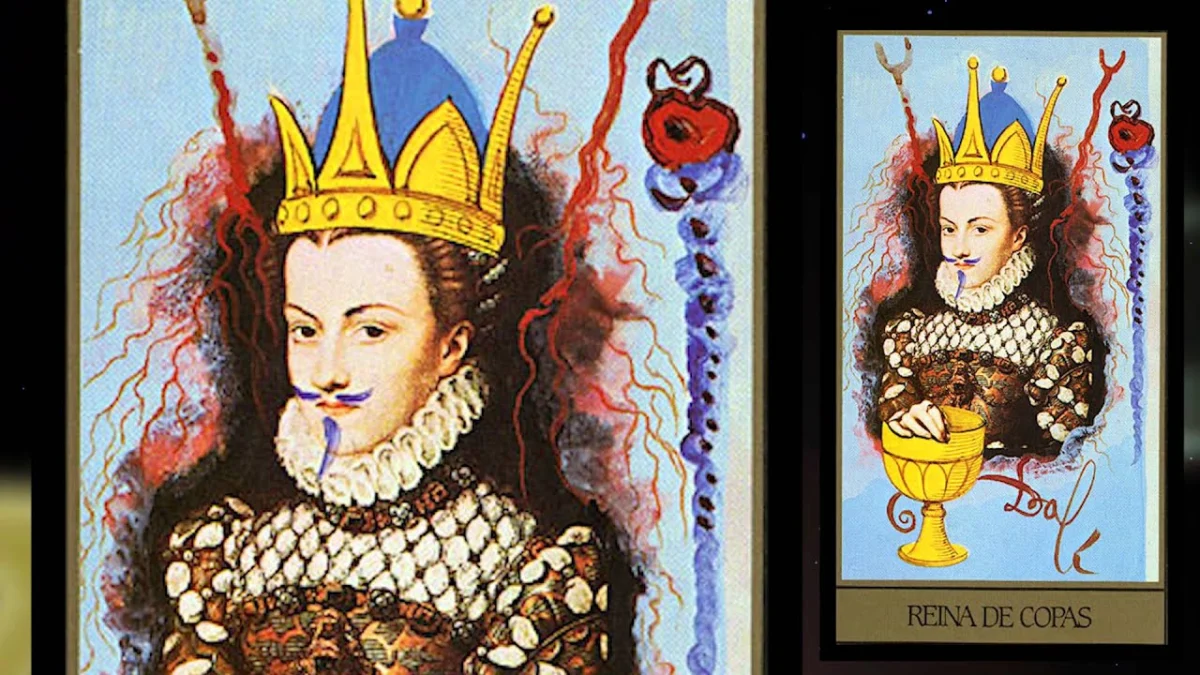
Dalí’s Tarot deck is a breathtaking fusion of the Tarot’s rich historical and occult origins with his own unmistakable artistic sensibility. It is a "pastiche of old-world art, surrealism, kitsch, Christian iconography, and Greek and Roman sculpture," as described by critics. Within this elaborate visual language, Dalí’s recurring motifs – the rose, the fly, the bull’s head – are woven throughout the deck, adding layers of personal symbolism and associative meaning.
The deck’s artistic merit lies in its ability to seamlessly blend diverse influences into a cohesive and captivating whole. Dalí drew inspiration from ancient art forms, religious imagery, and classical sculpture, juxtaposing them with the dreamlike, often unsettling, imagery that defined his surrealistic oeuvre. The result is a collection of cards that are both deeply familiar in their archetypal resonance and strikingly original in their execution.
One of the most compelling aspects of Dalí’s Tarot is the artist’s self-insertion into the imagery. His prominent depiction as the Magician, the figure of power, will, and manifestation, is a bold statement about his own perceived role as a creator and manipulator of reality. This act of self-representation, while perhaps characteristic of his ego, also speaks to his belief in the transformative power of art and the artist’s ability to channel universal forces.
The introductory booklet accompanying the deck, published in Spanish, English, and French, eloquently articulates the artistic and esoteric significance of Dalí’s creation. It declares:
"The Wizard (Arcanum I), Salvador Dalí, has transformed with his exceptional art and his marvelous talent the 78 golden plates of ‘The Fabulous Book of Thot’ into as many artistic marvels, each one of them duly signed by the hand of this unmatched, internally famous painter… such an extraordinary artistic creation does not detract, in any way, from the Tarot’s close symbolism. On the contrary, it enhances with its captivating beauty, the Tarot’s esoteric and plastic meaning."
This statement underscores the intention behind the deck: to elevate the Tarot beyond mere divination and to present it as a profound work of art in its own right, capable of enhancing and illuminating the inherent meanings of the cards.
The Tarot’s Place in Art History and Esoteric Practice
The intersection of art and the Tarot is not a new phenomenon. Throughout history, artists have been drawn to the visual richness and symbolic depth of the Tarot, using it as a source of inspiration, a thematic framework, or even a direct subject for their work. The Tarot’s archetypal figures – the Fool, the High Priestess, the Emperor, the Lovers – resonate with universal human experiences and psychological states, providing fertile ground for artistic exploration.
Dalí’s contribution to this tradition is significant because he approached the Tarot not merely as a visual motif but as a system of profound meaning that he sought to reinterpret through his unique surrealistic lens. He recognized the Tarot’s capacity to tap into the subconscious, a core tenet of Surrealism itself. By infusing the traditional imagery with his characteristic dreamlike logic and unsettling juxtapositions, Dalí created a Tarot deck that is both a profound exploration of the archetypes and a quintessential expression of his own artistic vision.
The appeal of the Tarot to artists like Dalí lies in its inherent ability to serve as a visual language for complex ideas. The archetypal symbolism provides a framework that can be interpreted and reinterpreted, allowing for endless creative possibilities. For Dalí, the Tarot offered a canvas upon which to project his own inner world, his obsessions, and his philosophical musings, all while engaging with a system that had long been associated with spiritual and psychological insight.
Enduring Legacy and Availability
Salvador Dalí’s Tarot deck, first published in a limited edition in 1984, has since been reissued in various formats, making its unique vision accessible to a wider audience. Editions by TASCHEN and other publishers have ensured that the deck continues to be appreciated by collectors, art enthusiasts, and those interested in the esoteric. The deck remains a testament to Dalí’s boundless creativity and his ability to transcend artistic boundaries.
The enduring fascination with Dalí’s Tarot speaks to its power as both a work of art and a tool for personal reflection. It invites viewers to engage with the archetypal narratives of the Tarot through the unconventional and captivating perspective of one of the 20th century’s most iconic artists. Whether used for divination, creative inspiration, or simply as an object of aesthetic appreciation, Dalí’s Tarot deck offers a unique and profound journey into the surreal and the symbolic.
The availability of preview videos of the full deck and various purchasing options, from limited edition sets to more affordable versions, allows individuals to connect with this extraordinary artistic creation. The continued interest and reissuance of Dalí’s Tarot deck solidify its place as a significant contribution to the intersection of art, mysticism, and popular culture.
Conclusion: A Bridge Between Worlds
Salvador Dalí’s Tarot deck is more than just a collection of illustrated cards; it is a testament to the enduring power of art to illuminate the hidden depths of the human psyche and the mysteries of the universe. By merging the ancient wisdom of the Tarot with his revolutionary surrealistic vision, Dalí created a work that is both deeply personal and universally resonant. His deck serves as a bridge between the realms of conscious and unconscious, the rational and the irrational, the earthly and the divine. It invites us to contemplate the archetypes that shape our lives, to explore the landscapes of our own minds, and to discover the profound beauty that lies at the intersection of art and the esoteric. In the hands of Dalí, the Tarot became a canvas for dreams, a portal to the subconscious, and an enduring masterpiece of surrealist artistry.


Leave a Comment