
The Radical Legacy of VALIE EXPORT: A Pioneer of Feminist Actionism Dies at 85
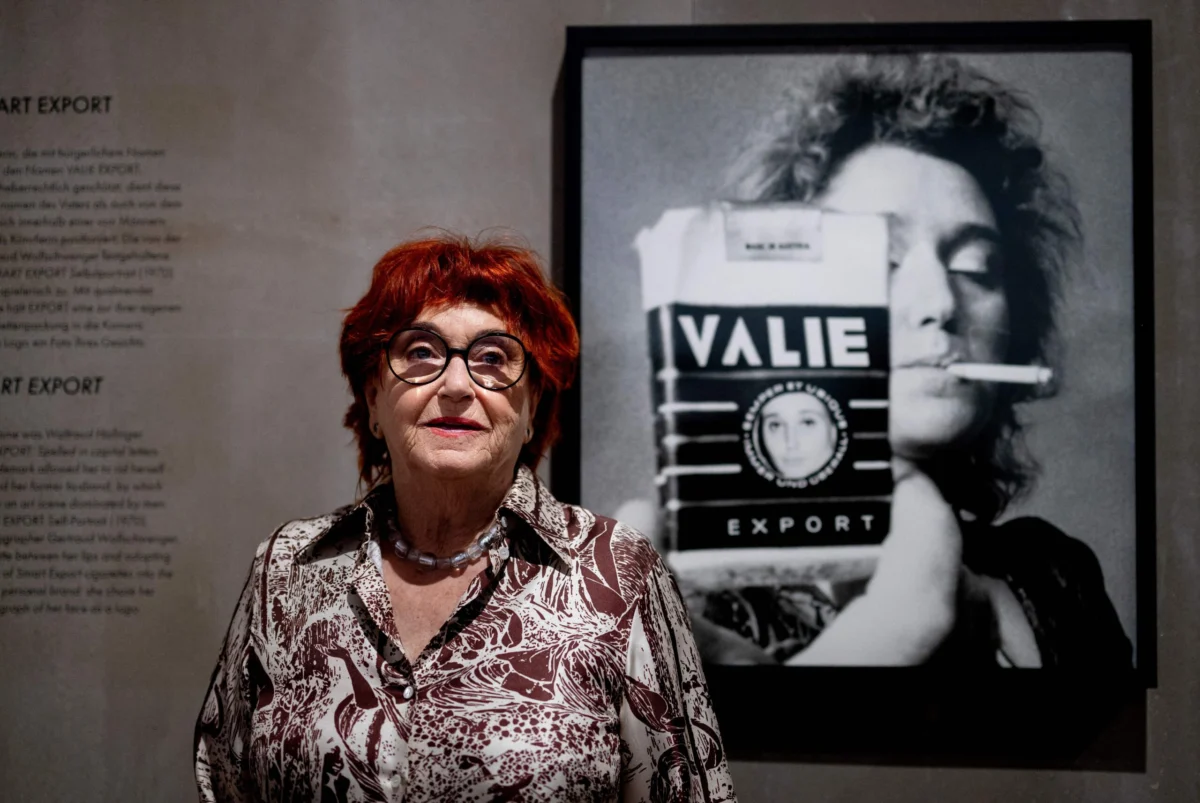
The international art world is mourning the loss of VALIE EXPORT, the radical performance artist, filmmaker, and sculptor whose provocative body-centered works redefined feminist art in the post-war era. The artist passed away in Vienna on May 14, just three days before her 85th birthday. Her death was confirmed by Galerie Thaddaeus Ropac, her long-time representative, marking the end of a career that spanned over six decades of fearless confrontation with social, political, and patriarchal structures.
Known for her "acts of protest," EXPORT utilized her own body as both a canvas and a weapon. In an era when the female form was primarily viewed through the lens of male desire or domestic servitude, she reclaimed sexual agency and autonomy, often at great personal risk. Her work—ranging from the iconic Tap and Touch Cinema to her "Body Configuration" photographs—remains a cornerstone of the contemporary canon, influencing generations of artists who seek to challenge the boundaries of the physical and the political.
The Architect of Her Own Identity: From Waltraud Lehner to VALIE EXPORT
To understand the radical nature of VALIE EXPORT’s work, one must first look at the radical nature of her identity. Born Waltraud Lehner in Linz, Austria, on May 17, 1940, she grew up in a nation grappling with the physical and moral ruins of World War II. Raised by a single mother and educated at a convent school, she was acutely aware from a young age of the rigid hierarchies that governed Austrian society.
At the age of thirteen, she famously noted, "In the beginning was the word and the word was a man." This early realization of gender inequality fueled a lifelong mission to deconstruct patriarchal language and imagery. After a brief marriage and the birth of a child, she moved to Vienna in the 1960s, a city then vibrating with the aggressive avant-garde energy of the Viennese Actionists.
In 1967, she committed one of her most significant acts of rebellion: she discarded her father’s and husband’s names entirely. Adopting the name VALIE EXPORT—derived from a popular cigarette brand, Smart Export—she insisted that her name always be written in uppercase. This was not merely a pseudonym; it was a branding exercise and a rejection of the patronymic tradition. By turning herself into an "export," she asserted her presence as a producer of ideas rather than a passive object of exchange.
Chronology of a Revolution: The 1960s and 70s
The late 1960s marked EXPORT’s emergence as a "Feminist Actionist." While the male members of the Viennese Actionists—such as Otto Muehl and Hermann Nitsch—focused on visceral, often blood-soaked rituals, EXPORT’s actions were surgically focused on the social construction of womanhood.
1968: The Year of Public Confrontation
In 1968, EXPORT executed two of her most enduring performances. The first, Tapp und Tastkino (Tap and Touch Cinema), involved the artist wearing a miniature cardboard theater box over her naked torso. She walked through the streets of various European cities, inviting passersby to reach through the curtains and touch her breasts for thirty seconds. It was a critique of the cinematic gaze; instead of a voyeuristic experience in a dark theater, the "audience" was forced into a tactile, public encounter with a real person.
The backlash was immediate and vitriolic. One Austrian newspaper famously suggested that since modern society no longer had witches to burn, they should "take Valie Export and burn her!" Undeterred, EXPORT continued to push boundaries. Later that year, in Aus der Mappe der Hundigkeit (From the Portfolio of Doggedness), she led fellow artist Peter Weibel through the streets of Vienna on a leash while he crawled on all fours. The piece subverted traditional power dynamics and gender roles, causing a public scandal that cemented her reputation as a provocateur.

1969: Genital Panic
Perhaps her most infamous image stems from Aktionshose: Genitalpanik (Action Pants: Genital Panic). In 1969, she reportedly walked through an experimental pornographic cinema in Munich wearing crotchless trousers, her pubic area exposed at eye level to the seated audience. By presenting the reality of the female anatomy in a space dedicated to the fantasy of it, she forced the viewers to confront their own voyeurism. While the live performance remains a point of historical debate, the subsequent 1970 photographic documentation by Peter Hassmann became an iconic symbol of feminist defiance.
Innovation in Expanded Cinema and Video Art
Beyond performance, EXPORT was a pioneer of "Expanded Cinema," a movement that sought to break film out of the confines of the screen and the projector. In 1968, she co-founded the Austrian Filmmakers Collective, advocating for multimedia and immersive experiences.
Her work Abstract Film No. 1 (1967–68) was a masterclass in minimalism, projecting light through running water onto a mirror to create shifting, organic patterns that defied traditional narrative. In 1971, she utilized the medium of television for social critique with Facing a Family. Broadcast on Austrian public television during prime time, the video showed a middle-class family eating dinner. Viewers at home, also eating their dinner, were presented with a mirror of their own domesticity, creating a feedback loop that exposed the banality of the nuclear family unit.
The Body in the Built Environment: 1972–1982
In the 1970s, EXPORT’s focus shifted toward the relationship between the human body and urban architecture. Her photographic series Körperkonfigurationen (Body Configurations) saw her contorting her body to match the curves of sidewalks, the angles of buildings, or the indents of public squares. These works highlighted how the built environment—designed largely by men—dictates and restricts human movement and behavior.
The decade culminated in a historic milestone. In 1980, VALIE EXPORT and Maria Lassnig became the first women to represent Austria at the Venice Biennale. EXPORT’s installation, Geburtenbett (Birth Bed), was a stark, visceral commentary on the intersection of religion and the female body. The work featured mannequin legs in a birthing position with red neon tubes symbolizing the flow of life (or blood), while a television playing a Catholic mass replaced the figure’s head. It was a searing indictment of how the Church and the State exert control over female reproduction.
Institutional Recognition and Academic Influence
As the decades progressed, the "witch" that the public once wanted to burn became one of the most respected figures in global art. EXPORT transitioned into academia, serving as a professor of multimedia and performance at the Academy of Media Arts in Cologne from 1995 to 2005. She became a mentor to a new generation of artists, teaching them that the body was the most potent tool for political discourse.
In 2015, the VALIE EXPORT Center Linz was established in her hometown. Housed in a former tobacco factory, the center serves as an archive and research hub, ensuring that her extensive body of work—including sketches, films, and theoretical writings—is preserved for future study.
Her contributions were further validated by prestigious awards, most notably the Roswitha Haftmann Prize in 2019, Europe’s most significant art honor. Recent major retrospectives at the Albertina in Vienna (2023) and C/O Berlin (2024) underscored her enduring relevance in a world still grappling with many of the same issues she first raised in the 1960s.

Official Responses and Global Tributes
The news of her passing has prompted a wave of tributes from the international art community. Thaddaeus Ropac, whose gallery has championed her work for decades, emphasized her visionary nature:
"VALIE was one of the most visionary feminist artists to emerge in Europe in the second half of the 20th century. Her passing marks the loss of a singular perspective in contemporary art, one that influenced artists across generations. Her pioneering work continues to be of such great urgency."
Curators from the Museum of Modern Art (MoMA) in New York, the Tate in London, and the Centre Pompidou in Paris—all of which hold her work in their permanent collections—have echoed these sentiments, noting that EXPORT did not just create art; she created a new language for resistance.
Implications: The Enduring Urgency of EXPORT
The death of VALIE EXPORT comes at a time of renewed global debate over bodily autonomy and the representation of women in the public sphere. Her work remains "urgent," as Ropac noted, because the structures she fought against have proved remarkably resilient.
EXPORT’s legacy is visible in the work of contemporary artists like Marina Abramović, Cindy Sherman, and the Pussy Riot collective. She proved that humor, when paired with radical vulnerability, could be a devastatingly effective tool for social change. She showed that the "private" sphere of the body is always public and always political.
As the art world reflects on her eighty-five years, it is clear that VALIE EXPORT achieved her goal: she exported her ideas so successfully that they are now woven into the fabric of modern thought. She was an artist who recognized no boundaries, who faced death threats and indecency charges with a smirk, and who ultimately forced a conservative society to look—really look—at what it had tried so hard to suppress.
VALIE EXPORT may have passed, but her "acts of protest" continue to resonate, challenging us to confront the mirrors she held up to our world. In her own words, "Celluloid you can burn, but Valie Export you can’t." Through her archive, her influence, and her indomitable spirit, she remains unburnable.


Leave a Comment