Unveiling the Light: Why the Technology Behind Red Light Therapy Determines Deep-Tissue Healing

NEW YORK, NY – June 17, 2026 – In the burgeoning landscape of wellness technologies, red light therapy devices have become ubiquitous, promising a myriad of benefits from accelerated recovery to reduced inflammation and enhanced energy. From sleek facial masks to expansive full-body panels and portable wraps, the market is saturated with options. However, beneath the uniform marketing claims often lies a critical divergence in technology that dictates a device’s true efficacy: the fundamental difference between light-emitting diodes (LEDs) and infrared lasers. This distinction is not merely a technical nuance but a pivotal factor in determining whether the therapeutic light genuinely penetrates to the tissues that need it most, especially for deep-seated issues like chronic joint pain or muscle inflammation.
For individuals contending with persistent discomfort, slow post-workout recovery, or inflammatory conditions, understanding the inherent capabilities and limitations of LED versus laser technology in red light therapy is paramount. It’s the difference between achieving superficial relief and unlocking profound, cellular-level healing. While a foundational understanding of photobiomodulation (PBM) – the scientific term for how red and near-infrared light interacts with biological tissue – provides a helpful starting point, a deeper dive into the specific mechanisms of light delivery reveals why some devices are poised to deliver superior results for serious therapeutic goals.
The Core Mechanism: How Red Light Therapy Ignites Cellular Healing
Red light therapy operates under the scientific umbrella of photobiomodulation (PBM), a well-researched modality that leverages specific wavelengths of red and near-infrared (NIR) light to stimulate healing, alleviate pain, and mitigate inflammation at a cellular level. This process is not a superficial warming effect but a targeted interaction with the very engines of our cells.
The cornerstone of PBM’s efficacy lies in its interaction with cytochrome c oxidase (CCO), a vital enzyme located within the mitochondria – often referred to as the "powerhouses" of the cell. When red and NIR light photons are absorbed by CCO, a cascade of beneficial biochemical reactions is initiated. This includes a notable increase in adenosine triphosphate (ATP) production, the primary energy currency of the cell. Enhanced ATP fuels cellular repair, regeneration, and overall function. Simultaneously, PBM triggers a transient, beneficial burst of reactive oxygen species (ROS), which act as signaling molecules to activate cell survival pathways and reduce oxidative stress. The release of nitric oxide (NO) is another critical outcome, leading to improved localized blood flow and nutrient delivery, while also modulating calcium levels essential for cellular communication.
The anti-inflammatory prowess of PBM stems directly from these secondary signals. Research has consistently demonstrated that PBM can modulate key inflammatory pathways, such as the NF-kB pathway. This modulation is particularly significant because NF-kB is a protein complex that controls transcription of DNA, cytokine production, and cell survival, and is a central regulator of inflammatory responses. By influencing NF-kB, PBM helps to normalize cellular function, reducing inflammatory markers in overactive immune cells while promoting cellular resilience in healthy ones. This sophisticated regulatory action underscores that PBM doesn’t merely stimulate; it actively rebalances and harmonizes cellular activity to combat inflammation effectively.
Main Facts: The Divergent Paths of Light Delivery
The effectiveness of red light therapy hinges not just on the presence of specific wavelengths, but on how those wavelengths are delivered to the target tissue. This is where the fundamental distinction between LEDs and lasers becomes crucial.
Understanding LEDs: Broad Coverage, Superficial Reach
Light-emitting diodes (LEDs) represent the most prevalent form of light source in consumer-grade red light therapy devices. LEDs generate light through a process called electroluminescence, where a semiconductor material emits light when an electric current passes through it. The light emitted by LEDs is incoherent, meaning the light waves are not in phase with each other, and it is diffuse, scattering in multiple directions.

This diffuse nature makes LEDs exceptionally well-suited for broad surface area coverage. A typical red light LED panel, often emitting at wavelengths around 660nm, can penetrate several millimeters into the skin, effectively reaching the epidermis and upper dermis. For applications targeting the skin – such as improving complexion, reducing fine lines, accelerating wound healing for superficial cuts, or enhancing general skin circulation – LEDs are genuinely effective and have a strong evidence base. Their relative affordability to manufacture also contributes to their widespread availability in various forms, from compact facial masks to larger full-body treatment panels.
However, the inherent properties of LED light – its non-coherent and scattered nature – impose a significant limitation on its depth of penetration. The light energy rapidly dissipates as it encounters and is absorbed by chromophores (light-absorbing molecules) in the superficial layers of tissue. This "ceiling" on penetration means that while LEDs can provide excellent surface-level benefits, they struggle to deliver a therapeutically significant dose of light to deeper structures like joints, tendons, or larger muscle groups. For these deeper targets, the light energy often diminishes to sub-therapeutic levels before it reaches the intended site.
Decoding Infrared Lasers: Focused Power, Deep Penetration
In stark contrast, therapeutic lasers (specifically low-level or cold lasers, often referred to as Low-Level Laser Therapy or LLLT) operate on fundamentally different principles. A laser emits a coherent, monochromatic, and collimated beam of light. "Coherent" means all the photons travel in phase with each other. "Monochromatic" means they are all of the same wavelength. "Collimated" means the beam remains narrow and focused over distance.
This unique combination of properties allows laser light to penetrate significantly deeper into biological tissue compared to LED light of the same wavelength. The focused, coherent nature of the laser beam minimizes scattering and absorption by superficial chromophores, allowing a higher concentration of photons to reach target cells in deeper anatomical structures.
Near-infrared (NIR) lasers, particularly those operating around 808nm, have been extensively studied for their remarkable interaction with cellular mitochondria. Research has specifically identified that 808nm NIR light directly enhances the activity of Complex IV (cytochrome c oxidase) within isolated mitochondria. As previously discussed, CCO is the precise chromophore that initiates the entire PBM cascade, including the crucial anti-inflammatory response. This means that an 808nm NIR laser isn’t just physically reaching deeper tissue; it is directly triggering the exact biological mechanism responsible for reducing inflammation at the cellular source.
Further studies corroborate this deep therapeutic action. Photobiomodulation therapy, when delivered with sufficient dose and depth, has been shown to reverse a wide array of inflammatory parameters in experimental models, encompassing both vascular and cellular inflammation. These findings underscore the profound impact that targeted, sufficient-dose light delivery can have on producing meaningful anti-inflammatory outcomes, particularly when leveraging the penetrating power of laser technology.
The Critical Distinction: Depth of Penetration and Cellular Reach
The practical implication of the LED vs. laser dichotomy is profound: LEDs offer broad but shallow coverage, whereas lasers provide focused and deep penetration. This difference is paramount when considering the location of the tissue requiring treatment. For inflammatory conditions affecting a knee joint, a deep hip flexor, a rotator cuff tendon in the shoulder, or an ankle ligament, the target tissue often resides several centimeters beneath the skin’s surface. This depth is typically well beyond the reliable reach of most conventional LED devices.

A comprehensive review of PBM’s efficacy in reducing joint inflammation, specifically in conditions like rheumatoid arthritis and osteoarthritis, confirms the vital role of near-infrared light. This research also highlights that specific device parameters – including the precise wavelength, power density (irradiance), and duration of irradiation – are not merely technical specifications but critical variables that directly influence therapeutic outcomes. This means that simply having "red light" is insufficient; the quality and delivery method of that light are what ultimately determine whether the therapy will be effective for a given goal.
Without adequate depth of penetration, the light energy delivered by an LED device may scatter and be absorbed by superficial tissues before it can reach the target cells in deeper joints or muscles at a therapeutically relevant dose. Lasers, by virtue of their coherent and collimated beams, can bypass much of this superficial absorption and scattering, delivering concentrated energy directly to the mitochondria within the deep-seated inflammatory cells, thereby initiating the desired biochemical changes.
Chronology of Understanding: Evolution of Photobiomodulation Science
The journey of photobiomodulation began serendipitously in 1967 when Hungarian physician Endre Mester observed that low-power ruby laser light could stimulate hair growth and accelerate wound healing in mice. Initially termed "low-level laser therapy" (LLLT), early research focused predominantly on visible red light. Over the subsequent decades, understanding evolved significantly.
The 1980s saw increasing interest in the cellular mechanisms, particularly the role of mitochondria. Researchers began to identify cytochrome c oxidase as the primary photoreceptor, explaining how light could directly influence cellular metabolism and energy production. The discovery that near-infrared wavelengths (like 808nm and 980nm) offered superior tissue penetration compared to visible red light marked a pivotal shift, expanding PBM’s potential from superficial skin conditions to deeper musculoskeletal and neurological issues.
The development of LED technology in the late 20th and early 21st centuries broadened the accessibility of light therapy. While not possessing the deep penetration of lasers, LEDs offered a safer, less expensive, and broader coverage alternative for dermatological and superficial applications. This led to a bifurcated market, with LEDs dominating consumer devices and lasers remaining prevalent in clinical settings for deeper treatments.
More recently, scientific inquiry has moved beyond simply identifying benefits to optimizing parameters. Studies now focus on precise wavelengths, optimal power densities, pulsed versus continuous wave delivery, and the synergistic effects of combining different light sources. This chronological progression of research has culminated in the understanding that for comprehensive therapeutic effect, particularly in inflammatory conditions, a multi-faceted approach leveraging the unique strengths of both LEDs and lasers is often the most effective.
Scientific Consensus and Expert Insights: The Power of Combination Therapy
The scientific community increasingly recognizes that LEDs and lasers are not competing technologies but rather complementary tools in the PBM arsenal. Each brings distinct advantages that, when combined, offer a more comprehensive therapeutic solution. LEDs excel at providing broad surface coverage, enhancing general circulation, supporting superficial tissue repair, and influencing a wider treatment area. This can be beneficial for reducing generalized inflammation in the surrounding tissues and improving overall cellular health in the upper layers.

Lasers, on the other hand, deliver highly concentrated energy precisely where deep-seated inflammation often originates – within joints, connective tissues, and deep muscle fibers. The ability of lasers to reach these depths with a therapeutically effective dose is what makes them indispensable for chronic pain and inflammation.
A meta-analysis of nine randomized controlled trials on low-level laser therapy (LLLT) highlighted its significant efficacy in improving pain and stiffness compared to placebo. Crucially, this review noted that trials employing a combination of LLLT and LED phototherapy demonstrated substantial improvements across most measured outcomes. This compelling evidence suggests that a dual-technology approach provides additive benefits that neither technology can achieve in isolation.
The rationale is clear: by using LEDs, practitioners can address the broader tissue environment, promoting superficial healing and improving local blood flow. Simultaneously, the focused power of lasers can penetrate through these layers to deliver a targeted, high-energy dose directly to the core inflammatory site, activating mitochondrial pathways deep within the affected joint or muscle. If a device relies solely on LEDs, the deeper inflammatory source may remain largely untreated. Conversely, a laser-only approach might miss the broader superficial tissue environment that also contributes to overall tissue health and recovery. The synergy of both technologies ensures a holistic treatment, covering the full spectrum of what light therapy can offer.
Implications: Making Informed Choices for Optimal Health Outcomes
The implications of this scientific distinction are significant for consumers and healthcare professionals alike. In a market flooded with red light therapy devices, making an informed choice is critical to achieving desired health outcomes and avoiding ineffective investments.
For consumers, the key takeaway is to scrutinize device specifications beyond generic marketing claims. Understanding the target condition is the first step. For purely superficial concerns like skin rejuvenation, a high-quality LED device may suffice. However, for deep-tissue inflammation, chronic joint pain, or significant muscle recovery needs, a device incorporating therapeutic lasers is essential.
For the industry, the trend points towards more sophisticated, evidence-based devices that integrate both technologies. This ensures that users receive a broad range of benefits, from superficial tissue health to deep cellular regeneration and inflammation reduction. Regulatory bodies also play a role in ensuring devices meet safety and efficacy standards, with classifications like "Class 1 medical-grade" providing an important indicator of quality and controlled output.
The future of photobiomodulation likely involves further personalization, with devices tailored to specific conditions and individual physiological responses. However, the foundational understanding of light physics – the coherent, deep penetration of lasers versus the diffuse, superficial reach of LEDs – will remain central to developing effective therapeutic tools.
What to Look for in a Dual-Technology Device
When evaluating a red light therapy device that claims to offer "combination" or "dual-technology" benefits, several key specifications are crucial indicators of its potential efficacy:
- Specific Wavelengths: Look for precise wavelengths with strong scientific backing. For broad surface effects, 660nm (deep red) is ideal. For deep tissue penetration and mitochondrial activation, 808nm (near-infrared) is highly effective. Avoid devices that are vague about their wavelengths or offer a very broad spectrum without justification.
- Power Density (Irradiance) and Energy Density (Fluence): These metrics, often expressed as mW/cm² and Joules/cm², determine the amount of light energy delivered to the tissue. For deep penetration, lasers need sufficient power. Class 1 lasers are designed to be eye-safe and generally operate at lower powers (e.g., 5mW per diode), but their focused beam ensures effective energy delivery at depth. High-quality LED arrays will also specify their irradiance.
- Laser Class: Therapeutic lasers are classified based on their power output and potential for harm. Class 1 lasers are considered safe for general use without specific eye protection, making them ideal for home devices. Higher classes (e.g., 3B or 4) are typically found in clinical settings and require professional operation due to eye and skin hazard risks.
- Device Design and Contact: The effectiveness of light therapy is significantly impacted by distance. Devices designed for direct skin contact, such as wearable or modular units, minimize power loss due to scattering in the air or reflection from the skin surface, ensuring a more consistent and potent dose delivery. Panels used at a distance will require significantly higher overall power output to compensate for this loss.
- Modularity and Flexibility: For targeted treatment of various body parts (knees, shoulders, elbows, ankles), a modular or wearable design allows for precise placement and consistent application, ensuring the light reaches the specific area of concern.
- Clinical Evidence and Certifications: Reputable brands will often cite peer-reviewed research supporting their chosen wavelengths and technologies. Look for devices that have relevant certifications (e.g., FDA clearance in the US, CE marking in Europe) if they are marketed as medical devices, indicating they meet certain safety and performance standards.
The Kineon MOVE+: An Exemplar of Dual-Technology Integration
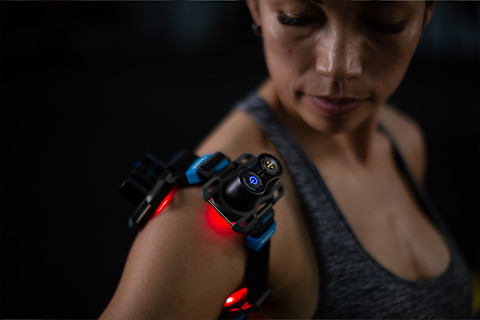
The Kineon MOVE+ device stands as a prime example of a product engineered around the principle of dual-technology integration for optimized therapeutic outcomes. Each module of the Kineon MOVE+ incorporates a strategic blend of eight 660nm deep red LEDs and ten 808nm infrared lasers. This combination specifically targets the two wavelengths with the strongest scientific evidence base for both broad surface coverage and profound deep-tissue anti-inflammatory effects.
The infrared lasers within the MOVE+ are Class 1 medical-grade, ensuring safety for home use while operating at 5mW per laser diode, culminating in 50mW per module. This careful balance of power and safety, combined with the coherent nature of laser light, ensures effective deep tissue penetration. Furthermore, the device’s modular, wearable design is a critical aspect of its efficacy. By maintaining direct contact with the skin, the MOVE+ virtually eliminates the power loss typically associated with distance-based panels, guaranteeing a consistent, targeted dose of therapeutic light is delivered precisely where it’s needed – be it a knee, shoulder, elbow, or ankle joint. This design philosophy aligns perfectly with the scientific understanding that optimal light delivery is crucial for activating cellular repair and reducing inflammation effectively.
The Takeaway: Informed Investment for Real Results
In conclusion, the scientific evidence is unequivocally clear: the technology embedded within a red light therapy device is the ultimate determinant of its therapeutic potential. While LEDs offer valuable superficial benefits, 808nm laser light specifically activates the mitochondrial pathways that drive inflammation reduction at a fundamental cellular level. The judicious combination of both LED and laser phototherapy demonstrates additive benefits, creating a comprehensive treatment profile that neither technology can achieve on its own. For those investing in red light therapy with the goal of achieving tangible results, particularly for deep-seated inflammatory conditions or accelerated recovery, a thorough understanding of these technological distinctions is not merely advisable – it is essential. Choose wisely, and empower your body with the light it needs for true healing.