
Meditations on the Abyss: Duty, Deception, and the Price of Peace in the Interstellar Alliance
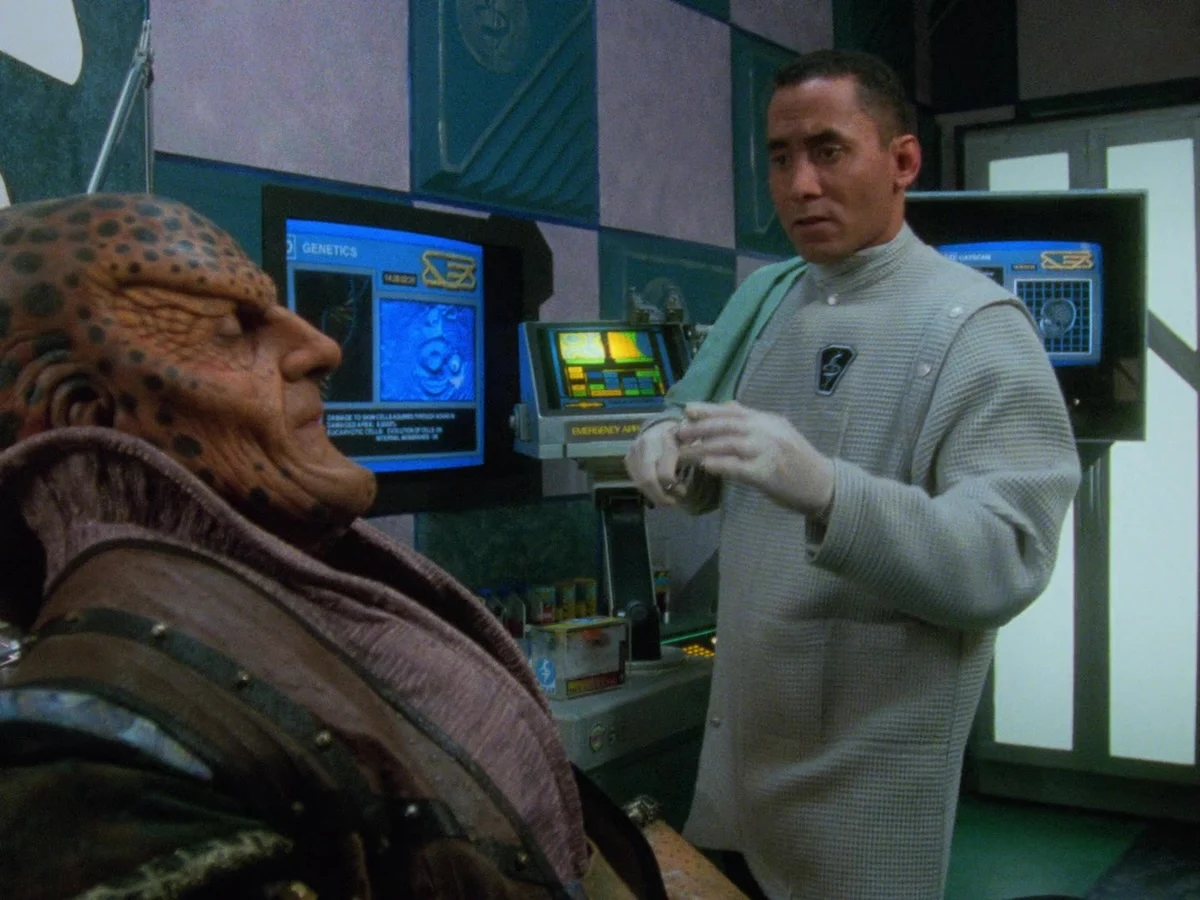
Babylon 5’s penultimate season delves into the intricate web of personal duty, political machinations, and spiritual awakening in "Meditations on the Abyss," the fourteenth episode of Season 5. Airing on May 27, 1998, and penned by series creator J. Michael Straczynski, the episode, directed by Michael Vejar, weaves together multiple character arcs, exploring themes of loyalty, leadership, and the enduring scars of conflict.
As the Interstellar Alliance grapples with the fragile peace following the Shadow War, hidden dangers emerge from within its ranks, compelling key figures to undertake clandestine operations and confront deeply personal struggles. The episode meticulously chronicles the initiation of a secret mission by Delenn and Lennier to uncover the truth behind escalating attacks on cargo ships, the surprising evolution of Vir Cotto into a figure of newfound assertiveness, the rigorous and morally challenging training of Ranger recruits, and the ongoing existential crises faced by G’Kar and Michael Garibaldi. These converging narratives illuminate the complex landscape of the new galactic order, where trust is a rare commodity and the abyss of past conflicts continues to cast long shadows.
Chronology of Events: A Galaxy Under Scrutiny
A Covert Summons and a Clandestine Mission
The episode opens with an immediate sense of intrigue. Delenn, tormented by insomnia, is stirred by a coded signal from Lennier. Their rendezvous point is an unassuming nightclub in Babylon 5’s bustling Downbelow sector, a location chosen for its anonymity. Here, Delenn’s formidable nature is briefly showcased as she deftly breaks the finger of an unwelcome suitor, a stark reminder of her capacity for decisive action, even in civilian attire. The purpose of their secret meeting is grave: Delenn requires Lennier for a highly classified mission, one so sensitive that even her husband, President John Sheridan, remains unaware. The objective is to gather irrefutable evidence implicating the Centauri Republic in the recent spate of attacks on cargo ships – a series of depredations threatening to destabilize the nascent Interstellar Alliance. To maintain utmost secrecy and prevent leaks, Lennier is given a cover assignment: a training mission aboard White Star 27, now rechristened Maria by its pragmatic captain, Enrique Montoya, and deployed to the Centauri border. This deep-cover operation underscores the deep distrust still simmering beneath the surface of galactic diplomacy, even among allies.
Centauri Ascensions and Political Espionage
Meanwhile, within the opulent, yet increasingly bug-ridden, quarters of Ambassador Londo Mollari, political maneuvers are afoot. Vir Cotto arrives, laden with groceries, only for Mollari’s advanced bug detector to expose a hidden listening device embedded within a fruit bag obtained from a Drazi merchant. With a theatrical flourish and a cutting remark aimed at the Drazi ambassador’s spouse, Mollari destroys the device, signaling his awareness of the pervasive surveillance. In a moment of unexpected candor and foresight, Mollari informs Vir of a significant promotion: upon Londo’s inevitable ascension to Emperor, Vir is slated to become the new Centauri ambassador to Babylon 5. This revelation positions Vir at the precipice of considerable power, a stark contrast to his often-underestimated persona.
The Drazi ambassador, predictably irate, later confronts Sheridan, reporting yet another ship attack. He presents a hypothesis linking a high-ranking individual within the Interstellar Alliance to the perpetrators, implicitly pointing fingers at the Centauri. Sheridan, ever the pragmatist, insists on concrete proof over conjecture, but assures the Drazi that no stone will be left unturned. Mollari’s subsequent, dismissive interaction with the Drazi ambassador in the council chamber further fuels suspicions, highlighting the diplomatic tightrope Sheridan must walk.
Ranger Trials: Meditations on Survival
Lennier’s Ranger training begins in earnest aboard Captain Montoya’s Maria. He meets his fellow trainee, Findell, who expresses profound admiration for Montoya. The initial mission assigned to Lennier and Findell is a routine scouting patrol in two fighters. However, what begins as a simple exercise quickly escalates into a life-or-death scenario. Both trainees discover their fuel tanks, previously confirmed full, are suddenly nearly empty, with barely an hour of air remaining. Compounding their peril, the Maria unexpectedly jumps into hyperspace, leaving them stranded. Lennier, drawing upon his Minbari discipline, proposes a meditative trance to conserve air by slowing their metabolic functions. Findell, lacking Lennier’s mental fortitude, struggles to maintain composure, foreshadowing his deeper vulnerabilities. Miraculously, Maria returns just before their air runs out. In the debriefing, Montoya commends Lennier’s resourcefulness and leadership, implicitly highlighting Findell’s near-failure.

Vir’s Metamorphosis and a Fruit Stand’s Demise
Back on Babylon 5, Vir, emboldened by Mollari’s trust and his impending promotion, confronts the Drazi fruit vendor suspected of planting the listening device. The vendor, dismissive and arrogant, mocks Vir’s perceived weakness. What follows is a pivotal moment in Vir’s character arc: seemingly defeated, he retreats to Mollari’s quarters, only to re-emerge armed with a Centauri sword. Returning to the Zocalo, Vir unleashes a cathartic, furious assault on the fruit stand, meticulously dismantling it with precise, albeit comically misplaced, aggression. Mollari observes the spectacle with paternal pride, declaring to an astonished Allan that Vir is, at last, ready for the responsibilities of ambassadorship. This act, while absurd, symbolizes Vir’s shedding of his timid past and embracing a more assertive, albeit still uniquely Vir-like, form of power.
G’Kar’s Reluctant Prophethood and the Search for Truth
A quieter, yet equally profound, storyline unfolds with G’Kar. Dr. Franklin successfully installs his new Narn prosthetic eye, bringing a moment of joy as G’Kar beholds two red eyes reflecting in the mirror. Franklin, a Foundationist seeking new religious perspectives, requests to observe one of G’Kar’s public discussions. G’Kar, increasingly burdened by his unexpected role as a spiritual leader, agrees reluctantly, believing Franklin will find little profundity in the sessions.
During the discussion, G’Kar is posed a seemingly simple yet profoundly complex question: "What is truth? What is God?" He offers a rich, metaphorical answer involving lights and shadows, a nuanced philosophical musing on life’s struggles and the subjective nature of perception. Yet, his audience, eager for definitive pronouncements, repeats the question. Exasperated, G’Kar provides a deliberately simplistic, Vorlon-esque cryptic answer that, paradoxically, satisfies the crowd. A shared glance of mutual amusement and frustration between G’Kar and Franklin speaks volumes about the challenges of genuine spiritual inquiry versus the human craving for easy answers.
Ranger Trials: The Ethical Quandary
Montoya devises a second, more ethically complex training mission for Lennier, Findell, and two other recruits: an "Easter egg hunt" within an asteroid field, where each trainee must locate ten hidden beacons. The catch: there are only 39 beacons for four trainees, guaranteeing one failure. This exercise is less about skill and more about moral choice.
Findell, increasingly overwhelmed, confides in Lennier that he never truly desired to be a Ranger, joining only out of a sense of familial obligation after two family members perished in the Shadow War. Lennier, recognizing the inherent flaw in this motivation, gently but firmly advises him that true dedication must stem from personal conviction, not inherited duty.
The "Easter egg hunt" commences, and Findell’s emotional fragility quickly surfaces. Lennier realizes Findell has set a course to deliberately crash into an asteroid, an act of suicidal despair. On a private channel, Lennier attempts to reason with him, but Findell’s determination to self-destruct is absolute. In a moment of desperate ingenuity and moral courage, Lennier overrides Findell’s targeting system and fires upon his fighter, knocking him off course and saving his life.

Upon their return to Maria, Lennier fabricates a story of equipment failure to protect Findell. Montoya, displaying remarkable insight, declares Lennier a "failure" in the mission (for not retrieving ten beacons) and gives Findell a neutral grade, acknowledging he didn’t complete the assignment. However, Montoya’s true compassion is revealed in his subsequent decision: Findell is reassigned to recruitment, tasked with ensuring all new Rangers possess a genuine, intrinsic desire for the calling. Privately, Montoya thanks Lennier, subtly revealing that White Star vessels can monitor all fighter communications, even "private" channels. He understood everything.
Garibaldi’s Descent and the Lingering Threat
The episode concludes with a meal shared by Sheridan, Delenn, Allan, and Franklin. Allan recounts Vir’s dramatic confrontation with the fruit vendor, portraying Mollari as a proud father. Sheridan expresses mock regret that Mollari discovered the bug, but Delenn astutely suggests the Centauri regent and his court, rather than Mollari himself, are the likely orchestrators of the attacks.
Notably absent from the table is Michael Garibaldi, whose empty seat is a poignant symbol of his deepening isolation. The scene cuts to his quarters, where he is seen in a profound state of intoxication, singing "Show Me the Way to Go Home" and ordering a pizza. His struggle with alcoholism, a recurring theme, continues its downward spiral, marked by a trivial yet symbolically resonant moment: a coffee cup stain on G’Kar’s sacred manuscript, which, due to Narn tradition, will be replicated on every subsequent copy of The Book of G’Kar. This minor incident underscores Garibaldi’s disarray and the unintended consequences of his personal battles.
Supporting Data: Echoes of the Past, Seeds of the Future
"Meditations on the Abyss" excels in its character-driven narratives, a hallmark of Straczynski’s writing. The episode skillfully advances multiple major character arcs, setting the stage for future developments while drawing on established lore.
Thematic Resonance: The episode is rich with thematic depth.
- Duty vs. Desire: Lennier’s unwavering loyalty to Delenn and the Rangers is tested, while Findell’s tragic inability to reconcile duty with his true desires highlights the perils of forced allegiance.
- Leadership and Compassion: Captain Montoya emerges as an exemplary leader, combining strictness with profound empathy, understanding that true leadership involves not just testing, but also guiding and rehabilitating.
- Truth and Perception: G’Kar’s struggle with his prophetic role questions the nature of truth and how it is received by those seeking easy answers, contrasting genuine philosophical inquiry with the comfort of simple platitudes.
- The Cost of War: Findell’s trauma from the Shadow War and Garibaldi’s continued self-destruction underscore the lingering psychological toll of galactic conflict, even after the battles have ceased.
- Political Deception: Delenn’s secret mission and Londo’s bugged quarters illustrate the ever-present undercurrent of espionage and distrust in the post-war political landscape, particularly regarding the Centauri.
Character Arcs:

- Lennier: His dedication to Delenn is paramount, bordering on obsession, yet he also displays remarkable maturity and compassion during his Ranger training. The episode foreshadows Morden’s prophecy of his betrayal, making his current selfless actions all the more poignant. His growth as a Ranger is evident in his quick thinking and moral choices.
- Vir Cotto: This episode marks a significant turning point for Vir, transforming him from Londo’s meek subordinate into a more assertive, albeit still quirky, political figure. His dramatic act of defiance against the fruit vendor, observed with pride by Mollari, symbolizes his readiness for greater responsibility and foreshadows his eventual rise.
- G’Kar: His reluctant prophet arc continues to provide both comic relief and profound philosophical insights. His exasperation with his followers’ simplistic interpretations of truth highlights the burden of spiritual leadership. His new eye is a symbolic return to wholeness, even as his spiritual role fragments his inner peace.
- Garibaldi: His spiraling alcoholism, though criticized by the original review for its slow pacing, serves as a grim counterpoint to the more hopeful arcs. It reflects the deep-seated trauma and cynicism he developed, particularly after his betrayal and imprisonment, and highlights the personal cost of the fight for freedom.
Production Insights:
J. Michael Straczynski’s script masterfully balances multiple plotlines, a testament to his long-form storytelling. Michael Vejar’s direction ensures each storyline receives adequate focus, with particular success in the tension-filled Ranger training sequences and the subtle character interactions. The guest casting, as noted in the original review, is exceptional, with Richard Yniguez as Captain Montoya delivering a nuanced performance that elevates the Ranger arc. Ron Campbell returns as the cantankerous Drazi ambassador, and Martin East provides a sympathetic portrayal of the struggling Findell. The inclusion of Carl Ciarfalio as the Drazi fruit vendor adds another memorable, if short-lived, character.
Official Responses: In-Universe Reactions and Critical Acclaim
In-Universe Reactions:
The reactions within the episode are crucial to understanding its themes. Sheridan’s cautious pragmatism regarding the Drazi accusations stands in contrast to Delenn’s pro-active, covert investigation, highlighting different approaches to security. Londo’s genuine pride in Vir’s newfound aggression is a significant endorsement, a passing of the torch that speaks volumes about their evolving relationship. Captain Montoya’s quiet, yet knowing, acknowledgment of Lennier’s actions, coupled with his compassionate reassignment of Findell, demonstrates a profound understanding of human nature and the true spirit of the Ranger Corps. Franklin’s silent, shared amusement with G’Kar at the simplistic quest for truth underscores a bond of shared intellectual frustration. These character interactions serve as "official responses" to the unfolding events, shaping the narrative and revealing deeper motivations.
Critical Reception:
As the original review notes, "Meditations on the Abyss" largely succeeds in recapturing the quintessential Babylon 5 "feel," which had been somewhat lacking in parts of Season 5. Critics lauded the strong, character-focused storytelling and the exceptional guest performances, particularly Richard Yniguez as Montoya. The Ranger training arc was highlighted as a compelling exploration of duty, morality, and leadership. Vir’s transformation was widely praised as a long-overdue and satisfying development for the character. However, the pacing of certain ongoing plotlines, notably Garibaldi’s prolonged struggle with alcoholism and the slow burn of the cargo ship attacks, drew some criticism for feeling protracted, especially after the breakneck pace of Season 4. Despite these pacing concerns, the episode was generally well-received for its return to form and its rich character development.
Implications: The Shifting Sands of the Alliance
"Meditations on the Abyss" is a pivotal episode that sets the stage for major conflicts and character resolutions in the final stretch of Babylon 5.
The Centauri Threat Intensifies: Delenn’s clandestine mission marks a critical turning point in the Interstellar Alliance’s understanding of the Centauri Republic’s aggression. The need for secret intelligence highlights the perilous state of affairs and the growing evidence that the Centauri, under the influence of the Regent and his court, are actively destabilizing the galaxy. This storyline directly fuels the escalating tensions that will dominate the remainder of the season, leading to direct confrontation.
Vir’s Path to Power: Vir Cotto’s transformation is not merely a character moment but a strategic development. His newfound assertiveness, validated by Mollari, positions him as a credible and capable future ambassador. More importantly, it foreshadows his eventual, and reluctant, ascension to the Centauri throne, where his unique blend of decency and unexpected resolve will be crucial for the Republic’s survival.

Lennier’s Deepening Conflict: Lennier’s unwavering loyalty to Delenn, emphasized in this episode, ironically heightens the dramatic tension surrounding Morden’s prophecy of his betrayal. His selfless actions as a Ranger, coupled with his repressed romantic feelings for Delenn, create a complex emotional landscape that will inevitably lead to a tragic climax, where his devotion might ironically lead him down a darker path. His journey explores the fine line between absolute loyalty and self-destructive obsession.
G’Kar’s Enduring Legacy: G’Kar’s continued struggle with his prophet status reinforces his role as a reluctant spiritual leader. His ability to distill complex truths into accessible (or deliberately simplistic) messages solidifies his influence over the Narn and other races. This arc emphasizes the power of ideas and faith in shaping civilizations, even when the prophet himself is uncomfortable with the mantle.
Garibaldi’s Unresolved Crisis: Garibaldi’s continued descent into alcoholism underscores the series’ commitment to portraying the long-term psychological effects of war and betrayal. His failure to rejoin the main group, symbolizing his isolation, indicates that his personal demons remain a significant obstacle. His arc serves as a cautionary tale, hinting at a long and difficult road to recovery, if recovery is even possible for him, and underscores the vulnerability of even the strongest characters to internal struggles.
"Meditations on the Abyss" serves as a crucial mid-season anchor, deftly weaving together personal and political threads that will ultimately determine the fate of the Interstellar Alliance and its key figures. It is an episode that meditates not just on the vastness of space, but on the profound depths of the human (and alien) spirit, where duty, deceit, and destiny intertwine.

Leave a Comment