Baghdad, Iraq – In the annals of ancient Mesopotamian mythology, few figures evoke as much intrigue and symbolic power as Tiamat. Revered and feared as the primordial goddess of the salt sea and the embodiment of chaotic forces, Tiamat’s most enduring legacy stems from the Babylonian epic, Enuma Elish. This foundational text, a cornerstone of Mesopotamian cosmology, casts her as the formidable adversary whose defeat is crucial for the establishment of cosmic order and the rise of a new divine pantheon. While her image, often depicted as a fearsome serpent or dragon, is widely recognized today, ancient iconography remains elusive, leaving much to scholarly interpretation and the vivid descriptions of the epic itself.
Her narrative, woven through the Enuma Elish and its later variations, consistently positions Tiamat as the chaotic "other" against whom the hero-god Marduk (or Ashur in Assyrian iterations) must contend to safeguard the nascent world. This epic struggle is not merely a tale of gods and monsters; it is a profound exploration of creation, cosmic governance, and the socio-political dynamics of ancient Babylonian society.
Main Facts: The Enigmatic Mother of Chaos
Tiamat, a name derived from the Akkadian word tiamtum, meaning "sea," is fundamentally linked to the primordial waters that preceded creation. In the Babylonian creation myth, she is the salt sea, one half of the original undifferentiated watery mass, while Apsu embodies the freshwater. From their union, the first generation of gods is born. This maternal role, however, dramatically shifts, transforming her from a quiescent, if agitated, progenitor into a vengeful force of destruction.
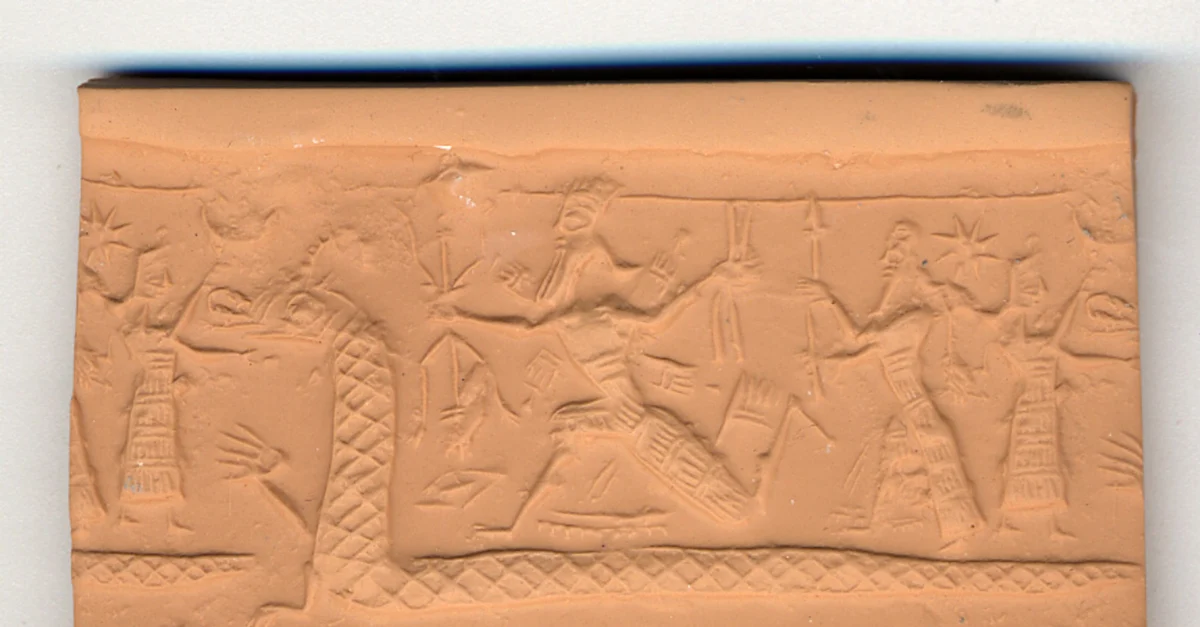
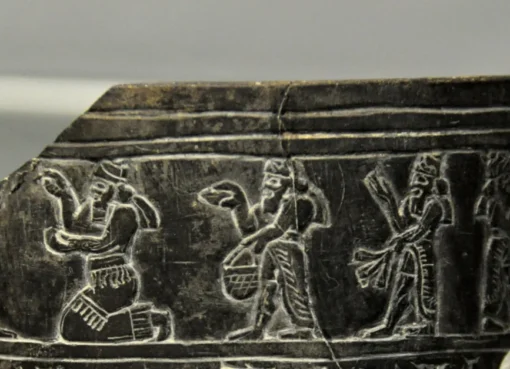
Her depiction as a monstrous serpent or dragon is a later artistic convention, influenced by the vague yet powerful descriptions within the Enuma Elish. No direct ancient Mesopotamian iconography of Tiamat has been discovered, suggesting that her form was left largely to the imagination, amplifying her terrifying and formless nature. Her primary function in the myth is to symbolize the unbridled, untamed power of nature – the chaotic potential that must be subdued for civilization and order to flourish. Her eventual defeat by Marduk is therefore a symbolic victory of order over chaos, a recurring theme in many world mythologies.
Chronology: Tiamat’s Place in Mesopotamian Religious Evolution
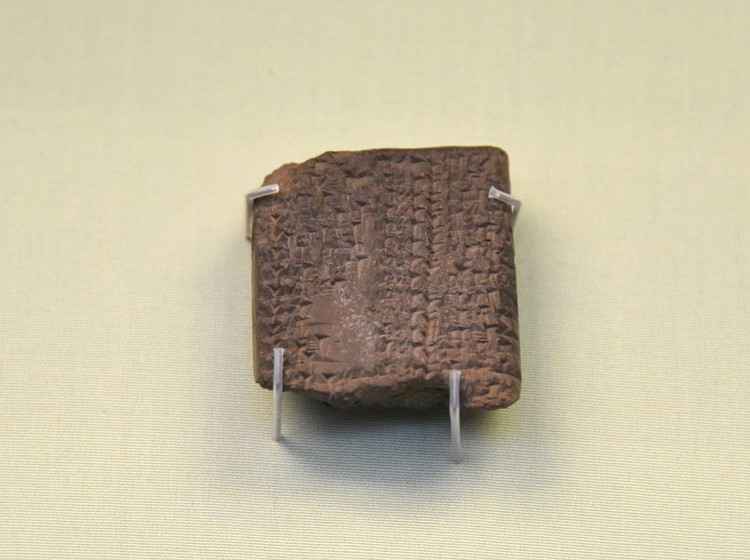
The earliest definitive literary appearance of Tiamat is within the Enuma Elish, a work typically dated to circa 1750 BCE, during the reign of the powerful Babylonian king Hammurabi (1792-1750 BCE). While her name or concept might have earlier roots, perhaps in the Akkadian term tiamtum itself, it is in this epic that she gains her definitive mythological stature. The Enuma Elish became a central text, recited annually during the Akitu (New Year) festival in Babylon, underscoring Tiamat’s integral role in the city’s cosmic narrative.
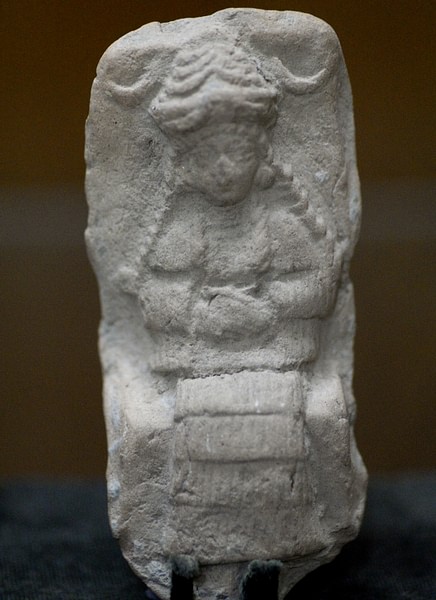
Before Tiamat, the Sumerian mother goddess Nammu (or Namma) held a similar association with primordial waters and the birth of gods. Nammu is attested as early as the Early Dynastic period in Mesopotamia (circa 2900-2350/2334 BCE), specifically Early Dynastic III (2600-2350 BCE). In texts like Enki and Ninmah, Nammu is portrayed as a nurturing figure, the "original mother who gave birth to the gods," awakening Enki to address the younger gods’ woes. This contrasts sharply with Tiamat’s later destructive character, though both share a connection to the sea and divine genesis.
Another crucial influence on Tiamat’s complex character is the Sumerian goddess Inanna, later known as Ishtar in Akkadian. Inanna’s popularity surged significantly after the time of the priestess and poetess Enheduanna (circa 2300 BCE), daughter of Sargon of Akkad (reign 2334-2279 BCE), who founded the Akkadian Empire. By Hammurabi’s era, Inanna/Ishtar was arguably the most venerated deity in Mesopotamia, a goddess of fertility, love, and sensuality, but also war, violence, and notorious capriciousness. Her volatile nature, particularly evident in The Epic of Gilgamesh where as Ishtar she unleashes the Bull of Heaven after being rejected by Gilgamesh, provides a clear thematic precursor to Tiamat’s vengeful turn.
The period of Hammurabi’s reign marks a significant shift in the Mesopotamian theological landscape. While female deities had long been prominent, Hammurabi’s ascension saw the deliberate elevation of Marduk, previously a minor agricultural god, to the supreme position within the Babylonian pantheon. This political and religious maneuver effectively diminished the status of older, often female, patron deities, including Inanna/Ishtar, in favor of the newly enthroned male sovereign god. The Enuma Elish, with Tiamat at its center, is widely seen as a product of this profound theological and socio-political transformation.
Supporting Data: The Enuma Elish and Tiamat’s Evolution
The Enuma Elish commences with a depiction of primeval existence, a swirling, undifferentiated mass of water. This cosmic soup subsequently separates into Apsu, the freshwater, and Tiamat, the saltwater. Their union begets a host of younger gods, who, in their youthful exuberance, grow increasingly boisterous and disruptive. Their clamor jars Tiamat, throwing her into turmoil, as the epic recounts:
"The divine brothers came together / Their clamor got loud, throwing Tiamat into a turmoil. / They jarred the nerves of Tiamat / And by their dancing they spread alarm…" (lines 21-24)
Initially, Tiamat exhibits a maternal reluctance to punish her unruly offspring, wishing to "spare them" despite their displeasing conduct. It is Apsu, exasperated by the incessant noise, who proposes their destruction, consulting his vizier Mummu. Tiamat vehemently opposes this, pleading: "How can we destroy what we have given birth to? / Though their behavior causes distress, let us tighten discipline graciously." (lines 45-46). Her plea for restraint is tragically ignored.
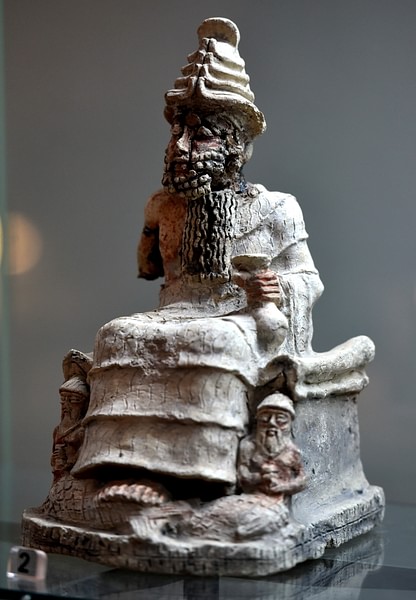
The narrative takes a pivotal turn when Apsu and Mummu resolve to eliminate the younger gods. Tiamat, feeling betrayed and helpless, covertly warns her wisest child, Ea (also known as Enki), the god of magic and wisdom. Ea, utilizing his potent sorcery, puts Apsu into a deep sleep, kills him, and then imprisons Mummu. From Apsu’s corpse, Ea establishes his abode, symbolic of the freshwater springs of Eridu, bringing a semblance of order. In this newly secured realm, Ea and his wife Damkina conceive Marduk, a god of unparalleled power and brilliance.
Marduk’s arrival, however, brings a new wave of disturbance for Tiamat. Described as "dazzling" and "mighty," his tempestuous activities, such as forming dust and driving hurricanes, confound Tiamat anew. The elder gods, Tiamat’s own children, who had been spared by Ea, now confront her. They accuse her of inaction following Apsu’s murder and Mummu’s imprisonment, reproaching her for not avenging their father. They lament their current misery under Marduk and the younger gods’ unchecked revelry, urging Tiamat to wage war.
This collective counsel, coupled with her past grievances, finally pushes Tiamat past her breaking point. She agrees to unleash her fury, declaring, "Let us make demons, as you have advised" (line 126). From her primordial essence, she gives birth to a terrifying host of eleven monstrous creatures, including giant snakes, dragons, lion-demons, and scorpion-men, each imbued with venom and unyielding ferocity. She then elevates Quingu, her lover, to lead her monstrous army, bestowing upon him the Tablets of Destiny. These tablets, which legitimize divine rule and control fate itself, grant their holder supreme authority over the cosmos, turning Quingu into a formidable champion.
With her formidable legions, Tiamat engages the younger gods in battle. Despite their numbers, the younger gods are overwhelmed by Quingu, the Tablets of Destiny, and Tiamat’s monstrous creations. Despair grips the pantheon until Marduk steps forward. He volunteers to confront Tiamat alone, but only on the condition that, should he succeed, he be proclaimed the supreme ruler of all gods, his decrees unchallengeable.
"If I should become your avenger, / If I should bind Tiamat and preserve you, / Convene an assembly and proclaim for me an exalted destiny. / Sit, all of you…in gladness, / And let me, with my utterance, decree destinies instead of you. / Whatever I instigate must not be changed. / Nor may my command be nullified or altered." (lines 156-162)
The desperate gods readily agree. Armed with a magical mace, a club, and a mighty bow of his own creation, Marduk confronts Tiamat. In a dramatic cosmic struggle, he swiftly defeats Quingu, seizing the Tablets of Destiny. He then turns his wrath upon Tiamat, smashing her skull with his mace and splitting her vast body in two with an arrow. Her monstrous progeny are vanquished and bound as trophies to his feet.
From Tiamat’s immense corpse, Marduk meticulously crafts the cosmos: one half forms the heavens, the other the Earth. Her weeping eyes become the sources of the Tigris and Euphrates rivers, the lifeblood of Mesopotamia, and her tail transforms into the Milky Way. After consulting with Ea, Marduk decrees the creation of humanity from the blood of Quingu, who is executed for his role in instigating the conflict. These humans, named Lullu, are destined to serve the gods, thereby maintaining the newly established order. The epic concludes with a grand encomium to Marduk, extolling him as the undisputed king of the gods, his triumph over Tiamat securing the universe.
Official Responses: Scholarly Interpretive Frameworks
The profound narrative of Tiamat and Marduk has generated diverse scholarly interpretations regarding its deeper meaning and historical context. These interpretations, while varied, collectively highlight the complexity of ancient Mesopotamian thought.
One prominent interpretive framework, championed by scholars like Robert Graves and popularized by Merlin Stone in When God Was a Woman, posits that the Enuma Elish allegorically represents a paradigm shift from an earlier matriarchal religious system to a patriarchal one. This view suggests that Tiamat, initially a protective mother goddess embodying aspects of Nammu, is intentionally twisted into a vengeful monster to symbolically represent the decline of female deities and the rise of male-dominated theology during Hammurabi’s reign. The shift from a nurturing Nammu-like figure to the erratic and violent Inanna/Ishtar, whose negative traits are exaggerated in Tiamat, serves as a poetic lament for the lost status of women and goddesses. While it is undeniable that female deities experienced a diminished status under Hammurabi, historical evidence for a widespread, dominant matriarchal theological paradigm in early Mesopotamia remains scarce, with Sumerian pantheons consistently featuring a dominant male figure.
Conversely, Paul Kriwaczek offers a socio-political interpretation, viewing the Enuma Elish as a codified history of the rise of the "lugal" or "big man"—the chieftain—in Mesopotamian society. As city-states evolved, the need for centralized leadership and professional military protection against external threats became paramount. Kriwaczek argues that Marduk’s demand for supreme authority in exchange for protecting the gods mirrors the chieftain’s bargain: loyalty and service from the community in return for defense. In this reading, Tiamat functions primarily as the archetypal external threat, the chaos that necessitates a strong, singular leader like Marduk (or the king) to preserve and improve upon established order. However, this interpretation is sometimes criticized for potentially oversimplifying Tiamat’s initial nuanced characterization, overlooking her initial reluctance and her journey from a grieving mother to a destructive force.
A more balanced perspective, and one suggested by the original article, posits that the Enuma Elish is not necessarily a subversion of an existing matriarchal paradigm nor a mere allegory for the rise of chieftains, but rather a direct theological and political statement commissioned by King Hammurabi. Marduk, previously a relatively minor god, was Hammurabi’s chosen patron deity. To legitimize his own rule and solidify Babylon’s dominance, Hammurabi needed to elevate Marduk to the head of the entire Mesopotamian pantheon. The Enuma Elish achieves this by depicting Marduk as the sole savior capable of defeating Tiamat, thereby making him indispensable and supreme.
In this context, Tiamat’s character is a masterful synthesis of familiar Sumerian goddesses: the primordial, water-associated aspects of Nammu, combined with the capricious, vengeful, and powerful traits of Inanna/Ishtar. By having Marduk triumph over a figure embodying these powerful, albeit now "chaotic," feminine forces, the epic effectively announces the end of an older, perhaps more decentralized, divine order and the inauguration of a new, centralized, male-dominated cosmic hierarchy under Marduk. This narrative would have resonated deeply with the Babylonian populace, explaining the epic’s enduring popularity and its central role in the annual Akitu festival as a celebration of Marduk’s (and by extension, Babylon’s) supremacy.
Implications: Tiamat’s Enduring Legacy
Tiamat’s story, as recounted in the Enuma Elish, offers profound insights into ancient Mesopotamian cosmology, social structures, and political maneuvering. Her journey from the benevolent source of life to a monstrous embodiment of chaos reflects a complex understanding of creation, where order emerges from the violent subjugation of primal forces. This narrative provided a theological foundation for Babylonian imperial ambitions and the cult of Marduk, legitimizing the king’s authority as the earthly counterpart to the supreme god.
Beyond its historical and political context, the myth of Tiamat and Marduk speaks to universal themes that continue to resonate. It explores the eternal struggle between order and chaos, the cyclical nature of creation and destruction, and the often-violent genesis of new beginnings. Tiamat represents the untamed, unpredictable aspects of existence, a force that must be confronted and integrated (or dismembered and repurposed) for structured life to emerge.
Her legacy extends far beyond ancient Mesopotamia, influencing later mythologies and narratives of cosmic conflict. The imagery of a primordial serpent or dragon of chaos, defeated by a heroic deity to create the world, echoes in various cultural traditions, highlighting the archetypal power of her story. Even today, Tiamat remains a compelling figure for scholars and enthusiasts, a reminder of the rich and complex tapestry of ancient religious thought and the enduring human quest to understand the origins of the universe and our place within it. The ongoing scholarly debates surrounding her character underscore the deep, multifaceted layers of meaning embedded within this ancient epic, ensuring Tiamat’s place as a cornerstone of mythological studies.
London, UK – For many, the word "folklore" conjures images of quaint historical curiosities or esoteric practices far removed from modern life. Think of the antler-wearing men of Abbotts Bro
Mesopotamia, the cradle of civilization, was a land deeply attuned to the cycles of life and death, creation and destruction. Within its rich pantheon of deities, few embodied the raw, terrifying powe
London, UK – From the depths of ancient seas to the intricate chambers of the human heart, folklore continues to captivate and instruct. A groundbreaking new compendium, "Fascinating Folklore,&qu




Leave a Comment