Unveiling the Universal Tapestry: "The Treasury of Folklore" Returns in a Definitive Single Volume
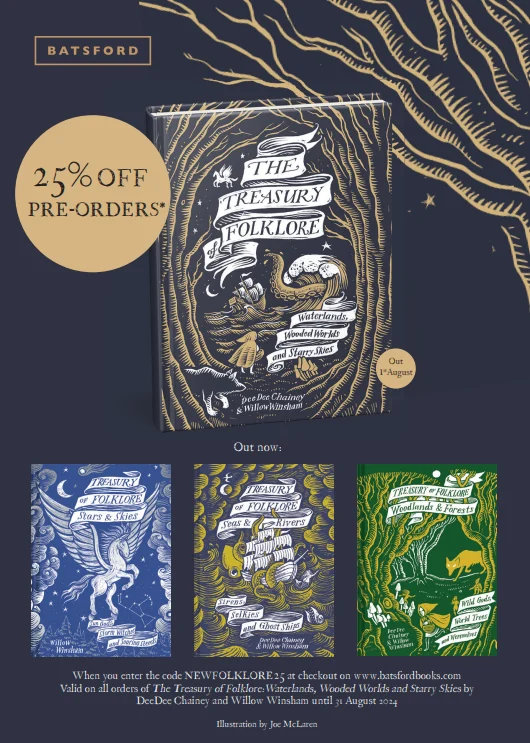
LONDON, UK – July 25, 2024 – A landmark compilation in the realm of global myth and legend is set to captivate readers this August, as the acclaimed "Treasury of Folklore" series culminates in a singular, magnificent volume. Titled The Treasury of Folklore: Waterlands, Wooded Worlds and Starry Skies, this special edition brings together the most beloved and insightful narratives from the original three best-selling books – Seas and Rivers, Trees and Woodlands, and Stars and Skies – into one comprehensive tome. Spearheaded by authors Dee Dee Chainey and Willow Winsham, this release marks the fulfillment of an ambitious, decade-long vision to explore the shared human experience through the lens of folklore.
Main Facts: A Decade-Long Journey Culminates
When the concept for "The Treasury of Folklore" first took shape nearly a decade ago, the ambition was grand: a single, expansive volume that would traverse the diverse physical landscapes inhabited by humans worldwide, cataloguing the rich tapestry of customs, beliefs, and tales woven around them. The sheer volume of material unearthed during initial research, however, proved too vast for a single book, necessitating a trilogy. Now, after the resounding success of the individual volumes, the original dream has been realized with the imminent release of The Treasury of Folklore: Waterlands, Wooded Worlds and Starry Skies.
This compilation is more than just a collection; it is a carefully curated journey through humanity’s collective imagination. It underscores a profound truth discovered by the authors: despite the myriad ways cultures express themselves – in dress, language, or the names they bestow upon their mythical creatures – humans universally share primal fears and dreams. From the awe inspired by a vast, uncharted ocean to the dread evoked by a dark, whispering forest, or the wonder at the eternal glimmer of ancient stars, our shared humanity resonates through these timeless narratives. The book serves as a testament to the enduring power of storytelling to connect us, revealing the threads of commonality that bind diverse peoples across continents and centuries.
Chronology: From Hashtag to Hefty Tome
The genesis of "The Treasury of Folklore" series can be traced back to a period of burgeoning online engagement with traditional narratives. Inspired profoundly by the overwhelming outpouring of folklore shared through the #FolkloreThursday hashtag, authors Dee Dee Chainey and Willow Winsham recognized a collective yearning for deeper connection with these ancestral stories. It was this vibrant digital community that spurred their initial resolve to create something meaningful and lasting – a work that would reflect the unifying universality of folklore across the globe.
Their initial vision of a singular, comprehensive volume, however, faced a practical challenge. The wealth of material they uncovered, delving into the mythological undercurrents of Seas and Rivers, Trees and Woodlands, and Stars and Skies, quickly surpassed the confines of a single publication. This led to the creation of three distinct, yet interconnected, books, each dedicated to exploring the folklore associated with specific natural environments. The popularity of these three individual volumes proved both surprising and heartwarming for the authors, validating their belief in the public’s enduring fascination with folklore.
The idea of a compendium was a natural evolution, arising from the desire to present the material as originally conceived – a cohesive, singular narrative. This required an intensive behind-the-scenes effort, involving a meticulous review of familiar texts with fresh eyes. The process of selection and arrangement was crucial, aimed at harmonizing disparate elements into a unified whole that seamlessly spans shared landscapes across time and place. The culmination of this dedicated work is a volume that has, in the authors’ own words, "blown them away," a beautifully bound collection that stands as a testament to their enduring passion and the universal appeal of folklore.
Supporting Data: Unearthing Our Shared Humanity and the Power of Myth
The core premise of "The Treasury of Folklore" is the exploration of how human beings, regardless of their geographical location or cultural specifics, construct beliefs and narratives around the natural world that reflect fundamental shared experiences. This new compilation powerfully reinforces the authors’ discovery that our primal fears, dreams, and aspirations are remarkably consistent, manifested through a rich diversity of myths and legends. Folklore, in this sense, acts as a collective mirror, reflecting our awe of nature’s power, our anxieties about the unknown, and our hopes for connection and understanding.

Waterlands: The Enigmatic Water Horses
The compilation delves into the perilous depths of global waterways, introducing readers to the majestic yet malevolent creatures known as water horses. These mythical steeds, often beautiful and alluring, embody humanity’s ancient respect and fear of powerful, unpredictable bodies of water. Whether they serve as cautionary tales or personifications of real-world dangers like treacherous currents or hidden bogs, their widespread presence in folklore speaks to a universal human experience of confronting the untamed wild.
The Scottish Kelpie is perhaps the most renowned of these creatures, distinct from the each-uisge which prefers lochs and lakes. Kelpies, inhabiting rivers, lure unsuspecting travellers onto their backs before dragging them to a watery demise. The enduring cultural impact of the Kelpie is evident in Scotland, not only through its deep roots in oral tradition but also in its contemporary manifestations. The colossal 30-meter (98-foot) Kelpies sculptures near Falkirk, a striking feature of the modern landscape since 2013, stand as a powerful testament to the legend’s hold on the Scottish imagination. Its appearance in modern literature, from Lari Don to J.K. Rowling’s Fantastic Beasts and Where to Find Them, further solidifies its place in popular culture. Interestingly, the English folkloric landscape remains largely devoid of similar water horse figures, highlighting distinct regional mythologies.
Crossing into Wales, the Ceffyl Dwr offers a fascinating variation. Still a staple belief into the 19th century, the Welsh water horse often shapeshifted, especially in the north, demonstrating a more fluid identity. In the south, it consistently appeared as an enchanting, small horse, luring riders to their doom with impossible speed. A peculiar exception to its malevolent nature was its treatment of clergymen of any creed, who were said to be able to ride it safely, revealing a curious intersection of pagan belief and Christian influence within the folklore.
Scandinavia contributes the bäckahäst, or ‘brook horse,’ a luminous, majestic being most frequently sighted in fog. This creature, too, entices riders, often children, before plunging them into the water. Tales of the bäckahäst frequently feature a narrow escape, such as the story of boys saved by the accidental utterance of Christ’s name, which the bäckahäst detests. These narratives, while terrifying, often incorporate elements of trickery or divine intervention, suggesting that even the most formidable supernatural forces can sometimes be outwitted or overcome. The prevalence of children as victims in these tales often serves to heighten the sense of peril and underscore the importance of caution near dangerous waters.
Wooded Worlds: The Potent Lords of the Wild
Moving from the watery depths to the verdant expanse of forests, the compilation introduces the "Lords of the Wild" – powerful spirits and creatures that embody the dual nature of woodlands as places of both refuge and danger. These figures reflect humanity’s complex relationship with forests: sources of sustenance and spiritual awe, yet also realms of mystery and potential threat.

The Finnish forest god Tapio, also known as Metsähine or Hiisi, is depicted as the tall, thin king of the forest realm, adorned in ermine fur or moss, with a great beard of moss and lichen. Like the European Green Man, he is both the personification and protector of the forest, embodying its ancient power. Hunters in the past would seek his blessing, pledging respect for the land and its creatures, understanding that Tapio held sway over their success or failure. His family, including his benevolent wife Mielikki (or Kuurikki when malevolent), son Nyrikki who guides hunters, and daughter Tulikki who directs prey, further illustrates a comprehensive spiritual ecosystem governing the Finnish woodlands, reflecting a deep-seated animistic reverence for nature.
In Slavic folklore, the Leshy (or leshii/lyeshy) stands as a formidable tutelary spirit, protector of the trees and animals, particularly wolves and bears. A master shapeshifter, the Leshy can alter his size and form at will, appearing as anything from a blade of grass to a towering tree. His human guise is often identifiable by a lack of eyelashes or brows, shoes worn on the wrong feet, or clothing wrapped inversely to local fashion – subtle markers of his otherworldly nature. Leshies are trickster figures, known for confusing travellers, luring them from paths with mimicry, and even tickling victims to death. They inflict curses upon farms and abduct women and children, embodying the unpredictable and sometimes cruel aspects of the untamed wilderness. However, their wrath can be appeased with offerings of bread or tobacco, or averted by specific counter-measures such as turning clothes inside out or swearing – actions that highlight the intricate rituals humans developed to navigate and survive within these powerful mythical landscapes. The tales of Leshies gambling with squirrels, frequenting taverns, and even battling their own kind provide a rich, multifaceted portrayal of these enigmatic forest guardians.
Starry Skies: The Enduring Myth of the Moon Hare
Finally, the compilation turns our gaze skyward, exploring humanity’s fascination with the celestial bodies, particularly the moon. Across countless cultures, people have seen faces and figures etched upon its surface, giving rise to myriad tales explaining these cosmic patterns. The motif of a hare or rabbit living on the moon is a particularly widespread example, often linking the visible markings of the Sea of Tranquillity, Fertility, and Nectar to its head and ears. This universal tendency to find familiar shapes in the heavens, known as pareidolia, has given birth to profound narratives about sacrifice, consequence, and destiny.
The Buddhist Sasa-jātaka tells of a virtuous hare who, finding himself with no food to offer a disguised deity, Sakka, selflessly offers his own body as sustenance. In recognition of this ultimate sacrifice, Sakka preserves the hare, placing his image on the moon for all to see. Similar tales resonate in Sri Lanka and Japan, where the Tsuki no Usagi (Moon Rabbit) likewise sacrifices itself for Buddha or a disguised beggar, subsequently ascending to the moon as a reward for its compassion. These narratives, often told to children during the Harvest Moon and Mid-Autumn Festival in Japan, powerfully convey virtues of generosity, selflessness, and the spiritual rewards of altruism, emphasizing themes of compassion and the interconnectedness of all living beings.
A contrasting narrative emerges from South Africa, where the hare is cast as a figure of misfortune. In this tale, the Moon dispatches Hare to deliver a message of cyclical mortality to humankind – that humans, like the moon, would "die" only to return. However, the flighty Hare misdelivers the message, declaring only that humans would die permanently. Enraged by this catastrophic error, the Moon attacks Hare, splitting his lip, while Hare, in retaliation, scars the Moon’s face – markings still visible today. This narrative shifts from a story of divine reward to an origin myth for human mortality and the imperfections seen in the natural world, revealing a different cultural perspective on fate and the consequences of careless actions.
Crafting a Masterpiece: The Physicality of the Volume
Beyond its rich content, The Treasury of Folklore: Waterlands, Wooded Worlds and Starry Skies is designed to be an artifact in itself. The authors have expressed their utter thrill at the end result, describing it as a "hefty tome" with a beautifully bound cover that harmoniously combines the themes of the original three books. The choice of beautiful cream paper enhances the reading experience, lending a tactile quality that elevates the book beyond a mere collection of stories. Integral to the series’ appeal are the wonderful original illustrations by Joe McLaren, which are faithfully reproduced throughout the compilation. McLaren’s distinctive artwork visually anchors the tales, adding an evocative layer that transports readers deeper into the mythological landscapes. While the book intentionally contains no new textual material, drawing directly from the existing three volumes, its curated presentation and exquisite production quality make it a compelling addition to any bookshelf or coffee table – a true conversation starter and a tangible link to ancient wisdom.

Implications: A Legacy Reimagined for Modern Readers
The release of The Treasury of Folklore: Waterlands, Wooded Worlds and Starry Skies carries significant implications for both seasoned folklore enthusiasts and newcomers to the field. For existing fans of the series, it offers the convenience and aesthetic pleasure of a definitive, consolidated edition, a unified expression of the authors’ original vision. For new readers, it serves as an accessible and captivating entry point into the vast and fascinating world of global folklore, demonstrating the power of myth to transcend cultural boundaries and reveal universal human truths.
In an increasingly digital age, the deliberate creation of such a beautifully bound, physical volume underscores the enduring value of tangible books as cherished objects. It encourages a slower, more immersive reading experience, fostering a deeper connection with the ancient stories it contains. From a broader cultural perspective, this compilation plays a vital role in popularizing folklore, ensuring that these invaluable oral traditions and ancient narratives are not only preserved but actively celebrated and understood in contemporary society. It highlights how these stories continue to resonate, offering insights into human psychology, environmental reverence, and the very fabric of our shared heritage. The book acts as a bridge, connecting the modern reader to the collective wisdom and imagination of generations past, fostering a greater appreciation for the diverse yet interconnected narrative landscape of humankind.
The Treasury of Folklore: Waterlands, Wooded Worlds and Starry Skies is now available for pre-order and will be officially released on August 1, 2024.
Readers can secure their copy through Amazon UK: https://www.amazon.co.uk/Treasury-Folklore-Waterlands-Wooded-Worlds/dp/1849949212
For a special offer, receive 25% off when ordering directly from Batsford Books: https://www.batsfordbooks.com/book/the-treasury-of-folklore/ using the code NEWFOLKLORE25.