Homer’s Odyssey: An Enduring Epic of Homecoming, Peril, and Human Spirit
By Mark Cartwright
Main Facts: The Quintessential Journey
Homer’s epic poem, the Odyssey, stands as a monumental pillar of Greek literature and a foundational text of Western civilization. Penned in the 8th century BCE, though drawing from a much longer and richer oral tradition, it chronicles a journey of unparalleled scope and profound human resonance. More than just a tale of adventure, the Odyssey masterfully weaves together the elements of a perilous road trip, a spiritual journey of redemption, and the deeply human yearning for homecoming, all wrapped into one captivating narrative.
At its heart is Odysseus, the cunning and resourceful king of Ithaca, a veteran of the decade-long Trojan War. Having survived the brutal conflict, his saga truly begins with the arduous quest to return to his beloved island kingdom and his steadfast wife, Penelope. This homecoming, however, is far from straightforward. For ten additional years, Odysseus is buffeted by the whims of meddling gods, tormented by monstrous creatures, battered by raging storms, and even ensnared by the allure of a particularly persistent nymph.
The Odyssey is, quite literally, a voyage into hell and back, both physically and metaphorically. Its narrative, replete with daring deeds, harrowing misadventures, and a much-longed-for happy ending, continues to fascinate audiences across literature and film. It serves as a timeless reminder of a long-lost golden era where persistence, loyalty, ingenuity, and sheer heroism were believed to be the ultimate virtues capable of overcoming all conceivable obstacles. The poem not only solidified many elements of Greek mythology but also set a benchmark for epic storytelling that has been emulated and reinterpreted for millennia.
Chronology: A Decade of Trials and Tribulations
Odysseus’s journey home from Troy is not merely a geographic traversal but a series of encounters that test his physical strength, mental acuity, and moral compass. Each stop, each challenge, peels back layers of his character, revealing both his heroic virtues and his human flaws.
From Troy’s Ashes to the Isle of Calypso
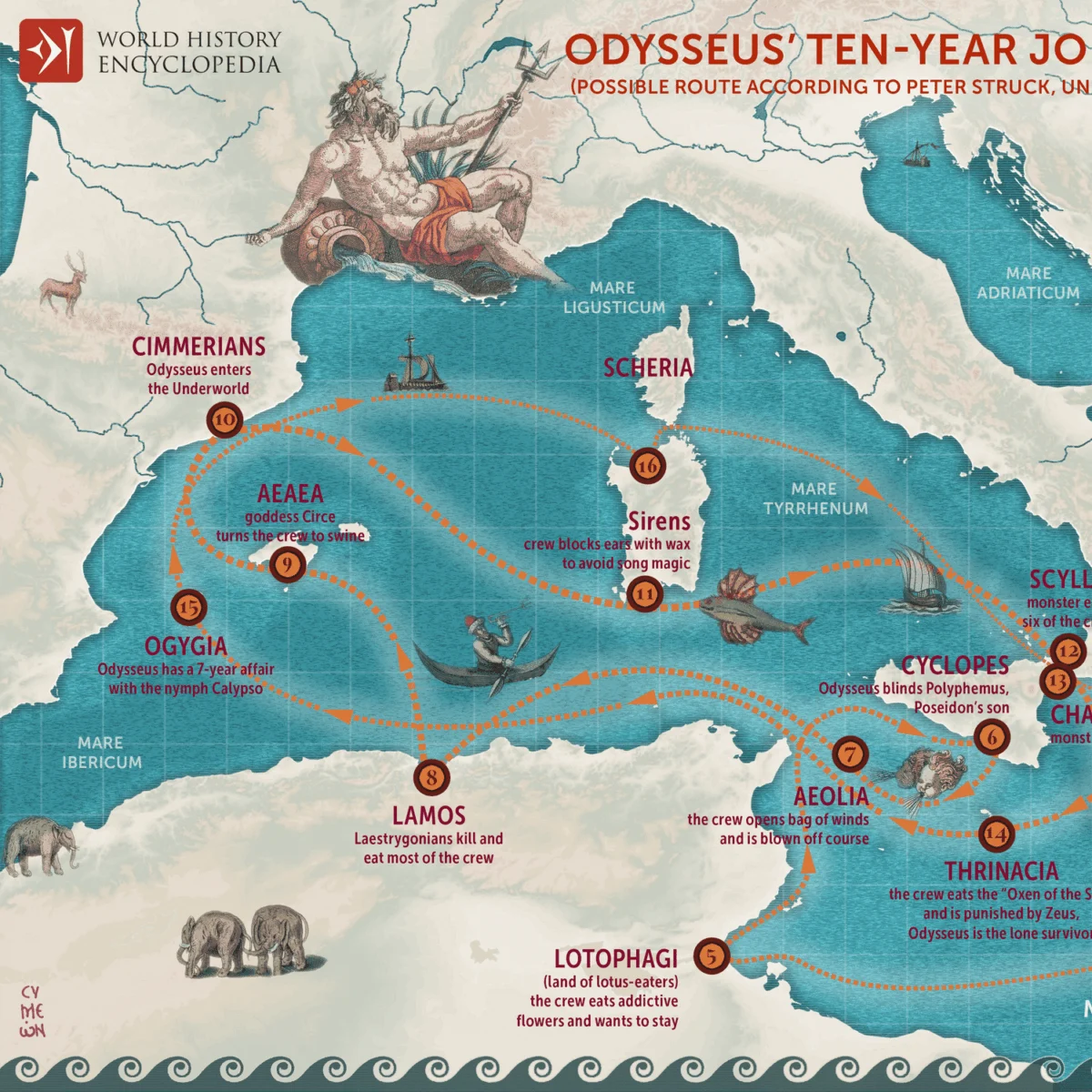
Upon the fall of Troy, Odysseus and his men set sail, eager for Ithaca. Their initial stop at Ismarus, the land of the Cicones, quickly turns disastrous due to the men’s greed and insubordination, resulting in significant losses. This early setback foreshadows the difficulties to come.
Next, they encounter the Lotus-Eaters, whose intoxicating fruit causes forgetfulness and a loss of the desire to return home. Odysseus demonstrates his leadership by forcibly removing his men from this seductive peril, reasserting their purpose.
One of the most iconic episodes is their encounter with Polyphemus, the Cyclops, on an island teeming with sheep and cheese. Odysseus, identifying himself as "Nobody," blinds the monstrous one-eyed giant, but his subsequent hubris in revealing his true name invokes the wrath of Polyphemus’s father, Poseidon, the god of the sea. This act sets in motion much of Odysseus’s subsequent suffering and divine opposition.
They then reach the floating island of Aeolia, home of Aeolus, the god of the winds. Aeolus graciously provides Odysseus with a bag containing all unfavorable winds, allowing a smooth journey home. However, within sight of Ithaca, Odysseus’s curious and mistrustful crew opens the bag, unleashing a tempest that blows them all the way back to Aeolia. Aeolus, believing them cursed, refuses further aid.
The journey continues to the land of the Laestrygonians, a race of giant cannibals who destroy all but one of Odysseus’s ships, annihilating most of his remaining crew. This devastating loss underscores the extreme dangers lurking in the unknown seas.
Next, Odysseus and his few remaining men arrive at Aeaea, the island of the sorceress Circe. She transforms some of his men into pigs, but Odysseus, aided by the god Hermes, resists her magic and compels her to restore his crew. He then spends a year with Circe, who eventually advises him on how to reach home.
The Underworld and Further Perils
Circe instructs Odysseus to journey to the Underworld (Nekyia) to consult the blind prophet Tiresias. This descent into Hades is a pivotal moment, a "voyage into hell and back" in the most literal sense. There, he receives prophecies regarding his future and encounters the spirits of fallen heroes like Achilles and Agamemnon, as well as his own mother, Anticlea, whose death in his absence deeply grieves him. Tiresias warns him of the dangers ahead, particularly concerning the cattle of Helios.
Returning to Circe, she provides Odysseus with crucial warnings and advice for the next leg of his journey. This is where the provided excerpt fits in:
Odysseus returns to Circe, who warns him of the Sirens, creatures which are half-bird and half-woman who prey on sailors. She advises the men to plug their ears with wax and for Odysseus to lash himself to the mast. He must then negotiate passage past the six-headed monster Scylla and deadly whirlpool Charybdis. He also receives his second warning of the folly of interfering with the herds of Helios. The heroes set sail across the wine-dark sea once more to negotiate the perils described by Circe…
Following Circe’s counsel, Odysseus and his crew navigate past the enchanting and deadly Sirens. Odysseus, lashed to the mast, is the only one to hear their irresistible song without succumbing to their lure, gaining invaluable wisdom and demonstrating his unique capacity for endurance.
They then face the harrowing passage between Scylla and Charybdis. Scylla, a six-headed monster, devours six of Odysseus’s men, while Charybdis, a monstrous whirlpool, threatens to swallow the entire ship. Odysseus makes the agonizing choice to sail closer to Scylla, sacrificing six men to save the rest, a testament to the impossible decisions of leadership.
Their journey continues to Thrinacia, the island of Helios, the sun god. Despite solemn warnings from both Tiresias and Circe, Odysseus’s famished and disobedient crew, while Odysseus sleeps, slaughters and eats some of Helios’s sacred cattle. This act of sacrilege incurs the wrath of Zeus, who subsequently destroys their ship with a thunderbolt, drowning all of Odysseus’s remaining men. Odysseus, the sole survivor, clings to wreckage and drifts for nine days.
He eventually washes ashore on Ogygia, the island of the nymph Calypso. Calypso, enchanted by Odysseus, holds him captive for seven years, offering him immortality if he would stay with her. Though he shares her bed, Odysseus constantly yearns for his home and Penelope. It is only through the intervention of Athena and Zeus, who sends Hermes to deliver the divine decree, that Calypso reluctantly releases him.
The Return to Ithaca and Vengeance
Odysseus builds a raft and, after enduring another storm sent by Poseidon, washes up on the shores of Scheria, the land of the Phaeacians. There, he is discovered by Nausicaa, the king’s daughter, and hospitably received by King Alcinous and Queen Arete. It is during a feast with the Phaeacians that Odysseus, finally revealing his identity, recounts his epic adventures, forming a significant portion of the poem’s narrative in flashback. Impressed by his tale and moved by his plight, the Phaeacians provide him with a swift ship and safe passage back to Ithaca.
Upon his arrival in Ithaca, Odysseus is disguised as an old beggar by Athena, allowing him to assess the situation in his palace, which has been overrun by arrogant suitors vying for Penelope’s hand and Odysseus’s throne. He is recognized only by his loyal old dog, Argos, who dies shortly after, and his old nurse, Eurycleia, who identifies him by a scar while washing his feet.
He reunites with his son, Telemachus, who has grown into a man and has been struggling to assert his authority against the suitors. Together, they plot their vengeance. Penelope, meanwhile, promises to marry the suitor who can string Odysseus’s great bow and shoot an arrow through the holes of twelve axe-heads. None of the suitors can accomplish this feat.

Odysseus, still disguised, requests a turn. To the suitors’ astonishment and fury, he strings the bow with ease and successfully performs the shot. With Telemachus and loyal servants by his side, and with Athena’s aid, Odysseus casts off his disguise and slaughters all the suitors in a brutal and bloody battle, reclaiming his palace and punishing those who dishonored his home.
Finally, after proving his identity to a cautious and testing Penelope, through the secret of their immovable marriage bed, Odysseus is reunited with his faithful wife. The poem concludes with Odysseus reaffirming his rule, reuniting with his aging father Laertes, and bringing peace to Ithaca after a brief skirmish with the suitors’ vengeful relatives, a peace brokered by Athena.
Supporting Data: The Enduring Power of Oral Tradition and Literary Craft
The Odyssey‘s power lies not just in its thrilling plot but also in its deep roots in oral tradition and its masterful literary execution.
The Oral Tradition and Homeric Question
For centuries before being written down, the Odyssey (and the Iliad) existed as part of a vibrant oral tradition, performed by bards (rhapsodes) who would recite, improvise, and adapt tales of heroes for various audiences. This context explains many of the poem’s unique features, such as its formulaic epithets ("rosy-fingered dawn," "wine-dark sea"), repeated scenes, and extended similes, which served as mnemonic devices for the performers and aided audience comprehension. The precise dating of the written Odyssey to the 8th century BCE places it at a crucial juncture in the development of Greek literacy and identity.
The "Homeric Question"—whether Homer was a single individual or a collective name for a tradition of bards—remains a subject of scholarly debate. Regardless, the unified artistic vision of the Odyssey speaks to a profound creative genius, whether singular or accumulated.
Key Themes and Symbolism
The Odyssey explores universal themes that resonate across cultures and time:
- Nostos (Homecoming): This is the central driving force, representing not just a physical return but a restoration of identity, family, and social order.
- Xenia (Hospitality): The sacred bond between host and guest is a recurring motif. Its observance (Phaeacians) brings blessings, while its violation (Cyclops, Suitors) brings divine retribution.
- Metis (Cunning Intelligence): Odysseus’s defining characteristic, his resourcefulness and trickery, is often more valuable than brute strength.
- Kleos (Glory/Reputation): A core value for Greek heroes, though Odysseus learns to temper his desire for immediate glory with strategic caution.
- Divine Intervention: The gods, particularly Athena and Poseidon, play active and often conflicting roles in Odysseus’s fate, highlighting the Greek belief in a universe influenced by powerful, anthropomorphic deities.
- Temptation and Perseverance: Odysseus faces numerous temptations (Lotus-Eaters, Sirens, Calypso) and must constantly exert self-control and resilience.
- Identity and Disguise: Odysseus’s extended period of disguise in Ithaca allows him to observe, plan, and ultimately reclaim his true self and status.
The "wine-dark sea," a famous Homeric epithet, symbolizes both the beauty and the perilous mystery of the vast oceans Odysseus traverses, a world filled with both wonder and terror.
Interpretations and Scholarly Discourse: A Living Text
For nearly three millennia, the Odyssey has been a fertile ground for interpretation, adapted and re-evaluated by each succeeding generation.
Ancient and Classical Readings
In ancient Greece, the Odyssey was a foundational text for education, moral instruction, and understanding the divine. Philosophers like Plato sometimes criticized Homer for his portrayal of the gods’ fallibility, yet the poem remained central to Greek cultural identity. Later, Roman poets like Virgil were directly influenced, crafting their own epic, the Aeneid, as a Roman counterpart to Homer’s works.
Allegorical interpretations also emerged early on, where figures and events were seen to represent deeper philosophical or psychological concepts. For instance, Odysseus’s journey could be seen as the soul’s arduous path through life’s temptations.
Modern Critical Perspectives
In the modern era, the Odyssey has undergone diverse critical analyses:
- Psychological Readings: Carl Jung’s archetypes find fertile ground in Odysseus’s journey as a universal hero’s quest for individuation and wholeness. Odysseus’s journey can be viewed as a symbolic exploration of the human psyche grappling with desire, fear, and the unconscious.
- Feminist Readings: Scholars have re-examined the roles of the female characters – Penelope’s strength and cunning in resisting the suitors, Circe’s power and knowledge, Calypso’s agency and vulnerability, Nausicaa’s innocent hospitality. These readings often challenge traditional patriarchal interpretations, highlighting the nuanced agency of women in the epic.
- Post-Colonial Readings: Some contemporary scholars interpret Odysseus’s encounters, particularly with figures like the Cyclops or the Laestrygonians, through a lens of early colonialism, where the "civilized" Greek hero encounters and often subjugates "barbarian" others.
- Structuralist and Narratological Approaches: These analyses focus on the poem’s innovative structure, particularly its use of flashback (Odysseus narrating his own tale to the Phaeacians) and its intricate plotting, which build suspense and reveal character gradually.
These varied interpretations underscore the Odyssey‘s enduring capacity to speak to new concerns and provide fresh insights into the human condition.
Implications: A Tapestry Woven Through Time
The implications of the Odyssey‘s existence are vast, stretching across every facet of human culture, from literature and art to philosophy and popular consciousness.
Literary and Artistic Legacy
The Odyssey has profoundly shaped Western literature. It established the epic genre’s conventions, influencing countless poets, including Dante Alighieri (Inferno), John Milton (Paradise Lost), and Alfred Lord Tennyson (Ulysses). Modern novelists, most notably James Joyce with his groundbreaking Ulysses, have reimagined Odysseus’s journey in contemporary settings, demonstrating the timelessness of its themes. Science fiction and fantasy literature frequently draw upon its motifs of exploration, monstrous encounters, and the quest for home.
In art, Odysseus’s adventures have been depicted since antiquity, from vase paintings and Roman frescoes to Renaissance paintings and modern sculptures. Each era has found new ways to visualize the Sirens, Scylla, the Cyclops, and the tender reunion with Penelope, reflecting the prevailing artistic styles and cultural values.
Philosophical and Psychological Impact
Philosophically, the Odyssey invites contemplation on themes of fate versus free will, the nature of heroism, the definition of home, and the process of self-discovery. Odysseus’s journey is often seen as an allegory for life’s challenges, emphasizing resilience, moral choice, and the wisdom gained through suffering. His "metis" (cunning) has been a subject of ethical debate, questioning whether ends justify means.
Psychologically, the narrative provides archetypal patterns for understanding human development and crisis. The "hero’s journey," a concept popularized by Joseph Campbell, finds one of its clearest expressions in Odysseus’s transformation through trials and his eventual reintegration into his community.
Cultural Idioms and Popular Culture
Beyond high art and philosophy, the Odyssey has permeated everyday language and popular culture. Phrases like "an odyssey" (a long, adventurous journey), "a siren call" (an irresistible temptation), and "between Scylla and Charybdis" (between two equally dangerous alternatives) are directly derived from the poem.
Its stories have been retold in countless films, television series, comics, video games, and even children’s books, adapting the ancient epic for new audiences while preserving its core narrative power. The character of Odysseus himself—the wily survivor, the longing husband, the vengeful king—remains a complex and compelling figure whose struggles mirror the universal human desire for belonging, identity, and peace after turmoil.
In conclusion, Homer’s Odyssey is more than an ancient poem; it is a living narrative that continues to evolve with each reading and interpretation. Its deep exploration of human nature, its thrilling adventures, and its timeless message of perseverance against overwhelming odds ensure its place not just as a historical artifact, but as a perpetual source of inspiration, wisdom, and wonder for generations to come.