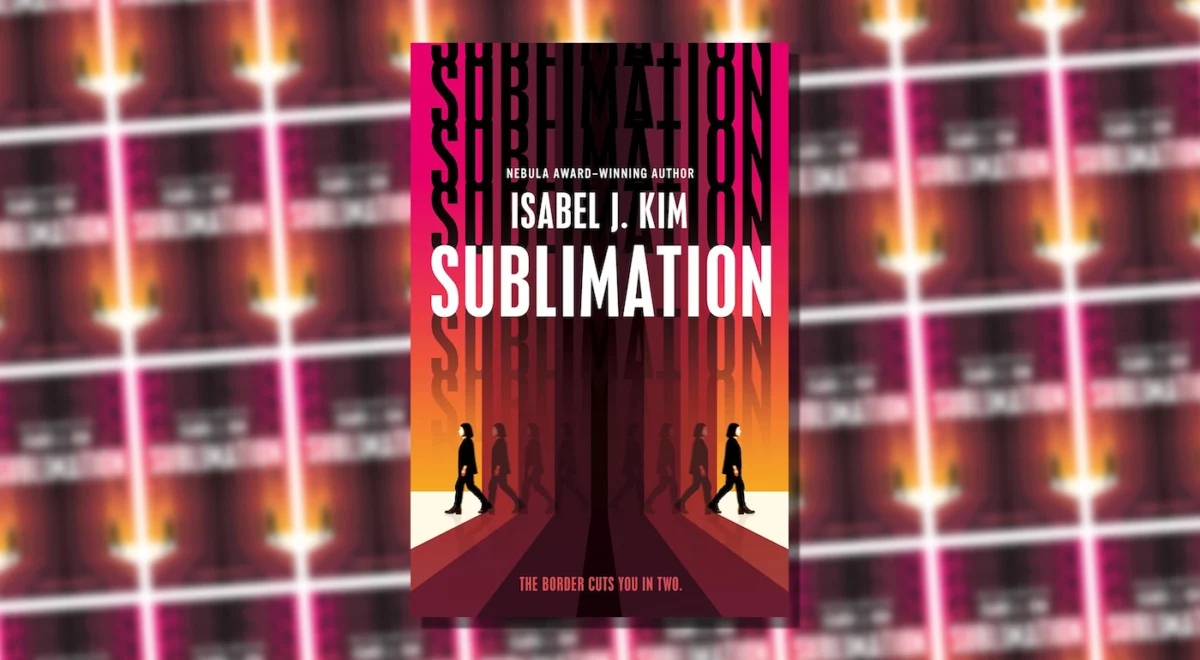
Sublimation: A Profound Exploration of Migration, Identity, and the Self Divided
SEO Keywords: Isabel J. Kim, Sublimation, debut novel, science fiction, migration, identity, self-division, instancing, techno-thriller, literary fiction, philosophical novel, immigration, colonial capitalism, cultural identity.
Introduction: The Unfathomable Split
Imagine a world where the profound act of migration isn’t merely a journey across borders, but a literal cleaving of the self. A physical mitosis, leaving behind a duplicate – an "instance" – to continue a life in the homeland while another instance embarks on an entirely new existence abroad. This startling, deeply philosophical premise forms the bedrock of Isabel J. Kim’s multi-award-winning debut novel, Sublimation, a work that has already garnered significant critical acclaim and caught the eye of Universal Studios for a television adaptation, drawing comparisons to the thought-provoking series Severance.
Kim, a writer celebrated for her incisive prose and imaginative concepts, introduces readers to a reality where the deeply personal and often agonizing experience of leaving one’s home country manifests as a profound physical and psychological bifurcation. As Kim elucidates, an "instance is a duplicate self cleaved mitosis-like from the original—though the duplicate and the original are both referred to as ‘instances’ in modern American vocabulary." No one understands the genesis of this phenomenon; only that it has been an immutable constant throughout human history. The possibility of reversal exists—instances meeting and touching can reintegrate, merging memories and consciousness into a single being—but what happens when this reunification is not a shared desire? Sublimation plunges into this intricate tapestry of identity, belonging, and the fractured self, offering a narrative as intellectually stimulating as it is emotionally resonant.
The Fabric of a Fractured Reality: Main Facts
At its core, Sublimation is a high-concept speculative fiction novel that redefines the act of migration. It posits a world where the emotional and psychological strain of leaving home is made corporeal: individuals physically split into two "instances." These instances live separate, independent lives, often in different countries, retaining distinct experiences, desires, and dreams. The novel explores the profound implications of this phenomenon on individual identity, familial bonds, and societal structures.
The narrative primarily follows two pairs of instanced individuals, offering a nuanced comparison of their divergent paths and emotional landscapes. Soyoung and Rose became instances when ten-year-old Rose and her mother departed Korea for America. Soyoung remains in Seoul, leading a life largely detached from her American counterpart, only encountering Rose when their shared grandfather passes away. In stark contrast, Youjin and YJ instanced when YJ left for university in America. Their relationship is active and strategic: Youjin, still in Seoul, and YJ maintain communication with the express intention of reintegrating once YJ secures American citizenship, a maneuver designed to spare Youjin from the mandatory Korean military draft.
Through these interwoven stories, Kim crafts a rich, character-driven narrative that delves into the complicated feelings these four individuals harbor for each other and for the fragmented lives they lead. The novel is lauded for its fascinating premise, thought-provoking philosophical arguments, and complex exploration of modern-day migration, all delivered with a professional journalistic tone that grounds its speculative elements in a stark, relatable reality.
A History of Duality: Chronology of Instancing
Kim’s genius lies not just in inventing "instancing" but in seamlessly integrating it into the fabric of our known world, albeit with a monumental twist. The phenomenon is not a recent discovery or a futuristic technology; it has, in the novel’s universe, always existed. Readers are informed that the recorded history of instancing stretches back to 1753 BC, with the first mention discovered within an ancient Babylonian text. This deep historical embedding immediately lends gravitas and an unsettling familiarity to the concept, suggesting that human identity and migration have always carried this potential for bifurcation.
The world’s understanding of instancing and its societal implications are meticulously unspooled throughout the narrative. Kim masterfully avoids exposition dumps, instead drip-feeding information to the reader, allowing for a gradual immersion into a world that is simultaneously familiar and profoundly alien. This elegant narrative technique serves to heighten the uncanny feeling of inhabiting a reality so close to our own, yet fundamentally altered by this one "tiny" change—a change, as the article rightly notes, that is "not, of course, tiny at all."
Historically, instancing is presented not as a random occurrence but as a response to a profound, almost primal, human desire. It signifies a longing "beyond wonder," transcending mere curiosity about foreign lands. As the novel illustrates, figures like Marco Polo "famously didn’t instance," implying that simple travel or exploration does not trigger the split. Instead, instancing suggests "a desire for escape, an understanding that either the world outside is so beautiful it must be permanently inhabited or the world inside is so terrible that it should be escaped." This ancient understanding frames migration as an act born of deep yearning, a profound internal conflict made manifest.
For the characters, their personal chronologies are defined by their instancing events. Rose’s split at age ten, tied to her mother’s migration, highlights the involuntary nature of some instances, particularly for children caught in their parents’ decisions. Her instance, Soyoung, lives a life in Seoul, initially unaware of her other self, later choosing a path of non-engagement until external circumstances—a family death—force a confrontation. This portrays a passive instance, shaped by the residual life left behind.
In contrast, Youjin and YJ’s instancing is deliberate, a strategic decision linked to YJ’s pursuit of higher education and American citizenship. Their continued communication and joint plan for reintegration to avoid military service showcase a more active, calculated approach to their dual existence. This dynamic raises questions about agency, self-determination, and the utilization of instancing for personal gain or societal evasion. The differing chronologies and relationships of these two pairs—one marked by absence and forced reunion, the other by collaboration and strategic reunification—provide a rich comparative study of how instancing can shape lives.
The Weight of Duality: Supporting Data and Philosophical Depth
Sublimation is not merely a clever plot device; it is a meticulously crafted exploration of profound philosophical and psychological questions. The novel provides compelling "supporting data" in the form of its characters’ internal struggles and the broader societal implications of instancing.
The Psychological Burden of the Divided Self
The core of the novel’s psychological depth lies in the lived experience of instancing. Anyone who has migrated will attest to the feeling of living "with a foot in each world," a constant balancing act between two homes, two cultures, two identities. Kim literalizes this metaphor, transforming it into a visceral reality. The guilt of leaving, the desire to escape, the longing for a fresh start—these universal migrant experiences are intensified when one’s very being is physically fractured. A border, usually an abstract line, becomes "an artificial thing with practical consequences: the severing of the self from the self."
This severing is depicted as a "twinning, a division, a mind-body-soul-memory torn asunder." Instancing, Kim writes, is "want turned so deep that it manifested in reality. Instancing was pure white-hot desire. Did you consciously know you were leaving forever? No. You didn’t know what part of yourself wanted to leave." This powerful imagery highlights the subconscious, almost primal, force behind the split, suggesting a hidden layer of desire that transcends conscious choice.
The process of reintegration, while offering the potential for wholeness, is fraught with its own existential terror. The idea of merging two distinct consciousnesses, two lifetimes of memories and emotions, into one mind and body is presented as a monumental challenge. The characters grapple with the implications: "Who are we if not our experiences? How do we then accommodate living with someone else’s experiences that feel like ours, but aren’t?" Youjin’s chilling early question, "Is it like murder?", encapsulates the profound cognitive dissonance and ethical quandaries surrounding reintegration. It implies a loss, an obliteration of one’s solo existence, even in the act of becoming whole. The novel delves into the "huge cognitive dissonance" and "burden of each solo existence wiped out" that such an act entails, forcing both characters and readers to confront the very nature of selfhood.
Colonial Capitalism and the Legacy of Instancing
Beyond the individual psyche, Sublimation offers a trenchant critique of geopolitical realities, particularly the legacy of colonial capitalism. Kim boldly asserts that the majority of the world’s instances are a direct consequence of historical and ongoing power imbalances. She declares this to be "the legacy of the west: a mitosis-like duplication of the self across lands already populated." This framing transforms instancing from a mere fantastical element into a powerful allegory for imperialism and displacement.
The novel explicitly connects America’s historical narrative to the phenomenon of instancing: "Instancing is written into America’s blood, into the story it tells itself: Here is where instances migrate. Give us your tired, your poor, your hungry, give us your copies and let them be fruitful and multiply, let them homestead, let them become titans of industry, let them and their non-instanced children build cities and towns and railroads." This passage is a devastating reinterpretation of the American immigration myth, suggesting that the very foundation of the nation was built upon the literal fragmentation of individuals fleeing oppression or seeking opportunity, often at the expense of indigenous populations. It reimagines the "melting pot" as a crucible for division, not just assimilation.
Socio-Political Realities and Power Dynamics
Kim’s authorial voice is unapologetically critical, refusing to "pander to her reader." She demands a degree of historical and social awareness, expecting readers to understand "how citizenship laws and visas work," and the intricate power dynamics that differentiate "expatriates" from "economic migrants." The novel underscores that this distinction is "usually the colour of their skin and/or their passport," highlighting systemic racism and xenophobia.
The novel paints a grim picture of the circumstances that often force instancing: "In a worst-case scenario you instance when you are ripped away from your family and your community and your life and you are trafficked across state borders when you catch a glimpse of the sign that demarcates where your country ends." It acknowledges that instancing can be the consequence of a desperate, agonizing choice: leaving a "beloved, broken shithole" for a "different broken shithole, one with more access to capital, that you will be able to gnaw the rind from and send back the scrapings." This stark realism grounds the speculative premise in the harsh realities of global inequality and forced migration, making Sublimation a deeply political and profoundly relevant work.
Navigating the Split World: Official Responses and Societal Implications
In a world where instancing is a recognized, albeit mysterious, phenomenon, official responses and societal structures would inevitably adapt, leading to complex legal, ethical, and economic ramifications. While the novel drip-feeds these details, the implications are vast and can be logically extrapolated from the text.
Governmental and Legal Frameworks
The existence of instancing would necessitate entirely new legal frameworks. Governments would face unprecedented challenges in managing population counts, citizenship rights, and the legal status of instances. If, as in Youjin and YJ’s case, reintegration can be strategically used to avoid national obligations like military drafts, it implies that governments have attempted to regulate instancing and its consequences. This would likely involve:
- Instance Registration: A system to register instances, track their movements, and differentiate them from "singular" individuals.
- Citizenship Laws: Complex laws determining the citizenship of an instance born from a migrant. Is the instance in the home country still a citizen? Does the migrating instance automatically acquire citizenship in the new land, or must they still navigate traditional immigration processes? The novel suggests the latter, given YJ’s pursuit of American citizenship.
- Military Service and Taxation: How are instances treated regarding national service, taxes, and social benefits? The Korean draft scenario highlights the tangible impact of instancing on national policy.
- Family Law: What are the implications for marriage, inheritance, and parental rights when a person has split? Do both instances have claims to the original family unit?
Economic Commodification and Control
The novel hints at the commodification of instances and their futures, stating: "What does life look like when your future can be commodified, controlled, capitalised upon?" This suggests that the unique nature of instances might be exploited economically. For example:
- Labor Markets: Instances might be seen as a unique labor pool, potentially for dangerous or undesirable jobs, or as a way to double a country’s workforce without increasing the birth rate.
- "Instance Trafficking": The mention of being "trafficked across state borders" for those who instance under duress points to a dark underbelly where instances could be illegally moved, bought, or sold.
- Reintegration Markets: Could there be industries or black markets around facilitating or preventing reintegration, given its profound impact on individuals?
Societal Perceptions and Xenophobia
The presence of instances would undoubtedly alter societal perceptions of identity and belonging. The novel’s critique of racism and xenophobia suggests that instances, particularly those from marginalized groups, would face discrimination.
- "Instance-phobia": A new form of prejudice could emerge, targeting instances as "lesser" or "unnatural" beings, distinct from "singular" humans.
- Cultural Identity: How would communities integrate or ostracize instances? Would an instance remaining in their home country feel alienated, knowing a part of them is elsewhere?
- The Concept of "Home": If instancing arises from a profound "desire for escape," returning home after instancing would be complex. "When you return, are you someone who can fit back in, or are you now an alien even in your home land? What part of you belongs where, if anywhere at all?" These questions highlight the persistent crisis of belonging.
These official responses, though subtly woven into the narrative, are crucial for Sublimation‘s world-building, transforming a fantastical concept into a believable, often unsettling, social commentary.
Beyond the Veil: Implications and Lasting Impact
Sublimation transcends its speculative premise to deliver a work of profound contemporary relevance, prompting readers to reflect on universal themes of identity, migration, and the human condition.
Relevance to the Modern World
Kim’s novel is a powerful allegory for the emotional and psychological realities of migration in our own world. By literalizing the internal split, she forces readers to confront the often invisible burdens carried by migrants—the constant negotiation of dual identities, the longing for a lost home, the struggle for acceptance in a new land. The questions raised by Sublimation—about belonging, about the cost of escape, about the definition of self—are not confined to its fictional universe but resonate deeply with the experiences of millions globally. It serves as a stark reminder of the "immediate physical impact" that "imperialism, citizenship laws, immigration, war, racism and xenophobia" already have, even without the physical splitting of the self.
The "Metaphor Made Flesh"
One of the novel’s most compelling implications is its central concept as "metaphor made flesh." Kim explains, instancing is not merely "a cleft of meat and bone… it is the cleave of one future from another. It is the psychological change as denoted through physical reality; it is metaphor made flesh. The physical effects are downstream from the higher-order changes taking place." This elevates Sublimation beyond mere science fiction, positioning it as a work of literary and philosophical depth. It argues that our deepest psychological states and societal pressures have the power to manifest in profound, tangible ways.
Stylistic Choices and Authorial Voice
Kim’s authorial voice is a significant strength, characterized by its refusal to simplify complex issues. She expects her readers to be engaged, informed, and empathetic, not shying away from dense philosophical arguments or intricate political critiques. Her use of the second-person narrative for substantial portions of the novel is a brilliant stylistic choice. It is not a gimmick but a deliberate, effective tool that immerses the reader directly into the bewildering experience of being an instance. This narrative mode "captures moments, feelings in a specific time and place… the heart at the moment of stepping over a border. The mind when it knows it is leaving." It compels the reader to inhabit the uncertainty and existential questioning that defines the characters’ lives.
Narrative Shift and Adaptation Potential
The novel’s transition in its final third towards a "techno-thriller" demonstrates its narrative ambition and versatility. This shift, while surprising, likely contributes to its broad appeal, including its acquisition by Universal Studios for a television adaptation. The comparison to Severance is apt, given both works explore profound questions of selfhood, memory, and the physical manifestations of psychological divides. This adaptation potential underscores Sublimation‘s capacity to translate its intricate themes into a compelling visual medium, reaching an even wider audience.
In conclusion, Isabel J. Kim’s Sublimation is an admirable and ambitious debut that successfully tackles a gargantuan premise with grace and intellectual rigor. It does not offer simplistic answers but instead poses a multitude of relevant, urgent questions about what it means to be an individual, a migrant, and a member of a global society in an increasingly interconnected yet fragmented world. By forcing us to imagine a literal division of the self, Kim invites us to profoundly reconsider the invisible divides that already shape our lives.
Sublimation is published by Tor Books.
Read an excerpt here: [Link to excerpt, if available]