The Rise of the Swamp King: An In-Depth Analysis of Frog Sqwad’s Chaotic Co-op Mechanics
The indie gaming landscape has long been a fertile ground for "physics-based chaos"—a subgenre where intentional mechanical friction creates emergent humor and challenging gameplay. From the wobbly stumbles of Human Fall Flat to the gelatinous brawls of Gang Beasts, players have shown a recurring appetite for games that prioritize "fun-failure" over surgical precision. Entering this crowded but vibrant arena is Frog Sqwad, a co-op party game that trades human appendages for sticky tongues and swamp-dwelling subjects.
Developed with a focus on high-player-count cooperation and procedural unpredictability, Frog Sqwad tasks players with a singular, absurd mission: satisfy the insatiable hunger of the Swamp King. By blending traditional platforming with a unique growth mechanic and grappling-hook-style physics, the title attempts to carve out a niche in the competitive party game market.
Main Facts: The Core Architecture of Frog Sqwad
At its heart, Frog Sqwad is a physics-driven cooperative action game designed for 1 to 8 players. While many titles in the genre cap their local or online play at four participants, Frog Sqwad’s decision to support up to eight players simultaneously signals its intent to be a "party-first" experience.
The Premise and Narrative Hook
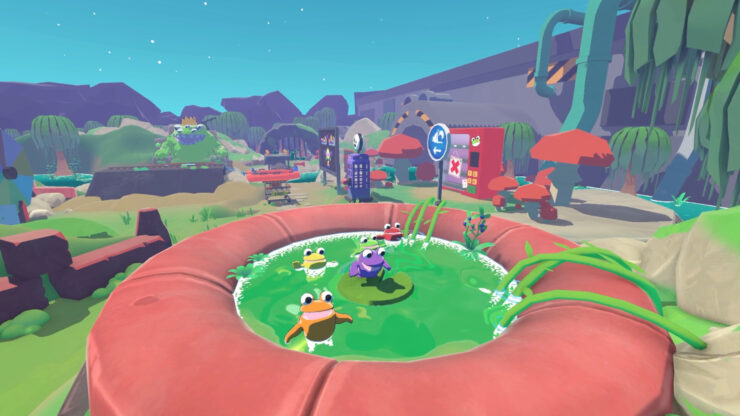
The narrative framework is intentionally surreal. Players control small, colorful frogs inhabiting a swamp governed by the enigmatic and demanding Swamp King. The King’s demands are not for flies or dragonflies, but for a bizarre assortment of "human" delicacies. Burgers, giant eggs, apples, and French fries are scattered throughout the environment, and it is the players’ duty to retrieve these items and deliver them to a central offering bowl.
The Tongue Mechanic
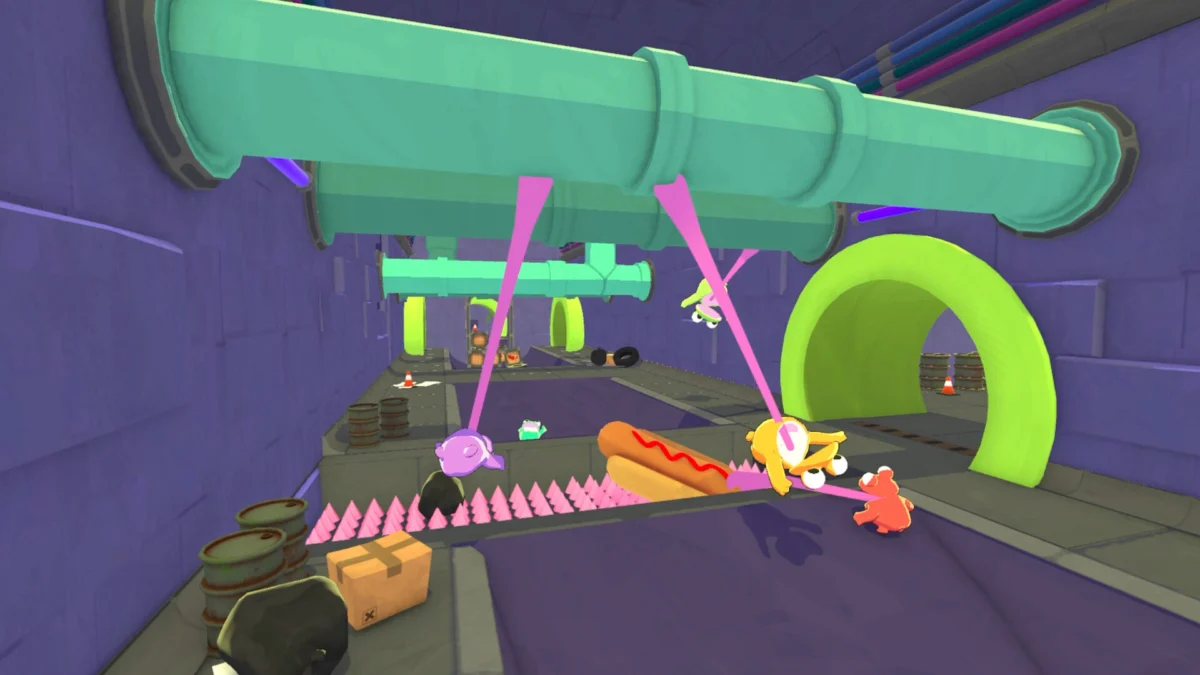
The central mechanical hook is the frogs’ tongues. Rather than being a simple attack or interaction button, the tongue serves as a multi-tool for:
- Traversal: Players use their tongues to grapple onto environmental objects, swinging across gaps or climbing vertical surfaces.
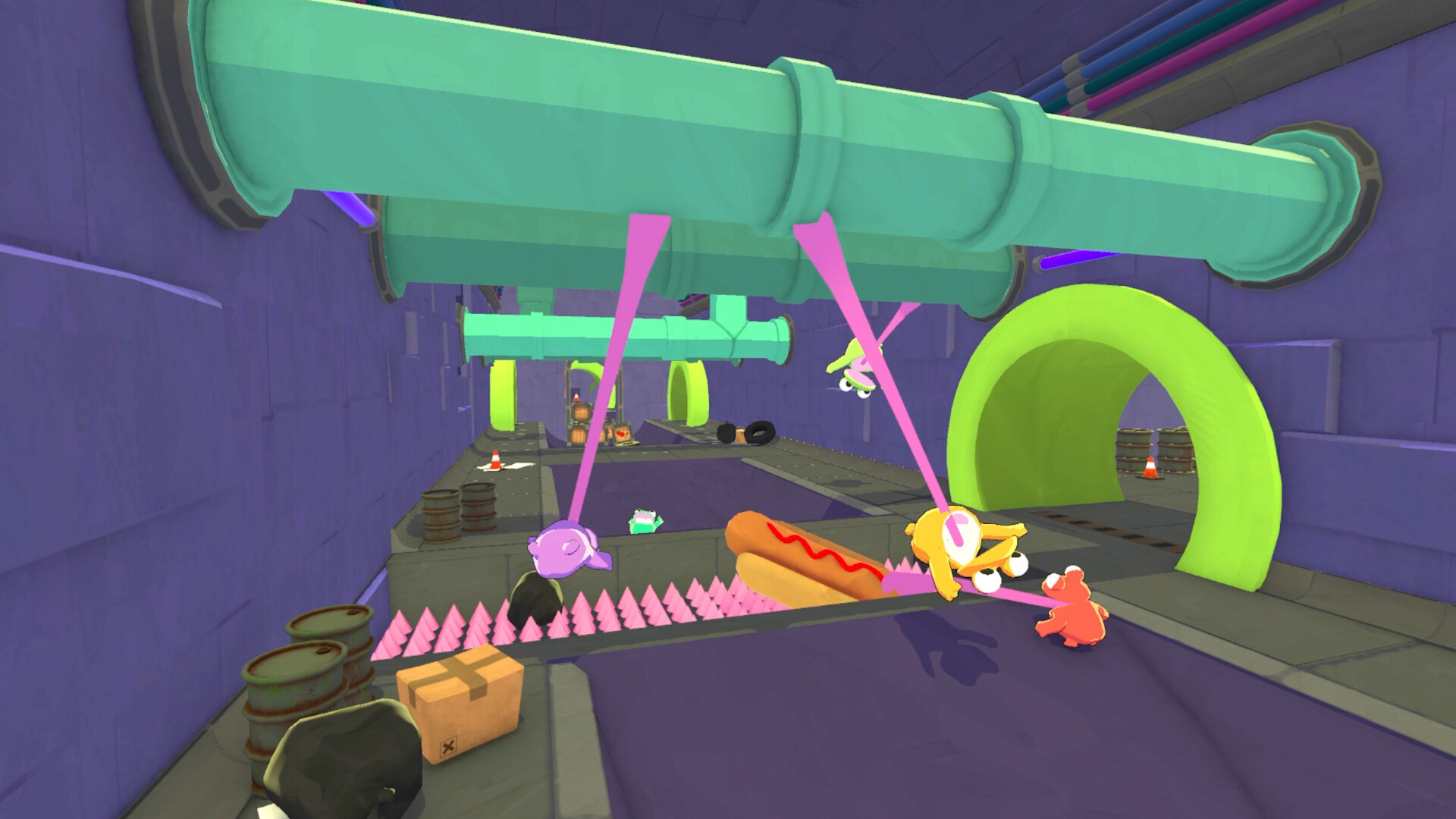
- Object Manipulation: Larger food items, such as giant eggs, cannot be picked up by hand. Instead, they must be latched onto and dragged through the environment, requiring players to account for momentum, friction, and the "floaty" nature of the game’s physics engine.
- Consumption: Smaller items can be eaten directly, leading to the game’s most distinctive feature: the growth system.
The Growth and Transformation System
Unlike many platformers where character stats remain static, Frog Sqwad introduces a dynamic scaling system. As frogs consume smaller food items, they regain health but also increase in physical size. If a player consumes enough, they transform into a giant, spherical "ball" frog. In this state, the traditional running and jumping mechanics are replaced by rolling. This transformation is a double-edged sword: while it grants the player the power to break through environmental barriers and walls, it also makes them more unwieldy and prone to rolling into hazards like toxic ooze.
Chronology: From Concept to Steam Release
The journey of Frog Sqwad from an indie concept to a fully realized Steam release follows a trajectory typical of high-potential indie gems, marked by public demos and community feedback loops.
The Development Phase and Public Debut
The game first garnered significant attention during its showcase at "New Game Plus," a London-based event dedicated to highlighting upcoming indie titles. This event allowed players and journalists to get hands-on experience with the title’s core loop. It was during this phase that the game’s "floaty" movement—a point of both praise and critique—was first identified as a defining characteristic of the experience.
The Announcement Trailer
Following the success of the New Game Plus demo, the official announcement trailer was released, showcasing the procedural nature of the levels and the sheer scale of the 8-player chaos. The trailer emphasized the "wacky" nature of the levels, moving from traditional swamp environments to more industrial or abstract settings filled with human food.
Full Release on Steam
Frog Sqwad officially launched on the Steam platform, targeting a demographic of PC gamers who enjoy social, high-energy multiplayer titles. The release version included the full suite of procedural level generation, ensuring that the "daily quota" challenges remained fresh for returning players.
Supporting Data: Mechanics, Hazards, and Procedural Design
To understand why Frog Sqwad stands out, one must look at the data-driven design of its levels and the specific hazards that create its high-difficulty ceiling.
Procedural Generation and Replayability
A significant portion of Frog Sqwad’s longevity relies on its procedural map generation. Each session presents a different configuration of platforms, hazards, and food placement. This prevents players from simply memorizing a path to the goal, forcing them instead to master the physics of the game.
- The Quota System: Each level has a specific "food quota" that must be met within a time limit. This adds a layer of resource management, as players must decide whether to eat food for health and growth or save it for the Swamp King to meet the day’s requirements.
- Environmental Puzzles: Levels are interspersed with buttons and pressure plates. Often, these require multiple frogs to coordinate—one holding a button while another drags a giant egg through a newly opened door.
The Hazard Matrix
The game employs a variety of hazards that interact specifically with the frogs’ physics:
- Slime Monsters: Mobile enemies that can consume the player, forcing a respawn and a loss of progress.
- Toxic Ooze: A liquid hazard that is instantly fatal upon contact. The "floaty" jump mechanics make navigating narrow platforms over ooze a high-stakes endeavor.
- Environmental Spikes: Static hazards that punish imprecise movement, particularly when players are swinging via their tongues.
Performance and Accessibility
Designed to be accessible on a wide range of PC hardware, the game utilizes a vibrant, low-poly aesthetic. This choice is not merely stylistic; it allows the game to maintain a stable frame rate even when eight players and dozens of physics-active food items are on screen simultaneously.
Official Responses: Developer Intent vs. Critical Reception
The reception of Frog Sqwad highlights a common tension in indie game design: the balance between intentional "jank" and player frustration.
The Developer’s Vision
The developers have positioned Frog Sqwad as a "chaotic, frantic" experience. In official communications and trailers, the emphasis is placed on the "magic" that happens when friends join forces. The intent was clearly to create a "water cooler" game—one where players laugh at their shared failures as much as their successes. The "floaty" movement, which some might see as a lack of polish, appears to be an intentional design choice meant to increase the difficulty and unpredictability of the 8-player sessions.
Critical Analysis: The "Floaty" Movement Debate
Prominent indie journalist Jupiter Hadley, who demoed the game at New Game Plus, noted that the movement felt "ridiculously floaty." In a professional context, this critique is vital. For a game that requires precise jumping to avoid toxic ooze or spikes, floaty controls can lead to a steep learning curve.
However, Hadley also noted that this friction is mitigated by the multiplayer aspect. "I can see that if I was playing with friends who were able to solve more of the precise rooms, we could all play to our strengths," Hadley remarked. This suggests that Frog Sqwad is balanced for collective skill rather than individual perfection. One player might act as the "heavy" (the giant ball frog breaking walls), while another acts as the "scout" (the small, agile frog navigating tight spaces).
Implications: The Future of Physics-Based Social Gaming
The release of Frog Sqwad carries several implications for the indie industry and the party game genre as a whole.
The Evolution of the "8-Player" Local/Online Model
By supporting eight players, Frog Sqwad enters a rare category of games. This choice reflects a growing trend in social gaming where larger friend groups—often connected via Discord or at physical parties—seek experiences that don’t exclude half the group due to a 4-player limit. The success of this model in Frog Sqwad could encourage more developers to optimize their physics engines for higher player counts.
Streamability as a Success Metric
Frog Sqwad is built for the "streaming era." Games that feature high-intensity chaos, visual humor (like a frog turning into a giant ball), and collaborative shouting are highly "watchable" on platforms like Twitch and YouTube. The procedural nature of the game ensures that streamers can provide unique content with every run, which is a key driver for organic marketing in the indie sector.
The Challenge of Solo Play vs. Group Play
One of the primary implications for players is the disparity between the single-player and multiplayer experience. While Frog Sqwad includes a single-player mode, the consensus suggests that the "magic" is heavily tied to the social dynamic. For the game to maintain a long-term player base, the developers may need to continue refining the solo experience or implement robust matchmaking systems to ensure that players can always find a "sqwad" to join.
Conclusion
Frog Sqwad is more than just a game about frogs eating burgers; it is a testament to the enduring appeal of cooperative chaos. By leaning into its floaty physics and procedural unpredictability, it offers a challenging, often hilarious experience that rewards teamwork and patience. While the controls may prove divisive for those seeking a tight, traditional platformer, those who embrace the frantic nature of the swamp will find a delightful, sticky-tongued adventure waiting for them on Steam. As the Swamp King awaits his next meal, the only question remains: are you and your friends ready to meet the quota?