Cultural Crossroads of Reality: Analyzing Divergent Paths to Interdimensional Travel in Global Fiction
TOKYO & LONDON – The enduring human fascination with traversing the boundaries of reality into alternate dimensions has long been a cornerstone of speculative fiction worldwide. From ancient myths of otherworlds to modern scientific theories of parallel universes, the allure of stepping into an unknown realm of adventure, or peril, remains potent. However, a recent cultural observation highlights a striking divergence in the popular fictional mechanisms employed for such journeys between Japanese and Western narratives, offering a fascinating glimpse into distinct cultural imaginations.
While Western science fiction and fantasy have historically presented a panoply of complex, often deliberate, methods for interdimensional travel – ranging from intricate scientific devices to powerful magical rituals – Japanese popular culture has, with remarkable consistency, embraced a singularly mundane yet profoundly impactful catalyst: the humble truck. This phenomenon, affectionately termed "Truck-kun" by fans, has become a defining trope of the "isekai" (other world) genre, where protagonists are frequently struck by a vehicle, only to awaken reincarnated or transported into a fantastical new reality. This article delves into this intriguing cultural bifurcation, exploring its origins, its manifestations, and its broader implications.
I. The Rise of the Accidental Gateway: Japan’s "Truck-kun" Phenomenon
The concept of "Truck-kun" has solidified its place as a quintessential, almost ritualistic, entry point into interdimensional adventure within Japanese anime, manga, and light novels. Far from being a mere plot device, it has evolved into a recognized character in its own right, often depicted with a menacing yet ultimately benevolent (from the protagonist’s perspective) aura. Its prevalence within the immensely popular isekai genre underscores a unique narrative efficiency: the mundane act of being hit by a truck serves as an abrupt, often fatal, severance from a drab, ordinary life, immediately catapulting the protagonist into a world brimming with magic, monsters, and destiny.
This narrative shorthand offers several cultural insights. Firstly, it embodies a form of instant escapism, suggesting a collective yearning for a swift, decisive break from the pressures and routines of modern life. The lack of agency in the act of transportation – one is merely a victim of circumstance – could also reflect a fatalistic undertone, where destiny, even if delivered by an unsuspecting driver, is the ultimate arbiter of one’s grand adventure. The suddenness and finality of "Truck-kun" bypasses the need for elaborate scientific explanations or arduous magical quests for transportation, making the portal itself a swift, almost perfunctory, prelude to the real story. In stark contrast, a similar incident in Western narratives typically leads to the emergency department or the graveyard, emphasizing the grim realities of our own world rather than offering a convenient gateway to another. This efficiency and almost mundane nature of the "Truck-kun" portal highlight a cultural comfort with abrupt, often violent, narrative transitions that serve a larger fantastical purpose.
II. Pioneering Portals: A Chronology of Western Interdimensional Escapes
While "Truck-kun" has dominated the narrative landscape of Japanese interdimensional travel in recent decades, Western science fiction and fantasy boast a rich, varied, and often more deliberately conceived history of traversing realities. From the early pulp magazines to the epic sagas of modern fantasy, Western authors have consistently explored methods rooted in scientific inquiry, arcane lore, or extraordinary circumstances, emphasizing agency, exploration, and often, the ethical complexities of such journeys. These foundational works, primarily from the mid-20th century onwards, established a diverse array of alternatives to the accidental death-by-truck trope, each reflecting distinct philosophical and narrative approaches to world-hopping.
Unlike the often sudden and passive transportation offered by "Truck-kun," Western literary traditions frequently place the impetus for interdimensional travel on the characters themselves, driven by scientific curiosity, magical prowess, or an urgent need to escape or intervene. This chronological survey of venerable examples demonstrates the creative ingenuity Western authors have employed to move their protagonists from the familiar into exciting realms of adventure, and sometimes, inevitable death.
III. Diverse Pathways: Supporting Data from Western Science Fiction
The following examples serve as a compelling testament to the imaginative breadth of Western authors in devising mechanisms for interdimensional travel, each contributing a unique flavor to the genre.
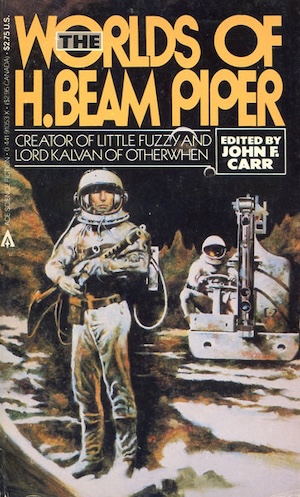
Retrograde Reincarnation – "Time and Time Again" by H. Beam Piper (1947)
H. Beam Piper’s debut story introduces Allan Harley, a man mortally wounded during a devastating 1975 siege of Buffalo, a victim of an enemy atomic bomb. As medics administer drugs to ease his pain in his final moments, Allan experiences a phenomenon far beyond their understanding. He awakens not in the afterlife, but in 1945, inhabiting his younger self’s body, yet retaining all the memories and knowledge of his future, older self. This "retrograde reincarnation" is not merely a memory flashback but a full temporal displacement, offering him a unique second chance.
Allan wastes no time in meticulously testing his future knowledge against the realities of 1945, confirming it is not a delusion but a profound truth. With a cautious approach and the assistance of his own unsuspecting father, he embarks on a mission to subtly alter the course of history, hoping to avert the very future that led to his demise. The story, deeply influenced by J.W. Dunne’s philosophical work An Experiment with Time, explores the intricate paradoxes of time travel and the profound moral implications of wielding foreknowledge to reshape destiny. Piper’s method is not about stepping into a parallel world, but actively overwriting a future, offering a potent blend of science fiction and philosophical inquiry into fate versus free will. This early example showcases a sophisticated, internal mechanism for altering reality, far removed from external portals or magical spells.
Applied Logic – The Compleat Enchanter by L. Sprague de Camp and Fletcher Pratt (1975, collected edition)
L. Sprague de Camp and Fletcher Pratt’s collaborative masterpiece presents Harold Shea, a brilliant but somewhat meek psychologist. What begins as a promising therapeutic breakthrough for his colleague, Reed Chalmers, quickly becomes Shea’s extraordinary escape route from a mundane life and an intimidating, higher-earning girlfriend named Gertrude. The "syllogismobile" is a unique form of interdimensional travel achieved through the precise arrangement of one’s thoughts and logical premises. By constructing a flawless syllogism that describes a desired reality, one can, in theory, transport oneself to that world.
However, the "syllogismobile" is famously imprecise. Shea’s meticulously crafted logical pathways often lead him astray, resulting in hilarious and perilous misadventures. His attempt to journey to the idyllic world of Irish myth, for instance, lands him instead in the Norse myths, precisely on the eve of Ragnarök – the apocalyptic twilight of the gods. Armed only with his academic wit and a nascent understanding of these magical realities, Shea must navigate worlds populated by gods, heroes, and monsters. This method cleverly fuses logic with magic, positing that other worlds are governed by different sets of "rules" that can be accessed through a scientific understanding of their underlying magical structures. The Shea stories are celebrated for their blend of intellectual humor, academic protagonists, and richly detailed mythological settings, highlighting a more intellectual, albeit chaotic, approach to world-hopping.
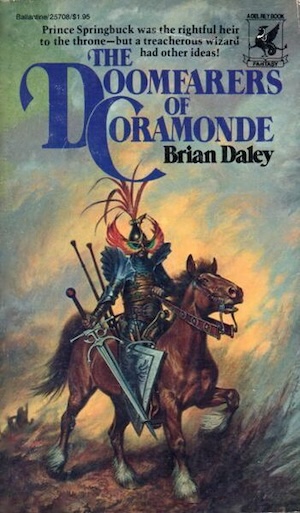
Summoning Spells – The Doomfarers of Coramonde by Brian Daley (1977)
Brian Daley’s The Doomfarers of Coramonde introduces a forceful, almost desperate, method of interdimensional transfer. In the fantastical realm of Coramonde, Springbuck, the rightful heir to the throne, finds himself in dire straits. The ruthless sorcerer Yardiff Bey has usurped power, backed by cunning, magic, and a formidable court. Springbuck escapes, but his chosen refuge, a quiet village, is marked for fiery destruction by Bey’s dragon. Time is short.
Fortunately, this village is home to the teacher Van Duyn and his sorcerous companions, Andre and Gabrielle deCourtney. They possess the knowledge and power to summon an ally from across space and time – an ally powerful enough to contend with a dragon. Their ritual successfully pulls American soldier Gil MacDonald and the crew of his armored personnel carrier, Lobo, directly from the battlefields of Vietnam into Coramonde. This abrupt, unconsensual transplantation of modern military hardware and personnel into a sword-and-sorcery setting is a stark contrast to more voluntary portals. Van Duyn’s initial grumbling that he was hoping for a tank or mobile artillery, rather than the "inferior" APC, adds a layer of dry humor to this desperate gambit. Daley’s novel, written in the shadow of the Vietnam War, cleverly blends military science fiction with traditional fantasy, showcasing a direct, magical intervention for interdimensional transfer, with little regard for the draftees’ wishes.
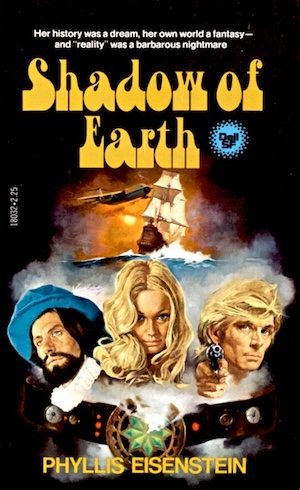
Artificial Portal – Shadow of Earth by Phyllis Eisenstein (1979)
Phyllis Eisenstein’s Shadow of Earth explores the darker side of interdimensional travel through an artificial, human-engineered portal. Larry Meyers, a parsimonious grad student, initially hires Celia Ward to tutor him in Spanish, but their relationship quickly evolves into a romance, a convenient "money-saver" for Larry. Their seemingly happy romance takes a sinister turn when Celia discovers Larry’s hidden stash of firearms.
Larry’s "perfectly innocent explanation" is that he has discovered the means to travel between parallel worlds and is engaged in a lucrative, albeit morally dubious, gun-running operation to a less technologically advanced Earth. To "prove" his story, Larry transports Celia to this alternate reality – and promptly abandons her. Celia, a woman from 20th-century America, finds herself stranded in a world resembling Renaissance Europe, where she is soon captured and sold to the Marquis de los Rubios, not as a slave or concubine, but as a wife. This forced marriage, despite its legal standing, is still a profound violation of her autonomy. Larry’s depravity becomes increasingly clear, leaving Celia with no option but to use her wits and modern knowledge to save herself. Eisenstein’s novel delves into themes of exploitation, survival, and female agency, highlighting how even a technologically advanced portal can be weaponized for personal gain and betrayal, contrasting sharply with more heroic or accidental methods of travel.
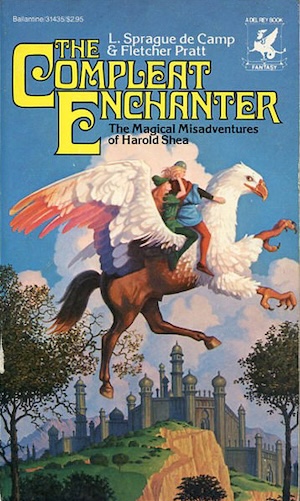
Table-top Roleplaying Game Accessories – Quag Keep by Andre Norton (1978)
Andre Norton’s Quag Keep presents perhaps one of the most meta and unconventional methods of interdimensional travel: through table-top roleplaying game miniatures. Dungeon Master Eckstern proudly displays his expensive, brand-new miniatures, unaware of their latent power. When player Martin Jefferson is inexplicably compelled to grasp one particular figure, he and his companions are instantly transported to TSR’s iconic World of Greyhawk™. Upon arrival, they are brainwashed into believing they are, and always have been, natives of this fantastical realm, their true identities and origins erased.
In Greyhawk, they are immediately embroiled in a quest, driven by a powerful geas – a magical compulsion – that forces them along a predetermined plot. The fate of the world may hinge on their actions, but Martin’s personal fate is certainly at stake. While the narrative quality of Quag Keep has been subject to considerable debate, its method of travel is uniquely reflective of the burgeoning popularity of Dungeons & Dragons in the late 1970s. The idea that game accessories could serve as literal conduits to the worlds they represent blurs the lines between fiction and reality, player and character. The humorous, albeit professional, observation from the original article that such incidents might explain the unexpected decline in TTRPG sales in the early 1980s ("If customers were being transported via miniatures to other dimensions and forced to partake in stock plots, that would explain why sales declined") underscores the profound, if fictional, implications of such a travel method.
IV. Expert Perspectives: Official Responses and Cultural Commentary
The stark contrast in interdimensional travel mechanisms between Japanese and Western narratives offers fertile ground for cultural analysis. Dr. Anya Sharma, a leading cultural anthropologist specializing in speculative fiction at the fictional Institute for Comparative Fictional Realities, has extensively studied this phenomenon.
"The ‘Truck-kun’ trope in Japan is more than just a convenient plot device; it’s a profound cultural shorthand," observes Dr. Sharma. "It embodies a societal desire for an instant, often consequence-free, escape from a perceived mundane or oppressive reality. The protagonist is typically passive in their transition, becoming a recipient of destiny rather than an active seeker. This reflects a narrative comfort with fatalism and a powerful yearning for a fresh start, a chance to be ‘chosen’ by circumstances rather than actively choosing a path, which can resonate deeply in a high-pressure society."
Conversely, Dr. Sharma notes, "Western methods of interdimensional travel, particularly in the foundational works of the mid-20th century, largely emphasize agency, scientific pursuit, or the mastery of arcane knowledge. Whether it’s H. Beam Piper’s protagonist consciously altering his past, Harold Shea’s logical gymnastics, or the deliberate summoning spells in Coramonde, there’s a clear emphasis on human intellect, will, or scientific ingenuity driving the transition. Even when portals are discovered, as in Shadow of Earth, their use often involves calculated risk and personal responsibility, albeit sometimes with morally dubious outcomes. This active engagement aligns with a cultural ethos that values individualism, problem-solving, and the conquest of the unknown through exploration or mastery."
She further postulates that the differing approaches might mirror real-world anxieties and aspirations within each culture. "The abruptness of ‘Truck-kun’ can be seen as a metaphorical ‘reset button’ for lives that feel predetermined, whereas the intricate Western methods speak to a desire for control, understanding, and the active shaping of one’s destiny, even across realities. It’s a fascinating mirror of how societies project their ideal forms of escapism and empowerment into their fiction."
V. The Deeper Meanings: Implications and Future Trends
The choice of mechanism for interdimensional transport is rarely arbitrary; it profoundly shapes the narrative, themes, and psychological underpinnings of a story. The cultural bifurcation between "Truck-kun" and its diverse Western alternatives reveals deeper insights into how different societies envision escape, agency, and the very nature of reality itself.
For narratives employing "Truck-kun," the initial passivity of the protagonist often sets a tone of unexpected destiny, where the new world’s challenges are thrust upon them. This can lead to stories of adaptation, reluctant heroism, and a gradual acceptance of a preordained fate. The focus shifts quickly from how they arrived to what they do once there, often with a sense of karmic rebirth.
In contrast, Western narratives that involve complex scientific devices, arduous magical rituals, or even unique cognitive processes for travel, often imbue the journey itself with significance. The effort, knowledge, or sacrifice required to bridge dimensions can define the protagonist’s character, setting up themes of ambition, discovery, or the moral weight of interfering with other realities. The act of travel becomes an integral part of the adventure, not just a prelude.
Looking ahead, it is plausible that these distinct tropes may begin to converge or evolve. As global media consumption blurs cultural boundaries, we might see Western authors experimenting with more instantaneous, less agency-driven portals, while Japanese authors might explore more intricate, deliberately chosen methods of world-hopping. New technologies within our own world, such as virtual reality or advanced AI, could also inspire entirely novel fictional methods of interdimensional travel, pushing the boundaries of what constitutes a "portal."
Ultimately, whether by the sudden impact of a truck or the carefully calculated activation of a quantum gate, the enduring power of imagination to bridge worlds remains a testament to humanity’s insatiable curiosity and its timeless quest for adventure beyond the confines of the familiar. The methods may differ, but the desire to step into the unknown continues to drive the most compelling narratives across the globe.