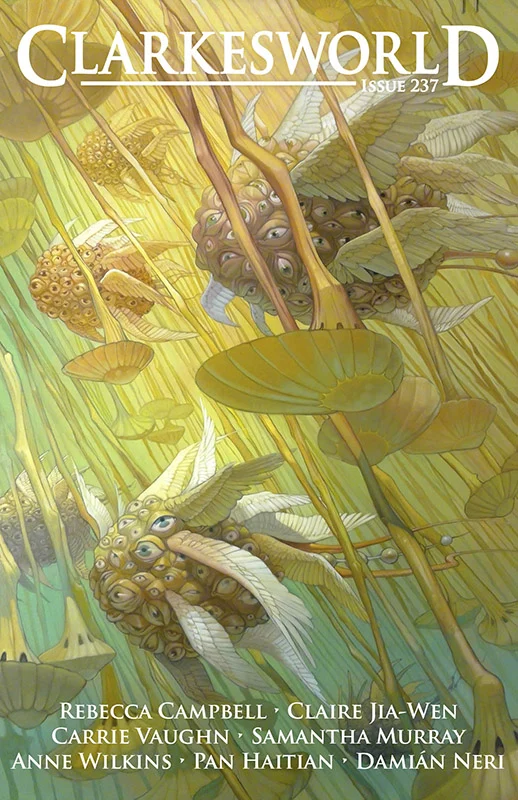
Clarkesworld Magazine – Science Fiction & Fantasy
FOR IMMEDIATE RELEASE
NEW YORK, NY – June 1, 2026 – Clarkesworld Magazine, a leading voice in science fiction and fantasy, has announced the release of its highly anticipated Issue 237 for June 2026. Headlining its original fiction offerings is "The Potential Side Effects of Roleplay Stimulation Therapy" by rising speculative fiction writer Claire Jia-Wen, presented in both text and a compelling audio format read by the acclaimed Kate Baker. This new work promises to delve into the complex ethical and psychological frontiers of advanced therapeutic technologies, sparking vital conversations within the genre and beyond.
The story, marking its debut in Clarkesworld’s June 2026 edition, immediately stands out with its provocative title, signaling an exploration of cutting-edge concepts at the intersection of psychology, technology, and identity. Claire Jia-Wen, whose background includes a PhD in Human-Computer Interaction, brings a unique blend of scientific rigor and narrative flair to a topic ripe for speculative examination. As the second podcast offering for the month, the audio rendition, clocking in at 35 minutes and 51 seconds, is poised to captivate listeners with Kate Baker’s renowned vocal performance, adding an immersive layer to Jia-Wen’s intricate narrative.
Main Facts: A Glimpse into Tomorrow’s Therapy
Clarkesworld Magazine’s June 2026 issue, number 237, features "The Potential Side Effects of Roleplay Stimulation Therapy" as a central piece of original fiction. Penned by Claire Jia-Wen, the story explores a futuristic therapeutic modality and its unforeseen consequences. The work is accessible to readers globally through multiple formats: a traditional text version available on the Clarkesworld website, and an audio podcast narrated by the highly respected Kate Baker. The podcast, a significant component of Clarkesworld’s multimedia strategy, runs for 35 minutes and 51 seconds and is available for streaming or download across a wide array of platforms including Apple Podcasts, Spotify, Pandora, iHeartRadio, Podchaser, TuneIn, Deezer, and via RSS feeds.
The story’s premise, though fictional, touches upon very real anxieties and hopes surrounding the advancement of therapeutic technologies. "Roleplay Stimulation Therapy" (RST), as conceptualized by Jia-Wen, is presented as an advanced psychological intervention, likely utilizing immersive virtual reality, neural feedback, and sophisticated AI to allow individuals to roleplay various scenarios, confront traumas, or explore alternative identities in a controlled environment. The narrative’s focus on "potential side effects" suggests a critical examination of the unforeseen consequences when such powerful tools are wielded, hinting at themes of identity dissolution, reality distortion, or the ethical boundaries of psychological manipulation.
Claire Jia-Wen herself is a notable figure in contemporary speculative fiction. Hailing from the "626" area code (a common reference to the San Gabriel Valley in Southern California), her work has previously appeared in esteemed publications such as khōréō and Clarkesworld. An alumna of the prestigious Viable Paradise writing workshop, her academic pursuits as a PhD student in Human-Computer Interaction (HCI) provide a particularly relevant lens through which to explore the intricate human-technology interface central to her latest story. This academic grounding suggests a thoughtful and informed approach to the speculative elements of "Roleplay Stimulation Therapy," moving beyond mere fantasy into a realm of scientifically plausible, albeit futuristic, extrapolation.
Chronology: From Concept to Publication
The journey of "The Potential Side Effects of Roleplay Stimulation Therapy" to the pages and airwaves of Clarkesworld Magazine represents a culmination of both authorial dedication and the magazine’s commitment to showcasing cutting-edge science fiction. While the specific submission and editorial timeline for Jia-Wen’s story are not publicly detailed, its appearance in the June 2026 issue places it firmly within Clarkesworld’s established rhythm of monthly releases, a schedule it has maintained for years, solidifying its reputation as a consistent purveyor of quality genre fiction.
Clarkesworld, under the editorship of Neil Clarke, has consistently been at the forefront of identifying and nurturing new talent while also publishing established voices. Its dual format — text and audio — has been a cornerstone of its accessibility strategy for over a decade, recognizing the evolving consumption habits of its readership. The selection of Jia-Wen’s story for the June 2026 issue underscores the magazine’s ongoing interest in hard science fiction that grapples with complex scientific and societal implications, often using near-future or slightly altered present-day settings to explore profound human dilemmas.
Claire Jia-Wen’s trajectory as a writer has seen a steady rise. Her prior publications in khōréō and Clarkesworld indicate a growing recognition of her distinctive voice and thematic concerns. The Viable Paradise workshop, known for its intensive focus on craft and genre exploration, would have undoubtedly refined her storytelling abilities and perhaps even provided a fertile ground for the initial conceptualization of ideas like Roleplay Stimulation Therapy. Her ongoing PhD studies in Human-Computer Interaction provide a continuous feedback loop between theoretical academic understanding of technology and its human impact, and the creative output of her fiction. This interdisciplinary approach is particularly valuable when crafting narratives that explore the nuanced relationship between humans and advanced technological systems, such as those that would underpin RST. The publication of this story in June 2026 is not merely an isolated event but a significant marker in her developing career, positioning her as an author capable of tackling weighty, relevant speculative concepts.
Supporting Data: Deconstructing Roleplay Stimulation Therapy and its Implications
The title alone, "The Potential Side Effects of Roleplay Stimulation Therapy," immediately conjures a landscape ripe with both promise and peril. To fully appreciate Jia-Wen’s narrative, it’s crucial to contextualize what "Roleplay Stimulation Therapy" (RST) might entail in a speculative future. Drawing from contemporary trends in psychology, virtual reality, and neuroscience, RST can be imagined as a highly sophisticated form of therapeutic intervention.
At its core, RST would likely involve fully immersive, sensory-rich virtual environments where patients can embody different personas, revisit past events from altered perspectives, or simulate future scenarios. This could be achieved through advanced virtual reality interfaces, perhaps even direct neural links that bypass traditional screens, allowing for an unprecedented level of immersion and psychological engagement. The "stimulation" aspect implies not just visual and auditory input, but potentially haptic feedback, olfactory cues, and even direct manipulation of brain states to enhance emotional responses or cognitive processing within the simulated roleplay.
The therapeutic goals of such a system would be ambitious: treating severe PTSD by allowing patients to safely re-process traumatic memories, helping individuals overcome social anxieties through repeated simulated interactions, or even facilitating identity exploration for those grappling with gender dysphoria or personal existential crises. Imagine a patient suffering from profound social anxiety being able to practice conversations with a hyper-realistic AI, or a trauma survivor reliving an event from the perspective of a third party, gaining emotional distance and new insights. The potential for healing and personal growth seems boundless.
However, it is precisely this boundless potential that sets the stage for "The Potential Side Effects." Jia-Wen, with her HCI background, is uniquely positioned to explore the subtle yet profound ways human psychology interacts with and is altered by advanced technology. The side effects could be multifaceted:
- Identity Diffusion: If individuals spend significant time embodying different roles or exploring alternative selves within RST, they might struggle to integrate these experiences back into their core identity, leading to a fragmented sense of self or an inability to distinguish their "true" self from their simulated personas.
- Reality Disorientation: The line between the meticulously crafted virtual world and physical reality could blur. Patients might begin to perceive elements of the simulated environment in their daily lives, or find mundane reality less compelling than the heightened experiences within RST.
- Dependency and Addiction: The therapeutic benefits, coupled with the immersive nature of RST, could foster a psychological dependency, where individuals prefer the controlled, often idealized, world of roleplay over the complexities of real-life interaction.
- Ethical Dilemmas: Who controls the narratives within RST? What if simulations are designed to subtly influence political beliefs or consumer choices? What are the implications for informed consent when the therapy itself might alter a patient’s perception of reality?
- Unforeseen Psychological Shifts: The human mind is incredibly complex. Manipulating it through such advanced stimulation could lead to unpredictable cognitive restructuring, new forms of psychological distress, or even the emergence of novel personality traits that are not necessarily beneficial.
Claire Jia-Wen’s academic work in Human-Computer Interaction directly informs these potential pitfalls. HCI is a field dedicated to understanding how humans interact with technology, focusing on usability, accessibility, and the broader impact of technological systems on human behavior and society. Her research would involve examining user interfaces, psychological responses to digital environments, and the ethical considerations of designing interactive systems. This expertise grants her a profound insight into the mechanics and potential consequences of a technology like RST, allowing her to craft a story that is not only imaginative but also grounded in a plausible understanding of future human-tech relationships.
The choice of Kate Baker as the narrator further amplifies the story’s impact. Baker is a celebrated figure in the audio fiction world, known for her versatile voice, emotional depth, and ability to bring complex characters and intricate worlds to life. Her nuanced delivery can elevate Jia-Wen’s exploration of psychological states and moral quandaries, making the abstract consequences of RST feel viscerally real to the listener. Her involvement signals Clarkesworld’s confidence in the story’s depth and its potential to resonate strongly in the audio format.
Clarkesworld Magazine itself, established in 2006, has consistently earned accolades, including multiple Hugo and World Fantasy Awards, for its commitment to publishing high-quality, thought-provoking science fiction and fantasy. Its editorial policy frequently favors stories that blend scientific accuracy or plausibility with compelling character-driven narratives, making "The Potential Side Effects of Roleplay Stimulation Therapy" a perfect fit for its ethos. The magazine serves as a crucial platform for exploring the societal implications of scientific advancements, often acting as a harbinger of future debates.
Official Responses: Anticipation and Authorial Intent
While specific official statements regarding "The Potential Side Effects of Roleplay Stimulation Therapy" are not yet available, its inclusion in Clarkesworld Magazine’s June 2026 issue inherently carries the weight of the magazine’s editorial endorsement. Editor Neil Clarke is known for curating a collection of stories that challenge readers and push the boundaries of the genre.
One could reasonably infer Clarke’s perspective, perhaps stating, "Claire Jia-Wen’s ‘Roleplay Stimulation Therapy’ is precisely the kind of story Clarkesworld strives to publish. It’s a prescient, deeply human exploration of a technology that, while offering immense therapeutic promise, also harbors profound risks. It forces us to confront not just what we can achieve with technology, but what we should and at what cost to the human psyche. Jia-Wen’s background in HCI shines through, lending an unsettling realism to the speculative elements."
From the author’s perspective, Claire Jia-Wen would likely articulate her motivations rooted in her academic and creative pursuits. "My work in Human-Computer Interaction constantly reminds me of the double-edged sword that technology represents," Jia-Wen might comment. "We design systems to enhance human life, to solve problems, but every powerful tool introduces new complexities and unforeseen consequences. With ‘Roleplay Stimulation Therapy,’ I wanted to explore a future where our most intimate psychological spaces are mediated by technology. What happens when the lines between self and simulation, reality and therapy, begin to blur? It’s a future that’s both alluring and terrifying, and one I believe speculative fiction is uniquely equipped to interrogate."
The pairing with Kate Baker, a celebrated narrator, also speaks volumes about the anticipated impact of the audio version. Baker might comment, "Narrating Claire’s story was a fascinating challenge. The psychological nuances, the subtle shifts in perception, and the ethical weight of the narrative demand a delicate touch. It’s a story that truly benefits from the immersive quality of audio, allowing listeners to step into the minds of characters grappling with such profound technological interventions." This collaborative effort between author, editor, and narrator ensures the story reaches its audience with maximum impact across different consumption preferences.
Anticipated reader responses are likely to be varied and robust. Initial reactions will undoubtedly focus on the intriguing concept of RST itself, prompting discussions on forums and social media about the feasibility and desirability of such therapy. Readers deeply interested in hard science fiction will appreciate Jia-Wen’s informed approach to the technological aspects, while those drawn to character-driven narratives will likely engage with the psychological toll and ethical dilemmas faced by the characters. The story is poised to become a touchstone for conversations about mental health, AI ethics, and the evolving definition of human identity in a technologically advanced world.
Implications: Speculative Fiction as a Foreshadowing Mirror
"The Potential Side Effects of Roleplay Stimulation Therapy" carries significant implications, not only for the landscape of speculative fiction but also for broader societal discourse. By presenting a near-future scenario involving a highly advanced, potentially transformative therapeutic technology, Claire Jia-Wen’s story acts as a crucial thought experiment, a function for which speculative fiction is uniquely suited.
Firstly, within the genre, this story contributes to a rich tradition of science fiction that examines the unintended consequences of scientific and technological progress. It stands alongside works that have explored the ethical quagmires of genetic engineering, artificial intelligence, and virtual reality, reminding readers that innovation, while often driven by benevolent intent, rarely unfolds without friction or unforeseen costs. Jia-Wen’s narrative solidifies her position as a writer who is not afraid to probe the darker, more ambiguous facets of technological advancement, a vital role in keeping the genre intellectually vibrant and socially relevant. Her specific focus on HCI ensures that these explorations are grounded in a plausible understanding of how humans interface with, and are shaped by, their technological environments.
Secondly, the story serves as a cautionary tale and a catalyst for discussion in the real world. As technologies like advanced virtual reality, brain-computer interfaces, and sophisticated AI continue to evolve, the concept of "Roleplay Stimulation Therapy" moves from pure fantasy to a plausible future direction for mental health treatment. Jia-Wen’s narrative prompts us to ask critical questions now, before such technologies become widespread: What regulatory frameworks would be necessary? How would we define and protect personal identity in an age of fluid, technologically mediated self-exploration? What are the responsibilities of developers and practitioners? The story, therefore, functions as a fictional pre-mortem, allowing society to explore ethical dilemmas and potential crises in a simulated narrative space before they manifest in reality. It underlines the importance of interdisciplinary dialogue between technologists, ethicists, psychologists, and policymakers.
Furthermore, the publication of this story in Clarkesworld, a magazine known for its international reach and dual text/audio format, highlights the enduring power of storytelling in multiple mediums. The podcast format, in particular, offers an intimate and immersive experience that can amplify the psychological depth of Jia-Wen’s narrative. The accessibility across numerous platforms ensures that these critical discussions can engage a broad and diverse audience, from seasoned science fiction aficionados to newcomers drawn by the intriguing premise or the reputation of Kate Baker. The growing popularity of audio fiction demonstrates a shift in how audiences consume narratives, and Clarkesworld, by consistently embracing this, remains at the cutting edge of content delivery.
In conclusion, "The Potential Side Effects of Roleplay Stimulation Therapy" is more than just a piece of fiction; it is a meticulously crafted speculative inquiry into the future of human psychology, technology, and ethics. Claire Jia-Wen, with her unique blend of academic insight and narrative talent, has delivered a story that is both timely and timeless, promising to resonate with readers and listeners as they contemplate the profound implications of technologies designed to reshape the very fabric of the self. Clarkesworld Magazine, through its continued commitment to such challenging and prescient works, reaffirms its vital role in guiding the conversations of tomorrow.