The Enduring Epic: Homer’s Odyssey, A Timeless Journey of Resilience and Return
By Mark Cartwright
[Date: October 26, 2023]
Introduction: The Odyssey’s Monumental Legacy
Homer’s epic poem, the Odyssey, stands as an indelible cornerstone of Western literature, a narrative so profound and influential that its title has become synonymous with any long, arduous journey. More than just an ancient tale, it is a multifaceted masterpiece that weaves together the threads of Greek mythology, human perseverance, divine intervention, and the universal longing for home. Written in the 8th century BCE, though rooted in a much older oral tradition, the Odyssey chronicles the tumultuous ten-year voyage of its hero, Odysseus, as he strives to return to his kingdom of Ithaca and his steadfast wife, Penelope, following the Trojan War. This sprawling saga is simultaneously a grand road trip, a spiritual journey of redemption, and the ultimate homecoming voyage, captivating audiences for millennia with its blend of daring deeds, harrowing misadventures, and a deeply desired resolution.
The enduring fascination with the Odyssey in literature, film, and popular culture stems from its exploration of fundamental human experiences. Odysseus, the wily veteran of the Trojan War, is not merely a warrior but a complex figure whose intelligence (metis), cunning, and resilience are tested against an array of formidable challenges: meddling gods, monstrous creatures, raging storms, and the seductive allure of various nymphs and sorceresses. His journey is a symbolic descent into hell and back, a testament to the power of persistence, loyalty, and heroism in overcoming seemingly insurmountable obstacles. It reminds us of a long-lost golden era, perhaps, but more importantly, it speaks to timeless virtues and vices that resonate across all epochs.
The Main Facts: A Hero’s Desperate Quest
At its core, the Odyssey is the story of Odysseus’s nostos, or homecoming. Having spent ten years fighting at Troy, he is then condemned to another ten years of wandering the seas, punished by the gods, particularly Poseidon, for his hubris and actions during the war (most notably, blinding the Cyclops Polyphemus). While his epic journey unfolds, back in Ithaca, his loyal wife Penelope is besieged by a horde of arrogant suitors, who believe Odysseus to be dead and vie for her hand and his throne. Their son, Telemachus, comes of age in the shadow of these usurpers, yearning for his father’s return and struggling to assert his own authority.
The narrative is structured non-linearly, with Odysseus recounting much of his journey to the Phaeacian court of King Alcinous and Queen Arete. This masterful narrative technique allows for both dramatic tension and the immediate establishment of Odysseus’s character as a skilled storyteller. The poem delves into themes of identity, disguise, loyalty, betrayal, the nature of good governance, and the profound significance of family and home. It is a tapestry woven with mythological encounters, human frailty, and the omnipresent hand of the divine.
Chronology of a Perilous Return: Ten Years Adrift
Odysseus’s journey begins immediately after the fall of Troy, a period where many Greek heroes met tragic fates or faced difficult returns. His own path was destined to be the most arduous, stretching over a decade of trials and tribulations.
From Troy to Calypso’s Embrace
The initial stages of Odysseus’s journey are marked by both plunder and grave miscalculations, setting the stage for the divine wrath he would incur.
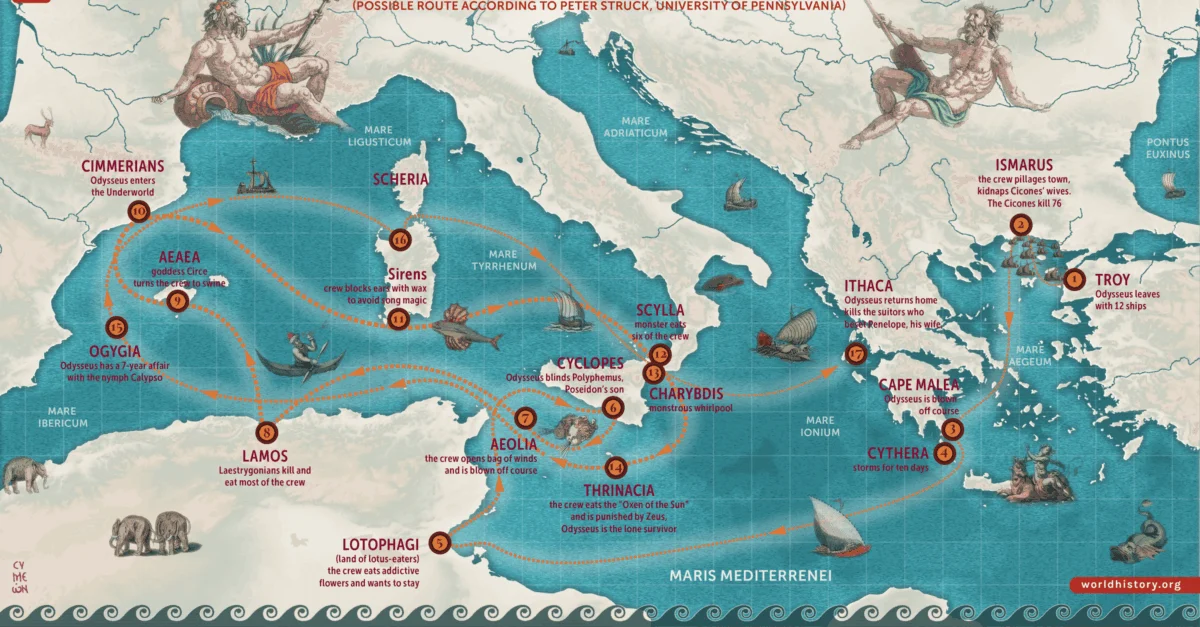
- The Cicones (Ismarus): His first stop, where Odysseus and his men plunder the city of Ismarus. Their victory is short-lived, however, as the Cicones rally and drive them back to their ships, inflicting heavy casualties. This early misstep highlights the dangers of unchecked hubris and the harsh realities of ancient warfare.
- The Land of the Lotus-Eaters: Blown off course by storms, the crew lands on an island inhabited by the Lotus-Eaters. Those who consume the lotus flower lose all desire to return home, succumbing to a blissful state of forgetfulness. Odysseus must forcibly drag his men back to the ships, demonstrating his leadership and the ever-present threat of temptation.
- The Cyclops Polyphemus: This encounter is perhaps the most famous and consequential of Odysseus’s early adventures. Landing on the island of the Cyclopes, a race of one-eyed giants, Odysseus and twelve of his men seek hospitality in a cave. Instead, they are trapped by Polyphemus, who begins to devour them. Odysseus employs his legendary cunning (metis), introducing himself as "Nobody" and intoxicating the Cyclops with wine. When Polyphemus falls asleep, Odysseus blinds him with a sharpened stake. They escape by clinging to the bellies of the Cyclops’s sheep as they are let out to pasture. However, in a moment of fatal pride, Odysseus reveals his true identity as they sail away. Polyphemus, son of Poseidon, then curses Odysseus, praying to his father for a long, difficult journey home, or no homecoming at all. This act of hubris incurs the wrath of Poseidon, who becomes Odysseus’s primary divine antagonist.
- Aeolia (Aeolus, God of Winds): They next reach the island of Aeolus, the benevolent god of the winds, who provides Odysseus with a bag containing all the unfavorable winds, leaving only the West Wind to guide them home. Tragically, just as Ithaca is within sight, Odysseus’s curious and mistrustful crew opens the bag, unleashing a tempest that blows them all the way back to Aeolia. This time, Aeolus refuses to help, believing them to be cursed by the gods.
- The Laestrygonians: A subsequent landing brings them to the land of the Laestrygonians, a race of gigantic, cannibalistic people. These monstrous inhabitants destroy eleven of Odysseus’s twelve ships and devour most of his remaining men. Only Odysseus’s ship and its crew manage to escape this devastating encounter.
- Aeaea (Circe, the Sorceress): With a severely depleted crew, Odysseus reaches the island of Aeaea, home to the sorceress Circe. She transforms many of his men into swine. With the help of the god Hermes, who provides him with the herb moly, Odysseus resists Circe’s magic and forces her to restore his men. He then becomes her lover and guest for a year. During this time, Circe advises him on the perilous journey ahead, instructing him to seek counsel from the blind prophet Tiresias in the Underworld.
The Descent into the Underworld (Nekyia)
This pivotal episode marks a significant turning point, providing Odysseus with crucial prophecies and a deeper understanding of his own fate and the world of the dead.
- Consulting Tiresias: Odysseus journeys to the edge of the world and performs a ritual to summon the dead. He converses with Tiresias, who foretells his future trials: the dangers of the Sirens, Scylla, and Charybdis, and crucially, a warning against harming the cattle of the sun god Helios on the island of Thrinacia. Tiresias also reveals the chaos awaiting him in Ithaca and the need for a final journey after his return to appease Poseidon.
- Encounters with the Dead: While in the Underworld, Odysseus also speaks with the spirits of many famous figures, including his own mother, Anticleia, who reveals the suffering of Penelope and Telemachus. He encounters Agamemnon, who warns him about the treachery of women, and Achilles, who famously states he would rather be a living serf than a king in the realm of the dead. These encounters reinforce the themes of mortality, the consequences of war, and the profound longing for the living world.
Navigating Further Perils
Armed with Tiresias’s prophecies and Circe’s practical advice, Odysseus faces the next series of deadly challenges.
-
Circe’s Further Warnings: Upon returning to Aeaea, Circe reiterates and expands upon Tiresias’s warnings, providing specific instructions for navigating the upcoming dangers. This is where the provided excerpt fits into the narrative:

"Odysseus returns to Circe, who warns him of the Sirens, creatures which are half-bird and half-woman who prey on sailors. She advises the men to plug their ears with wax and for Odysseus to lash himself to the mast. He must then negotiate passage past the six-headed monster Scylla and deadly whirlpool Charybdis. He also receives his second warning of the folly of interfering with the herds of Helios. The heroes set sail across the wine-dark sea once more to negotiate the perils described by Circe…"
-
The Sirens: Following Circe’s counsel, Odysseus orders his men to plug their ears with beeswax. He, however, chooses to hear the Sirens’ enchanting, deadly song, having himself lashed to the mast. This demonstrates his insatiable curiosity and willingness to face ultimate temptation, a unique experience that no other mortal had survived. The Sirens’ song promises knowledge and glory, luring sailors to their doom on rocky shores.
-
Scylla and Charybdis: Odysseus must then navigate the narrow strait between two terrifying monsters: Scylla, a six-headed beast who snatches six men from passing ships, and Charybdis, a monstrous whirlpool that swallows ships whole. Faced with an impossible choice, Odysseus opts to steer closer to Scylla, sacrificing six men to save the rest of his crew and his ship. This painful decision underscores the harsh realities of leadership and survival.
-
Thrinacia (Helios’s Cattle): Despite dire warnings from both Tiresias and Circe, Odysseus’s exhausted and starving men, against his strict orders, slaughter and eat some of the sacred cattle of Helios, the sun god. This act of sacrilege seals their doom. Helios appeals to Zeus, who, in retribution, sends a thunderbolt to destroy Odysseus’s last ship, drowning all his remaining men. Odysseus alone survives, clinging to wreckage.
-
Calypso’s Island (Ogygia): Washed ashore on the remote island of Ogygia, Odysseus is held captive for seven years by the beautiful nymph Calypso, who falls in love with him and offers him immortality if he stays. Despite the comforts and the promise of eternal life, Odysseus yearns for his mortal home and Penelope. His profound desire for his nostos ultimately prevails, and with divine intervention from Athena and Hermes, Zeus orders Calypso to release him. She reluctantly helps him build a raft.
-
The Phaeacians (Scheria): After another storm, sent by Poseidon, wrecks his raft, Odysseus washes ashore on the island of Scheria, the land of the Phaeacians. He is discovered by Nausicaa, the princess, and is welcomed by her parents, King Alcinous and Queen Arete. It is here, at their lavish court, that Odysseus, in disguise, finally reveals his identity and recounts the incredible tale of his ten years of wandering. Impressed by his story and moved by his plight, the Phaeacians, renowned seafarers, generously provide him with a ship and crew to finally sail him back to Ithaca.
The Homecoming: A Kingdom Reclaimed
Odysseus’s return to Ithaca is not one of immediate recognition and celebration, but rather a carefully orchestrated, suspenseful infiltration.
- Return to Ithaca and Disguise: The Phaeacians drop Odysseus off on Ithaca. With the help of Athena, he is disguised as an old beggar to assess the situation in his palace and avoid immediate ambush by the numerous suitors.
- Reunion with Telemachus and Loyal Servants: Odysseus first reunites with his loyal swineherd, Eumaeus, and then with his now-grown son, Telemachus. Their emotional reunion is a powerful moment. He also reveals himself to the cowherd Philoetius. His old dog, Argos, recognizes him despite his disguise and dies shortly after, a poignant symbol of unwavering loyalty.
- The Palace and the Suitors: In the palace, Odysseus endures the insults and abuses of the suitors, observing their disrespectful behavior and gauging their strengths. Penelope, though still loyal, is under immense pressure to choose a new husband. She has famously delayed her decision by weaving a shroud for Laertes, Odysseus’s father, by day and secretly unweaving it by night, a ruse that is eventually discovered.
- The Archery Contest: Penelope, inspired by Athena, finally proposes an archery contest: she will marry the man who can string Odysseus’s mighty bow and shoot an arrow cleanly through the holes of twelve axe-heads lined up in a row. None of the suitors can even string the bow. Odysseus, still in disguise, asks for a turn, and to the astonishment of all, he easily strings the bow and makes the impossible shot.
- The Slaughter of the Suitors: This signals the beginning of the brutal confrontation. With Telemachus, Eumaeus, and Philoetius at his side, Odysseus sheds his disguise and, with divine assistance, unleashes his fury upon the suitors, killing them all in a bloody battle within his own hall.
- Reunion with Penelope: Even after the suitors are slain, Penelope remains wary, testing Odysseus’s identity. She orders her servant to move their marriage bed, a bed carved from a living olive tree, an immovable fixture that only Odysseus would know about. His angry reaction at this command confirms his identity, and their long-awaited, emotional reunion is one of literature’s most tender moments.
- Restoration of Order: The final acts involve Odysseus reuniting with his aging father, Laertes, and quelling a potential uprising from the families of the slain suitors, with Athena’s final intervention ensuring peace and the restoration of his rule in Ithaca.
Supporting Data: Themes and Literary Significance
The Odyssey is rich with literary and thematic depth, making it a subject of continuous study and interpretation.
- Nostos (Homecoming) and Oikos (Household): These concepts are central to the epic. Odysseus’s journey is not just about returning to a physical place, but to his rightful position as head of his oikos, restoring order to his household and kingdom.
- Xenia (Hospitality): The poem frequently explores the sacred guest-host relationship. Good xenia is rewarded (e.g., the Phaeacians), while its violation (e.g., the Cyclops, the suitors) is severely punished by the gods.
- Metis (Cunning Intelligence): Odysseus is the quintessential man of metis. His ability to think quickly, deceive, and strategize is his primary weapon, often more effective than brute force. He is "the man of many twists and turns," a master of disguise and stratagem.
- Hubris (Excessive Pride): Odysseus’s fatal flaw, particularly evident after blinding Polyphemus, leads directly to Poseidon’s wrath and his prolonged suffering. The poem serves as a cautionary tale against pride that challenges the gods.
- Divine Intervention: The gods play an active and often contradictory role. Athena consistently champions Odysseus, while Poseidon relentlessly persecutes him. Zeus oversees the divine order, ensuring justice, albeit often slow and brutal.
- Oral Tradition and Epic Conventions: The Odyssey bears the hallmarks of its oral origins: formulaic epithets ("rosy-fingered Dawn," "wine-dark sea"), repeated scenes, and extended epic similes. These elements aided memorization and improvisation by ancient bards.
- Character Development: Not only does Odysseus undergo immense suffering and growth, but Telemachus also embarks on his own journey of self-discovery, transforming from an uncertain boy into a confident leader. Penelope embodies steadfast loyalty and quiet cunning.
Official Responses: The Odyssey’s Enduring Cultural Resonance
The Odyssey‘s impact on Western civilization is immeasurable. From ancient Greece to the present day, it has served as a touchstone for countless works of art, literature, and philosophy.
- Ancient Influence: It deeply influenced subsequent Greek and Roman literature, most notably Virgil’s Aeneid, which explicitly draws inspiration from both the Iliad and the Odyssey. Philosophers and dramatists engaged with its themes of fate, free will, and the human condition.
- Medieval and Renaissance Revival: Though less accessible in the Latin West during the early Middle Ages, its rediscovery during the Renaissance sparked renewed interest, shaping epic poetry and moral allegories.
- Modern Interpretations: In the 20th century, James Joyce’s monumental novel Ulysses reimagined Odysseus’s journey in a single day in Dublin, proving the epic’s adaptability and thematic universality. Margaret Atwood’s The Penelopiad offers a feminist retelling from Penelope’s perspective, questioning traditional heroism.
- Film and Television: The Odyssey has been adapted numerous times for the screen, from classic Hollywood productions to television mini-series. The Coen Brothers’ film O Brother, Where Art Thou? famously transposes the narrative to the American South during the Great Depression, demonstrating the timelessness of its plot elements.
- Academic Study: It remains a core text in classical studies, literary theory, and comparative mythology. Scholars continually find new layers of meaning in its intricate narrative, psychological insights, and cultural representations.
Implications: The Timeless Echo of the Wanderer
The Odyssey transcends its ancient origins to offer profound implications for understanding the human experience. It speaks to the universal desire for belonging, the psychological toll of prolonged absence, and the challenges of reintegration. Odysseus’s journey is a metaphor for life itself: a series of trials, temptations, and moments of self-discovery that ultimately lead to a deeper understanding of oneself and one’s place in the world.
The epic’s exploration of resilience in the face of overwhelming odds, the importance of family bonds, and the consequences of both cunning and hubris continues to resonate. In an increasingly globalized and often disorienting world, the story of a hero desperately trying to find his way home after immense personal and collective trauma feels as relevant as ever. The Odyssey reminds us that true heroism is not just about physical prowess, but about enduring intelligence, unwavering loyalty, and the unyielding hope for a return to what truly matters. It is a timeless narrative, echoing the wanderer in each of us, forever seeking our own Ithaca.