Tashan Mehta’s "Mad Sisters of Esi": A Glorious Landmark Forging New Paths in Indian Fantasy
Indian fantasy, a genre deeply intertwined with the nation’s spiritual and cultural fabric, has long navigated familiar mythological waters. For decades, its narrative currents have been shaped by the colossal epics of the Ramayana and the Mahabharata, their divine archetypes and moral landscapes serving as omnipresent guiding stars. This profound influence, often manifesting as mythological retellings, has become the genre’s defining characteristic, both a comfort and a constraint. However, a seismic shift is underway, heralded by Tashan Mehta’s Mad Sisters of Esi. This audacious novel not only dares to deviate from the established narrative spell but magnificently redefines the very possibilities of Indian speculative fiction, establishing itself as a glorious landmark in a burgeoning literary landscape.
Mehta’s work emerges not as a gentle evolution but as a radical departure, a bold exploration of non-linear storytelling, emotional logic, and an utterly unique cosmology that refuses to be confined by inherited narratives. In a genre often described as still "learning to walk," Mad Sisters of Esi doesn’t just run; it leaps into the unknown, trusting the fall to forge its own singular mythology.
The Deep Roots of Indian Fantasy: A Genre Shaped by Gods and Epics
The genesis of Indian fantasy is inextricably linked to its sacred texts. The Ramayana and the Mahabharata are more than mere stories; they are the bedrock of cultural consciousness, influencing societal norms, ethical frameworks, and the very perception of conflict, heroism, and villainy. This profound mythological presence is not just a literary motif but a lived reality, permeating every moral posture of Indian society. Consequently, it is hardly surprising that storytelling, particularly the nascent strands of Indian fantasy, would gravitate towards these familiar and revered narratives. The genre, still young and finding its footing, has historically staggered towards the nearest, most comforting handrail: the mythological retelling.
Societal and Religious Underpinnings
Beyond literary tradition, this inclination is deeply rooted in the fundamental self-perception of India. Despite its assertions of modernity, India largely conceives of itself as fundamentally religious, its populace guided by an unwavering belief in divine forces. A compelling 2021 Pew Research Centre survey underscores this reality, revealing that belief in God is virtually universal among Indians, with a staggering 97% affirming their faith. Only a small segment of Buddhists formed an exception to this pervasive religiosity. In this context, the divine is not merely a concept but the very "air with which narratives fill their lungs."
Even individuals who may not frequent temples or delve into religious scriptures often think in terms of fate, destiny, and a cosmic hierarchy that dictates fortune and misfortune. Thus, when Indian fantasy materializes, it is already adorned in the robes of these ancient epics, speaking their timeless tongue. The inevitable outcome has been the rise of a genre where mythological retelling has become almost synonymous with Indian fantasy itself.
A Chronology of Mythological Market Domination
The cornerstone of this commercial phenomenon was laid over a decade ago with Amish Tripathi’s The Immortals of Meluha (2010), the inaugural volume of his immensely popular Shiva trilogy. Tripathi’s success demonstrated the potent marketability of reimagined myths, effectively opening the floodgates for a new wave of authors. From that point, a diverse array of writers, including Kevin Missal and Anand Neelakantan, flocked to the same rich pantheon, each drawing from the vast reservoir of familiar names, cosmic struggles, and divine narratives.
Even established literary figures like Chitra Banerjee Divakaruni found themselves propelled into the spotlight of a newly reawakened "myth-hunger." Publishers, observing the burgeoning sales figures and insatiable market demand, enthusiastically greenlit title after title, fueling a literary ecosystem where mythological retellings proliferated. These books, as the original article vividly puts it, "sell like cupcakes—or kachori-samosas," becoming "snacks you keep reaching for: greasy, briefly satisfying."
The pattern of success wasn’t confined to India’s borders. Internationally, the appeal of these stories found resonance, notably with Rick Riordan, whose imprint, Rick Riordan Presents, capitalized on the same formula. His bestselling five-part Pandava series (2018-2022) offered a Westernized take on Hindu mythology, further cementing the commercial viability of such narratives on a global scale. The Marathi author Gautamiputra Kamble, in the Translator’s Note of his 2026 collection The Seekers, encapsulates this pervasive influence perfectly: "The two epics, Ramayana and Mahabharata, exert an immense influence on art and literature around us. Even if the epics aren’t referenced directly, art and literature is infused with a certain worldview that is shaped by these stories." This context of deep-seated tradition and commercial triumph is precisely what Tashan Mehta’s Mad Sisters of Esi brilliantly transcends.
"Mad Sisters of Esi": Charting a New Course Beyond the Epics
It is against this backdrop of deeply entrenched mythological retellings and culturally reinforced narratives that Tashan Mehta’s Mad Sisters of Esi demands to be read and celebrated. It is within this very context that its audacious narrative choices and groundbreaking approach must be recognized as a glorious landmark in the evolving world of Indian fantasy. The novel deliberately steers away from the familiar, opting instead for a singular vision that challenges conventions and invites readers into a truly unique imaginative space.
Embracing Narrative Innovation: The Circular Story
The journey into the "mad world" of Mad Sisters of Esi begins with a provocative and telling disclaimer: "The problem with circular stories is that it is difficult to know where to begin." This opening line is not merely an artistic flourish but a direct warning, a profound statement about the narrative experience awaiting the reader. It signals an immediate departure from the linear, cause-and-effect storytelling prevalent in traditional fantasy and, indeed, much of Western narrative. Mehta’s story refuses – and inherently cannot – move in a straight line.
Instead, the narrative unfolds as a spiral, a series of interconnected loops, a "twirling snake" where circles fold back into themselves. The past is perpetually present, and the future is often glimpsed in the cracks of the now. This intricate, non-linear structure masterfully echoes the intricate workings of memory itself, the way consciousness circles back, revisits, and reinterprets experiences, creating a subjective and ever-shifting reality. The book rejects the comfort of neatly defined narrative arcs, disavowing the expected coordinates of a conventional beginning, middle, and end. Rather than a straightforward map, it presents an "astral topography," immersing the reader in a perpetual mid-ocean state where shores are only fleetingly visible. Here, the circle is less a narrative device and more a fundamental "way of being in the world," a method of navigating time, memory, and the very fabric of existence.
A Universe Governed by Emotion, Not Logic
Unlike the tidy laws and ironclad rules often found in traditional fantasy and science fiction, Mad Sisters of Esi thrives on a deliberate, almost poetic chaos. It flirts with the incoherent, creating a dream-like state from which the reader finds it difficult to awaken. In Mehta’s universe, sense and nonsense are not antagonists but two sides of the same handshake, coexisting and informing each other. The world is governed not by objective logic or scientific principles, but by the raw, uncontainable desires and profound emotions of its characters. The very contours of its universe are defined and explored through these terms, centered around two pairs of sisters relentlessly trying to find each other across the vast expanse of time and space.
Mehta posits a powerful idea: "I find a new wonder," the text reads, "in the face of the sublime, it is our humanness we hold close." In this novel, humanity is not relegated to the lowest common denominator but elevated to the "highest note," becoming an integral part of the world’s very fabric. Islands, magical creatures, and ghosts are all imbued with consciousness and life. Even time itself, a concept often treated as an immutable constant, is depicted as a living, sentient entity, further blurring the lines between the animate and inanimate, the real and the imagined. This bold redefinition of reality and narrative structure firmly establishes Mad Sisters of Esi as a visionary work that transcends genre expectations.
The Heart of the Novel: Sisterhood and the Fabric of Time
At the core of Mad Sisters of Esi lies the profound and multifaceted exploration of sisterhood itself, an intricate theme woven through multiple layers of existence. The narrative introduces not merely two sisters, but echoes of sisterhood reverberating across different epochs and realities, each mirroring and informing the other.
Myung and Laleh: The Whale of Babel
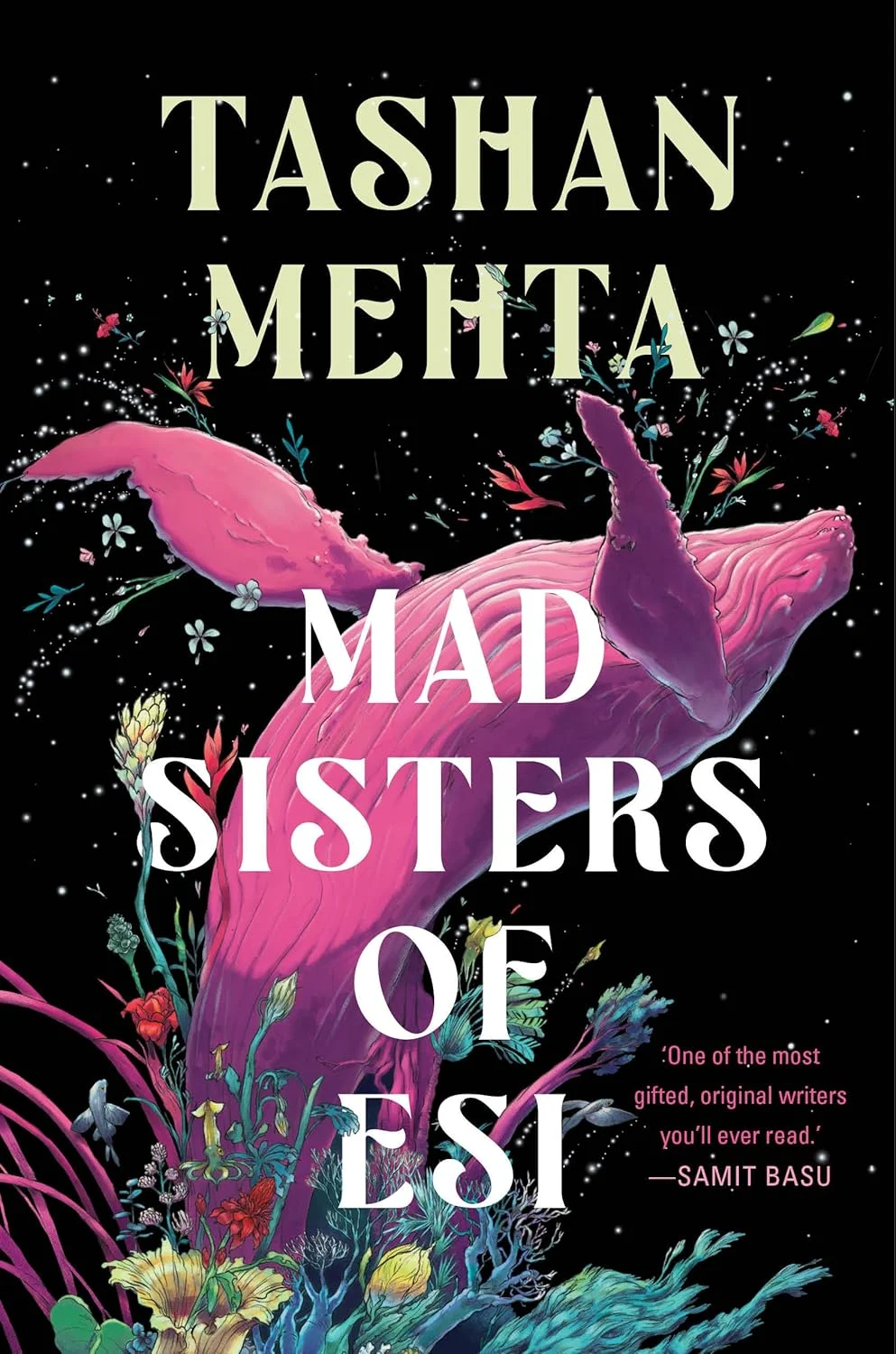
Our initial journey begins with Myung and Laleh, two sisters residing within the majestic "whale of Babel." This isn’t an ordinary creature but a mystic, cosmic leviathan swimming through the void of space, its immense form containing interconnected chambers and miniature worlds within its very skin. It is a universe in miniature, a place where the boundaries between distinct realities are porous, and the past and future often blur into an eternal present.
Within this boundless, living vessel, Myung and Laleh forge their own world, replete with unique stories, mythologies, and even distinct physics, chemistry, biology, and geography. As the text describes, "In the beginning of beginnings, there was Great Wisa. She was born of the whale’s heart and she roamed through its belly, carving its insides with many marvels." This internal world is one of constant growth and transformation, offering an endless bounty for them to inhabit and explore.
However, a fundamental divergence emerges between the sisters. One yearns for stability and connection within their boundless home, finding satiety in its endless possibilities. The other, Myung, feels an insatiable pull towards the unknown, invigorated by the concept of boundlessness that awaits her outside. This central dilemma – the choice between the freedom of staying (which offers safety) and the freedom of leaving (which feels like an imperative necessity) – becomes a universal question: "Have you ever felt an impulse so strong you know it is correct, but you cannot understand it? Have you ever chased something, a tail end of a feeling, always whipping out of sight? And you run and you run, hoping to catch it." This impulse, a profound compulsion akin to a leaf following the wind, drives Myung to flee, embarking on a quest through the mysteries and wonders of the universe.
Yet, Myung’s escape is never truly an escape. The further she travels, the more she carries the essence of her home with her – the whale’s song, the poignant memory of the past, and the indelible imprint of the sister she left behind. Her journey of departure ultimately becomes a journey of return, culminating in the realization that "You wandered, trying to find the wonders you hoped for, but they were pale. And when you came back and you held your mother, you learnt a truth very few people are given: that home is a person."
Ojda: The Museum of Collective Memory
Myung’s odyssey to find her way back to her sister leads her to Ojda, a sentient, shape-shifting island. Ojda is not static; it is perpetually in a state of becoming, its geography alive and restless, constantly reforming itself. Within this mutable landscape resides the Museum of Collective Memory, an expansive archive built not of artifacts but of songs and echoes. It is a place where the past is not merely preserved but actively sung, reshaped, and animated, much like memory itself, or the enduring echoes of grief.
The creator of this extraordinary museum, too, is rumored to be searching for her own sister. The entire island of Ojda functions as a desperate, living plea, a beacon cast into the cosmos, designed to one day catch the eye of a specific individual – someone who has spent centuries trying to leave. On Ojda, Myung encounters Blajine Kilta, the lonely, last living descendant of "Mad Magali" Kilta. Blajine is bound by an ancestral vow, forbidden to leave the island, tasked instead with its protection and an uncertain vigil for Magali’s long-lost sister to return. The island, therefore, is as much a sanctuary as it is a sentence, a place where Blajine’s waiting presses into an ever-shifting earth, its duration unknown.
Wisa and Magali: The Original Mad Sisters of Esi
The narrative elegantly reveals that Myung and Laleh are not the sole sisters whose destinies are entangled in the vagaries of human imagination, ambition, creation, and love. Before their existence, there were the original "mad sisters of Esi": Wisa and Magali. Before they would transform into the legendary Great Wisa (creator of the whale) and the enigmatic Mad Magali (creator of the museum), they were simply two inseparable sisters.
They resided on the island of Esi, a place of extraordinary beauty and flux, characterized by "whalebone mountains, purple-emerald forests, red and white sands, black ice, and an ever-shifting topography." The sisters were part of a Luddite colony, a community that deliberately shunned the magic of the Esites, choosing instead to live in simple, crumbling cottages, their lives pared down to a deliberate minimum. This colony represented a yearning for a world that remained manageable and predictable, a microcosm of humanity’s universal desire to control and understand its environment.
However, a profound "madness" begins to stir within Wisa, much to the fear and chagrin of the conformist society. This madness manifests as an uncontainable inner restlessness, an untamable force that ultimately initiates the cosmic game of hide-and-seek – a perpetual cycle of searching for, losing, and finding each other, only to lose and search again – into which Myung eventually finds herself drawn. This overarching theme culminates in a poignant declaration: "I said: sister is a special word; it’s a careful relationship. You have to be mad to love like that." The book masterfully weaves these interconnected stories of sisterhood, each layer revealing deeper truths about love, loss, longing, and the profound, often irrational, bonds that define us.
A Challenge to the Reader: Embracing the Unconventional
The review itself, with its direct address to the reader, becomes a meta-commentary, reflecting the very nature of Mad Sisters of Esi. The reviewer’s playful admonition – "Dear reader, it is at this point that I’ll gently nudge you to stop reading this piece and go pick up the book. Don’t read the blurb, don’t peek at the promotional material. The less you know, the more you’ll receive. I shall be waiting, as shall this piece." – is an "official response" not from an institution, but from the critical voice, urging an open-minded engagement that mirrors the book’s own demands.
This unconventional interjection serves to highlight the immersive and challenging experience that Mehta’s narrative offers. For a reader accustomed to linear plots and clear resolutions, the story’s circularity and "mind-boggling time-shifting, shape-shifting, world-shifting universe" can indeed seem "a bit too chaotic and overwhelming." The reviewer’s "I did warn you!" serves to validate this potential disorientation, while simultaneously inviting deeper engagement.
Mehta’s writing itself provides the key to navigating this perceived chaos. She offers a profound insight: "I cannot shake the feeling that gibberish is nothing but words ordered on a logic that’s beyond us, and I press my ears to my toddler’s lips as she gurgles the secrets of the universe." This eloquent passage suggests that what appears nonsensical from a conventional perspective may, in fact, be governed by an intricate, higher-order logic that simply lies beyond our immediate comprehension. The book, therefore, is not demanding to be understood in a purely rational sense. Instead, "It is asking you to listen."
This emphasis on listening rather than analytical understanding is crucial. As the novel states, "Everything is more powerful when you don’t understand it. When something is story-less, its mysteriousness makes it easier to accept. But when something has a story, it shrinks down to the same level at which you view the rest of your life." By resisting neat categorization and straightforward interpretation, Mad Sisters of Esi retains its enigmatic power, allowing its mysteries and revelations, its boundless grief and love, to resonate on a deeper, more visceral level. This "story-less, story-rich" narrative, with its profound questions and enduring losses, becomes a mirror reflecting our own human experience – our own recurring questions, our own unaddressed griefs.
Mehta’s philosophical inquiry into storytelling continues: "Why do fairy tales fascinate us? Why do they stay by our side long after we hear them and become our little pieces of pleasure?" She posits that fairy tales are "more beloved than most" because they "are stories that let us stare at ourselves, the essential parts of our humanness, before we step through into a new world; before we become something more." Mad Sisters of Esi achieves precisely this, drawing the reader into a world of profound introspection, urging them to confront the essential self before transforming, before evolving.
The Enduring Legacy: Uniqueness, Madness, and a New Mythology
Mad Sisters of Esi ultimately delivers a multifaceted narrative that explores the intricate dance between community and individuality. It delves into the challenge of separating the "one from many," the "I from the we," and the continuous process of shaping one’s own words and worlds, even as those creations, in turn, shape the creator. It is a profound meditation on resilience – of holding onto oneself amidst a world that constantly shifts its contours; of the impulse to leave, the patience of waiting, and the eventual discovery of one’s deepest desires. It speaks to the aching craving for what has been left behind, and the ceaseless, relentless act of searching, always searching, for connection, for belonging, for truth. This is a story that defies neat endings, mirroring the beautiful untidiness of life itself.
In its final, powerful statement, Mad Sisters of Esi emerges as a story of uniqueness, celebrating the distinct, individual note that often revolts against the collective chorus. It bravely confronts the communal fear of this uniqueness, this perceived "madness," and champions the arduous yet ultimately rewarding journey of finding others who share that same singular spark. More profoundly, it is about discovering one’s own madness – not as a loss of self, but as the most authentic path to bringing oneself home, to true self-acceptance and fulfillment.
In a genre that has, for too long, allowed its individual voices to dissolve into an inherited chorus, into the comfortable, predictable grammar of gods and heroes, Tashan Mehta’s Mad Sisters of Esi stands as a defiant and exhilarating counterpoint. It doesn’t merely reinterpret existing myths; it builds its own, rich and complex mythology from the ground up. This novel doesn’t cautiously stagger towards the nearest, most familiar handrail; it makes a daring leap, trusting in the exhilarating freedom of the fall, and in doing so, opens up vast, uncharted territories for Indian fantasy. Its legacy will undoubtedly be that of a trailblazer, inspiring a new generation of storytellers to embrace the unconventional and redefine the boundaries of imagination.