From Trash to Treasure: Spilt Milk Studios Surpasses Funding Goals for ‘Trash Goblin’ as Crowdfunding Campaign Enters Final 24 Hours
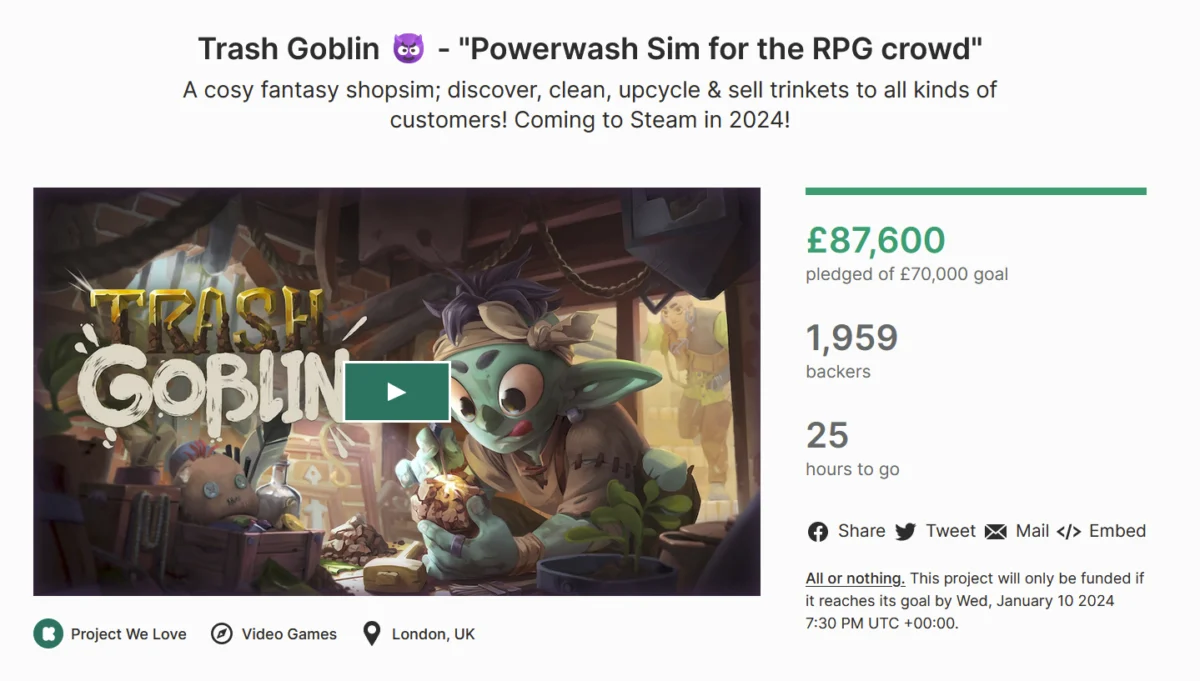
LONDON – In a significant victory for the burgeoning "cosy gaming" sector, London-based developer Spilt Milk Studios has announced that its latest title, Trash Goblin, has successfully surpassed its primary funding goal on Kickstarter. As the campaign enters its final 24-hour sprint, the project stands at 124% of its initial target, signaling strong consumer appetite for unconventional, meditative gameplay experiences.
The success of the campaign also marks a pivotal moment for the studio’s internal leadership. Nicholas Lovell, a renowned games industry consultant and founder of Gamesbrief, recently transitioned from a non-executive role to an executive position within Spilt Milk Studios to oversee the project’s commercial trajectory. The campaign’s momentum has brought the studio within striking distance of the "magic" £100,000 milestone, a figure that would unlock further polish and content for the highly anticipated title.
Main Facts: The Rise of the ‘Cosy’ Tinkering Simulator
Trash Goblin is described by its creators as a "cosy trinket-cleaning RPG." At its core, the game invites players to take on the role of a goblin shopkeeper who discovers, cleans, repairs, and upcycles discarded items found in "trash packs." Once restored, these items can be sold to a colorful cast of eccentric customers, each with their own backstories and specific needs.
The game draws clear mechanical inspiration from the "satisfying" genre popularized by titles such as Powerwash Simulator and Unpacking, yet it carves out its own niche by embedding these mechanics within a fantasy role-playing framework. The gameplay loop is designed to be low-stress, focusing on the tactile joy of restoration rather than high-stakes combat or time-sensitive pressure.
Key highlights of the project include:
- Current Funding Status: 124% funded (as of January 9, 2024).
- Platform Targets: PC (Steam) with potential for future console ports.
- Key Mechanics: Procedural item generation, manual cleaning tools, "tinkering" (customizing items), and shop management.
- The "Wholesome" Factor: A focus on sustainability and the philosophy of "one person’s trash is another’s treasure."
Chronology: From Concept to Crowdfunding Success
The journey of Trash Goblin began as an exploration of the "satisfying" gameplay loops that have dominated the indie scene over the last three years. Spilt Milk Studios, led by industry veteran Andrew Smith, sought to create a game that resonated with the "Wholesome Games" movement—a community-driven trend prioritizing non-violent, emotionally resonant, and aesthetically pleasing experiences.
Early 2023: Prototyping and Development
Spilt Milk Studios began internal prototyping of the cleaning and tinkering mechanics. The goal was to ensure that the physics of scrubbing dirt and polishing surfaces felt inherently rewarding. By mid-2023, the studio had established the "Goblin" aesthetic, moving away from traditional gritty fantasy tropes toward a more vibrant, endearing art style.
Late 2023: The Strategic Shift
During the development phase, Nicholas Lovell—previously a non-executive advisor to the studio—stepped into an executive role. Despite managing the lingering effects of Long Covid, Lovell’s involvement intensified as the studio prepared for a direct-to-consumer funding model. His expertise in "The Curve"—a business philosophy focusing on building a dedicated fanbase—became the cornerstone of the Trash Goblin marketing strategy.
December 2023: Kickstarter Launch
The campaign launched in late 2023, seeking to secure the necessary capital to finalize the game’s complex procedural item system and expand the narrative depth of the NPC interactions. The response was immediate, with the "cosy gaming" community on social media platforms like TikTok and X (formerly Twitter) quickly championing the project.
January 2024: The Final Push
Following the New Year break, the campaign reached its 100% funding goal. In the subsequent days, momentum accelerated, pushing the project past the 120% mark. On January 9, the studio entered the final 24 hours of the campaign, making a public plea to reach the £100,000 stretch goal.
Supporting Data: The Economics of Cosy Games
The success of Trash Goblin is not an isolated incident but rather a reflection of a broader shift in the gaming market. Data from industry analysts suggests that the "Cosy/Wholesome" genre has seen a 25% year-on-year growth in Steam tags since 2020.
The Power of "Satisfying" Mechanics
The benchmark for this genre, Powerwash Simulator, demonstrated that there is a massive, underserved market for games that simulate mundane tasks. Trash Goblin leverages this by adding a creative layer—upcycling. According to SteamDB, games with "Relaxing" and "Crafting" tags consistently outperform traditional high-difficulty indie titles in terms of long-tail sales and community engagement.

Kickstarter as a Market Validator
For Spilt Milk Studios, the Kickstarter campaign served two purposes:
- Capital Injection: Providing the runway to finish development without predatory publishing deals.
- Market Validation: Wishlists are the lifeblood of Steam success. The Kickstarter campaign has served as a primary driver for Steam wishlists, which are currently estimated to be in the tens of thousands. This high level of interest significantly increases the likelihood of being featured by Steam’s algorithms upon the game’s full release.
Official Responses: A Personal and Professional Milestone
Nicholas Lovell, Executive at Spilt Milk Studios, expressed both professional pride and personal relief regarding the campaign’s success. Lovell’s transition to an executive role comes at a time when he is navigating personal health challenges, specifically Long Covid, which has limited his ability to work full-time but has not dampened his strategic vision for the studio.
"I’m so excited that the Kickstarter I’m part of has funded," Lovell stated. "I’ve recently stepped up from a non-executive role at Spilt Milk to an executive one. I’m still part-time, but I’m much more involved. The biggest thing I’m involved in is Trash Goblin."
Lovell further characterized the game as "Powerwash Simulator for the RPG crowd," a pithy elevator pitch that has clearly resonated with backers. He emphasized the importance of the final 24 hours, noting that reaching the £100,000 mark would be "magic" for the team, allowing them to exceed their original scope and deliver a more polished product.
Andrew Smith, founder of Spilt Milk Studios, has previously noted that the studio’s goal is to create games that "people didn’t know they wanted until they saw them." The goblin-themed upcycling simulator appears to be the embodiment of that mission statement.
Implications: The Future of Indie Self-Publishing
The success of Trash Goblin carries several implications for the wider indie development landscape, particularly in the United Kingdom.
1. The Viability of the "Business-First" Indie Model
By bringing in a business strategist like Lovell into an executive capacity, Spilt Milk is demonstrating a sophisticated approach to indie development. Many indie studios fail not because of poor game design, but because of a lack of commercial strategy. Lovell’s influence suggests a move toward "smart publishing," where community building and data-driven marketing are integrated into the development process from day one.
2. The Maturation of the Cosy Genre
Trash Goblin represents a maturation of the cosy genre. It moves beyond the simple farming mechanics of Stardew Valley clones and explores more specific, tactile hobbies like restoration and antiquing. This diversification suggests that "cosy" is becoming a broad umbrella for various "lifestyle" simulators, much like "action" or "strategy."
3. Crowdfunding as a Community Hub
In an era where traditional games journalism is in flux and social media algorithms are increasingly volatile, Kickstarter remains one of the few reliable ways for indie developers to build a "true" community. The 124% funding status indicates a level of trust and direct communication between Spilt Milk and its audience that will be vital for the game’s post-launch support and potential DLC.
4. Sustainability and Gaming
The game’s focus on upcycling and finding value in the discarded mirrors growing real-world concerns regarding sustainability and consumerism. While Trash Goblin is a fantasy game, its thematic resonance with modern environmental values may contribute to its appeal among younger demographics (Gen Z and Alpha), who are statistically more likely to support brands that align with ethical consumption.
Conclusion
As the clock ticks down on the Trash Goblin Kickstarter, Spilt Milk Studios finds itself in an enviable position. With the project fully funded and the community actively engaged, the focus now shifts from fundraising to delivery. For Nicholas Lovell and the rest of the team, the success of this campaign is more than just a financial win; it is a validation of a new, more personal way of making and selling games in a crowded digital marketplace.
Investors and fans alike will be watching closely to see if Trash Goblin can translate its crowdfunding momentum into a breakout hit on Steam. For now, the "Trash Goblins" of the world can rest easy knowing their peculiar, peaceful world is officially on its way to reality.