The Quiet Architect of Cinema: The Unassuming Ascent and Lasting Legacy of Sam Neill
Main Facts: The Reluctant Superstar
In the high-octane ecosystem of Hollywood, where leading men are often defined by their pursuit of the "all-guns-blazing" spotlight, Sam Neill stands as a singular anomaly. A New Zealander by birth and a global icon by circumstance, Neill’s career is a masterclass in the art of the "sturdy everyman." For over five decades, he has navigated the industry with a quiet, masculine decency—or, when the role required, a steely, unsettling chill—that has made him one of the most reliable and respected figures in modern film.
The defining characteristic of Neill’s career is not a thirst for stardom, but a profound humility. Before becoming a household name at the age of 45, Neill spent nearly twenty years as the industry’s most dependable supporting pillar. He was the actor who stabilized the frame, allowing his female co-stars—among them Meryl Streep, Judy Davis, and Nicole Kidman—to deliver career-defining, "tour de force" performances.
However, 1993 changed everything. Through a rare alignment of commercial titanism and artistic prestige, Neill found himself at the center of the cultural zeitgeist. With the dual release of Steven Spielberg’s Jurassic Park and Jane Campion’s The Piano, Neill achieved A-list status without ever changing his fundamental approach to the craft. He remained a "servant" to the film, a philosophy that has allowed him to transition seamlessly between billion-dollar franchises, cult horror classics, and intimate independent dramas.
Chronology: From Wellington to Isla Nublar and Beyond
The Formative Years: The Supporting Pillar (1975–1992)
Sam Neill’s journey began far from the bright lights of Los Angeles. Born Nigel John Dermot Neill in Northern Ireland and raised in New Zealand, he cut his teeth in the New Zealand National Film Unit as a director and actor. His international breakthrough came in 1979 with My Brilliant Career, where he played the romantic interest to Judy Davis. Even then, critics noted his ability to project a quiet, intelligent presence that complemented rather than competed with his lead.
Throughout the 1980s, Neill became the "actor’s actor." In Possession (1981), he matched Isabelle Adjani’s visceral intensity with a brooding, psychological depth. In Dead Calm (1989), he provided the grounded emotional core that allowed a young Nicole Kidman to shine. He worked with Meryl Streep twice in quick succession—Plenty (1985) and A Cry in the Dark (1988)—solidifying his reputation as the ultimate screen partner. His performances were "carefully etched and modulated," designed to elevate the artistic whole rather than secure a solo bow.
1993: The Double-Edged Sword of Stardom
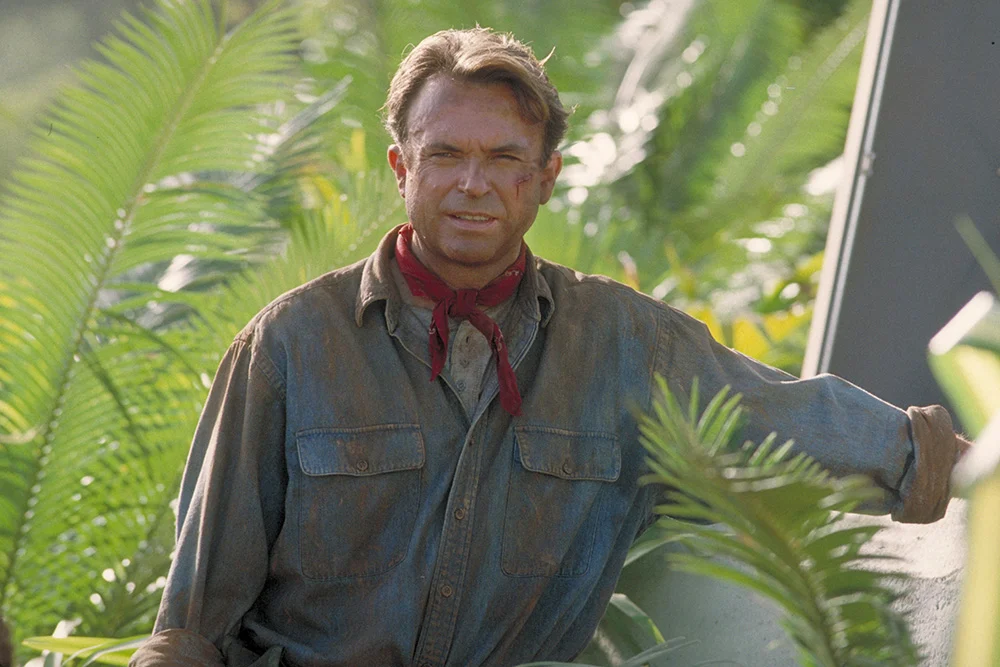
The year 1993 represents a pivot point in cinematic history, and Sam Neill was its unlikely face. In June, Jurassic Park was released, shattering box office records and introducing the world to Dr. Alan Grant. While Neill was first-billed, he famously joked that he was "second banana" to the dinosaurs. Spielberg chose Neill precisely because he lacked the distracting "superstar" baggage of a Tom Cruise or Harrison Ford; he was professional, affordable, and grounded enough to make the impossible premise of a dinosaur theme park feel real.
Simultaneously, Neill appeared in Jane Campion’s The Piano. In stark contrast to the heroic Dr. Grant, his character, Alisdair Stewart, was a colonial husband characterized by a "petty, almost poignantly impotent rage." While Jurassic Park dominated the box office, The Piano won the Palme d’Or at Cannes. This duality—playing the action hero and the priggish antagonist in the same year—defined the range that would sustain his career for the next three decades.
The Post-Blockbuster Era and Cult Status (1994–Present)
Following the success of 1993, Neill did not follow the traditional path of the action star. Instead, he used his newfound leverage to return to his first love: small, idiosyncratic films. He leaned into genre cinema, starring in John Carpenter’s Lovecraftian horror In the Mouth of Madness (1994) and the sci-fi cult classic Event Horizon (1997).
In the 21st century, Neill has found a new generation of fans through collaborations with visionary directors like Taika Waititi in Hunt for the Wilderpeople (2016) and Warwick Thornton in Sweet Country (2017). He also returned to the Jurassic franchise with Jurassic Park III (2001) and Jurassic World Dominion (2022), proving that his appeal as Dr. Grant remained undiminished by time.
Supporting Data: The Impact of a "Second Banana"
The statistical weight of Neill’s career highlights his unique position in the industry:
- Box Office Gravity: Jurassic Park (1993) grossed over $914 million in its initial run, becoming the highest-grossing film of all time until Titanic. Neill’s presence provided the human anchor for a film that relied heavily on then-unproven CGI technology.
- The "Oscar Effect": While Neill himself has never been nominated for an Academy Award—a fact often cited as one of the industry’s great oversights—his films have been awards magnets. The Piano received eight nominations and three wins, including Best Actress for Holly Hunter and Best Supporting Actress for Anna Paquin.
- Longevity and Volume: With over 150 acting credits to his name across film and television (including the hit series Peaky Blinders), Neill’s work ethic is nearly unparalleled among his peers.
- Social Media Influence: In recent years, Neill has garnered a following of over 500,000 on platforms like Instagram and X (formerly Twitter), where his "nice guy" persona and videos of his farm animals in New Zealand have created a brand of "wholesome celebrity" that contrasts with the traditional Hollywood mystique.
Official Responses: In His Own Words
Neill has always been his own most candid critic. Reflecting on the 1993 surge in an interview with the Los Angeles Times, he admitted his agents often complained about his "penchant for small films." Neill’s response was simple: "I like to play a lot of different things."
Regarding his role in The Piano, Neill has expressed a profound sense of pride that outweighs any desire for individual trophies. In his 2023 memoir, Did I Ever Tell You This?, he wrote:
"I regarded Campion’s important feminist film as being like a medal on my chest. It’s a film that will always have a place in cinema history. And I served in it."
This concept of "serving" a film is central to his identity. Producers, including Kathleen Kennedy, have noted that Neill’s lack of ego made him the ideal collaborator for massive productions. Kennedy once conceded that the role of Alan Grant "isn’t an intensely complicated part," but Neill’s professionalism ensured the production stayed on track and on budget—a rarity for a film of that scale.
In recent years, Neill has also been open about his health battles, including a diagnosis of stage 3 blood cancer (non-Hodgkin lymphoma). His response was characteristically pragmatic and devoid of melodrama, focusing on his desire to keep working and his gratitude for the life he has led.
Implications: The Legacy of the Anti-Movie Star
Sam Neill’s career offers a compelling counter-narrative to the standard Hollywood success story. His trajectory suggests that longevity in the film industry is not necessarily built on the pursuit of "star power," but on the cultivation of versatility and reliability.
Redefining Masculinity
Neill’s screen presence redefined a certain type of cinematic masculinity. He didn’t rely on physical intimidation or hyperbolic bravado. Instead, he brought an intellectual, often vulnerable quality to his roles. Whether as the skeptical scientist in Jurassic Park or the grieving husband in A Cry in the Dark, he proved that "quietly masculine decency" could be just as compelling as action-hero tropes.
The Value of the Ensemble
By often playing the "supporting pillar," Neill demonstrated the vital importance of the ensemble player. His ability to "throw all the spotlight on his co-star" without disappearing into the background is a rare skill. It suggests that the health of a film often depends on actors who are willing to "serve" the story rather than their own brand.
A Model for Modern Celebrity
Finally, Neill’s later-life transition into a social media "nice guy" and gentleman farmer provides a blueprint for aging gracefully in the public eye. He has managed to maintain his dignity and relevance without succumbing to the pressures of modern "influencer" culture, using his platform to promote nature, wine (through his Two Paddocks vineyard), and a wry, self-deprecating humor.
As the industry continues to grapple with the decline of the traditional "movie star," Sam Neill’s career stands as a testament to the enduring power of the character actor. He remains more interesting and unpredictable than the "nice guy" label suggests—a man who can lead a billion-dollar franchise on Monday and disappear into a gritty, experimental indie on Tuesday. In the end, Sam Neill didn’t just survive Hollywood; he outlasted it by simply being himself.