Uncanny Magazine Navigates Pivotal Year with Major Kickstarter, Leadership Changes, and Prestigious Award Nominations
FOR IMMEDIATE RELEASE
[Date: June X, 2026] – Uncanny Magazine, a leading voice in science fiction and fantasy literature, is bracing for a monumental period marked by its annual crowdfunding campaign, significant editorial advancements, and an impressive array of nominations for some of the genre’s most esteemed awards. The independent digital magazine, known for its blend of speculative fiction, essays, and poetry, faces both exhilarating opportunities and considerable challenges as it seeks to secure its thirteenth year of publication.
The cornerstone of Uncanny Magazine‘s continued existence remains its annual Kickstarter campaign, a "yearly referendum" on its survival, as described by Publisher and Editor-in-Chief Michael Damian Thomas. Scheduled to launch on July 13, 2026, the "Uncanny Magazine Year 13: The Space Unicorn Believes in YOU!" Kickstarter aims to fund another year of groundbreaking content, including the highly anticipated DIAMOND Issue #75. This special issue is slated to feature original fiction from authors who have previously garnered awards for their contributions to Uncanny Magazine, promising a celebration of the publication’s enduring legacy and impact.
The Annual Referendum: A Decade of Crowdfunding and Community Resilience
Since its inception in 2014, Uncanny Magazine has relied heavily on the direct support of its readership, affectionately known as the "Space Unicorn Ranger Corps." This unique funding model, while fostering a deep connection with its community, also introduces an annual period of intense uncertainty for its leadership. Michael Damian Thomas candidly articulates the emotional and logistical toll, describing the process as anything but "stress-free." Each year, he undertakes meticulous preparation and coordination before pressing the launch button, a moment fraught with hope and trepidation.
The upcoming Year 13 Kickstarter is not merely a financial endeavor; it is a reaffirmation of the magazine’s mission and its vital role within the speculative fiction landscape. Thomas emphasizes the importance of Uncanny‘s stories, essays, poems, interviews, covers, and podcasts, particularly in an increasingly complex world. "As the world darkens, having these pieces there for the folks who need them is vital," he states, underscoring the magazine’s commitment to providing thoughtful, passionate, and inspiring content.
Navigating Financial Headwinds and Personal Challenges
The urgency of this year’s campaign is heightened by recent financial setbacks. Uncanny Magazine has notably lost all subscription revenue previously derived from a "Big Online Retailer," a significant blow to its operational budget. This loss amplifies the magazine’s dependence on the "goodwill and generosity" of its community. The landscape for independent genre magazines is increasingly precarious, with many publications having recently ceased operations or facing severe financial distress. This broader trend underscores the fragility of creative enterprises in a rapidly evolving digital economy.
Adding to the professional pressures, Thomas is navigating a deeply personal and challenging period. He continues to grieve the loss of his late daughter, Caitlin, and his wife, Kirsty, and their children are currently across the Atlantic. This separation means that, for the first time in many years, he will not have Kirsty’s direct presence and support during a portion of the Kickstarter campaign. Furthermore, Thomas acknowledges that he earns "very little money" from Uncanny, highlighting the passion-driven nature of his work. These personal circumstances, combined with the financial strain, contribute significantly to the "Kickstarter stress."
Despite these formidable hurdles, Thomas’s belief in Uncanny Magazine‘s mission remains unwavering. He views the magazine as a crucial platform for diverse voices and perspectives, enabling the payment of its creators and staff. The call to action for the Space Unicorns is clear: to unite and ensure the continued publication of Uncanny Magazine, not only for themselves but also for those who lack the means to financially support it. "Every cent helps Uncanny Magazine pay its creators and staff. YOU make Uncanny Magazine possible, Space Unicorns," he asserts, rallying the community to collective action.
Editorial Evolution: Monte Lin Steps into Dual Leadership Role
In a significant development for Uncanny Magazine‘s editorial team, Managing Editor Monte Lin has been appointed as the new Nonfiction Editor, a role he will undertake in addition to his current responsibilities. This promotion reflects Lin’s substantial contributions and growing influence within the magazine.
Lin first joined Uncanny Magazine in September 2021 as Assistant Editor, quickly demonstrating his capabilities. By May 2022, he had advanced to the role of Managing Editor, a position in which he has already achieved notable success, including winning two prestigious Hugo Awards. His tenure has been marked by a commitment to editorial excellence and a keen understanding of the speculative fiction landscape.
Publisher Michael Damian Thomas expressed immense confidence in Lin’s expanded role, stating, "Monte will bring amazing amounts of thoughtfulness, organization, experience, and vision to the nonfiction editing." This appointment is expected to further enrich Uncanny‘s tradition of publishing "provocative, thoughtful, and passionate essays," solidifying its reputation as a hub for critical discourse within the genre. The dual role of Managing Editor and Nonfiction Editor will allow Lin to exert a cohesive vision across both the operational and intellectual facets of the magazine, promising an exciting future for its nonfiction section.
A Banner Year for Accolades: Uncanny Magazine Dominates Award Nominations
Uncanny Magazine and its contributors are experiencing an extraordinary year for award recognition, with multiple stories, poems, and the magazine itself earning finalist spots for some of the most prestigious honors in speculative fiction. These nominations underscore the consistent quality and impact of the work published within its pages.
Shirley Jackson Awards: "The Millay Illusion" Recognized
"The Millay Illusion" by Sarah Pinsker, published in Uncanny Magazine, has been announced as a finalist for the Best Novelette Shirley Jackson Award. The Shirley Jackson Awards recognize outstanding achievement in the literature of psychological suspense, horror, and the dark fantastic, honoring the legacy of the celebrated author Shirley Jackson.
The awards are voted upon by a jury of professional writers, editors, critics, and academics. The ceremony for the 2025 Shirley Jackson Awards is scheduled to take place in-person on Saturday, July 11, 2026, at 8 p.m. at Readercon 35, the Conference on Imaginative Literature, in Burlington, Massachusetts. Readercon 35 Guests of Honor P. Djèlí Clark and David Gerrold will host the event. Pinsker’s nomination highlights Uncanny‘s commitment to publishing work that explores the darker, more unsettling aspects of the human experience within the speculative framework.
Theodore A. Sturgeon Memorial Award: Three Finalists from Uncanny
The Theodore A. Sturgeon Memorial Award, which celebrates the best short science fiction of the year, has recognized three works with Uncanny Magazine connections as finalists. "Six People to Revise You" by J. R. Dawson and "The Shadow on the Nest" by Alaya Dawn Johnson, both published in Uncanny, are among the esteemed nominees. Additionally, Uncanny Magazine‘s Managing Editor, Monte Lin, received a nomination for "his love’s ashes on his tongue," published in The Deadlands.
Established in 1987 by James Gunn, Founding Director of the Gunn Center for the Study of Science Fiction at the University of Kansas, and the heirs of Theodore Sturgeon, the award seeks to honor stories that push the boundaries of science fiction. The winner will be announced later this summer and will be presented with their award and a cash prize as a guest of honor at the annual Sturgeon Symposium in October. This trio of nominations further solidifies Uncanny‘s reputation for publishing innovative and thought-provoking science fiction.
Eugie Foster Memorial Award: Valente’s "When He Calls Your Name" a Finalist
Catherynne M. Valente’s "When He Calls Your Name," also featured in Uncanny Magazine, has been named a finalist for the 2026 Eugie Foster Memorial Award for Short Fiction. The Eugie Award celebrates "the best in innovative fiction," honoring stories that are "irreplaceable, that inspire, enlighten, and entertain." The award seeks works that are "beautiful, thoughtful, and passionate, and change us and the field," becoming "essential to speculative fiction readers."
Presented annually at Dragon Con, one of the nation’s largest fan-run conventions, the Eugie Award is a testament to stories that exhibit unique vision and profound impact. Starting in 2020, the award ceremony also includes an online video presentation and a reading of sections from each finalist. Valente’s nomination underscores Uncanny‘s success in identifying and publishing emotionally resonant and uniquely crafted short fiction.
Dominating the Hugo Awards: A Plethora of Nominations
The pinnacle of speculative fiction awards, the Hugo Awards, has recognized Uncanny Magazine and its contributors across numerous categories, cementing its status as a powerhouse in the genre. Hugo Award voting is set to close on August 8, 2026, at noon PDT, and all Uncanny Magazine materials are readily available in the Hugo Award Packet and online for voters.
The magazine boasts an impressive five stories nominated across the novelette and short story categories:
- Best Novelette Hugo Award:
- "Kaiju Agonistes" by Scott Lynch
- "When He Calls Your Name" by Catherynne M. Valente
- "The Millay Illusion" by Sarah Pinsker
- Best Short Story Hugo Award:
- "Six People to Revise You" by J. R. Dawson
- "10 Visions of the Future; or, Self-Care for the End of Days" by Samantha Mills
Furthermore, two poems published in Uncanny are finalists for the Best Poem Hugo Award:
- "Care for Lightning" by Mari Ness
- "The Mourning Robot" by Angela Liu
Beyond individual works, Uncanny Magazine itself (led by Publisher/Editor-in-Chief Michael Damian Thomas, Managing Editor Monte Lin, Poetry Editor Betsy Aoki, and Podcast Producers Erika Ensign and Steven Schapansky) is once again a finalist for Best Semiprozine, an award it has frequently won, recognizing its sustained excellence in professional-quality publishing by a non-fully professional organization. Adding to this recognition, Michael Damian Thomas is also a finalist for the Best Editor-Short Form Hugo Award, acknowledging his pivotal role in shaping the magazine’s acclaimed content.
These extensive Hugo nominations highlight the magazine’s consistent dedication to publishing high-quality, diverse, and impactful works across multiple literary forms, reinforcing its position at the forefront of contemporary speculative fiction. The sheer breadth of nominations reflects a vibrant editorial vision and a commitment to nurturing exceptional talent.
Uncanny Magazine Issue 71: A Tapestry of Speculative Imagination
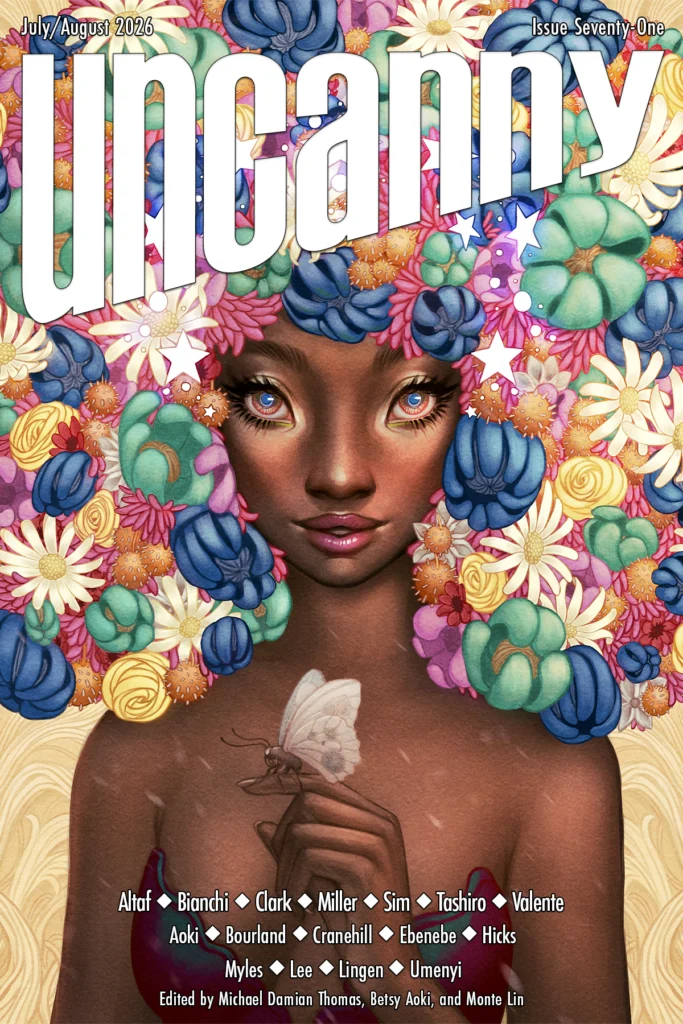
Amidst the crowdfunding efforts and award season excitement, Uncanny Magazine proudly unveils its latest offering, Issue 71, featuring a rich array of fiction, essays, poetry, and interviews. The issue is graced by the phenomenal cover art, Flower Crown, by Ejiwa "Edge" Ebenebe, setting a vibrant tone for the content within.
Featured Content:
- New Fiction:
- "Leavetaking" by Tia Tashiro
- "Learning the Loom" by P. Djèlí Clark
- "This Is Just Another Carnaval Love Story" by Jana Bianchi
- "The Cinema of Babel" by Sam J. Miller
- "Judar of the Island: A Story Told in Four Feasts" by Rida Altaf
- "A Hundred Ways the Story Ends" by Tara Sim
- Reprint: "White Lines on a Green Field" by Catherynne M. Valente, originally published in Subterranean Online, Fall 2011.
- Provocative Essays:
- "The Strange Worlds Among Us—of Turing, Trans People, and the Road to Laniakea" by Ryka Aoki
- "Doctor Who in an Exciting Adventure with AI Slop 1969 AD" by Lizbeth Myles
- "This Is Not About AI" by Hana Lee
- "Middle-Aged Love: Rereading in Your Forties and Beyond" by Marissa Lingen
- Evocative Poetry:
- "Instructions for Becoming Fire" by Chisomaga Umenyi
- "Six Views of a Speedster" by Gwendolyn Hicks
- "I called the swan down" by Laura Cranehill
- "enough johnnie blue" by E. A. Bourland
- Interviews: Caroline M. Yoachim engages in insightful conversations with P. Djèlí Clark and Rida Altaf about their respective stories.
Podcast Episodes:
The Uncanny Magazine Podcast complements the print issue with audio versions of select content:
- Episode 71A: Features "Leavetaking" by Tia Tashiro, read by Erika Ensign; "Instructions for Becoming Fire" by Chisomaga Umenyi, read by Matt Peters; and Michael Damian Thomas interviewing Tia Tashiro.
- Episode 71B: Presents "The Cinema of Babel" by Sam J. Miller, read by Matt Peters; "I called the swan down" by Laura Cranehill, read by Erika Ensign; and Michael Damian Thomas interviewing Sam J. Miller.
Issue 71 exemplifies Uncanny Magazine‘s ongoing dedication to presenting a diverse and engaging collection of speculative fiction and commentary, further solidifying its reputation as a vital platform for both established and emerging voices in the genre.
Implications and the Future of Independent Publishing
The confluence of these events – a critical Kickstarter, a significant editorial promotion, and an unparalleled number of award nominations – positions Uncanny Magazine at a pivotal juncture. The challenges it faces, particularly the loss of major retail subscription revenue, highlight the increasing fragility of independent media and the crucial role of direct community support. In an era where many smaller presses and literary magazines struggle to maintain solvency, Uncanny‘s annual crowdfunding model, while stressful, serves as a powerful testament to the loyalty and dedication of its readership.
The promotion of Monte Lin to Nonfiction Editor, alongside his existing role, signals a strategic investment in the magazine’s intellectual depth and its capacity to engage with contemporary issues through the lens of speculative thought. This move, coupled with the consistent recognition from prestigious awards like the Hugos, Shirley Jackson, Sturgeon, and Eugie Foster, not only validates Uncanny‘s editorial vision but also elevates its standing within the broader literary world.
For the speculative fiction community, Uncanny Magazine‘s continued success is more than just the survival of a publication; it represents the ongoing availability of a diverse platform for innovative storytelling and critical discourse. The emphasis on paying creators and staff fairly, even amidst financial pressures, underscores a commitment to ethical publishing practices that benefit the entire ecosystem of genre literature. As Michael Damian Thomas eloquently puts it, the magazine’s content is "important to people," serving as a beacon of imagination and insight in uncertain times. The upcoming Kickstarter is not just about funding a magazine; it’s about sustaining a vital cultural institution. The call to action for the "Space Unicorns" is a call to preserve a space where imagination thrives and important stories are told.
###
About Uncanny Magazine:
Uncanny Magazine is an online science fiction and fantasy magazine that publishes short stories, novelettes, poetry, essays, and interviews. Launched in 2014, it has quickly become one of the most respected publications in the genre, earning numerous Hugo Awards and other accolades for its high-quality, diverse, and thought-provoking content. Its unique crowdfunding model fosters a strong community known as the "Space Unicorn Ranger Corps."
Contact:
[Placeholder for Media Contact Information, if applicable]