Dual Visions of Adventure: Dungeons & Dragons Unveils Contrasting Covers for 2024 Player’s Handbook
SEATTLE, WA – Wizards of the Coast, the venerable publisher behind the world’s most popular tabletop roleplaying game, Dungeons & Dragons, has once again captured the imagination of its vast player base with the recent unveiling of the alternate front cover for the highly anticipated 2024 Player’s Handbook. This revelation follows closely on the heels of the standard cover’s debut, presenting a stark and intriguing contrast in artistic vision that speaks volumes about the multifaceted nature of the D&D experience. Far from being a mere aesthetic choice, these dual covers offer a glimpse into the diverse narratives and emotional spectrum that the game embodies, appealing to different facets of its global community.
The Player’s Handbook, often considered the foundational text for any Dungeons & Dragons enthusiast, serves as the primary guide for character creation, core rules, spells, and equipment. Its cover art, therefore, carries immense symbolic weight, acting as the first visual gateway into the fantastical worlds and heroic sagas contained within. The 2024 edition, poised to refine and evolve the core mechanics of the game, has leveraged its cover art to make a powerful statement about its identity and direction.
Unveiling the Two Faces of Adventure: The 2024 Player’s Handbook Covers
The reveal of both the standard and alternate covers has ignited discussions across the D&D community, with players dissecting every detail and pondering the implications of each artistic choice. What stands out most profoundly is the deliberate thematic divergence between the two, offering players a choice that resonates with their preferred style of play and aesthetic appreciation.
The Standard Edition: A Call to Arms
The initial artwork unveiled for the standard edition of the 2024 Player’s Handbook immediately struck a chord with its dynamic and action-packed portrayal of heroism. Created by the acclaimed artist Tyler Jacobsen, this cover is a vibrant tableau of classic D&D archetypes engaged in a desperate struggle. At its heart, the artwork features iconic characters from Dungeons & Dragons lore, including the valiant Strongheart the Knight, the steadfast Elkhorn the Dwarf Warrior, and the regal Yolande the Elven Queen. These figures, instantly recognizable to long-time fans, are depicted mid-combat, epitomizing the daring and often perilous nature of adventuring.
The scene unfurls with a party of heroes bravely confronting a horde of Kobolds, one of Dungeons & Dragons’ most enduring and recognizable low-level enemies. The depiction of these reptilian humanoids, often used as early adversaries, grounds the combat in a classic D&D scenario. Swords flash, spells crackle, and the intensity of the struggle is palpable, emphasizing the core elements of combat and strategic engagement that define a significant portion of the D&D experience. Behind the embattled party, offering a sense of powerful, benevolent oversight, stands a magnificent golden dragon. This colossal creature, often a symbol of immense power and ancient wisdom within the D&D multiverse, seems to be an ally, providing a formidable presence that reinforces the epic scale of the adventurers’ endeavors.
Jacobsen’s style for the standard cover is characterized by its dramatic flair, clear lines, and vibrant color palette, designed to convey immediate action and a sense of impending victory against overwhelming odds. It is a cover that speaks to the thrill of battle, the bond of fellowship in the face of danger, and the quintessential fantasy heroics for which Dungeons & Dragons is widely celebrated, particularly among the general public. It boldly asserts D&D’s identity as a game of high fantasy, combat, and grand quests.
The Alternate Edition: A Moment of Serenity
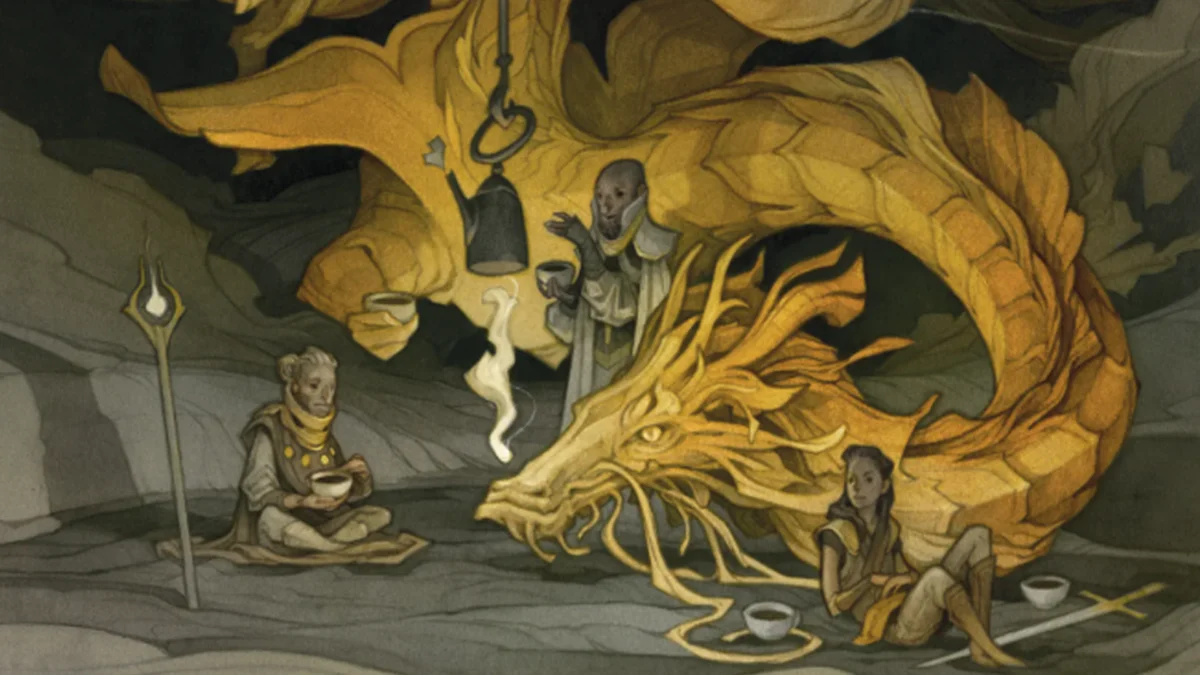
In stark contrast, the alternate cover for the 2024 Player’s Handbook, illustrated by the distinctive hand of Wylie Beckert, offers a profoundly different narrative. Where the standard cover roared with the urgency of battle, the alternate whispers with the quiet charm of camaraderie and shared moments. This edition, often sought after by collectors and those who appreciate a unique artistic take, retains the core content of the book but transforms its external presentation.
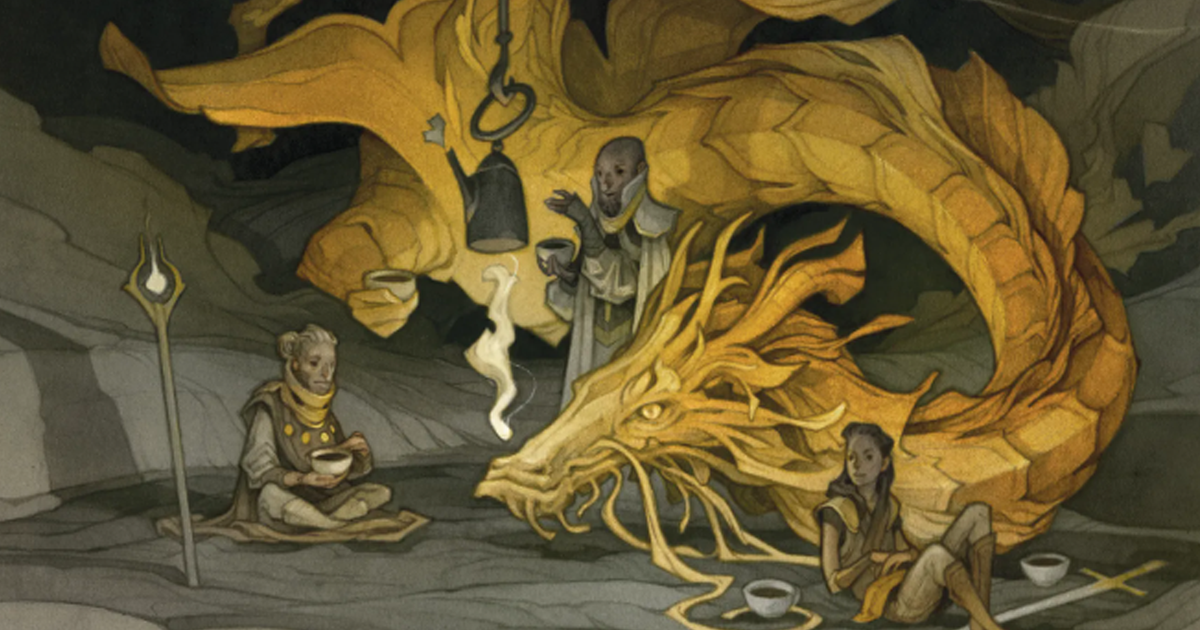
Beckert’s artwork transports the viewer to a serene, almost whimsical scene set within the cozy confines of a cave. Here, a classic Dungeons & Dragons party – comprising the archetypal wizard, cleric, fighter, and rogue – are not engaged in skirmish but are instead sharing a pot of tea. The mood is one of peace, introspection, and quiet companionship, a stark departure from the frenetic energy of the standard cover. This scene celebrates the often-overlooked moments of downtime, the bond forged between adventurers not just through shared peril, but through shared meals, stories, and simple, human (or elven, dwarven, gnomish) connection.
Intriguingly, the golden dragon, a powerful presence on the standard cover, reappears here but in a delightfully unexpected role. This time, the majestic beast is an active participant in the tea party, delicately grasping a normal-sized teacup in one of its massive paws. The sense of scale is playful and endearing, humanizing the legendary creature. Adding to the whimsical nature of the scene, the party’s rogue is depicted balancing precariously, yet comfortably, on a part of the dragon’s body, perhaps using it as a vantage point or simply enjoying a unique perch.
Wylie Beckert, known for her intricate, often surreal, and highly detailed illustrations, imbues this alternate cover with a sense of wonder and gentle humor. Her style, characterized by rich textures, evocative lighting, and a slightly fantastical realism, invites viewers to linger and discover hidden details. This cover appeals to players who value the narrative, roleplaying, and collaborative storytelling aspects of D&D as much, if not more, than the combat encounters. It suggests that D&D is not just about slaying monsters, but also about building relationships, exploring mysterious locales, and finding beauty and warmth even in the darkest of dungeons. The contrast between the two covers could not be more pronounced: one a declaration of war, the other an invitation to tea.
A Chronology of Anticipation: The Road to the 2024 Player’s Handbook
The release of any new core rulebook for Dungeons & Dragons is a landmark event, but the 2024 Player’s Handbook arrives with particular significance, building on years of iterative development and community engagement.
The Dawn of a New Edition (or Evolution)
The journey to the 2024 Player’s Handbook has been a protracted one, deeply rooted in Wizards of the Coast’s "One D&D" initiative. Announced in 2022, One D&D was presented not as a brand-new edition in the traditional sense, but rather as an evolution of the highly successful 5th Edition, aiming for backward compatibility while introducing refinements to core rules, character options, and gameplay mechanics. This approach sought to update and streamline the game without alienating the massive player base that 5th Edition had cultivated.
Throughout 2022 and 2023, Wizards of the Coast engaged in an extensive public playtest phase, releasing numerous Unearthed Arcana documents for community feedback. This transparent and collaborative development process allowed players to directly influence the direction of the game, fostering a sense of ownership and anticipation. The 2024 Player’s Handbook is the culmination of this feedback, promising a polished and enhanced D&D experience that addresses common player desires and streamlines gameplay. The anticipation for the final product has been steadily building, with each new piece of information or artwork release fueling excitement.
The Dual Reveal Strategy
The staggered reveal of the Player’s Handbook covers was a carefully orchestrated event designed to maximize community engagement and generate buzz. The initial unveiling of Tyler Jacobsen’s action-packed standard cover last week set a clear tone, aligning with many players’ expectations of D&D as a game of heroic fantasy and epic battles. It provided a powerful visual affirmation of the game’s adventurous spirit.
The subsequent reveal of Wylie Beckert’s alternate cover, first reported by Polygon, then served as a delightful surprise. This strategic timing allowed each cover to have its moment in the spotlight, highlighting their individual merits while also emphasizing their contrasting themes. The dual reveal effectively showcased the breadth of D&D’s appeal, demonstrating that the game encompasses both the high-octane combat and the intimate, character-driven moments that make roleplaying so compelling. This approach not only generated widespread discussion but also underscored Wizards of the Coast’s commitment to catering to a diverse player base with varied aesthetic tastes.
Key Release Dates
Players eager to get their hands on the new rulebook won’t have to wait long. The alternate version of the 2024 D&D Player’s Handbook is slated for an early release, making its debut at local game stores on September 3rd. This move is a deliberate strategy by Wizards of the Coast to support its retail partners and foster community engagement at the local level. Following this exclusive window, the wider release of the book, including the standard edition, will commence on September 17th. This staggered release not only creates a sense of exclusivity for the alternate cover but also provides a focused launch period for local game stores, allowing them to capitalize on the initial surge of enthusiasm.
Deeper Dives: Supporting Data and Artistic Philosophy
The choice of cover art is never arbitrary, especially for a product as iconic as the Dungeons & Dragons Player’s Handbook. It reflects artistic trends, market strategies, and the evolving identity of the game itself.
The Enduring Legacy of D&D Cover Art
Dungeons & Dragons has a rich history of iconic cover art that has shaped generations of fantasy enthusiasts. From the original white box set’s rudimentary yet evocative imagery to the legendary "Red Box" Basic Set’s depiction of a dragon and adventurer, and the detailed realism of the AD&D 1st and 2nd Edition Player’s Handbooks (often featuring a fierce mind flayer or a majestic dragon), each cover has served as a visual timestamp for its era. The covers of 3rd, 3.5, and 4th Editions continued this tradition, showcasing increasingly polished and dynamic illustrations of heroes battling fearsome foes. The 5th Edition Player’s Handbook, with its heroic party confronting a red dragon, set a high bar for contemporary fantasy art.
These covers are more than just pretty pictures; they are critical elements of world-building and branding. They establish the tone, genre, and aspirational themes of the edition within a single image. The 2024 covers, particularly with their thematic duality, continue this legacy by not only presenting compelling artwork but also by implicitly communicating the expanded scope of experiences D&D aims to offer. They underscore the understanding that D&D’s appeal lies not solely in grand battles but also in the quiet moments of camaraderie and shared narrative.
The Visionary Brushstrokes: Wylie Beckert and Tyler Jacobsen
The distinct styles of Wylie Beckert and Tyler Jacobsen are central to the impact of the 2024 Player’s Handbook covers. Understanding their artistic approaches provides deeper insight into the covers’ thematic expressions.
Tyler Jacobsen, the artist behind the standard cover, is renowned for his ability to craft dynamic, action-oriented scenes that are both epic and immediately engaging. His work often features bold compositions, powerful figures, and a sense of dramatic movement. He excels at conveying heroic narratives through traditional fantasy imagery, making him an ideal choice for a cover that emphasizes the high-stakes combat and adventure inherent in D&D. Jacobsen’s art often feels like a snapshot from a thrilling movie, capturing the peak of a heroic moment. His contributions typically align with the grand, fantastical expectations of the genre, making his standard cover a familiar yet fresh take on D&D heroism.
Wylie Beckert, conversely, brings a uniquely enchanting and often surreal aesthetic to her illustrations. Her style is characterized by intricate details, a rich, often muted color palette, and a whimsical yet sophisticated approach to fantasy subjects. Beckert has a knack for imbuing her scenes with narrative depth, inviting viewers to explore the nuances and subtle storytelling within her compositions. Her previous work on the alternate cover for Dungeons & Dragons: Tasha’s Cauldron of Everything is a testament to this, depicting a whimsical, slightly eerie scene that perfectly captured the arcane and unpredictable nature of that supplement. For the 2024 Player’s Handbook alternate cover, Beckert’s ability to create an intimate, character-focused scene with a touch of the fantastical allows the golden dragon tea party to feel both magical and genuinely endearing, providing a gentle counterpoint to the more overt heroism of the standard edition. Her art often evokes a sense of storybook charm, making the fantastical feel approachable and personal.
The Significance of the Golden Dragon
One of the most fascinating details connecting both covers is the presence of a golden dragon. Despite the wildly different scenarios, this majestic creature appears in both, albeit in drastically different contexts. In the standard cover, it is a formidable, almost divine ally towering behind the adventurers, ready to lend its immense power to the battle. Its presence reinforces the epic scope of the adventure and the powerful forces at play.
In the alternate cover, the golden dragon is transformed into a gentle, tea-drinking companion, symbolizing camaraderie and peace. This recurring motif is not accidental. Dragons are, arguably, the most iconic creatures in Dungeons & Dragons, lending their name to the game itself. Gold dragons, specifically, are often depicted as wise, benevolent, and lawful good beings, serving as guardians of justice and protectors of the innocent. Their inclusion on both covers, spanning the spectrum from combat ally to tea-party guest, subtly reinforces a deeper truth about D&D: that even the most powerful and fantastical elements of the world can be experienced in diverse ways. It suggests that the same creatures that pose existential threats can also be sources of wonder, wisdom, or even friendship, depending on the nature of the adventure. This duality mirrors the game’s capacity for both high-stakes confrontation and deeply personal, narrative-driven roleplaying.
Strategic Decisions: Why Alternate Covers?
The practice of offering alternate covers for D&D products has become a staple of Wizards of the Coast’s publishing strategy, and for good reason. Primarily, it caters to the significant collector’s market within the D&D community. Unique artwork, especially from celebrated artists, becomes a prized possession for many fans, driving additional sales and fostering a sense of exclusivity.
Beyond collectibility, alternate covers serve a crucial function in market segmentation. They allow the game to present different "faces" to different player demographics. While the standard cover might appeal to new players or those drawn to the game’s combat and heroic fantasy elements, the alternate cover reaches out to veterans who appreciate artistic diversity, players who prioritize roleplaying and character interaction, or those who simply prefer a more unconventional aesthetic. This strategy broadens the game’s appeal without compromising its core identity.

Furthermore, the early release of the alternate cover to local game stores (LGS) is a shrewd business move designed to support these vital retail partners. LGSs are often the heart of the D&D community, providing spaces for play, fostering local groups, and serving as crucial points of contact for new players. By giving them an exclusive window for a highly anticipated product, Wizards of the Coast incentivizes players to visit and support their local shops, strengthening the community infrastructure that D&D relies upon.
Official Stance and Community Resonance
While Wizards of the Coast has not released extensive official statements specifically detailing the artistic philosophy behind these dual covers, their actions and historical patterns allow for informed inferences regarding their design intent.
Wizards of the Coast’s Design Philosophy (Inferred)
The decision to commission two such distinct covers for the Player’s Handbook strongly suggests a deliberate effort by Wizards of the Coast to showcase the multifaceted nature of Dungeons & Dragons. It communicates an understanding that D&D is not a monolithic experience but rather a rich tapestry woven from elements of combat, exploration, social interaction, and personal storytelling. By presenting both a "call to arms" and a "moment of serenity," the publisher subtly reinforces its commitment to supporting diverse playstyles.
This approach aligns with the broader "One D&D" philosophy, which aims to create a more inclusive and adaptable game system. The covers, in this light, become a visual metaphor for the game’s flexibility – capable of delivering epic battles against hordes of monsters, or intimate, character-driven narratives around a campfire (or, in this case, a tea table in a cave). It’s a tacit acknowledgment that D&D’s appeal spans a wide spectrum, from the tactical wargamer to the theatrical roleplayer, and that all are welcome under its banner.
Anticipating Player Reception
The D&D community is renowned for its passionate discussions, and these covers are sure to spark lively debates. Many players will undoubtedly gravitate towards the standard cover, finding its heroic imagery to be the quintessential representation of D&D. It embodies the high-fantasy adventure that first drew them to the game.
However, the alternate cover is likely to resonate deeply with a significant segment of the player base that cherishes the non-combat aspects of D&D. Players who prioritize character development, intricate roleplaying, exploration, and the emotional bonds between party members will find Beckert’s artwork a refreshing and accurate reflection of their own campaigns. It offers a counter-narrative to the common perception of D&D as solely a combat simulator, highlighting the game’s capacity for quiet moments of beauty and camaraderie. The choice offered by these covers empowers players to select the visual representation that best aligns with their personal vision of Dungeons & Dragons, fostering a deeper connection with the product.
Broader Implications for the Future of Dungeons & Dragons
The unveiling of the 2024 Player’s Handbook covers carries implications that extend beyond mere aesthetics, hinting at potential shifts in D&D’s artistic direction, its evolving player base, and its market strategy.
Shifting Artistic Direction and Thematic Scope
The pronounced thematic contrast between the two covers may signal a broader, more diversified artistic direction for Dungeons & Dragons products moving forward. While heroic combat will undoubtedly remain a core theme, the alternate cover suggests a willingness to explore and highlight other facets of the game – downtime, exploration, social encounters, and the simple joy of companionship. This could lead to a richer variety of artwork across future supplements, modules, and accessories, appealing to a wider range of artistic sensibilities. It allows D&D to visually communicate that its narratives are not confined to sword-and-sorcery clashes but can also encompass moments of profound character interaction and world-building.
The Evolving D&D Player Base
Dungeons & Dragons has seen an unprecedented surge in popularity in recent years, attracting a new generation of players from diverse backgrounds. This expanded player base often brings different expectations and preferences to the table. The dual covers, therefore, can be seen as a strategic response to this evolving demographic. The standard cover retains its appeal for traditionalists and action-seekers, while the alternate cover reaches out to those who may be drawn to D&D through its storytelling potential, its social aspects, or its capacity for creative expression beyond combat. By visually affirming these varied interests, Wizards of the Coast positions D&D as an inclusive and adaptable game for everyone.
Market Strategy and Collector Culture
The sustained importance of physical books, especially those with unique artwork, in an increasingly digital world cannot be overstated. While digital platforms like D&D Beyond offer convenience, the tactile experience of holding a beautifully illustrated rulebook remains paramount for many players and collectors. The alternate covers capitalize on this, transforming a functional game aid into a desirable art piece. This strategy not only boosts initial sales but also cultivates a thriving secondary market for collectors, further embedding D&D into broader pop culture and art appreciation circles. The deliberate support for local game stores through early releases also strengthens the brick-and-mortar retail ecosystem, which remains a crucial pillar for community building and introducing new players to the hobby.
Conclusion
The unveiling of the 2024 Dungeons & Dragons Player’s Handbook covers, particularly the striking alternate edition by Wylie Beckert, marks a significant moment for the venerable tabletop RPG. Far from being a mere aesthetic choice, these dual covers—Tyler Jacobsen’s dynamic combat scene and Beckert’s serene tea party—serve as powerful visual metaphors for the game’s expansive appeal. They elegantly encapsulate the breadth of experiences D&D offers, from epic, high-stakes combat to intimate, character-driven moments of camaraderie and introspection.
This strategic artistic choice by Wizards of the Coast underscores a deep understanding of its diverse player base and a commitment to providing options that resonate with individual playstyles and aesthetic preferences. As the D&D community eagerly awaits the release of the 2024 Player’s Handbook, first at local game stores on September 3rd, then globally on September 17th, these captivating covers stand as a testament to the enduring power of imagination and the ever-evolving nature of adventure. They invite players, old and new, to choose their own narrative gateway into the limitless worlds of Dungeons & Dragons, promising that whether they seek the roar of battle or the quiet clink of teacups, their journey will be rich with magic and meaning.