Unpacking the Adventure: Essential Organizational Tools for the Modern Dungeons & Dragons Player and Dungeon Master
Introduction: The Evolving Landscape of Tabletop Adventures
Dungeons & Dragons, the venerable progenitor of tabletop role-playing games, has captivated millions for decades, offering boundless realms of imagination, epic quests, and unforgettable character journeys. Yet, as the game has grown in complexity, popularity, and the sheer volume of supporting materials, so too has the logistical challenge of managing a D&D session. What once required little more than a core rulebook, a pencil, and a handful of dice, now frequently involves a veritable arsenal of literature, miniatures, spell cards, character sheets, and enough polyhedral dice to rival a dragon’s hoard. The joyous chaos of adventure can, ironically, be undermined by the mundane chaos of a disorganized table.
This burgeoning need for order has given rise to a diverse market of organizational tools designed to streamline gameplay, enhance immersion, and safeguard precious gaming gear. From the meticulous Dungeon Master orchestrating a sprawling campaign to the dedicated player navigating their character’s intricate abilities, efficient organization is no longer a mere convenience but a crucial component of a smooth, engaging, and ultimately more enjoyable D&D experience. This article delves into the indispensable tools that transform tabletop clutter into a finely tuned engine for storytelling, examining their evolution, specific benefits, and broader implications for the D&D community.
The Unseen Battle: Combating Clutter in the Realms of Imagination
Every D&D session, whether a quick one-shot or a pivotal chapter in an ongoing saga, demands a confluence of physical components. Dungeon Masters juggle monster stat blocks, campaign notes, maps, and secret dice rolls, all while maintaining the narrative flow. Players contend with character sheets, spell lists, inventory tracking, and often a personal collection of dice and miniatures. Without proper systems in place, the tabletop can quickly devolve into a landscape of misplaced items, frantic searches, and disruptive pauses, pulling players and DMs alike out of the immersive fantasy world they’ve meticulously crafted. These organizational tools serve as silent heroes, ensuring that the only dragons being fought are the ones on the battle grid, not the ones buried under a stack of spell cards.
Chronology: The Evolution of D&D and the Rise of Specialized Accessories
The journey of Dungeons & Dragons from its humble origins in 1974 to its current global phenomenon status has been mirrored by the increasing complexity and volume of its physical accoutrements. Understanding this evolution helps contextualize the modern demand for sophisticated organizational solutions.

The Early Days (1970s – Early 1980s): Simplicity and Improvisation
In its nascent forms, such as the original "white box" edition, D&D was a relatively lean affair. Players often shared a single rulebook, and miniatures were scarce, often replaced by coins or even abstract representations. Character sheets were rudimentary, and improvisation reigned supreme. Organization was largely an informal, ad-hoc process, dictated by the immediate needs of a small, pioneering community. The primary "tool" was often a binder or a simple box to hold the few books and dice.
The Golden Age (Mid-1980s – 1990s): AD&D and Expanding Horizons
With the advent of Advanced Dungeons & Dragons (AD&D) 1st and 2nd Editions, the game began to expand significantly. More rulebooks, setting guides, and monster manuals were introduced, each adding layers of detail and options. Miniatures became more prevalent, especially for combat encounters. This era saw the first stirrings of a need for better organization, as players accumulated more books and DMs started managing larger campaigns with a greater cast of NPCs and monsters. Basic binders and tackle boxes became popular, but dedicated D&D organizational tools were still niche.
The Modern Era (2000s – Present): Digital Integration and Physical Resurgence
The 3rd, 4th, and especially 5th Editions of D&D witnessed an explosion in both official and third-party content. The rise of crowdfunding platforms like Kickstarter enabled artisan creators to produce high-quality, specialized accessories. Digital tools emerged as alternatives for character sheets and rule lookups, yet a strong contingent of players clung to the tactile experience of physical play. The widespread adoption of miniatures, diverse dice sets (often numbering in the dozens per player), and supplementary materials like spell cards and condition tokens made the cluttered table a ubiquitous problem. This period marks the true genesis of the sophisticated organizational tools we see today, born out of a community’s collective desire to enhance the physical play experience despite—or perhaps because of—the game’s growing complexity. The visual appeal of organized play on streaming platforms also subtly influenced players’ desires for tidier setups.
Supporting Data: An In-Depth Look at Essential Organizational Tools
The market for D&D organizational tools is vibrant and varied, catering to every aspect of gameplay. Here, we dissect some of the most impactful and widely appreciated solutions, detailing their specific utility and how they enhance the tabletop experience.
Player’s Handbook Page Tabs: Navigating the Tome of Knowledge
One of the perennial frustrations at any D&D table is the dreaded "rule lookup." The moment a player or DM utters, "Wait, just let me check something real quick," the immersive flow of the game grinds to a halt. Flipping frantically through hundreds of pages in the Player’s Handbook, Dungeon Master’s Guide, or Monster Manual can consume precious minutes, disengaging players and breaking narrative tension.

Problem Solved: Player’s Handbook page tabs directly address this interruption. These small, durable plastic or laminated tabs adhere to key pages, clearly labeling sections such as "Combat," "Magic Items," "Conditions," "Spells," "Classes," and "Races."
Features and Benefits:
- Instant Access: The primary benefit is speed. Instead of guessing or relying on the index, users can flip directly to the relevant section in seconds. This significantly reduces downtime, keeping the momentum of the game flowing.
- Enhanced Immersion: Fewer pauses for rule checks mean players remain immersed in the narrative and their characters’ actions, preventing the meta-game distraction of flipping pages.
- Learning Aid: For new players, these tabs are invaluable. They provide a visual roadmap to the book’s structure, making it less intimidating to learn and reference rules independently.
- Consistency: Quick access to rules helps ensure consistent application of game mechanics, reducing disputes and clarifying ambiguities promptly.
- Durability: Most modern tabs are designed to withstand frequent use, protecting the pages from wear and tear associated with constant rifling.
- Customization: While many sets are pre-labeled, some offer blank tabs, allowing users to customize their books for specific campaigns or personal reference points.
User Profiles: Essential for every player and DM, especially those who frequently reference rules or are still learning the nuances of the game. Even veteran players benefit from the speed and efficiency, allowing them to focus on strategy and role-playing rather than logistics.
Travel Dice & Mini Storage: Safeguarding Your Arsenal
The sheer volume of dice and miniatures accumulated by dedicated D&D enthusiasts can be staggering. Transporting these precious (and often expensive) items safely and efficiently between gaming locations is a common challenge. Loose dice scatter, painted miniatures chip, and small spell cards get lost in transit.
Problem Solved: Dedicated travel cases designed specifically for dice and miniatures offer a consolidated, protected, and organized solution for transporting these vital components. The example given, with space for seven sets of dice and thirty minis, exemplifies a well-designed portable unit.
Features and Benefits:

- Protection: Individual slots for dice sets prevent them from scratching each other or other items. Foam inserts or padded compartments for miniatures protect delicate paint jobs and fragile parts from damage during travel.
- Consolidation: Bringing all essential small items into one secure case eliminates the need for multiple pouches or bags, simplifying packing and reducing the risk of forgetting something crucial.
- Organization: Specific compartments for different items—dice, minis, spell cards, condition tokens, notes—ensure everything has its place and is easily accessible upon arrival.
- Portability: Often compact and lightweight, these cases are designed for easy transport, fitting into larger bags or backpacks. Zippers or secure latches prevent accidental spills.
- Versatility: Ideal for DMs who need to bring a variety of monster minis and dice, or players who participate in multiple campaigns, each potentially requiring different character minis or dice sets.
- Aesthetic Appeal: Many cases are designed with an eye for style, reflecting the hobby’s aesthetic and making a positive impression at the game table.
User Profiles: Invaluable for DMs who manage a large roster of monsters and NPCs, and for players who attend games at different locations, or who like to have options for their character’s appearance and dice rolls.
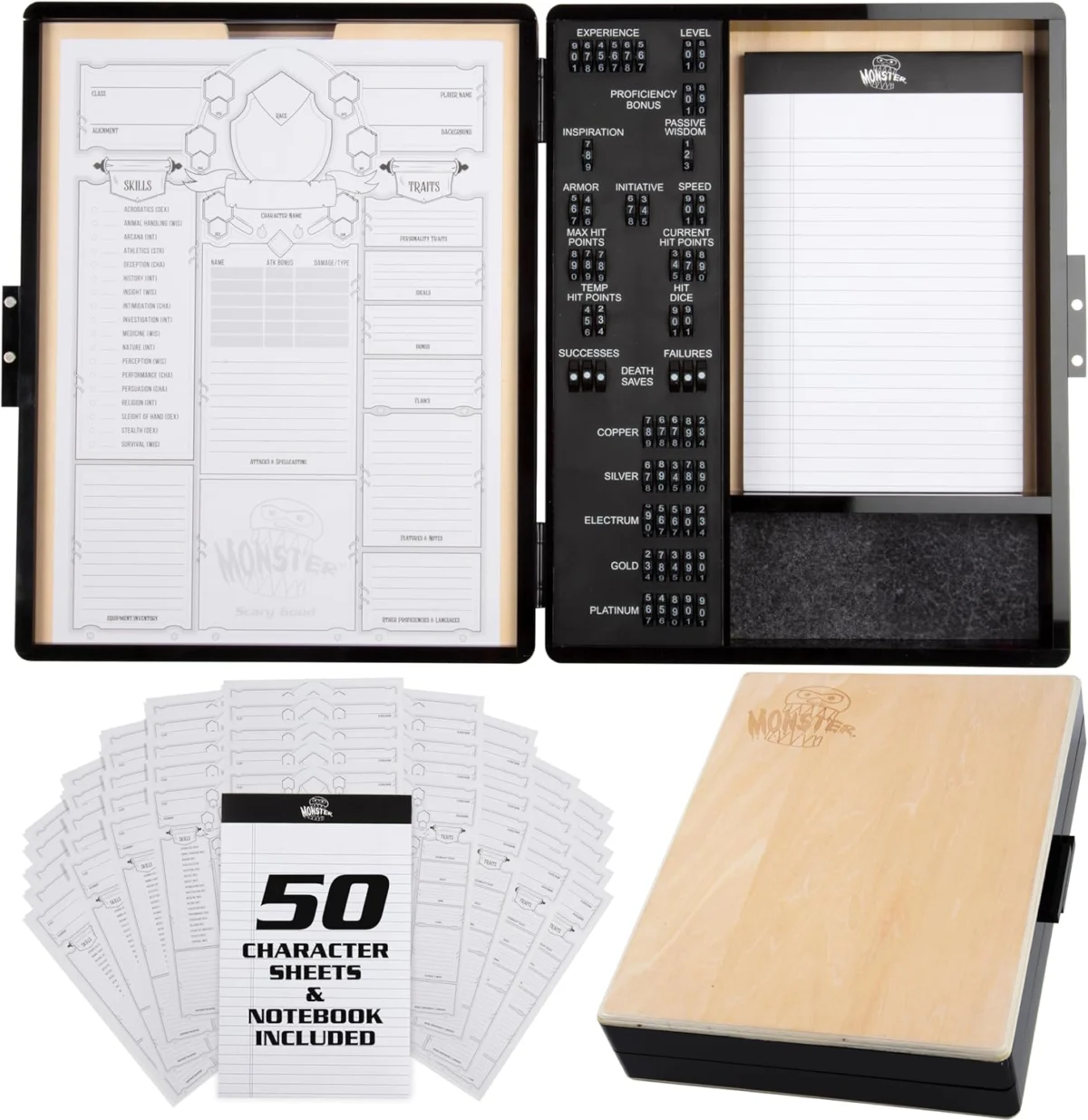
Character Sheet Holder & Stat Tracker: Preserving Your Hero’s Legacy
The physical character sheet is a sacred artifact for many players. It’s a tangible representation of their character’s journey, triumphs, and tribulations. However, the dynamic nature of D&D means these sheets are constantly updated—hit points fluctuate, spell slots are expended, inspiration is gained, and abilities change. This often leads to a messy, erased-through, and ultimately illegible document.
Problem Solved: A character sheet holder combined with a stat tracker offers a dual solution: protecting the sheet itself and providing an alternative, non-destructive method for tracking frequently changing numerical values.
Features and Benefits:
- Sheet Preservation: A dedicated holder keeps the paper character sheet flat, clean, and safe from spills, tears, and excessive wear. This ensures the permanent information remains legible and pristine.
- Dynamic Stat Tracking: Integrated dials or sliders allow players to track fluctuating stats like Hit Points, temporary HP, spell slots, ammo, or even inspiration points without needing to constantly erase and rewrite on the sheet. This maintains the sheet’s integrity and reduces mental arithmetic.
- Clarity and Readability: By offloading dynamic tracking, the character sheet remains clear and easy to read, allowing players and DMs to quickly ascertain core statistics.
- Integration with Notes: Many holders include space for a game notebook, allowing players to keep campaign notes, quest objectives, and lore snippets alongside their character’s stats.
- Tactile Satisfaction: For players who prefer the physical feel of a paper sheet over digital apps, this tool enhances the experience by making it more organized and less prone to physical degradation.
- Reduced Cognitive Load: Not having to constantly manage erasing and rewriting frees up mental bandwidth, allowing players to focus more on role-playing and strategic decisions.
User Profiles: Ideal for any player who uses physical character sheets and wants to maintain their condition, especially those playing classes with many fluctuating resources (e.g., spellcasters, martial classes with limited abilities).
D&D Travel Bag: The Mobile Command Center
For the truly dedicated D&D player or DM, the collection of necessary gear can grow exponentially. Multiple core rulebooks, setting guides, adventure modules, dozens of miniatures, dice sets, spell cards, notepads, pens, and even battle maps often need to be transported. A small case or a few pouches simply won’t suffice.

Problem Solved: A specialized D&D travel bag, often resembling a backpack or messenger bag with extensive compartmentalization, provides an all-encompassing solution for transporting a substantial amount of gaming equipment.
Features and Benefits:
- Comprehensive Capacity: Designed to hold multiple large books, varying sizes of miniatures (from small goblins to large dragons), multiple dice sets, spell cards, writing implements, and even rolled-up maps or battle grids.
- Optimized Compartmentalization: Dedicated padded slots for books protect their spines and pages. Various pockets, pouches, and sometimes modular dividers allow for organized storage of different item types, preventing them from shifting or getting damaged.
- Ergonomic Transport: Often designed as backpacks, these bags distribute weight effectively, making even a heavy load comfortable to carry over distances.
- Protection: Padded interiors and durable, often water-resistant, exteriors protect valuable gaming gear from bumps, drops, and environmental hazards.
- Professional Presentation: Arriving with all your gear neatly organized in a dedicated bag can project an image of preparedness and seriousness, enhancing the overall gaming atmosphere.
- Reduced Forgetting: Having a single, designated bag for all D&D essentials significantly reduces the chances of leaving an important item behind.
User Profiles: Absolutely essential for DMs who bring extensive campaign materials, and for "power players" or collectors who travel with a wide array of personal miniatures, multiple character options, and a substantial dice collection.
DM Screen: The Bastion of the Dungeon Master
The DM screen is arguably the most iconic and universally recognized organizational tool for Dungeons & Dragons, a ubiquitous presence at nearly every table. While simple in concept, its utility is multifaceted and indispensable for a Dungeon Master.
Problem Solved: The DM screen addresses several core challenges faced by DMs: quick rule reference, maintaining privacy for rolls and notes, and creating a physical barrier that visually separates the DM’s operational space from the players’ interactive space.
Features and Benefits:

- Quick Reference: The interior panels of most DM screens are adorned with frequently used tables, charts, and rules—such as monster conditions, common spell effects, DCs for various tasks, initiative tracking, and encounter building guidelines. This "at-a-glance" information dramatically reduces the need to flip through rulebooks during play.
- Privacy: The screen shields the DM’s notes, monster stat blocks, secret dice rolls (e.g., perception checks, damage rolls, saving throws), and other confidential information from player view. This preserves suspense, prevents metagaming, and allows the DM to manipulate the narrative as needed without spoiling surprises.
- Atmosphere and Authority: The physical barrier of the DM screen visually designates the DM’s role as the game’s orchestrator and impartial arbiter, subtly reinforcing their authority and focus.
- Note-Holding Capability: Many modern DM screens feature pockets, clips, or magnetic surfaces on the interior, allowing the DM to attach temporary notes, initiative trackers, or specific monster stats for the current encounter.
- Structure and Flow: By providing easy access to rules and a private space for management, the DM screen helps maintain the narrative flow and ensures the game progresses smoothly, minimizing interruptions.
- Customization: While official screens are popular, many third-party options offer magnetic surfaces, dry-erase panels, or even modular designs, allowing DMs to personalize their screen with their own charts or artwork.
User Profiles: Absolutely indispensable for every Dungeon Master, regardless of experience level. It is the cornerstone of efficient DMing.
Dice Holder, Roller, & Tower: The Integrated Rolling Solution
Dice are central to D&D, but managing them can be surprisingly messy. Dice can scatter across the table, roll off onto the floor, or be perceived as rolling "unfairly" due to uneven surfaces. Storing multiple sets can also be cumbersome.
Problem Solved: An integrated dice holder, roller, and tower system provides a contained, fair, and convenient method for both storing and deploying dice during gameplay, all within a single, portable unit. The example of a case that unfolds into a tower and tray is a perfect illustration.
Features and Benefits:
- Fair and Contained Rolls: A dice tower ensures a truly random roll by tumbling the dice through internal baffles before depositing them into a contained tray. This prevents dice from scattering, eliminates accusations of unfair rolls (e.g., "cocked dice" or "table bumps"), and keeps the dice within easy view.
- Integrated Storage: The ability to collapse back into a carrying case for multiple dice sets is a significant convenience. It means players only need to bring one item for their dice storage and rolling needs.
- Portability and Quick Setup: Designed for travel, these units are often compact and unfold/setup in seconds, transforming from a storage box to a functional part of the game table with minimal effort.
- Tabletop Protection: The rolling tray prevents dice from scratching or damaging the game table surface.
- Aesthetic and Ritual: For many, the act of dropping dice into a tower adds a satisfying, almost ritualistic element to the game, enhancing the overall experience.
- Organization: Keeping multiple dice sets organized within the holder means players can quickly select the specific dice they need for different rolls (e.g., d20 for attack, specific damage dice).
User Profiles: Highly beneficial for any player or DM who uses multiple dice sets, wants to ensure fair rolls, or plays on surfaces where scattering dice is a concern. It’s particularly useful for players who appreciate efficiency and a tidy setup.
Official Responses: Industry Trends and Community Adoption

While Wizards of the Coast (WotC), the official publisher of Dungeons & Dragons, primarily focuses on core rulebooks and adventure modules, their implicit "response" to the need for organizational tools is evident in the increasing complexity of their own products. The sheer number of monsters, spells, and character options across various sourcebooks implicitly necessitates better organization for DMs and players alike. WotC’s occasional release of official DM screens or dice sets also acknowledges the demand for such accessories.
More significantly, the thriving ecosystem of third-party manufacturers, artisans, and independent creators provides the most robust "official response" to this demand. Platforms like Etsy, Kickstarter, and specialized gaming retailers are teeming with innovative and high-quality organizational solutions. The sustained growth of this accessory market demonstrates a powerful community-driven recognition that these tools are not just luxuries, but increasingly essential for a premium D&D experience. Content creators and actual play streamers further normalize and popularize these tools, often showcasing their own organized setups, which in turn inspires their audiences. The market is not just responding to needs; it’s also shaping expectations.
Implications: The Broader Impact on the D&D Experience
The integration of effective organizational tools into Dungeons & Dragons play extends far beyond mere tidiness. Their impact resonates across several crucial aspects of the gaming experience, influencing player engagement, DM efficiency, and the overall health of the community.
Enhanced Player Experience and Immersion:
When a player isn’t fumbling for their character sheet, searching for the right spell description, or chasing runaway dice, their focus remains squarely on the game world. This uninterrupted immersion allows for deeper role-playing, more strategic thinking, and a greater sense of presence within the narrative. The smooth flow fostered by organized tools translates directly into more enjoyable and memorable sessions for everyone at the table. Players can fully embody their characters, rather than being pulled back to mundane reality by logistical hurdles.
DM Efficiency and Stress Reduction:
For the Dungeon Master, organizational tools are a lifeline. Managing complex narratives, a cast of NPCs, monster encounters, and the rules of the game can be an incredibly demanding task. Tools like DM screens, dedicated travel bags, and organized mini storage significantly reduce the DM’s cognitive load and logistical stress. By having essential information at their fingertips and all materials readily accessible, DMs can dedicate more energy to storytelling, improvisation, and reacting to player actions, leading to more dynamic and responsive campaigns. This also helps prevent DM burnout, ensuring the longevity of campaigns.

Accessibility and Inclusivity:
A well-organized table can make D&D more accessible to new players or those with cognitive differences. Clear labeling, distinct storage, and streamlined rule access reduce the intimidation factor often associated with learning a complex game. New players can quickly find information without feeling like a burden, fostering a more welcoming and inclusive environment. The visual clarity of an organized setup can also aid players who benefit from structured environments.
The Future of D&D Accessories:
As D&D continues to evolve, so too will its organizational tools. We can anticipate further innovations, including:
- Modular Designs: Tools that can be easily customized and reconfigured for different campaign needs.
- Smart Integration: Accessories that might subtly integrate with digital tools (e.g., a physical character tracker that can sync with an online sheet).
- Sustainable Materials: A growing demand for eco-friendly and durable materials in accessory manufacturing.
- Personalization: More options for players and DMs to customize the aesthetics of their organizational gear to reflect their personal style or campaign themes.
Reinforcing the Tactile and Social Experience:
Despite the rise of virtual tabletops, the enduring appeal of physical D&D lies in its tactile and social elements. The clatter of real dice, the presence of painted miniatures, and the shared physical space of a game table are irreplaceable. Organizational tools don’t just facilitate this physical play; they elevate it. They transform a potentially messy and distracting environment into a refined, efficient, and aesthetically pleasing space where the magic of collaborative storytelling can truly flourish. A tidy table is often a sign of respect for the game, the DM, and fellow players, contributing to a more harmonious and focused social experience.
In conclusion, the journey from scattered components to an organized tabletop is a critical one for enhancing the Dungeons & Dragons experience. These tools, whether simple page tabs or elaborate travel bags, are more than mere accessories; they are enablers of adventure, allowing players and DMs alike to fully immerse themselves in the fantastical worlds they create and explore. As the D&D universe continues to expand, so too will the ingenuity of the community in finding new and better ways to keep its many wonders neatly in order.