The Gamification of Survival: How a Game Designer’s Sketch Helped Explain the Exponential Reality of COVID-19
By [Journalist Name/Editorial Staff]
Six years after the initial tremors of the global COVID-19 pandemic, the world continues to grapple with the legacy of the crisis—not just in terms of public health, but in the way information, mathematics, and public sentiment collided. While the early days of 2020 were defined by confusion and denial, a unique intersection of game design and epidemiology emerged to bridge the gap between abstract data and visceral understanding.
Raph Koster, a veteran game designer renowned for his work on Ultima Online and Star Wars Galaxies, found himself at the center of this intersection. What began as a frustrated Facebook post about the public’s inability to understand exponential growth evolved into a series of "serious games" that were eventually utilized in classrooms and praised by medical professionals. This retrospective examines the chronology of those designs, the data that fueled them, and the implications for future pandemic preparedness.
Main Facts: Translating the Invisible
The core challenge of the COVID-19 pandemic was its mathematical invisibility. In early 2020, the general public struggled to comprehend how an Infection Fatality Rate (IFR) of 0.4% to 1.0% could result in millions of deaths. This "numeracy gap" became a barrier to effective public health policy.
Raph Koster’s contribution was the conceptualization of a "pandemic simulator" that stripped away political rhetoric and replaced it with a systems-based model. By using the logic of game design—where inputs (social distancing) directly affect outputs (infection rates)—Koster aimed to make the "invisible" curves of the pandemic "felt in the bones" of the player. This led to the development of two notable indie titles: Covid Ops and In the Time of Pandemia.
Chronology: From Facebook Sketch to Global Press
The Early Warnings (Late 2019 – February 2020)
As early as November 2019, Koster was tracking rumors of a novel respiratory illness in Wuhan, China. Utilizing his background in statistics and system design, he began modeling potential outcomes in personal spreadsheets. While the world remained largely open, Koster’s internal math suggested a catastrophe of global proportions.
The Design Sketch (March 24, 2020)
Frustrated by what he described as "typing to a wall," Koster posted a detailed game design sketch to Facebook. He argued that certain professions—epidemiologists, Wall Street quants, and game designers—are uniquely trained to understand exponential curves. He proposed a simple simulation: circles bouncing in a field, representing a population.
The Rapid Response: Covid Ops (March 30, 2020)
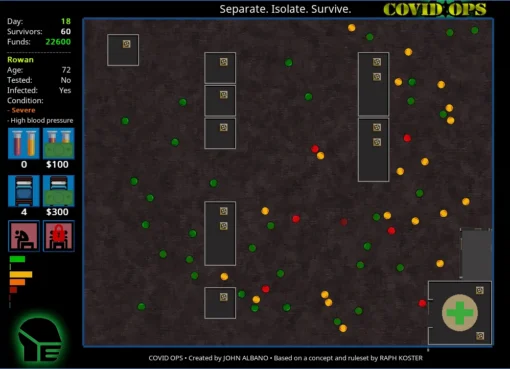
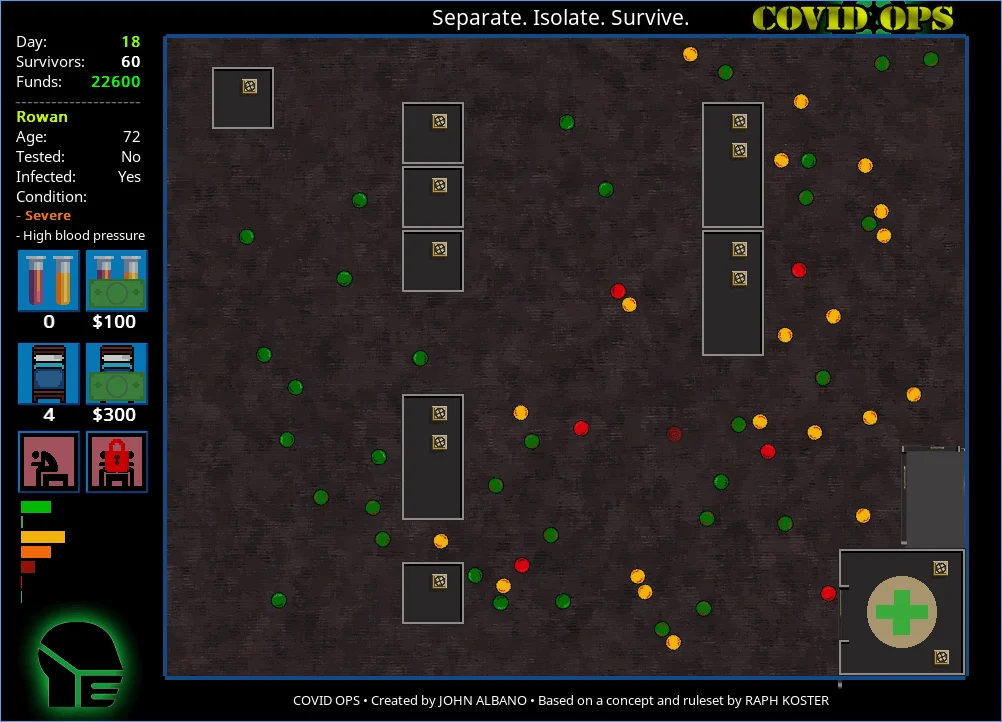
Within six days of Koster’s post, developer John Albano released Covid Ops on the indie platform Itch.io. Albano took Koster’s ruleset as a challenge, creating a functional simulation that allowed players to toggle lockdowns and testing protocols. It was one of the first interactive tools available to the public that visualized the "flatten the curve" concept.
The Academic Expansion: In the Time of Pandemia (April – July 2020)
Shortly after, a team in the Philippines led by Khail Santia began work on In the Time of Pandemia. This project was born out of necessity; Santia’s own community in Cebu City was becoming a COVID-17 hotspot. By July 2020, the game launched on Newgrounds, where it topped the charts and gained viral traction across the Pacific Rim. Unlike the initial sketch, this version involved a team of 48 people, including mathematical biologists and medical doctors.
Supporting Data: The Mechanics of the Simulation
The power of Koster’s design lay in its adherence to grim demographic realities. The simulation wasn’t just about infection; it was about the vulnerability of specific populations.
The Comorbidity Factor
Koster’s design required each "circle" (citizen) to be generated with statistically accurate chances of having underlying conditions. To support this, he cited data that many Americans underestimated:
- Hypertension: According to the American Heart Association, nearly 46% of US adults have high blood pressure, a significant risk factor for COVID-19.
- Diabetes: The American Diabetes Association notes that over 10% of the population is diabetic, with another 34.5% being pre-diabetic.
- Obesity: Data from JAMA indicates that nearly 42% of the US population meets the criteria for obesity.
Koster’s argument was that the "at-risk" population was not a small, isolated group, but rather a massive slice of the general public. In the game, this meant that "protecting the vulnerable" was impossible without broad societal measures, as these individuals lived within multi-generational households where the virus spread most effectively.
The Math of Mortality
The simulation used a baseline IFR of 0.4% and an assumption of 60% population infection to reach "herd immunity." Even with these conservative estimates, the math pointed to millions of deaths. Today, the reality has surpassed those early models:
- United States: Estimated 1.2 to 1.4 million deaths.
- Worldwide: Estimated 15 to 28.5 million deaths.
Official Responses and Professional Validation
While some critics on platforms like Reddit dismissed the idea of a pandemic game as "pathetic" or "reductive," the academic and medical communities in Southeast Asia saw it as a vital educational tool.
Gregg Victor Gabison, Dean of the University of San Jose-Recoletos, integrated In the Time of Pandemia into the curriculum. "This is the kind of game that mindful individuals would want to check out," Gabison stated. "It has substance and a storyline that connects with reality."
Dr. Mariane Faye Acma, a resident physician who consulted on the game’s medical plausibility, emphasized the cognitive benefits for players. "The game will make players realize how challenging the work of the health sector is," she noted, citing the development of critical thinking and resource allocation skills.
The game eventually received extensive coverage from IGN Southeast Asia, The Star Malaysia, and The Philippine Star, becoming a cultural touchstone for the region’s response to the crisis.
Implications: Preparing for the "Next One"
As Koster reflects on the six-year anniversary, he notes that the "denialism" he faced in 2020 has not disappeared; it has merely shifted. The current discourse often focuses on the economic and educational costs of lockdowns while ignoring the catastrophic loss of life that would have occurred had the response been even more lenient.
The implications of these games extend beyond COVID-19. As of late 2024, reports of H5N1 (bird flu) jumping to humans have reignited fears of a new pandemic. Koster’s design philosophy suggests that we are still ill-equipped to understand the threats we face.
The Role of Serious Games
The success of In the Time of Pandemia proves that games can serve as more than entertainment. They are:
- Empathy Engines: By giving each "circle" a name and a family, the games humanized the statistics.
- Systems Classrooms: They allowed players to fail in a safe environment, showing them that "soft" responses often lead to the worst of both worlds—high death tolls and high economic costs.
- Psychological Outlets: For developers like Santia and Albano, creating these tools was a way to "transcend the chaos" and regain a sense of agency in a world that felt out of control.
Conclusion
Raph Koster’s design sketch was a small pebble dropped into a very large, very turbulent pond. However, the resulting ripples reached tens of thousands of players and provided a framework for understanding a global tragedy.
"There is no retreat to how it used to be," Koster wrote during the height of the pandemic. "There is only through." As we face future biological threats, the lesson of 2020 remains clear: our survival may depend on our ability to respect the math, and sometimes, a simple game is the only way to make us listen.