In the landscape of contemporary illustration, few artists have managed to bridge the gap between digital accessibility and fine art prestige as seamlessly as Felicia Chiao. Based in the San Francisco Bay Area, Chiao has cultivated a massive following for her evocative, often surreal depictions of domestic life, mental health, and the quiet tribulations of modern existence. Her work, characterized by soft watercolor washes and precise ink lines, offers a window into a world where the mundane and the fantastic collide.
The central pillar of Chiao’s current professional trajectory is her upcoming solo exhibition at Harman Projects, scheduled for October. This show represents a significant milestone in her career, showcasing a body of work that synthesizes her traditional aesthetic with new, experimental techniques. Chiao’s art is defined by its recurring, faceless characters—entities that serve as universal vessels for the viewer’s own emotions. Whether they are mounded in piles, surrounded by hyper-detailed floral arrangements, or lost in a sea of domestic clutter, these characters articulate a specific brand of "cozy anxiety" that has resonated deeply with a global audience.
The artist’s recent evolution has been marked by a move toward mixed media, incorporating gouache, gel pens, and markers into her traditional watercolor and ink repertoire. This shift, alongside high-profile collaborations such as her 2023 partnership with Heath Ceramics, has expanded her influence beyond the page, positioning her as a multifaceted creator capable of navigating various physical and conceptual mediums.
Chronology: From Childhood Dreams to Artistic Maturity
The genesis of Felicia Chiao’s unique aesthetic can be traced back to a seemingly idiosyncratic childhood desire. “When I was really little, I wanted to be one of those stackable chairs you’d see in like a school auditorium,” Chiao reflects. “I thought they looked cozy.” This memory, while playful, serves as the foundational logic for much of her spatial composition. The idea of being "stacked"—of being part of a structured, compact, and perhaps anonymous whole—recurs throughout her portfolio.
The Formative Years and the "Stacks" Concept
Chiao’s early work was heavily influenced by her background in industrial design, which instilled in her a meticulous eye for perspective and mechanical detail. However, her personal work remained a sanctuary for emotional expression. The "stacking" motif eventually manifested in one of her most recognizable pieces, aptly titled Stacks, where her signature characters are layered atop one another in a manner that evokes both the comfort of a huddle and the claustrophobia of overpopulation.
2023: The Heath Ceramics Collaboration
A pivotal moment in Chiao’s chronological development occurred last year during her collaboration with Heath Ceramics. Transitioning from the two-dimensional constraints of paper to the three-dimensional world of clay and glaze forced a reimagining of her process. This period marked the beginning of her experimentation with "constraint as a catalyst for play." The tactile nature of ceramics influenced how she approached the physical "mats" for her framed drawings, leading her to treat the frames and borders not just as accessories, but as integral components of the artwork.
2024–2026: The Lunar New Year Series and Beyond
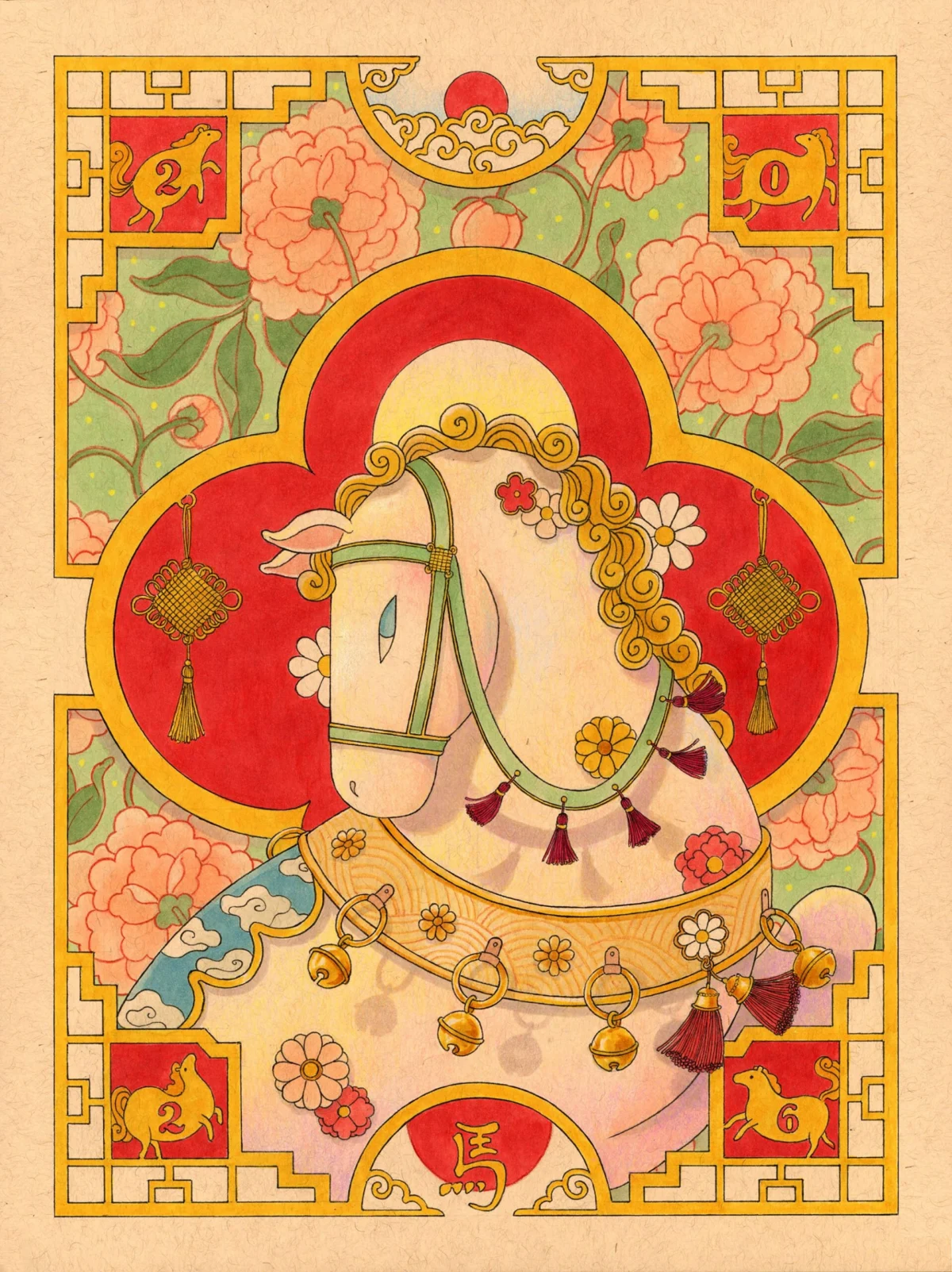
As she moved into the mid-2020s, Chiao began a consistent expansion of her Lunar New Year series. These works represent a departure from her muted, domestic palettes, instead utilizing gilded and crimson backdrops to celebrate the Chinese Zodiac. Her piece Year of the Horse 2026 serves as a bridge between her heritage and her surrealist style, blending traditional symbolism with her distinctively soft, emotive rendering.
Supporting Data: The Visual Language of Mental Health
Chiao’s work is not merely decorative; it is an ongoing data set of the human psyche. Analysts of her work often point to several recurring motifs that provide a framework for her exploration of mental health.
The Symbolism of "Clutter"
In Chiao’s imagined worlds, domestic spaces are rarely empty. Piles of books, stacks of dishes, and walls covered in clocks and calendars serve as physical manifestations of cognitive load. In her piece Stacks, the inclusion of overflowing calendars suggests a preoccupation with time and the mounting pressure of "productivity"—a common theme in modern anxiety disorders.
Floral Entrapment and Growth
Flowers are a dominant feature in Chiao’s work, but they rarely function as simple symbols of beauty. In Anemone Orange, flowers grow directly from a character’s head, while the figure sits in a pool of its own tears. This imagery suggests a complex relationship between suffering and growth—the idea that beauty can emerge from pain, or perhaps that pain can be as overwhelming and invasive as a blooming garden.
Technical Specifications
Chiao’s process is rigorous. While many contemporary illustrators have moved entirely to digital platforms like Procreate, Chiao remains rooted in physical media. Her typical toolkit includes:
Ink: For precise, structural outlines.
Watercolor: Used for soft, atmospheric gradients.
Mixed Media: Recent additions of gouache for opacity and gel pens for highlights.
Paper: High-quality, toothy surfaces that allow for the layering of multiple wet and dry media.
This commitment to physical media adds a layer of "human error" and texture that digital art often lacks, reinforcing the themes of vulnerability present in her subject matter.
Official Responses: Insights from the Artist
In various statements regarding her process and the philosophy behind her work, Chiao has emphasized the importance of evolution and the rejection of stagnation.
Regarding her shift in media, Chiao stated:
“I’ve been experimenting with more mixed media. While the Heath Ceramics collaboration was a completely different medium than what I am used to, I think it has influenced my drawing process. I’m enjoying the challenge of customizing the otherwise stark white material [of frame mats] to complement my works.”
This response highlights a key aspect of Chiao’s professional identity: she views herself as a perpetual student of her own craft. Her willingness to move away from the "safety" of the watercolor-and-ink style that made her famous suggests an artist more concerned with personal growth than brand consistency.
Curators at Harman Projects have also commented on Chiao’s upcoming solo show, noting that her work occupies a unique niche in the "New Contemporary" movement. They highlight her ability to take "heavy" themes—depression, isolation, and social anxiety—and package them in a visual style that is "accessible without being reductive."
Implications: The Intersection of Commercial Success and Emotional Authenticity
The rise of Felicia Chiao has broader implications for the art world, particularly concerning how artists navigate the digital age.
1. The De-stigmatization of Mental Health through Art
Chiao is part of a generation of artists who use their platforms to normalize the conversation around mental health. By depicting anxiety as a "cozy" or "surreal" experience rather than a purely dark or violent one, she provides a visual language for individuals who may struggle to articulate their feelings. The implication is that art can serve as a form of collective therapy, creating a shared space where viewers feel "seen."
2. The "Instagram Artist" to "Gallery Artist" Pipeline
Chiao’s career serves as a blueprint for how to leverage a massive social media following (currently over 1.2 million followers on Instagram) into a legitimate fine art career. Often, "Instagram artists" are dismissed by the traditional gallery circuit. However, Chiao’s technical proficiency and her ability to sell out physical shows and high-end collaborations prove that digital popularity and artistic merit are not mutually exclusive.
3. The Future of Mixed Media
Chiao’s recent experiments suggest a trend toward "maximalist" traditional media. As AI-generated art becomes more prevalent, the value of hyper-detailed, hand-drawn mixed media works is likely to increase. The "constraints" Chiao speaks of—the physical limits of paper, ink, and clay—are becoming the very things that define the value of human-made art.
4. Cultural Representation in Contemporary Surrealism
By integrating Lunar New Year themes and Eastern aesthetics into her surrealist world, Chiao is broadening the scope of the genre. Her work doesn’t just reflect a universal "human" experience; it reflects a specific Asian-American perspective that balances traditional heritage with the contemporary Western urban experience.
As Felicia Chiao prepares for her solo show at Harman Projects this October, the art world watches a creator at the height of her powers. From her childhood dream of being a stackable chair to her current status as a pillar of contemporary illustration, Chiao has proven that the most personal, quirky memories can be transformed into a universal language of comfort and complexity. Her stacks of books, her pools of tears, and her golden horses are more than just drawings—they are the blueprints of a modern soul.
In a ceremony held at The Photographers’ Gallery in London on May 14, 2025, the art world witnessed a significant shift in the landscape of contemporary photography. Rene Matić, a London-based multidi
The art world mourns the loss of Mary Lovelace O’Neal, a titan of American abstraction, a tireless civil rights activist, and a barrier-breaking educator who died on May 10, 2026, in Mérida, Mexico. S
In an era increasingly dominated by pixels and generative algorithms, a small studio in SoHo is proving that the most profound disruptions of reality are still carved by hand. Furry Puppet Studio, a d